Spoiler Warning
This guide reveals Jinshi's royal name and disguise, with family spoilers through Volume 15. The name and royal title appear before the later confirmation of his biological parentage.
What Is Jinshi's Real Name?
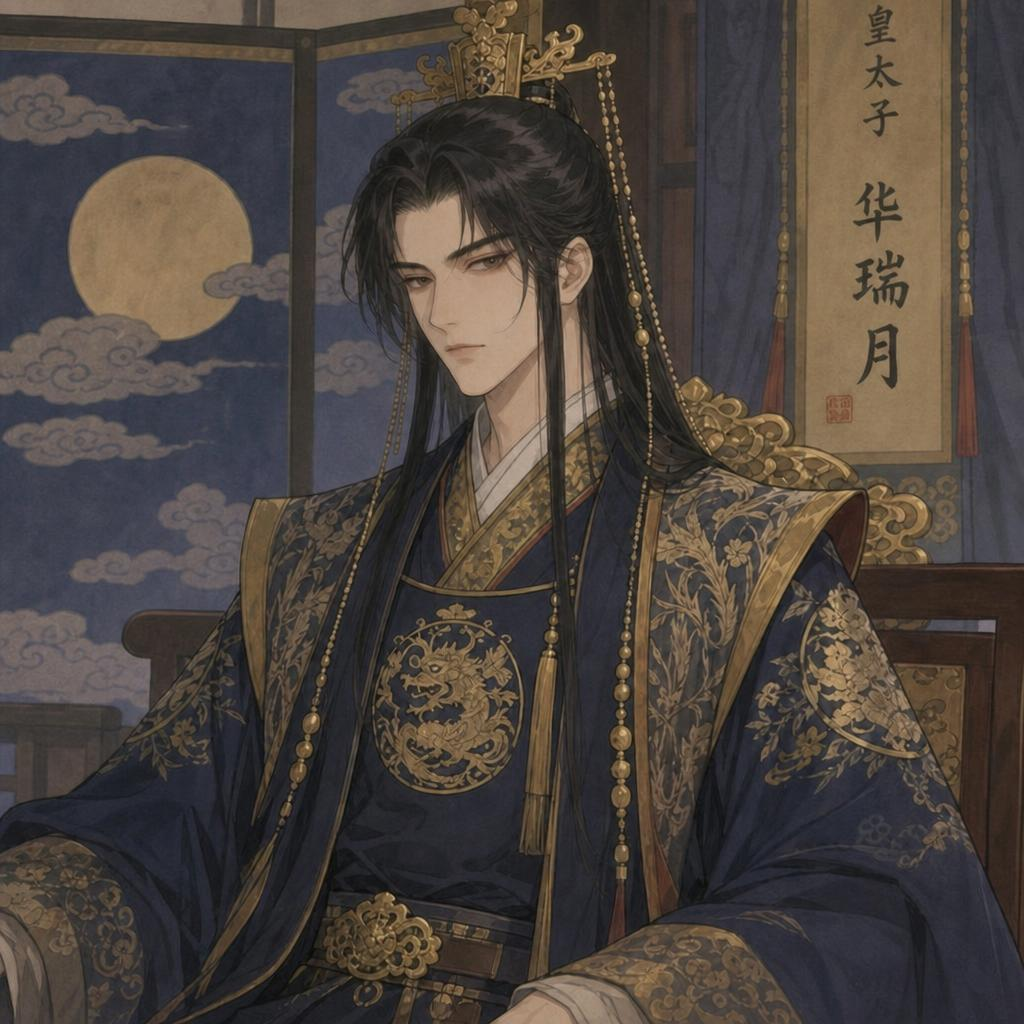
Jinshi's royal name is Ka Zuigetsu (華瑞月). Ka is the imperial family name and Zuigetsu is his given name. Jinshi is the name associated with his eunuch persona; Moon Prince is a title or form of address, not another given name.
Jinshi, Ka Zuigetsu and the Moon Prince
| Name or title | What it means in context |
|---|---|
| Jinshi (壬氏) | The identity used for his work as a eunuch administrator and the familiar name retained in many interactions. |
| Ka Zuigetsu (華瑞月) | His royal name: Ka is the family name; Zuigetsu is the given name. |
| Hua Ruiyue | The Mandarin reading of the same written name, often encountered in discussion of the Chinese-language text. |
| Moon Prince / Lord of the Moon | A royal form of address associated with him; wording varies by translation. |
The Volume 3 final chapter names him directly in Gaoshun's thoughts. It also emphasizes how restricted the imperial family name is. This is a clearer name reference than treating every earlier royal hint as the moment his full identity is announced.

What Does Ka Zuigetsu Mean?
The given name Zuigetsu (瑞月) can be glossed as “auspicious moon”: 瑞 carries the sense of an auspicious sign, and 月 means moon. That gloss describes the given name, not the entire family-and-given-name combination. 華 is the family-name character read Ka in the Japanese name.
Moon imagery is also part of his relationship to imperial authority. In Volume 13, Chapter 14, Ah-Duo reflects on the contrast between “moon” and the Emperor's “sun.” The imagery places Jinshi alongside the ruler while preserving the difference in their positions.
The setting is fictional and Chinese-inspired. Japanese and Mandarin readings of the characters can therefore appear in discussions without identifying different people. See the setting and historical-inspiration guide for that distinction.
Why Do People Keep Calling Him Jinshi?
The alias is useful while he works behind a eunuch's identity, but court etiquette also matters after his royal status becomes more visible. In Volume 7, Chapter 16, Maomao notes that most people cannot casually use his royal name, so other forms of address serve instead.
Volume 15, Chapter 10 makes the rule concrete: Gaoshun rebukes a court figure for using Zuigetsu's name as though he had the standing to do so. A name here expresses access and rank, not merely familiarity.
Listen to Who Is Speaking
When a character says Jinshi, Moon Prince or his royal name, consider their position and the setting. The variation can reveal how much formality is required. It does not automatically reveal how much they know about the infant exchange.
Is Jinshi Actually a Eunuch?
No. His eunuch identity is a disguise. Volume 2, Chapter 14 also distinguishes his twenty-four-year-old cover from his actual age of nineteen at that point. The name, age and occupation belong to a constructed persona.
What Does the Medicine Establish?
The novels describe medicine used by men posing as eunuchs. Volume 7, Chapter 14 explicitly discusses suppressing sexual desire and the risk of side effects. That supports an explanation of the disguise; it does not establish that the medicine permanently stops his physical maturation or prevents his voice from changing.
Does His Royal Name Reveal His Parents?
The Official Family Story
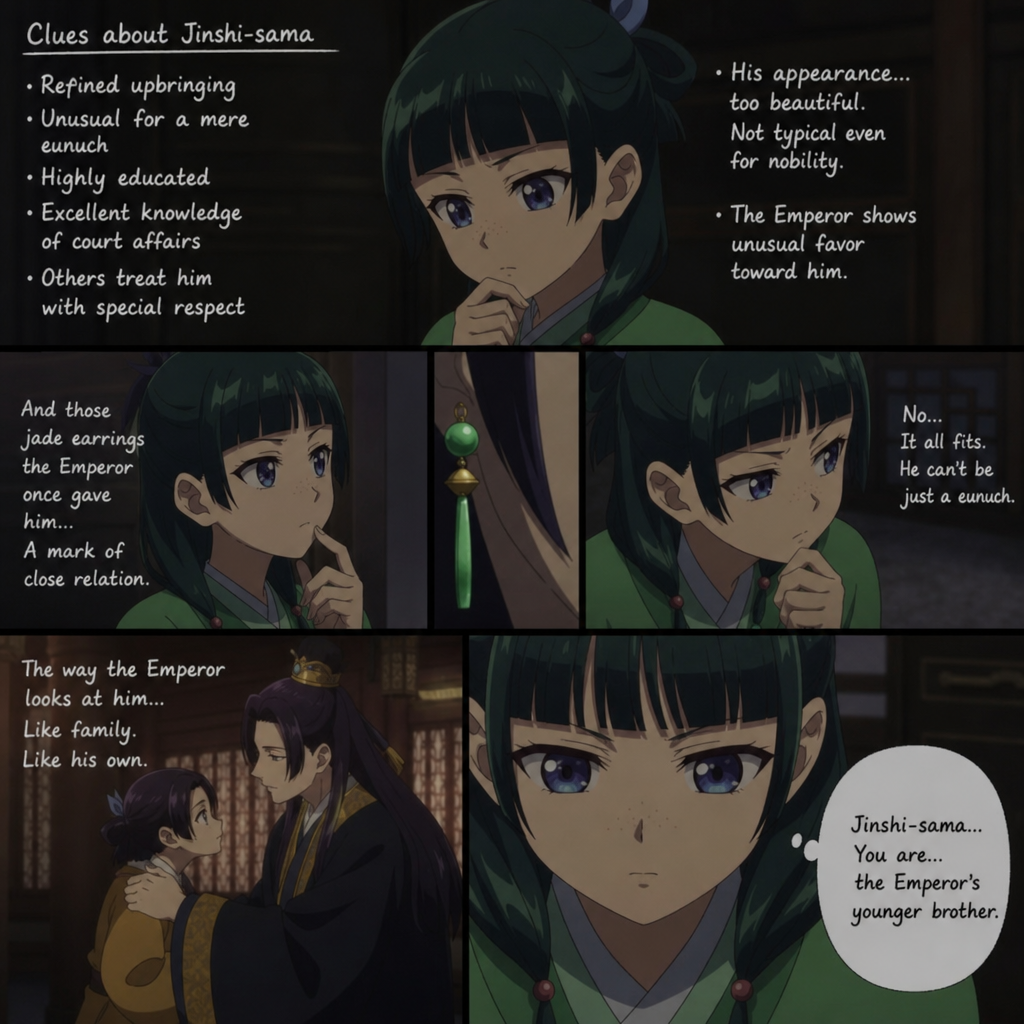
Publicly, Ka Zuigetsu is the reigning Emperor's younger brother, presented as a son of the former Emperor and Anshi. That official role carries succession significance, but it should not be treated as an unchanging claim that he is the current designated heir at every point in the novels.
The Biological Family Story
Ah-Duo and the current Emperor are his biological parents. The infant exchange concealed that relationship beneath the identity of an imperial brother. Volume 13, Chapter 14 confirms it to Maomao; it does not show Ah-Duo telling Jinshi himself.
For the exchange and the later uncertainty over what he knows, see does Jinshi know Ah-Duo is his mother? Keeping that question separate lets the name guide answer its main subject without turning every royal detail into a single reveal.
What Does Maomao Discover, and When?
The Cave Encounter
The cave encounter in Volume 3, Chapter 19, often called the “frog” scene, confronts Maomao with physical evidence that the eunuch disguise is false. This is a different discovery from learning his name or receiving confirmation of his parents.
Royal Status Is Not the Whole Secret
The hunting party and its aftermath clarify the imperial-brother identity, while the final chapter supplies the full royal name to the reader. Much later, Ah-Duo's confession confirms the biological relationship for Maomao. A reader can know one layer before a character knows another.
The Name to Remember
Ka Zuigetsu is Jinshi's royal name; Zuigetsu is the part meaning “auspicious moon.” His alias and titles reflect the roles he occupies and the rules governing who may address him. The family secret adds another layer, but it does not change the answer to his name.
Scene Locator
These references follow the light novel chapter numbering used here; titles and numbering may vary by edition.
- Volume 3, Chapter 19 and final chapter: The cave encounter challenges the eunuch disguise. The final chapter explicitly names Ka Zuigetsu in Gaoshun's thoughts.
- Volume 2, Chapter 14: The prince's actual age of nineteen is distinguished from the twenty-four-year-old cover identity.
- Volume 7, Chapters 14 and 16: The medicine suppresses sexual desire; later, Maomao notes that most people cannot casually address Jinshi by his royal name.
- Volume 13, Chapter 14: Ah-Duo confirms the biological family relationship to Maomao and discusses the moon-and-sun imagery.
- Volume 15, Chapter 10: Gaoshun rebukes a court figure for using Zuigetsu's name without the standing to do so.
Use the Scene Locator to browse related chapter references.
Volume-level entry only. The source is community-hosted; availability and rights status may vary.
Volume-level entry only. The source is community-hosted; availability and rights status may vary.
Volume-level entry only. The source is community-hosted; availability and rights status may vary.
Volume-level entry only. The source is community-hosted; availability and rights status may vary.
Volume-level entry only. The source is community-hosted; availability and rights status may vary.