Spoiler Warning
This article discusses light novel spoilers for Volume 5, including Maomao's western trip, the Western Capital banquet, the lion incident, Jinshi's political marriage pressure, and how the final chapter reframes Maomao's role beside him.
Scene Locator
The setup begins before the Western Capital itself. In Volume 5, Jinshi sends a message that pulls Maomao out of her pharmacy routine. Maomao understands the request as something she cannot casually refuse, which is why she immediately starts arranging the pharmacy so someone else can keep it running while she is gone.
That detail matters. The story does not frame the trip as a holiday. Maomao's first practical reaction is not excitement about travel or closeness to Jinshi; it is logistics. She looks for a replacement pharmacist, teaches what can be taught quickly, and prepares for the fact that Jinshi's requests often drag her into trouble.
The answer becomes sharper in the Volume 5 final chapter. After the banquet danger, Jinshi and Maomao discuss broken iron, suspicious animal behavior, perfume, political marriage, and the way the west is being used to test future alliances. That scene quietly shows why Maomao had to be there. Jinshi needs someone who can stand beside political theater and still notice the physical clue sitting on the bench.
Volume-level entry only. The source is community-hosted; availability and rights status may vary.
The Short Answer
Not a Date, Not a Reward
Jinshi takes Maomao west because the Western Capital is not only a social visit. It is a pressure point where politics, medicine, local conditions, suspicious accidents, and hidden motives overlap. Maomao is uniquely useful in exactly that kind of space.
If Jinshi only needed company, he could take attendants. If he only needed guards, he had military protection. If he only needed administrative reports, officials could write them. Maomao fills a different role: she recognizes the kind of evidence that polished court people walk past. She can read plants, smells, wounds, food, drugs, illness, and behavior without being impressed by rank.
That is why the trip should not be reduced to romance. The romantic tension is there, especially in the final chapter, but it grows out of a more practical truth: Jinshi trusts Maomao's mind. He knows she will not flatter him, and he knows she is dangerous in the useful sense. She notices what others prefer not to notice.
Maomao Is Field Intelligence
The west creates problems that cannot be solved from the capital by etiquette alone. The journey involves travel, medicine, unfamiliar terrain, local households, elite women, foreign contact, and sudden danger. Maomao's value is that she turns small physical details into usable judgment.
This is the same reason her presence keeps changing the plot across the series. She is not powerful in the formal court sense. She is powerful because she can walk into a room and treat every strange smell, bruise, plant, cup, insect, or gesture as evidence. In Volume 5, Jinshi needs that exact kind of person.
Why Jinshi Needed Maomao in the West
Medicine, Poison, and Local Plants
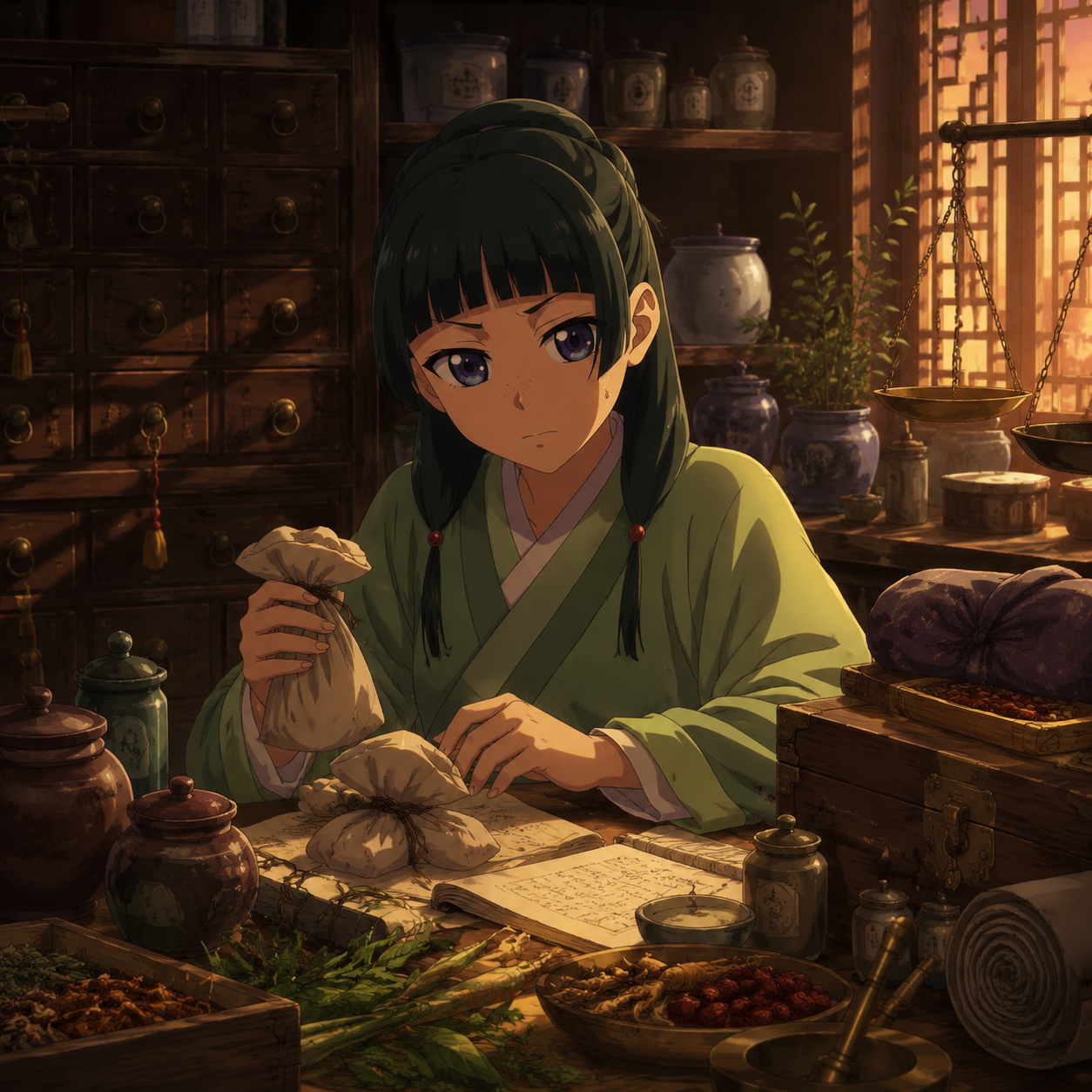
Maomao's first function is obvious but easy to underestimate: she is an apothecary. Western travel means new food, new water, unfamiliar plants, different climate, wounds, fatigue, and the possibility of poison or drugging. A noble party can bring servants, but not every servant can judge whether a plant is useful medicine, harmless decoration, or a warning sign.
Volume 5 reminds readers of this before the trip. Maomao's pharmacy scenes are not filler. They show that she thinks in terms of continuity, replacement labor, and practical medical coverage. If she is being pulled away, she has to make sure the pharmacy does not collapse. That setup reinforces the idea that her work is real work, not a cute character label.
When Jinshi brings her west, he is bringing the same practical skill set into a higher-risk environment. The Western Capital is full of people who can talk beautifully. Maomao is useful because she can ask uglier questions: What was applied to the body? What scent would an animal follow? What material failed? What illness is being hidden? What plant should not be here?
People Lie; Bodies Do Not
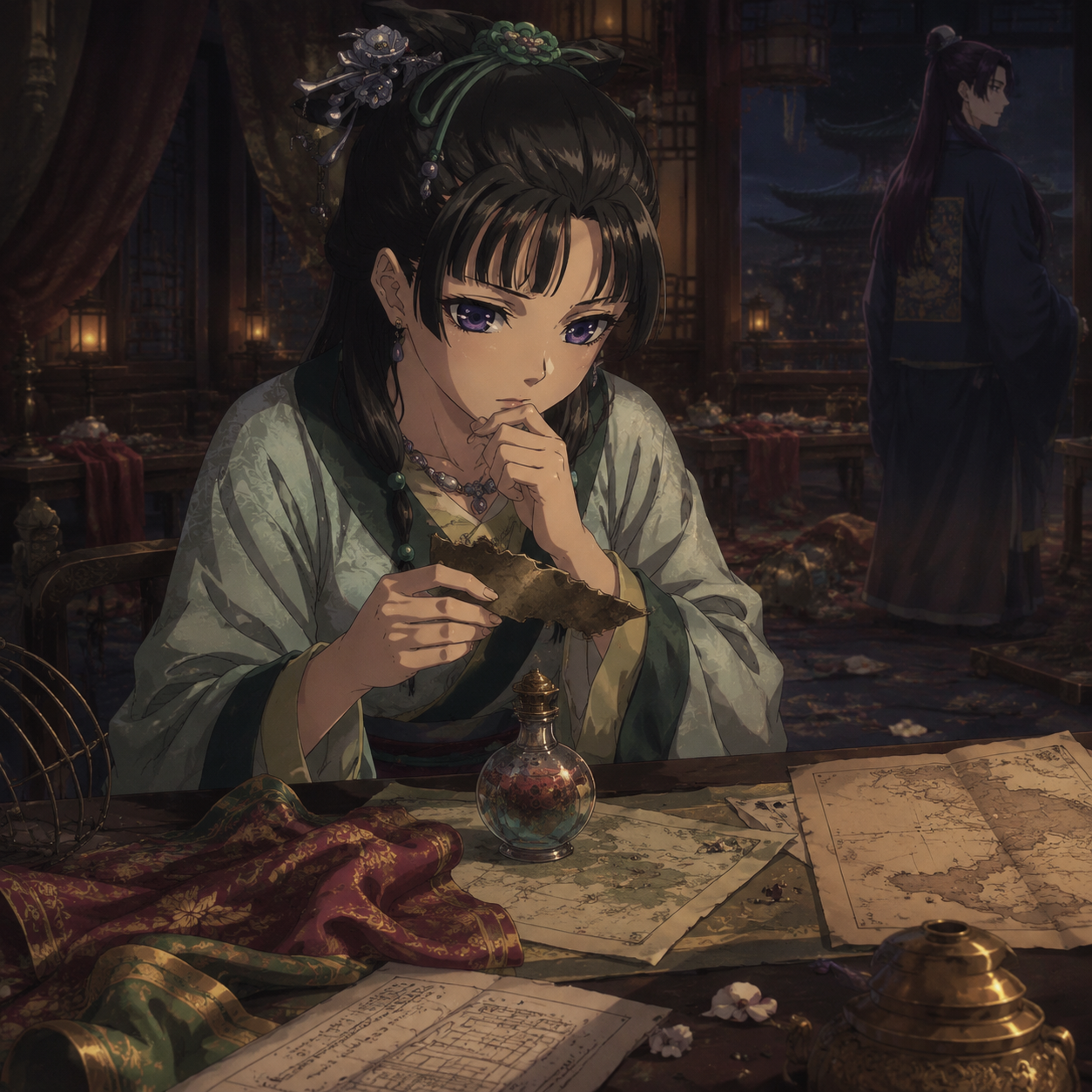
Her second function is investigative. In court politics, people lie with words, posture, timing, and silence. Maomao does not always know the whole political map, but she often catches the body before she catches the motive. That makes her valuable to Jinshi precisely because he is surrounded by people performing for him.
The final chapter uses this contrast well. Jinshi is dealing with official pressure, political marriage implications, and what his choices mean for the west. Maomao, meanwhile, keeps seeing physical problems: brittle iron, the lion's behavior, the scent on the target, and the possibility that a staged accident may be hiding under the surface of a public event.
That is the answer to "why take Maomao?" Jinshi cannot afford to see only the political stage. He needs someone who will look under it. Maomao is not there to replace officials or guards. She is there because the body of the mystery speaks her language.
How Volume 5 Proves the Point
The Aptitude Setup
The chapter often translated around the idea of aptitude is one of the strongest clues. Before Maomao leaves, she finds someone with enough practical herb knowledge to help at the pharmacy. She does not do this randomly. She knows she will be away because Jinshi's request is urgent enough to disrupt her life.
That scene quietly mirrors the larger article question. Maomao recognizes talent in someone who does not yet see himself as qualified. Jinshi does something similar with Maomao: he recognizes that her talent belongs not only in a pharmacy or palace back room, but also in a regional crisis where the wrong interpretation can cost lives.
It also shows why Maomao can be taken west without the story pretending she is a noble guest. She remains a worker. She thinks about medicine, coverage, practical failure, and what happens if ordinary people have no competent care. That grounded perspective is exactly what makes her useful in a Western Capital arc full of noble display.
The Final Chapter Proof
The final chapter makes the proof explicit without turning it into a speech. After the banquet, Maomao notices that the dangerous incident does not feel random. The broken iron matters. The animal's behavior matters. The perfume-like scent matters. These are not the details a marriage candidate, guard, or court beauty is supposed to prioritize.
Jinshi also reveals that the trip is tied to political selection and western alliances. That makes Maomao's presence even more uncomfortable and more necessary. She is standing beside a man who is being pushed toward a choice that could reshape his future. Yet she keeps trying to define herself as a mere apothecary, because that is the only position where she can still act clearly.
Then Jinshi cuts through that escape route. When he tells her not to pretend she does not know she is one of the people being considered, he is not making a tidy official announcement. He is forcing her to admit the emotional and political truth she keeps dodging: she is not only the apothecary brought to read clues. She is also someone whose presence affects the question of what Jinshi will choose.
This is why the final chapter is such a good answer to the title question. Jinshi took Maomao west because he needed someone who could stay useful when politics turned intimate and danger turned physical. But he also took her because the Western Capital makes his future visible, and he wants Maomao to stop acting as if she can remain outside it. The west is full of people reading Jinshi's rank. Maomao reads the evidence, and Jinshi makes her face the choice.
For the broader reason Jinshi himself had to travel west, read the companion piece on why Jinshi had to go west in The Apothecary Diaries. This article narrows the focus to why Maomao had to be included.
The Relationship Layer
Trust Comes Before Romance
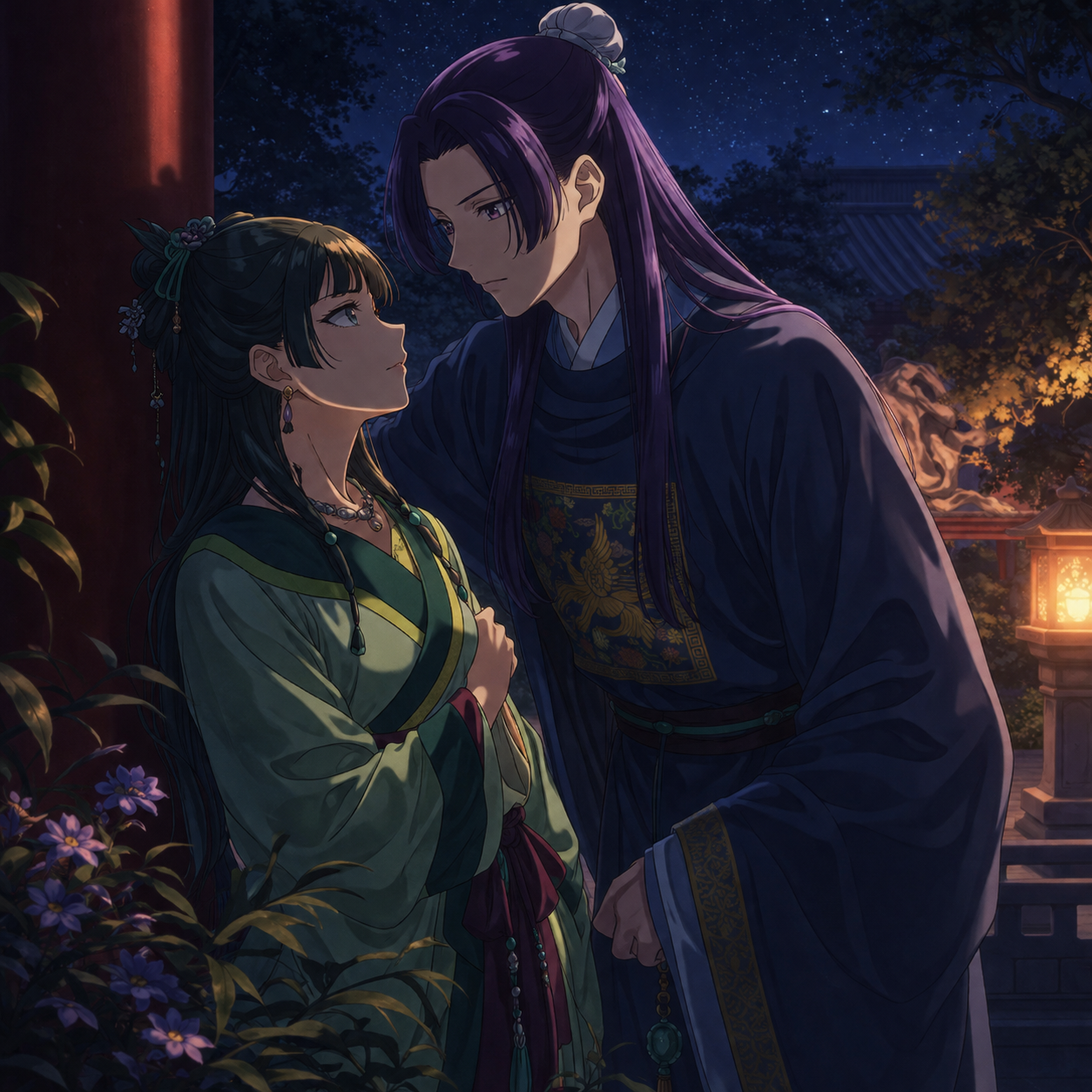
There is no need to pretend the relationship layer does not exist. Jinshi wants Maomao near him. The final chapter plays with touch, avoidance, irritation, and the fact that Maomao is far more aware of his political marriage situation than she wants to admit. But the most interesting part is that the intimacy is built on trust before romance.
Jinshi does not trust Maomao because she is gentle with him. She usually is not. He trusts her because her reactions are honest, her curiosity is hard to redirect, and her conclusions often survive contact with reality. That kind of trust is rare for someone whose entire life is structured around hidden identity and controlled appearances.
Maomao also benefits from being there, although she would never phrase it romantically. The west forces her to see the scale of Jinshi's burden. He is not merely a troublesome beautiful man who drags her into cases. He is a political figure being pressed toward alliances, choices, and responsibilities that can decide other people's futures.
Maomao as One of the Choices
The line about Maomao being one of the choices changes the meaning of the trip. It does not mean she has suddenly become a formal Western Capital marriage candidate in the same way as the noble women gathered around Jinshi. That would flatten the scene into a simple romance trope. The sharper reading is that Jinshi is speaking from his own position: among all the acceptable political flowers being arranged for him, Maomao is the unacceptable person he keeps choosing to look at.
Maomao's instinct is to hide behind usefulness. If she is only a pharmacist, then she can diagnose the lion incident, comment on the broken iron, notice the scent, and retreat. If she is only a servant-like specialist, then Jinshi's marriage politics belong to another world. His line tells her that this self-protection is no longer convincing. She understands too much, and he knows she understands.
That is why taking her west has a second purpose. Jinshi is not only using her eyes for danger; he is making her stand inside the scene she wants to observe from the edge. She has to see the women, the alliances, the pressure from the emperor, and the way his choice will shape the country. Only then can she understand what it costs him to keep reaching for her.
Why He Cannot Say It Cleanly
Jinshi cannot simply say, "I need you because I trust your judgment," or even, "I want you to understand that you matter to my future." Their class gap, his hidden status, her survival instincts, and the political purpose of the trip all make those sentences dangerous. So the story expresses them through action. He sends for her. She prepares because she knows refusal is not realistic. Then the Western Capital proves why she mattered.
This also connects to the long-running dynamic between them. In Jinshi and Maomao's relationship dynamic, their bond is strongest when desire and usefulness become tangled. Jinshi wants closeness, but Maomao keeps proving that closeness has consequences. In the west, being near him means being near power, suspicion, danger, and a choice she can no longer pretend not to see.
Common Misreadings
Misreading 1: Jinshi took Maomao west only because he likes her
He does like her, and the story does not hide that. But "because he likes her" is too thin for Volume 5. Maomao's presence is repeatedly justified by her usefulness: medicine, poison awareness, practical observation, and her ability to detect patterns others dismiss. The romantic point is sharper than simple affection: Jinshi wants her to recognize that she is part of his choice, even if the court would never list her neatly among acceptable options.
Misreading 2: Maomao is just a personal attendant in this arc
She is not there as decoration. The Western Capital gives her real interpretive work. She notices the physical logic of an incident while everyone else is trapped in the social and political meaning of the event.
Misreading 3: The final chapter is only romantic tension
The tension matters, but the scene is also an evidence scene and a political confrontation. Broken material, animal behavior, scent, political marriage, and Jinshi's changing role all appear together. The emotional closeness works because the investigation and political pressure are present at the same time.
Misreading 4: Maomao is officially the same kind of candidate as the noble women
That reading goes too far. Jinshi's line is not a clean bureaucratic statement. It is a personal and political challenge. Maomao is not socially positioned like the noble candidates, but Jinshi is telling her that his choice is not only being shaped by the women the court can openly approve.
FAQ
Why did Jinshi take Maomao to the west?
Jinshi took Maomao west because her apothecary knowledge and observational skill were useful in a region where medicine, local politics, suspicious incidents, and hidden motives overlapped. He also wanted her to see the political marriage pressure around him and stop pretending his future choices had nothing to do with her.
Is Maomao officially important during the Western Capital arc?
Not in the noble-rank sense. Her importance is practical. She can read clues through bodies, medicine, plants, smells, and physical evidence in ways formal officials often cannot.
Does Volume 5 show Jinshi trusting Maomao?
Yes. The fact that he pulls her into the trip shows that he values her judgment, even when he does not explain it cleanly. The final chapter reinforces that trust by placing her beside him during both political pressure and an active mystery.
Is Maomao really one of Jinshi's choices?
Emotionally and narratively, yes. Officially, it is more complicated. She is not presented as a standard noble marriage candidate, but Jinshi's line makes clear that he sees her as part of the choice he is being forced to confront.
What should I read next?
Read why Jinshi had to go west for the larger political reason, then the Light Novel 5 guide for broader Volume 5 context.