Spoiler Warning
This article discusses light novel spoilers for the Shisui/Loulan reveal, the Shi clan aftermath, Jinshi's Western Capital movement, and the Volume 5 locust threat. If you are anime-only and want those links preserved, stop here and return later.
Scene Locator
The question belongs to the transition after the Loulan/Shisui reveal and the wider Volume 5 arc. Volume 4 leaves behind a hidden message and a political wound. Volume 5 shows why that wound cannot stay inside the palace: Jinshi has to move west because the danger has moved beyond court gossip into land, food, local power, marriage politics, and insect patterns.
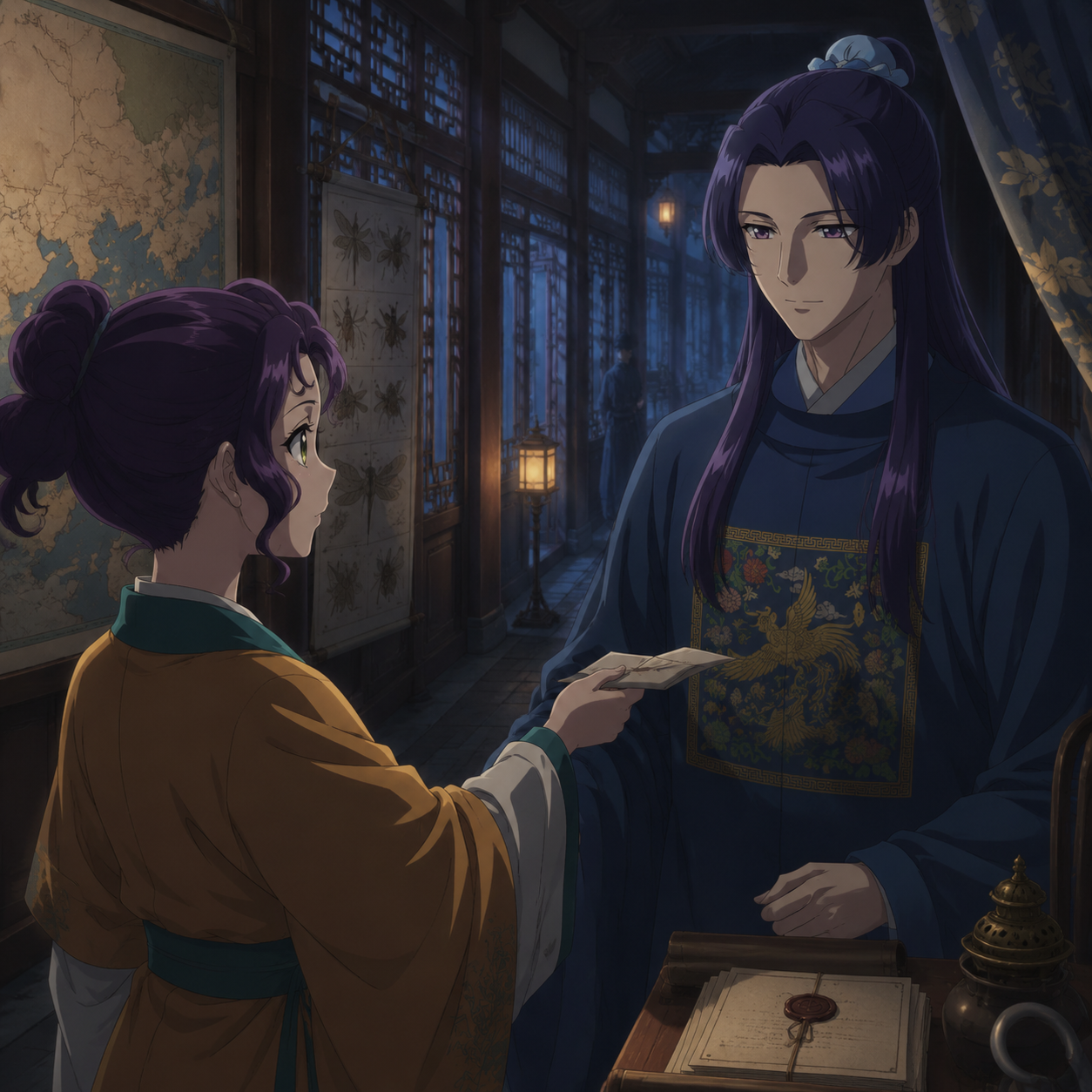
This article does not claim to quote the note word for word. The better reading is inferential: look at what Shisui knows, what Loulan chooses to pass along, and what Jinshi is forced to investigate afterward. The note matters less as a sentimental farewell than as a compressed piece of intelligence. It seems to give Jinshi three things at once: a direction, a category of danger, and a reason to move before the court has clean proof.
That is why the westward movement should be read beside the Volume 5 threat pattern. Once flying locusts enter the story, the problem is no longer a private aftermath of the Shi clan. It becomes a food-security problem. If a swarm reaches the wrong fields at the wrong time, the court is not dealing with embarrassment. It is dealing with hunger, local panic, tax failure, and a threat to the stability of Li itself.
Volume-level entry only. The source is community-hosted; availability and rights status may vary.
The simple answer is that Jinshi had official business in the west, including a matchmaking-style social purpose tied to Western Capital politics. The better answer is that this public purpose gives him a socially acceptable way to enter a region where several hidden lines finally cross: Shisui's insect knowledge, Loulan's warning, the Shi clan's political residue, the Western Capital's local factions, and a possible locust disaster that could threaten more than one noble household.
That is why the trip feels different from a normal royal inspection or a simple marriage-politics visit. Jinshi is not only traveling as a beautiful high-ranking official with a difficult identity. He is moving toward a problem that exposes whether he can read indirect information, keep his own status under control, and act before the court understands what is happening.
In other words, the note does not have to spell out every answer to change the plot. A warning can be powerful precisely because it is incomplete. If Loulan gives Jinshi enough to suspect that insects, western conditions, and timing are connected, then Jinshi cannot wait for a perfect report. By the time a perfect report arrives, the swarm may already have become a famine story.
If you need the immediate setup first, read the related analysis of what Loulan gave to Jinshi. This article starts from that warning and asks why it points west.
The Short Answer
A Regional Mission with National Stakes
Jinshi had to go west because the story turns the Loulan/Shisui incident into a national-security problem. The west is not just a place on the map. It is where the series tests whether palace information can become practical governance.
At court, danger often looks like poison, rumors, succession anxiety, or personal scandal. In Volume 5, danger starts looking like crop failure, insects, food supply, regional distrust, and local administrators who may not tell the capital the truth. Jinshi is one of the few people with enough rank to move through that system and enough personal pressure to take the clue seriously.
The key is scale. A poison case can kill a person. A succession scandal can shake a faction. A locust crisis can empty fields, break transport schedules, expose corrupt reporting, and turn ordinary hunger into political anger. The series uses the west to push Jinshi from palace management into state management.
The Matchmaking Purpose Is the Public Layer
But the trip also has a more ordinary-looking surface: a social, matchmaking-adjacent purpose in the Western Capital. That detail matters because it gives the journey plausible court logic. Jinshi is not openly marching west as if he already knows a crisis is forming. He can appear to be participating in the expected movements of elite society while quietly entering the same region Loulan's warning points toward.
This is exactly the kind of double-purpose setup The Apothecary Diaries likes. The visible reason is polite, aristocratic, and socially acceptable. The hidden pressure is practical and dangerous. A marriage-politics setting lets Jinshi meet people, observe local families, measure factional behavior, and move through the Western Capital without announcing that he is following a warning tied to insects and food security.
A Hidden Warning Changes the Timing
So his westward trip has four layers. Socially, he is pulled into a matchmaking-style setting that fits his rank and the court's expectations. Politically, he must check a region that matters to the imperial order. Strategically, he must follow the warning left behind by the Shisui/Loulan arc. Personally, he must learn that his rank is useless unless he can turn hidden information into action.
That timing is important. If Jinshi acts only after the court publicly recognizes the danger, he is late. If he acts too loudly before he understands it, he alerts people who may want the capital blind. The west is where he has to choose a third path: quiet enough to gather truth, forceful enough to prevent collapse.
Why Shisui Matters to Jinshi's Trip West
Insects Stop Being a Joke
Shisui matters because her insect knowledge stops being a personality quirk. Early on, her interest can feel like odd charm: the kind of detail that makes a side character memorable. After the Loulan reveal, the same detail becomes evidence that she was watching a different layer of the world from everyone else.
The west makes that clearer. A locust threat is not a cute bug fact. It is a warning about harvest collapse. In a premodern court setting, harvest collapse is political collapse waiting to happen. Food shortage can produce panic, migration, tax failure, local anger, and rebellion. That is a much bigger problem than one hidden identity.
This is why Shisui's knowledge has a sharp edge. A palace official may see insects as background noise. Shisui understands that insects can be evidence: of weather, crops, soil, movement, neglect, and coming scarcity. Her value is not just that she knows bugs. It is that she knows what others are trained to ignore.
Loulan Turns Knowledge into Pressure
That is the key to Shisui's role in this topic. She does not need to stand beside Jinshi and explain everything. Her knowledge, her warning, and the way she disappears create a trail. Jinshi has to decide whether to treat that trail as sentimental residue or operational intelligence.
Loulan's move is therefore coldly practical. Giving Jinshi a note does not undo what happened. It does not make her innocent, and it does not give him emotional closure. It puts a burden in his hands. If he understands it, he moves west. If he dismisses it, the court may lose the chance to respond before the threat becomes visible to everyone.
For the identity side of the same issue, the guide to Shisui's secrets in The Apothecary Diaries explains why her Loulan identity changes the meaning of her earlier behavior in the palace.
Why This Is Not a Normal Assignment
Reports Can Hide the Ground Truth
A normal assignment would begin with official reports and end with a report back to the capital. A normal matchmaking visit would be judged by social optics, family politics, and whether the right people are impressed. Jinshi's trip west is more dangerous because the most important information is not neatly official or neatly romantic. It comes through fragments: a note, suspicious timing, Shisui's knowledge, field observations, and the way local conditions refuse to match a comfortable palace explanation.
That makes Jinshi's role delicate. If he moves too publicly, the wrong people can prepare for him. If he ignores the warning, the disaster gets time to grow. If he treats the matter as only a Loulan problem, he misses the possibility that the real threat is not a person but a system failing before anyone powerful wants to admit it.
The most dangerous part of the western problem is that it can look boring at first. A minor report delay, an odd insect pattern, a local official smoothing over numbers, a traveler noticing something out of place: none of these details has the glamour of a palace poisoning. But together they can describe a country-level crisis forming below the official narrative.
Jinshi Cannot Move Too Loudly
This is why the question "why did Jinshi have to go west?" should not be answered with "because he was ordered." Orders are the surface. The narrative reason is that only a westward move lets the story prove whether hidden court intelligence can prevent damage outside the court.
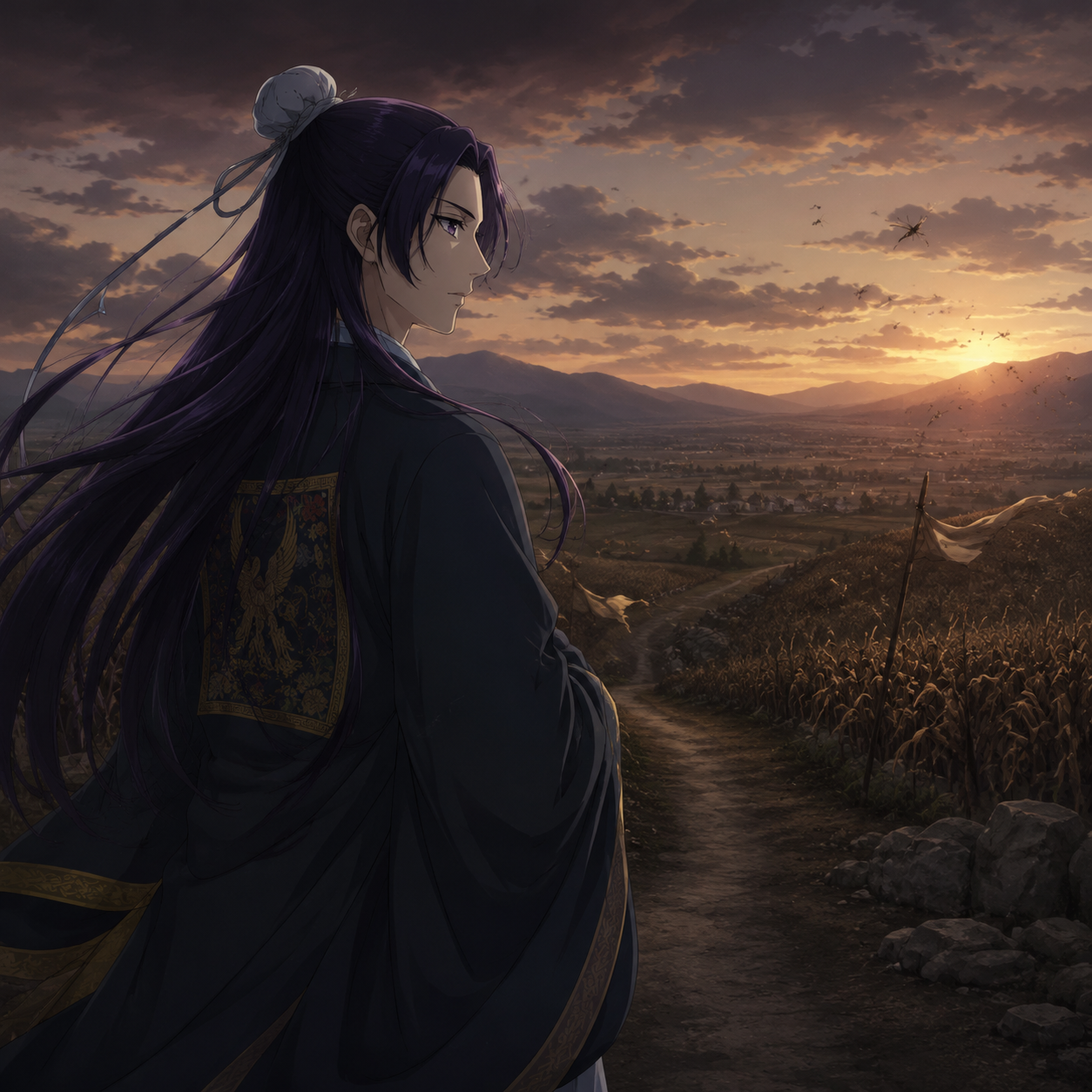
It also forces Jinshi out of the spaces where his beauty and controlled persona dominate the room. In the Western Capital, rank still matters, but the land does not care who he is. Flying locusts do not respect etiquette. Crop failure does not pause for palace rank. That is why the arc is so useful for testing him.
The assignment is also a test of restraint. Jinshi cannot simply storm into the region as a prince-like figure and demand truth from everyone. His hidden identity makes every gesture political. The matchmaking/social layer makes that even trickier, because people are already watching his behavior for status implications. The quieter he moves, the more he can learn. The more authority he reveals, the more the situation starts reacting to him instead of revealing itself.

What Jinshi Had to Check in the West
Local Loyalty
Jinshi's task is not one clean mystery. It is a cluster of linked risks. The first is political loyalty. The west is far enough from the central palace that local power can develop its own rhythm. That makes reports unreliable. An official can write what the capital wants to hear while the ground tells another story.
That matters because the Shi clan aftermath does not leave a clean political field behind. Even after a central crisis appears resolved, relationships, favors, fear, and silence remain. Jinshi has to ask whether the west is merely administratively distant or actively distorted by people who know more than they admit.
Food Security
The second risk is food security. Once insects and harvest danger enter the plot, Jinshi is no longer investigating a court secret. He is looking at the kind of crisis that can destabilize ordinary people first and officials second. A court that waits until hunger becomes visible has already waited too long.
This is the part that makes the westward trip feel urgent. A flying locust threat is not solved by identifying one culprit. It requires timing, observation, preparation, and cooperation before the damage is obvious. If Jinshi misunderstands the warning as personal intrigue, he loses the window where prevention is still possible.
Information Control
The third risk is information control. If Shisui/Loulan's warning points west, then somebody in or around that region may have reason to hide, delay, or distort the truth. Jinshi has to check not only what is happening but also who benefits from the capital misunderstanding it.
That is where the note becomes more than a clue. It gives Jinshi permission to distrust the neat version of events. Loulan cannot hand him a full administrative report, but she can make him look where official channels may be weakest. For a man whose whole life is tangled in masks and hidden names, that is exactly the kind of message he should understand.
Jinshi's Own Identity
The fourth risk is his own identity. Jinshi cannot move like a neutral inspector forever. His hidden rank and future political weight make every action heavier. If he handles the west poorly, the consequences are not only administrative. They can affect how factions read him, how the court measures him, and how enemies prepare for him.
That is why the Western Capital arc belongs beside articles like Jinshi's real name and hidden rank. The west is not separate from his identity problem. It is where identity becomes responsibility.
Why the West Changes Jinshi
Authority Becomes Responsibility
The Western Capital matters because it changes the scale of Jinshi's burden. Inside the palace, he can hide behind role, beauty, etiquette, and controlled access. In the west, the consequences are harder to aestheticize. If the warning is real, people can starve. If the reports are wrong, the court can misgovern. If Jinshi delays, the failure is not abstract.
That makes the arc a leadership test. Jinshi must learn to act on incomplete information without turning uncertainty into paralysis. He must move carefully enough not to expose Loulan's warning too crudely, but decisively enough to prevent a larger crisis. That tension is exactly the kind of political maturity the series keeps demanding from him.
It is easy to admire Jinshi when he is elegant, wounded, or romantically frustrated. The west asks a harsher question: can he protect people who will never know his name, never understand his hidden position, and never thank him directly? That is the difference between being fascinating at court and being necessary to the country.
That is why "Jinshi goes west" is not just movement on a map. It is the story asking whether Jinshi can become the kind of person who deserves the authority he is trying so hard to manage.
Common Misreadings
Misreading 1: Jinshi went west only because of official duty or matchmaking
Official duty and matchmaking politics both matter, but they are not enough. The story builds a deeper chain through Shisui's knowledge, Loulan's warning, and the emerging western crisis. The social purpose is the visible form. The warning is the narrative pressure underneath it.
If the story only wanted an official trip or a marriage-politics detour, it would not need Shisui's insect knowledge to echo so strongly into Volume 5. The point is that public duty, social cover, and hidden intelligence overlap. Jinshi goes because the court gives him a path, but Loulan's note gives that path urgency.
Misreading 2: The Shisui/Loulan arc ends before the Western Capital arc
Emotionally, it may feel like the Loulan reveal closes one chapter. Structurally, it opens the next one. Shisui's insect clues and Loulan's controlled message make more sense once Volume 5 starts treating the west as a place where environmental knowledge can become political survival.
This is one of the series' better tricks. It lets a character vanish from the immediate stage while her knowledge keeps changing the plot. Shisui does not need to appear in every scene for her warning to keep pressing on the western investigation.
Misreading 3: The west is only a change of scenery
The west changes the kind of mystery the series can tell. Instead of a palace-contained case, the story can explore regional governance, food supply, travel, local reports, and how slowly the capital reacts when the first signs of disaster are easy to dismiss.
FAQ
Why did Jinshi have to go west?
He had to go west because the Western Capital becomes the place where matchmaking politics, Loulan/Shisui's warning, insect knowledge, local power, and the Volume 5 flying locust threat converge. It is both a socially acceptable journey and a crisis response.
Is Shisui the reason Jinshi goes west?
Shisui is not the only reason, but she is one of the most important hidden links. Her insect knowledge and Loulan's warning help explain why the west matters before the danger becomes obvious.
Is this connected to the Loulan note?
Yes. The note is best read as a warning that gives Jinshi a direction, not a full confession. The westward move makes more sense if the message points toward a larger problem outside the palace, especially a threat tied to insects, harvests, and regional instability.
What should I read next?
Read the Loulan note analysis for the warning itself, then the Light Novel 5 guide for the broader Western Capital context.