Spoiler Warning
This article discusses major light novel spoilers from Volume 5, Chapter 16 and Volume 12, Chapter 12. It covers Lu Sun's dance with Maomao, Jinshi's visible reaction, the political meaning of Maomao's position, and the narration that directly raises the possibility that Lu Sun knows he is irritating Jinshi on purpose.
Scene Locator
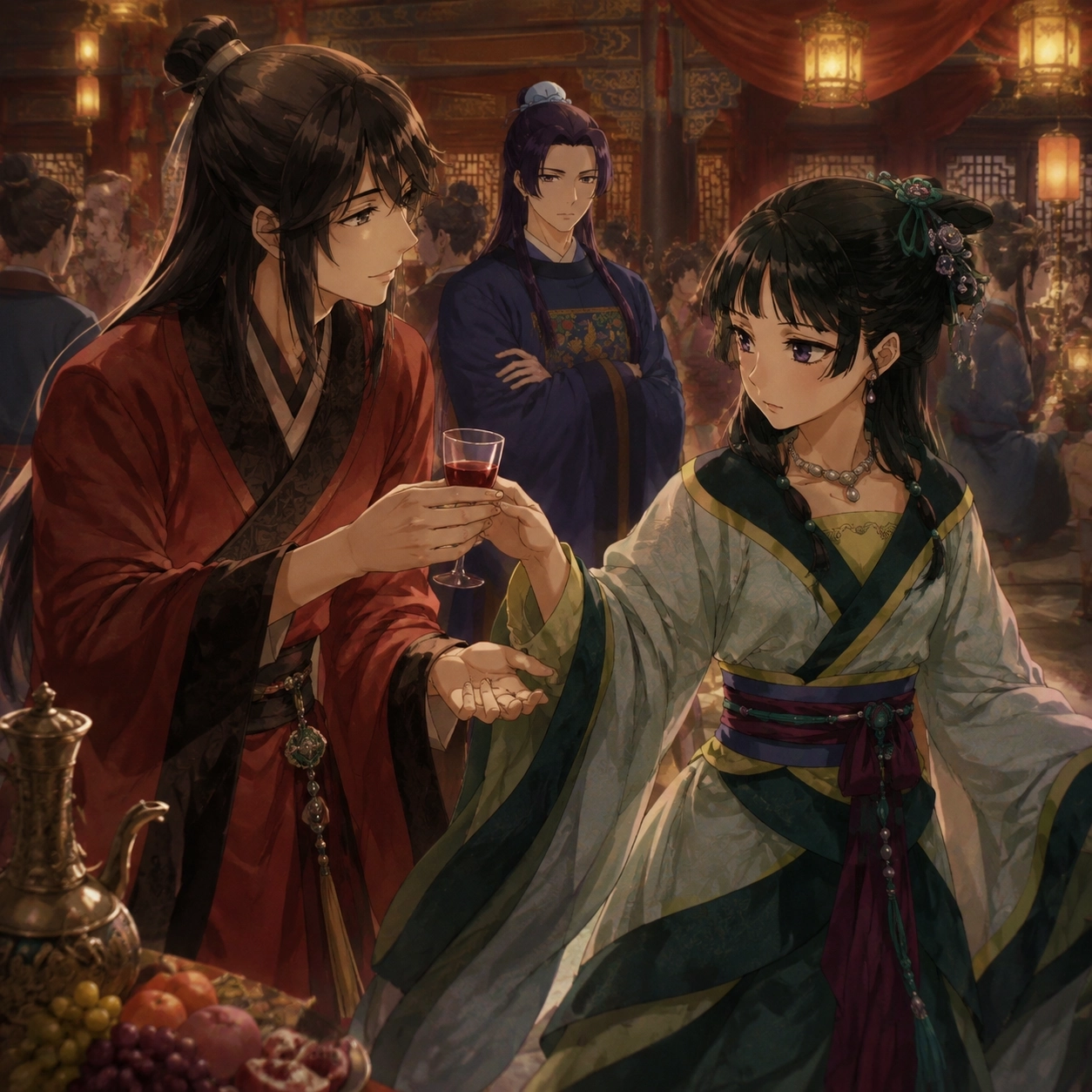
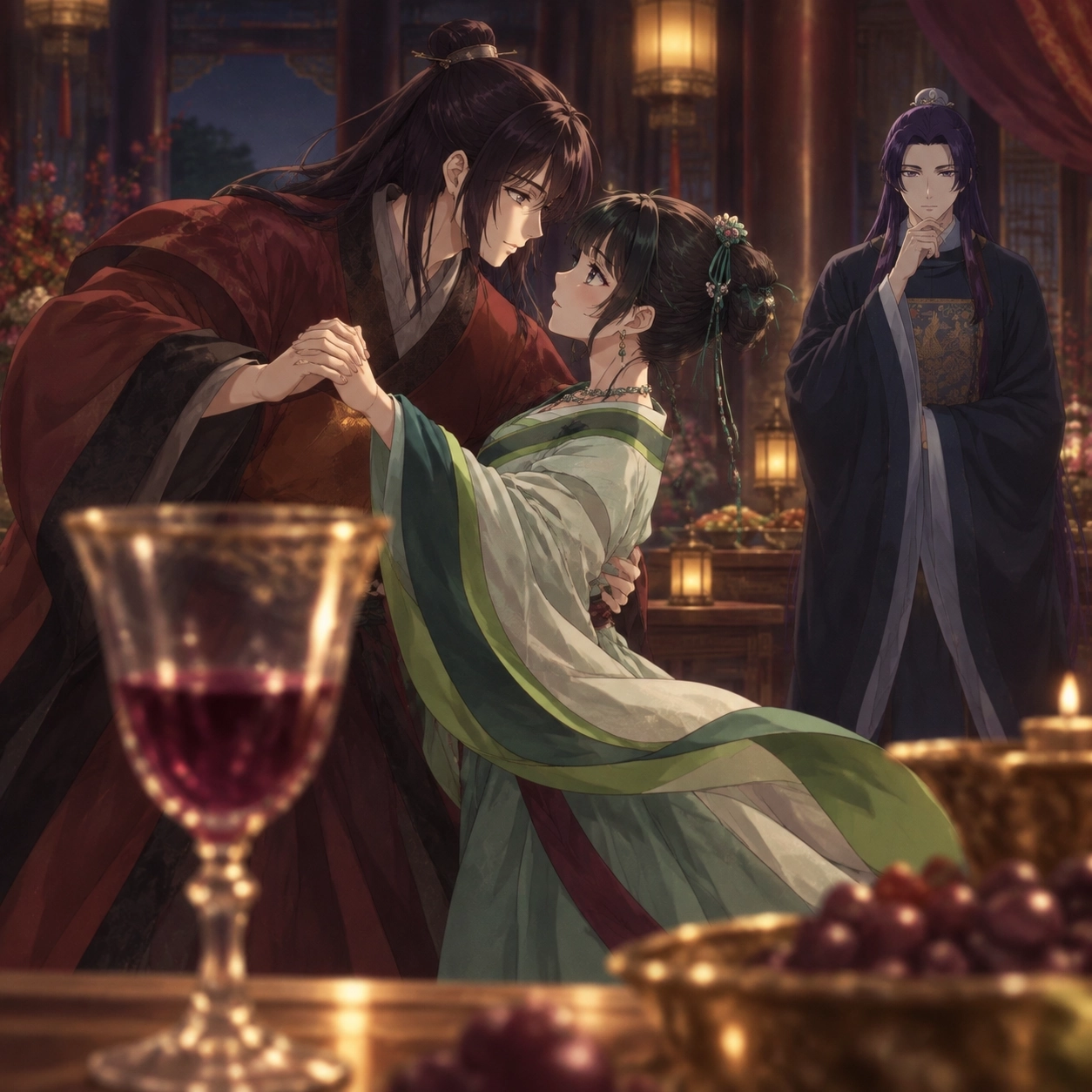
The first major checkpoint is Volume 5, Chapter 16, the banquet in the Western Capital. Lu Sun gives Maomao the last glass of a rare western fruit wine, says he did not get any himself, and then pulls her into the couples' dance. During the dance he holds her hand, supports her waist, tells her to understand her own value, and looks toward Jinshi before kissing her fingertip.
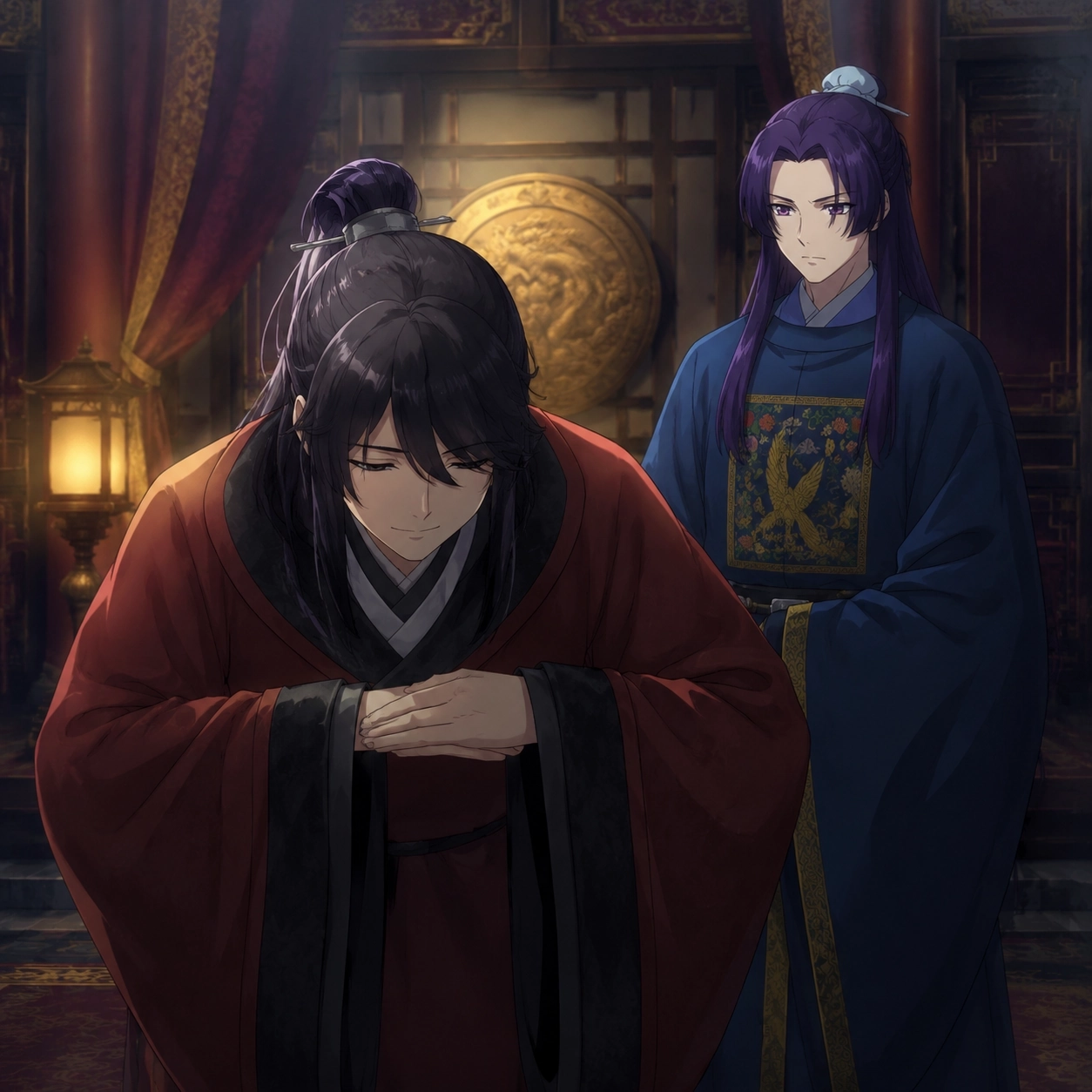
The second and most direct checkpoint is Volume 12, Chapter 12, during the Rihito Country matter. Lu Sun appears before Jinshi with exaggerated politeness. Jinshi thinks that Lu Sun may be aware of how irritating he has become and may be deliberately trying to provoke him. Read these two scenes together: Volume 5 shows the behavior, while Volume 12 gives Jinshi's interpretation of the motive.
This article sits beside the wider Jinshi and Maomao relationship analysis, the reason Maomao travels west with Jinshi, and the themes of Jinshi's light novel arc. The scene is not only a jealousy joke; it is a small contest over who gets to define Maomao's value.
Volume-level entry only. The source is community-hosted; availability and rights status may vary.
The Short Answer
Yes: Lu Sun's Contact with Maomao Is Deliberate
Lu Sun does not simply happen to stand beside Maomao. He chooses the moment, the object, the physical contact, and the audience. The wine is presented as rare and limited. The dance places Maomao in the center of a room where Jinshi is already visible. Lu Sun then turns a pleasant social gesture into a pointed display by speaking about Maomao's value while watching Jinshi.
Any one of those actions could be explained away. Taken together, they form a pattern. Lu Sun is an experienced official and strategist, not someone who accidentally creates the exact kind of scene most likely to irritate Jinshi.
Polite Courtesy Gives Him Cover
Lu Sun's method depends on manners. He is polite when he offers the drink, polite when he asks Maomao to dance, and polite when he kisses her fingertip. That surface makes it difficult for Jinshi to accuse him of a direct insult without looking possessive or unreasonable.
This is why the provocation works. Lu Sun does not challenge Jinshi openly. He creates a situation in which Jinshi must either watch quietly or reveal that Maomao's treatment matters to him. The social rules become a shield for the person bending them.
Jinshi Is Meant to See It
The most important detail is Lu Sun's glance toward Jinshi while he is explaining Maomao's value. The action is not kept private. Lu Sun makes sure the meaning travels across the room. Maomao is the person he touches, but Jinshi is the person he addresses indirectly.
That is why the later Volume 12 narration matters so much. Jinshi is not merely annoyed by Lu Sun's personality. He begins to suspect that Lu Sun knows exactly what he is doing. The novel gives the suspicion to Jinshi himself, which makes the deliberate-provocation reading much stronger than a reader-generated jealousy theory.
The Volume 5 Banquet Evidence
The Wine and the Dance Are One Sequence
Lu Sun first gives Maomao the last glass of a western fruit wine. He emphasizes that it is the final serving and adds that he did not get to drink any. That line sounds playful, but it also establishes a tiny debt: Maomao has received something rare from him, so he can immediately convert the gift into a request.
The request is not for a private conversation. It is a dance in the middle of a public banquet. Lu Sun could have asked Maomao to walk outside, discuss the investigation, or simply explain the wine. Instead, he chooses an activity that forces physical closeness and makes the pair visible to everyone nearby.
He Uses the Dance to Redefine Maomao
Maomao thinks of herself as a low-ranking apothecary from the pleasure district. Lu Sun pushes against that self-description. While holding her hand and supporting her waist, he tells her that she should understand her own value. He is not only flirting. He is reminding her that the hairpin, the Luo name, and the people around her have already placed her inside a larger political network.
That statement is especially sharp because Jinshi has brought Maomao west precisely because her practical value is unusually high. Lu Sun takes the fact Jinshi relies on and turns it into a public performance. He tells Maomao she matters, but he makes Jinshi watch him say it.
The Hairpin Makes the Contact More Dangerous
Lu Sun's warning about the object on Maomao's head makes the scene more than a casual dance. The hairpin is a sign that Maomao is not socially unclaimed. It connects her to court relationships and to the people who have marked her as important.
By drawing attention to that symbol and then kissing Maomao's fingertip, Lu Sun acts as if he understands the political language around her better than Maomao does. That is exactly the sort of performance that can irritate Jinshi: Lu Sun is not ignorant of the boundary. He appears to know where it is, then steps close enough to make the boundary visible.
The Volume 12 Confirmation
Volume 12 removes much of the ambiguity. When Lu Sun visits Jinshi, he offers an exaggerated greeting. Jinshi notices that the politeness has become excessive and thinks that Lu Sun may be conscious of the effect he is having. More pointedly, Jinshi suspects that Lu Sun is deliberately trying to make him angry.
This is the novel's strongest evidence because the thought belongs to Jinshi, the person being provoked. It does not prove that Lu Sun confesses a plan in private, but it shows that the story wants readers to take the possibility seriously. Lu Sun's behavior has become consistent enough for Jinshi to recognize it as a method.
Why the Later Scene Reframes the Earlier One
Without Volume 12, a reader could describe the banquet as Lu Sun being casually flirtatious or theatrically friendly. With Volume 12, the earlier scene looks more intentional. The same man who knows how to be excessively courteous to Jinshi also knows how to use courtesy around Maomao.
The two scenes create a character portrait: Lu Sun is capable, socially agile, and comfortable making other people carry the emotional cost of his jokes. He can provoke Jinshi without losing the appearance of professionalism.
Jinshi Cannot Easily Punish Him
There is another reason Lu Sun can keep doing this. He is a capable official. Jinshi may dislike him, but dismissing or punishing him out of personal irritation would create more work and weaken the administration. The novel makes that pressure explicit: Jinshi has to separate private anger from public personnel decisions.
Lu Sun's competence is part of his protection. He can make himself annoying while remaining useful. That combination forces Jinshi to endure the provocation instead of answering it directly.
Why Maomao Is the Perfect Target
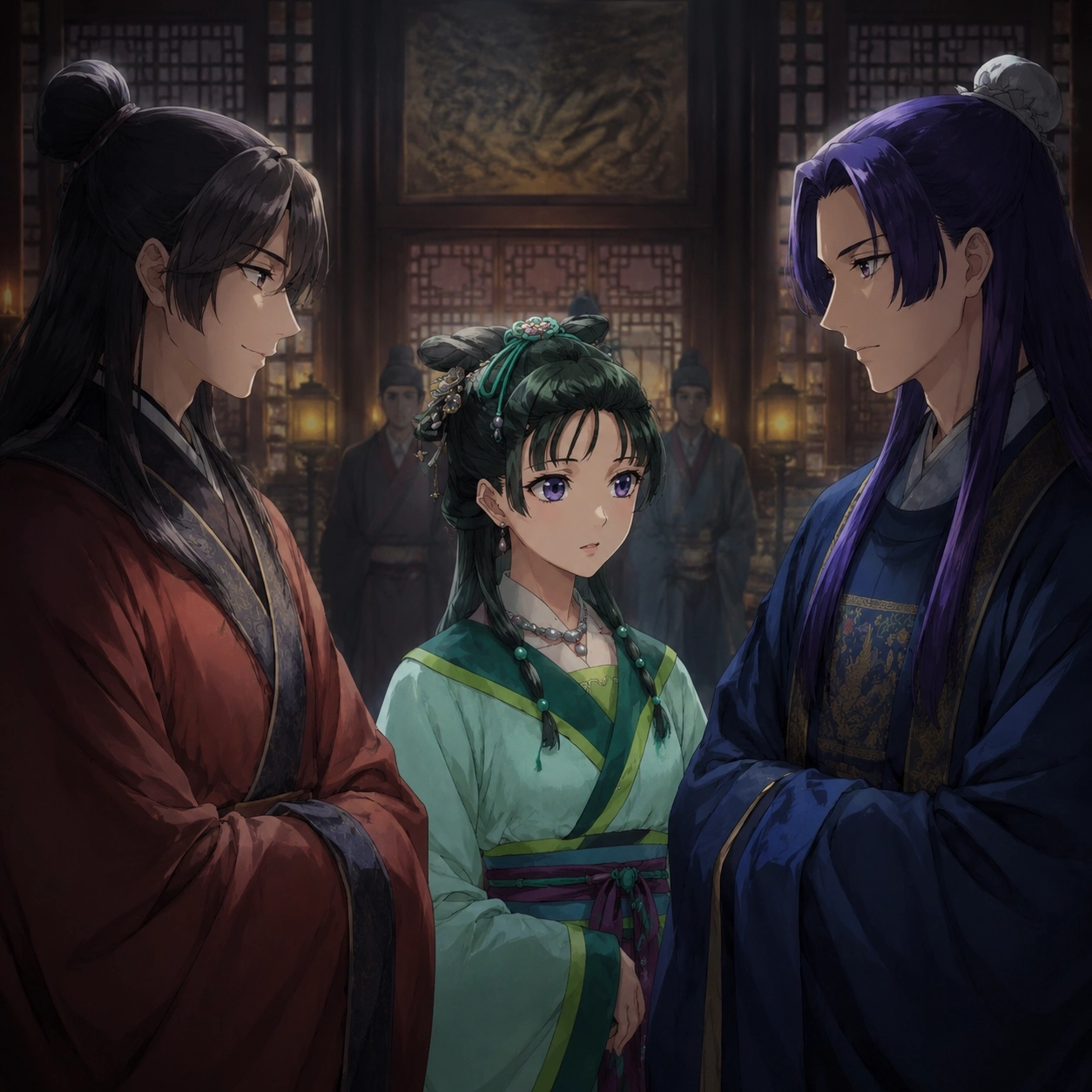
Lu Sun does not choose an arbitrary court lady. Maomao is valuable, difficult to control, and connected to Jinshi without being fully absorbed into his official household. That makes her the perfect person to use in a provocation: her presence carries political weight, but her own bluntness keeps the scene from becoming an obvious romantic declaration.
Maomao Does Not Perform Jealousy for Him
Maomao is not trying to make Jinshi jealous. She accepts the wine because it tastes good, dances because the request has been made, and interprets Lu Sun's behavior through practical observations rather than romantic signals. Her lack of theatrical reaction actually makes the scene more effective. Lu Sun can create the display without needing Maomao to cooperate emotionally.
Her Practical Value Is Also Personal Value
Lu Sun's language about Maomao's value works on two levels. He means her political and investigative usefulness, but he also knows that Jinshi's attention toward Maomao is not purely administrative. The more Lu Sun insists on the first meaning, the more the second meaning becomes visible.
That double meaning is characteristic of The Apothecary Diaries. A medical skill, a hairpin, a dance, or a glass of wine can carry both practical and intimate consequences. Lu Sun understands that overlap and uses it carefully.
What Lu Sun Wants from the Provocation
He Wants to Measure Jinshi's Reaction
The safest conclusion is that Lu Sun wants to see how Jinshi reacts. A person who claims not to care can still reveal himself through attention, interruption, questions, or a sudden change in tone. Jinshi's gaze and later irritation give Lu Sun useful information even if no one says the quiet part aloud.
He May Also Be Enjoying Himself
Lu Sun is not a solemn manipulator who treats every interaction as a grand political plan. He appears to enjoy the freedom of irritating powerful people while remaining technically correct. The provocation can be both strategic and entertaining. Those motives are not contradictory.
He Keeps Deniability Intact
Lu Sun never needs to admit that Maomao's contact was designed for Jinshi's benefit. He can say the wine was hospitality, the dance was a western custom, the kiss was playful courtesy, and the formal greeting was simply respect. Every individual explanation is plausible. The pattern is what gives him away.
That is why the answer should be "yes, strongly suggested" rather than "the novel gives a formal confession." The evidence is behavioral and structural. Lu Sun repeatedly chooses actions that bother Jinshi, and Jinshi eventually notices the pattern himself.
Common Misreadings
Misreading 1: Lu Sun is only interested in Maomao romantically
The text supports a more complicated motive. Lu Sun is interested in Maomao's value, her position, and the reaction she produces in Jinshi. The dance can be flirtatious without being a straightforward confession of love.
Misreading 2: Maomao is deliberately helping Lu Sun make Jinshi jealous
Maomao does not appear to understand the full emotional signal. She treats the wine and dance as immediate events, while Lu Sun is the one arranging the meaning around her.
Misreading 3: Jinshi is angry only because he is childish
Jinshi's irritation is personal, but the scene also touches status and political boundaries. Lu Sun is publicly reframing a woman connected to Jinshi while pointing out her value. Jinshi has reason to read that as both teasing and a challenge.
Misreading 4: Volume 12 proves Lu Sun confessed everything
No. Volume 12 gives Jinshi's strong suspicion, not a private confession from Lu Sun. The best reading is that the novel confirms the pattern without removing Lu Sun's deniability.
FAQ
Did Rikuson deliberately provoke Jinshi?
Yes. The novel strongly suggests that Lu Sun uses contact with Maomao to irritate Jinshi, especially in the Volume 5 banquet scene. Volume 12 makes the reading more direct when Jinshi suspects Lu Sun knows exactly how much he is provoking him.
Why does Lu Sun dance with Maomao?
He uses the rare western wine as an opening, then turns the public banquet into a visible display. The dance lets him talk about Maomao's value while Jinshi is close enough to notice.
Does Lu Sun want Maomao for himself?
The novel does not establish a simple romantic goal. Lu Sun is clearly interested in Maomao's value and is comfortable using flirtatious behavior, but the strongest target of the performance is Jinshi's reaction.
Does Maomao know she is being used to provoke Jinshi?
Not fully. Maomao notices the physical and social details, but she does not respond as though she understands the emotional contest Lu Sun is creating.
Why cannot Jinshi simply punish Lu Sun?
Because Lu Sun is a capable official. Jinshi knows that making personnel decisions out of personal anger would create more administrative problems, so Lu Sun's competence gives him room to keep teasing.
What should I read next?
Read the Jinshi and Maomao relationship guide, why Jinshi stops before sleeping with Maomao, how Jinshi's self-harm changes Maomao, and why Jinshi takes Maomao west for the connected relationship and boundary threads.