Spoiler Warning
This article discusses light novel spoilers for The Apothecary Diaries Volume 6, including Fengxian's death, Lakan's breakdown, the family headship dispute, Maomao's intervention through Go records, and the later importance of Lakan's Go book.
Scene Locator
The key Lakan material appears after Maomao and Lahan return from the western trip and get pulled into Lakan's family problem. Volume 6 places this thread around the family chapters, the return-home aftermath, and later mentions of Lakan's Go book.
The scenes to remember are not battlefield scenes. They are domestic and humiliating: Lakan failing to function after Fengxian's death, his family trying to pressure him while he is vulnerable, Maomao finding a way to reach him through recorded Go moves, and Lakan turning those games into a book.
Volume-level entry only. The source is community-hosted; availability and rights status may vary.
The Short Answer
Lakan Loses Fengxian Before He Loses Power
What happens to Lakan in Volume 6 is not simply that he gets trapped by his family. That is the visible plot. The real event is that Fengxian dies, and Lakan briefly loses the internal structure that normally makes him terrifying.
Before this, Lakan is easy to describe as a strange strategist: manipulative, brilliant, socially repulsive, and hard to move. Volume 6 changes the angle. It shows that his genius depends on a very narrow emotional architecture. He can treat most people like pieces on a board, but Fengxian was not just another piece. She was one of the few people who broke through the board.
That is why his collapse matters. Lakan does not fall because an enemy outplays him in ordinary politics. He falls because the person who gave his private world shape is gone.
His Family Moves When His Mind Is Elsewhere
Lakan's family chooses exactly the wrong, or perhaps exactly the most convenient, moment to act. While Lakan is mentally absent, they try to use his condition to force a family headship issue. The fact that this can happen tells readers that Lakan's power is not as absolute inside his own house as it appears from the outside.
Publicly, Lakan is the eccentric military strategist whose presence bends rooms. Privately, he is also part of a family system that resents him, depends on him, fears him, and wants the symbolic authority attached to his position. Volume 6 uses that contradiction to make him vulnerable without making him weak in a simple way.
Why Lakan Does Not Go West
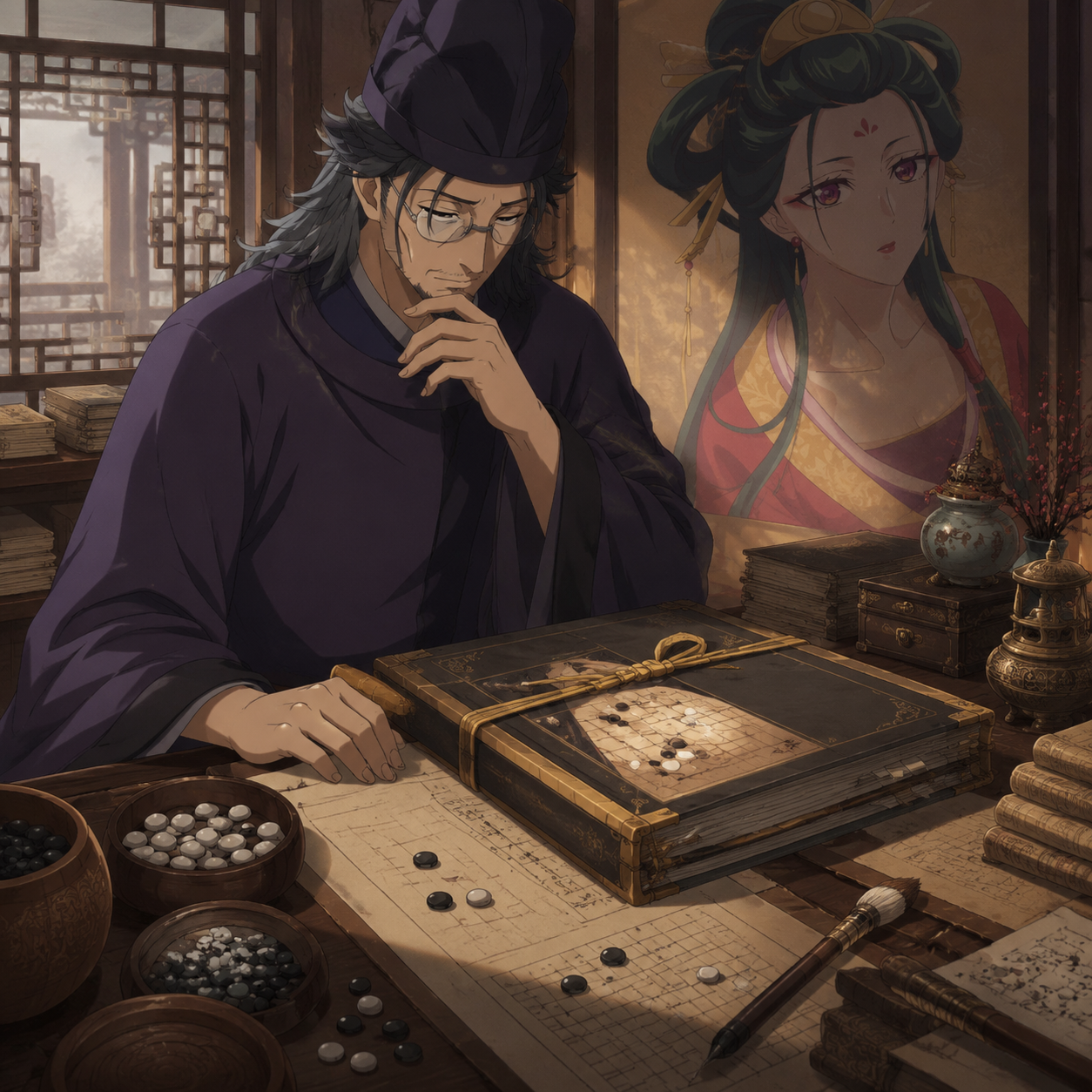
The first important detail is absence. The western journey pulls in Jinshi, Maomao, Ah-Duo, Lishu, Lahan, and the larger politics of the frontier, but Lakan himself does not simply join the trip and dominate the board. Volume 6 gives a very personal reason: Fengxian's condition.
That matters because it turns Lakan's absence into characterization. He is not away because the plot forgot him. He is away because Fengxian has become his priority. The same man who often treats social life like an irritating game chooses to remain near the woman he redeemed from Verdigris House, even as her health is failing.
Fengxian Changes Lakan's Priorities
Lakan and Fengxian keep playing Go and shogi. Even when Lakan goes to court, the games continue through recorded moves and messengers. That detail can sound absurd, but it is emotionally precise. Lakan does not express attachment through soft language. He expresses it through continuation: another move, another record, another unfinished exchange.
For a normal romance, that might feel cold. For Lakan and Fengxian, it is intimate. They do not need a confession scene to prove they understand each other. Their shared language is the board.
His Office Can Survive His Absence
Volume 6 also makes a dry political joke out of Lakan's work life. His subordinates are capable enough that the administration does not immediately collapse when he is absent. That is funny, but it is also important. Lakan has built or inherited a system where people around him can keep working even if he disappears for a while.
That makes his private collapse more revealing. The state can survive without him for a time. His household cannot handle him. His family cannot understand him. And Lakan himself cannot translate grief into ordinary behavior until Maomao finds the one language that still reaches him.
If you want the wider western context that happens while Lakan is off that public board, the article on why Jinshi had to go west covers the larger political pressure around the trip.
The Family Trap
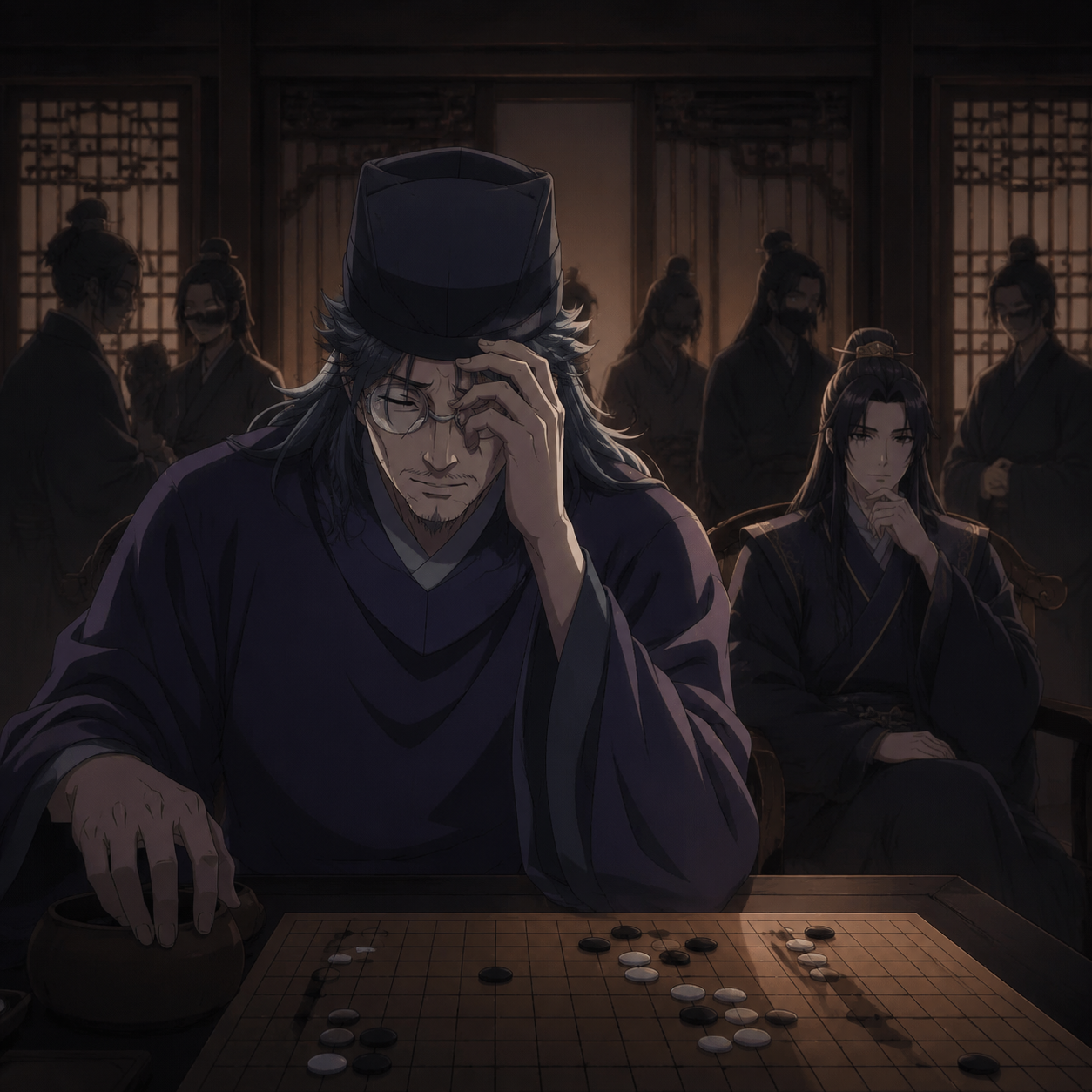
Once Fengxian is gone, Lakan is not shown as a cool mastermind carefully calculating the next move. He is dirty, disheveled, muttering, and stuck in front of the traces of the game. That image is important because it strips away the usual performance of control.
His family reads that condition as an opening. They are not only worried about a relative. They are thinking about the family headship, the object tied to that headship, court recognition, and whether Lakan can be forced to yield authority. In other words, grief becomes a political opportunity.
The Headship Is Not Just a Household Title
The family headship is treated as something with public weight. It involves a recognized object, court procedure, and symbolic authority. So when Lakan's family presses him, they are not asking whether he can manage dinner accounts. They are testing whether they can separate him from the official identity that makes him difficult to replace.
This makes Volume 6 more than a grief chapter. It is a small succession crisis inside a family. Lakan's breakdown invites people to ask who owns the household, who owns the title, and who gets to decide when genius has become useless.
Lahan's Position Exposes the Absurdity
Lahan's presence makes the trap even more revealing. He is Lakan's adopted son, but he is also one of the people who actually understands the family's practical operations. Volume 6 lets readers see that removing Lakan would not automatically make the family stronger. The household's politics are full of people who want authority without fully understanding the cost of running the system.
That is the comedy and the danger of Lakan's family. They are surrounded by clever people, resentful people, useful people, and ridiculous people. The result is a household that can imprison its own monster but cannot easily replace him.
Maomao's Rescue Is Not Sentimental
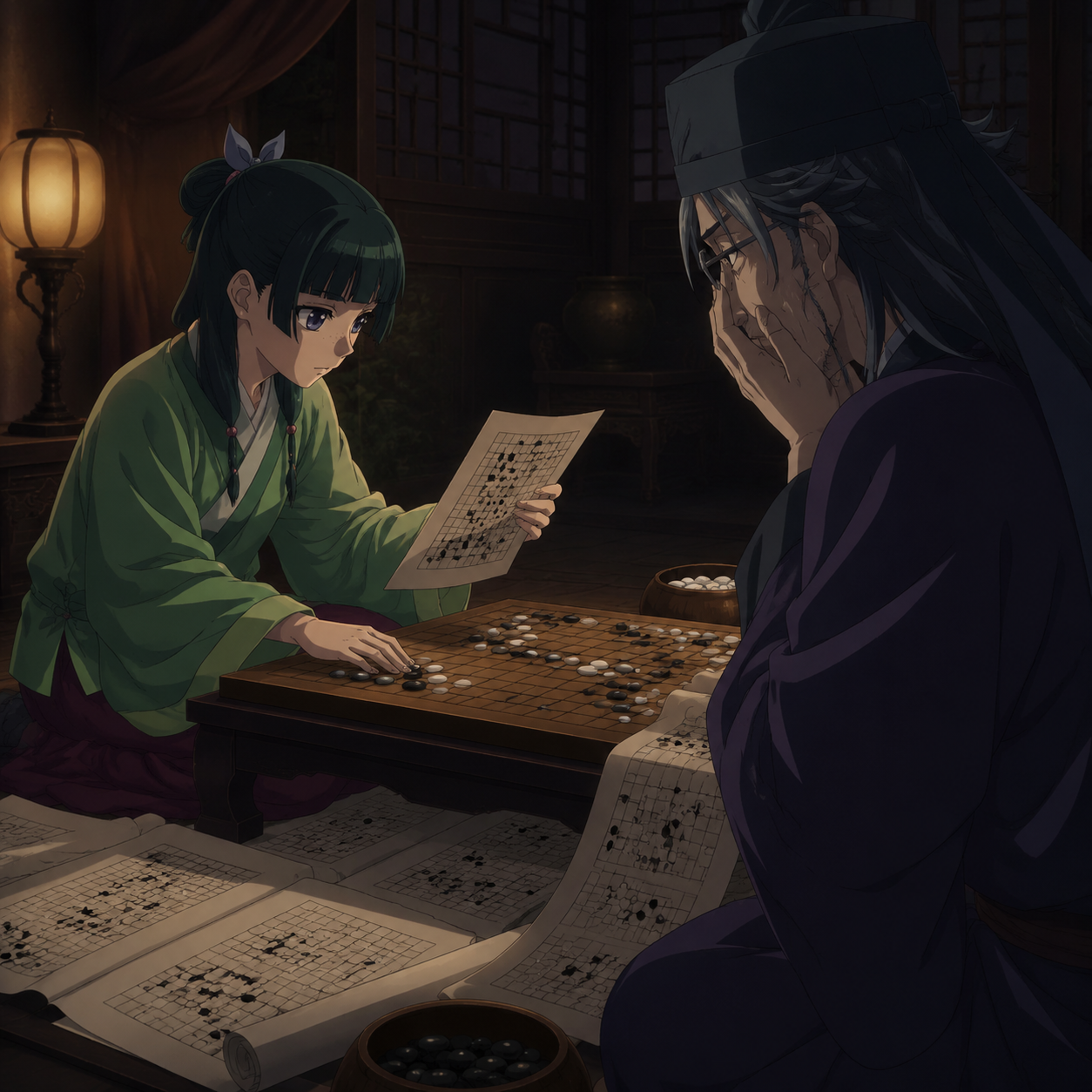
One of the best parts of the Volume 6 Lakan arc is that Maomao does not rescue him by suddenly becoming conventionally affectionate. The story does not force a clean daughter-father reconciliation because that would feel false for both characters.
Instead, Maomao reaches him through method. She sees the recorded moves, asks for the board, and reconstructs the game. That is an extremely Maomao kind of intervention: not dramatic comfort, not tearful forgiveness, but the correct tool applied to the correct wound.
She Does Not Heal Him by Calling Him Father
Lakan wants recognition from Maomao. The uncomfortable part is that he often wants it in a way that ignores Maomao's boundaries. Volume 6 does not erase that. Maomao still does not become the daughter he fantasizes about.
But she does something more honest than empty affection. She looks at the problem in front of her. She recognizes that Lakan's mind is locked inside the game he can no longer finish with Fengxian. Then she opens that door using the record of their moves.
Why the Go Record Works
A normal conversation cannot reach Lakan because grief has pushed him outside normal conversation. The Go record works because it is not just a record. It is Fengxian's voice in the form Lakan understands best.
This is why the scene is more powerful than a simple "snap out of it" moment. Maomao is not dragging Lakan back by force. She is letting him hear the rest of a language that only Fengxian could speak to him fluently.
The earlier article on why Lakan's move matters to Jinshi's survival looks at Lakan as a strategist. Volume 6 is the companion piece: it shows what happens when the strategist becomes the one who must be moved.
Fengxian's Final Game
The most important emotional clue is not simply that Fengxian dies. It is that the game records suggest a final exchange Lakan had not fully understood. Fengxian's play does not remain comfortably predictable. Something in the move sequence changes, and Lakan is forced to confront the fact that he had not finished reading her.
That is devastating because Lakan's pride is built on reading positions. He can read military arrangements, court dynamics, family leverage, and people's usefulness. Yet the woman who mattered most to him still leaves him with a move he must interpret after she is gone.
The Final Move Is Not Just Strategy
When Maomao suggests that Fengxian may have been bored with ordinary patterns, the comment lands harder than it first appears. It turns the last game into a final act of personality. Fengxian is not reduced to a dying woman. She is still a player, still difficult, still able to surprise Lakan.
That is why the scene does not sentimentalize her. Fengxian remains sharp. Even in absence, she can disturb Lakan's assumptions. The final game becomes a way for the dead to remain active in the living person's mind.
Lakan Finally Has to Read Grief Like a Board
Lakan cannot undo Fengxian's death. He cannot command the court, bully his family, or manipulate Maomao into making the loss neat. What he can do is read the remaining moves. That is the narrow bridge Volume 6 gives him.
For Lakan, mourning becomes analysis. That sounds emotionally stunted, but the novel treats it with surprising tenderness. He is not cured. He is given a form of grief he can survive.
The Go Book Is the Real Turning Point
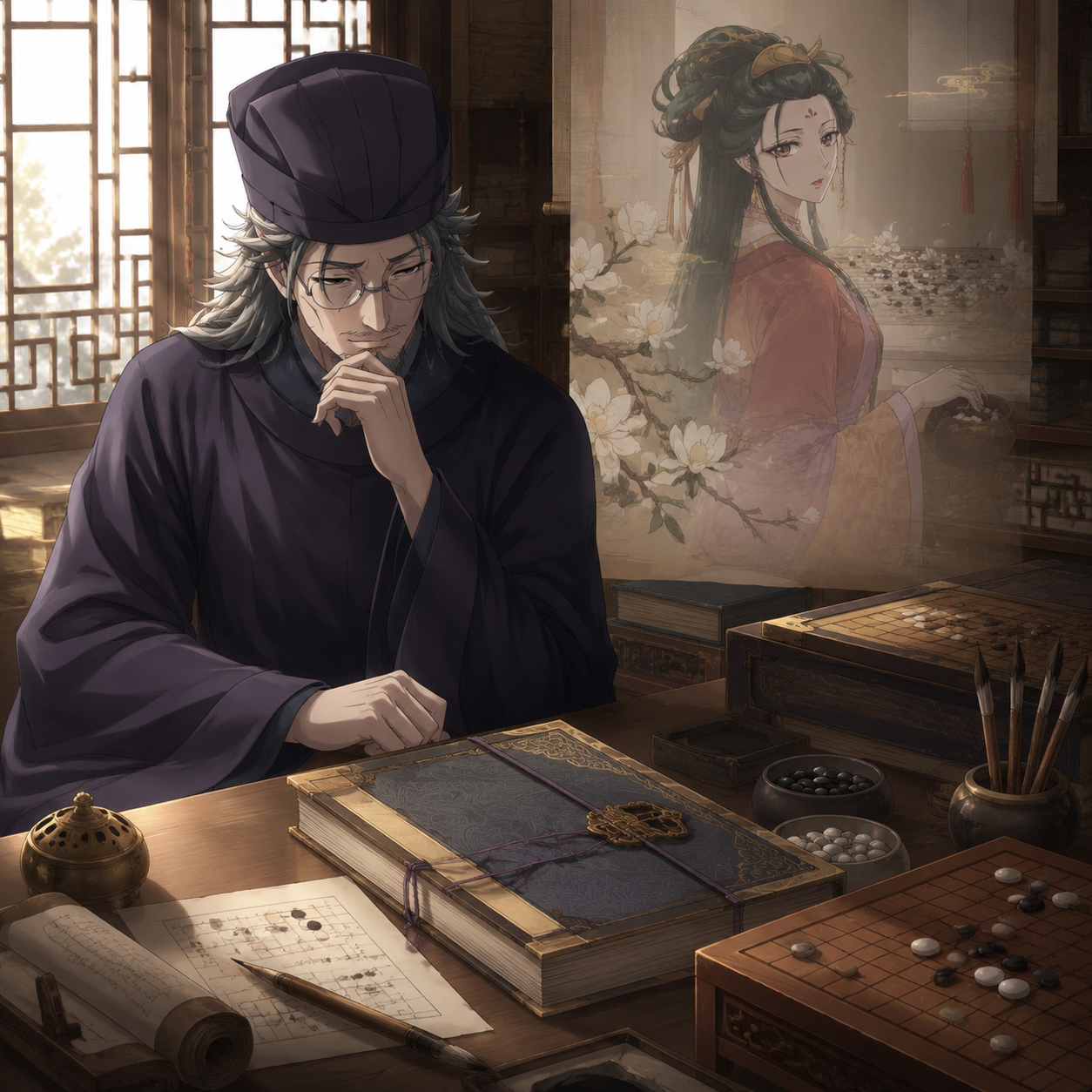
At first, Lakan wanting to compile a Go book can sound like comic eccentricity. The strange old strategist survives a breakdown and immediately turns to a weird project. But Volume 6 makes that project much more meaningful.
The book is a way to keep the games from disappearing. It turns private grief into an archive. Lakan cannot keep Fengxian alive, but he can preserve the shape of their exchanges. That is why the Go book feels like the true endpoint of the arc.
Grief Becomes Record
Lakan is not a man who processes feeling cleanly. If he tried to mourn in ordinary language, he would probably become unbearable or incoherent. The records give him a structure. Each move says: this happened, she answered, I answered, she changed, I failed to see it in time.
That is not healthy in a modern therapeutic sense, but it is psychologically believable for him. He turns loss into something he can study, order, and continue carrying.
The Book Later Becomes Useful
The Go book does not stay only as private mourning. Later, it becomes an object that can move through the plot. That is very Apothecary Diaries: a personal artifact becomes practical currency, and emotional history becomes part of the information economy.
This is one reason the Lakan arc should not be dismissed as a side comedy. The novel turns his grief project into something that can re-enter court business. Lakan's private collapse produces a public object.
What Volume 6 Reveals About Lakan
He Is Brilliant, But Not Untouchable
The most important takeaway is that Lakan is not untouchable. He can be outmaneuvered when the wound is personal enough. He can neglect power when grief takes the place of strategy. He can become so trapped inside a dead conversation that his family sees a chance to strip him of authority.
That does not make him less dangerous. It makes him more human, and therefore harder to dismiss. A perfect mastermind is boring. Lakan is more interesting because Volume 6 shows the broken machinery underneath the genius.
He Can Read Boards Better Than Hearts
Lakan understands positions better than feelings. That is why Fengxian matters so much. She was not someone he could flatten into a piece. She beat him, surprised him, and forced him to see a human face where he usually saw a game object.
Volume 6 extends that idea after her death. Even when Fengxian is gone, she is still the person Lakan has to keep reading. The final game tells us that he never fully solved her, and that is exactly why she remains real to him.
Maomao's Role Stays Complicated
Maomao helps him, but the help does not resolve everything between them. She does not become warm and obedient. She does not reward his past behavior with simple forgiveness. She identifies the functional path out of collapse and takes it because it is the cleanest solution available.
That is why their relationship remains one of the strangest in the series. Lakan wants a daughter. Maomao gives him a diagnosis, a board, and a route back to motion. In The Apothecary Diaries, that may be the closest thing to mercy he is allowed to receive.
FAQ
What happened to Lakan in The Apothecary Diaries Volume 6?
Lakan stays behind because of Fengxian, collapses after her death, gets pulled into a family headship crisis, and is reached again when Maomao uses Fengxian's Go records to restart the conversation he was mentally trapped inside.
Did Fengxian die in Volume 6?
Yes. Volume 6 treats Fengxian's death as the emotional cause behind Lakan's breakdown and his inability to function normally for a time.
Why does Lakan's family imprison or pressure him?
They appear to use his vulnerable state to push the family headship issue. The conflict is not only personal resentment; it is tied to symbolic family authority and court-recognized status.
How does Maomao help Lakan?
She does not comfort him in a normal sentimental way. She recognizes the Go records as the language that still reaches him and uses the game to draw his mind back into motion.
Why is Lakan's Go book important?
The Go book turns Lakan and Fengxian's private games into a lasting record. It is also important because the object later becomes useful within the story's information economy, not just as a mourning keepsake.
What should I read next?
Read why Lakan's move matters to Jinshi's survival for his earlier strategist role, then visit the character relationship map for Lakan's place beside Maomao, Jinshi, and the wider court.