Spoiler Warning
This article discusses major story details from The Apothecary Diaries, including character identities, political secrets, light novel developments, or future anime-relevant plot points. If you are anime-only and want to avoid spoilers, bookmark this page and return after catching up.
Scene Locator
Volume 2, Chapter 12 is the most useful fixed anchor for the ritual incident and the political movement discussed in this article. It shows why a seemingly personal intervention can affect who remains protected inside the imperial system.
The survival argument is interpretive rather than a claim that every later consequence is confirmed in that one chapter. Read the article as a bridge from the incident to Jinshi's broader succession danger, with the novel's later identity material supplying the context.
Continue with the Emperor and Jinshi relationship and Jinshi's real-name guide for the surrounding evidence trail.
Volume-level entry only. The source is community-hosted; availability and rights status may vary.
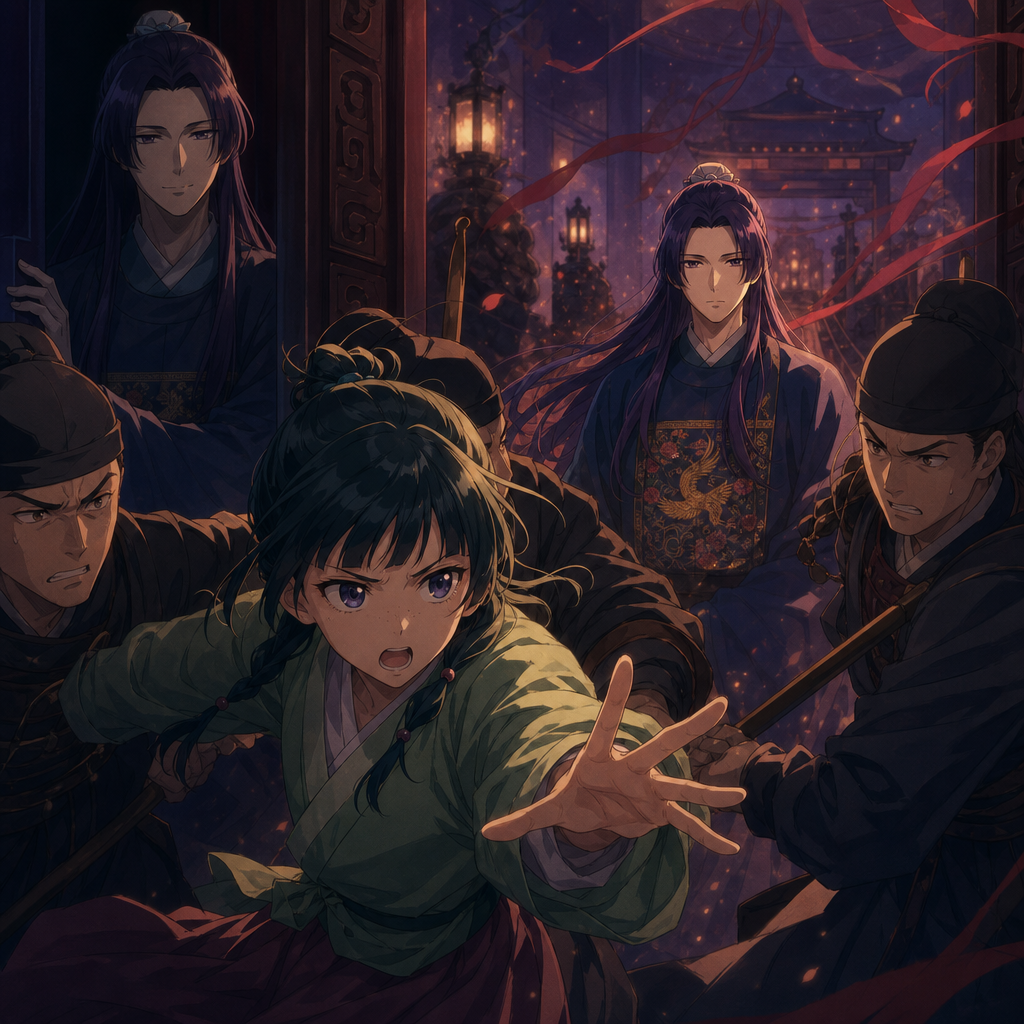
Everyone remembers the ritual incident for Maomao's desperate rush. She sees the pattern, runs toward the danger, forces herself past people who outrank her, and reaches Jinshi just in time. It is one of the clearest examples of why her mind matters in The Apothecary Diaries.
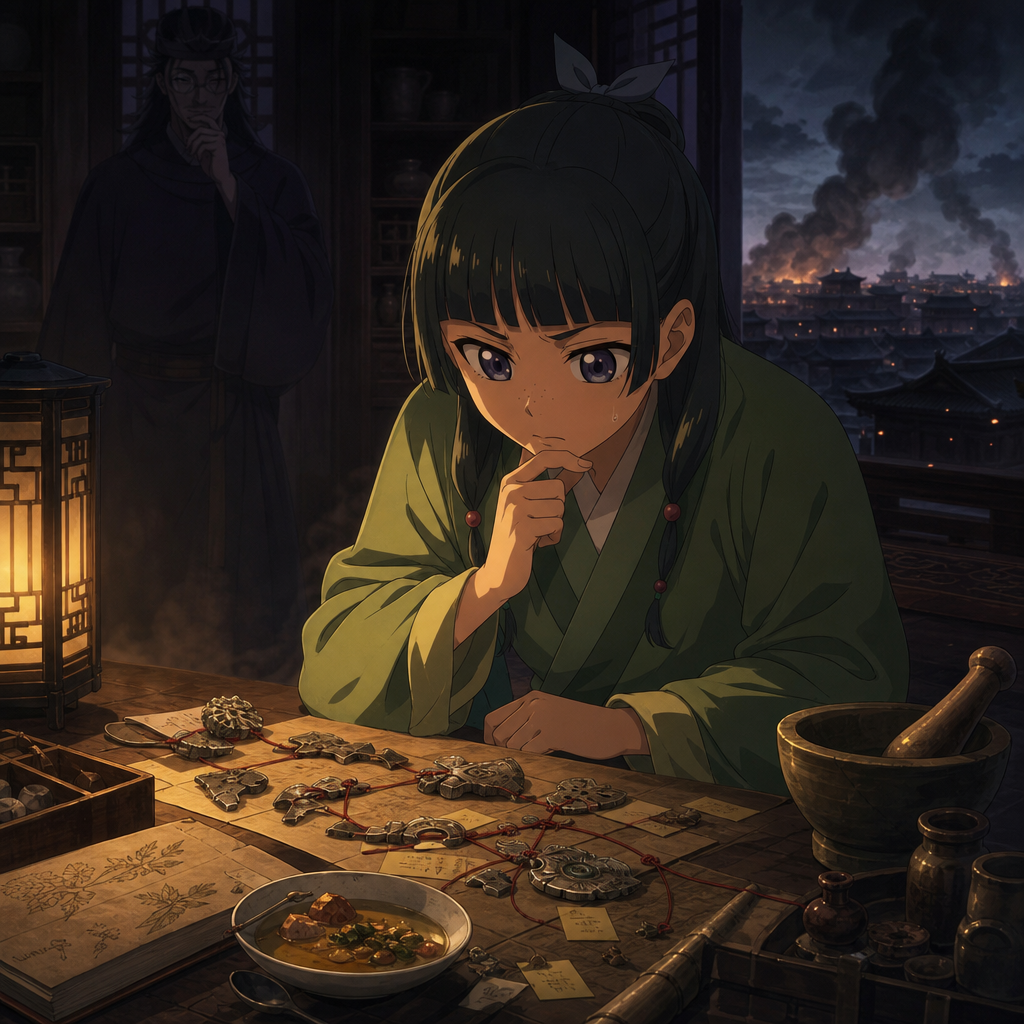
But that scene becomes sharper if you stop treating it as a sudden miracle. Maomao does not solve the threat in an empty room. Before she reaches the ritual site, the story has already placed several clues in front of her: poisoned food, a warehouse accident, suspicious metalwork, and the strange behavior of materials under heat.
That is where Lakan becomes difficult to ignore.
This article is not arguing that Lakan is kind, heroic, or easy to forgive. It is asking a narrower question: what if Jinshi survives because Lakan quietly pushes Maomao into the exact position where her intelligence can matter?
If you want the broader stakes behind Jinshi's rank and identity, the guide to Jinshi's real name and hidden status gives useful background before going deeper into this theory.
The Question Behind Jinshi's Survival
Direct Rescue vs Hidden Positioning
The obvious answer is simple: Maomao saves Jinshi. She is the one who understands the danger, physically enters the ritual space, and acts at the critical second.
That answer is correct. It is also incomplete.
The Apothecary Diaries often separates deduction from power. Maomao can notice what others miss, but noticing is not the same as being allowed to act. Her intelligence solves mysteries, yet the palace constantly reminds her that class, gender, rank, and access decide whether truth can move through a doorway.
Lakan's importance sits inside that gap. He is not the hand that stops the final blow. He is the strategist who understands that the right person must be moved near the right information at the right time.
Why Maomao Is Still the Direct Savior
It would be a mistake to make Lakan the secret hero and erase Maomao's agency. The ritual incident works because Maomao connects the evidence herself. She does not need Lakan to explain the whole plot to her. In fact, if he did, the scene would lose much of its force.
Maomao's strength is that she treats odd details as evidence before anyone else respects them. Food that should not poison someone, a warehouse fire that seems like an accident, a craftsman's inheritance that looks unrelated, and a metal property that feels like trivia all become useful in her mind.
This is why her relationship with Jinshi is so unusual. He gives her access, pulls her into palace problems, and often underestimates how far her curiosity will go. The article on Jinshi and Maomao's dynamics covers that tension from the relationship side, but the ritual incident shows the same pattern in a life-or-death form.
Maomao saves Jinshi because she thinks like Maomao. Lakan matters because he seems to understand how to place that mind on the board.
What Lakan Actually Moves Before the Ritual
Why Lakan Does Not Need to Explain
Lakan is frightening because he does not need to announce himself. He can enter a scene, touch the right pressure point, and leave other people believing they reached the next step on their own.
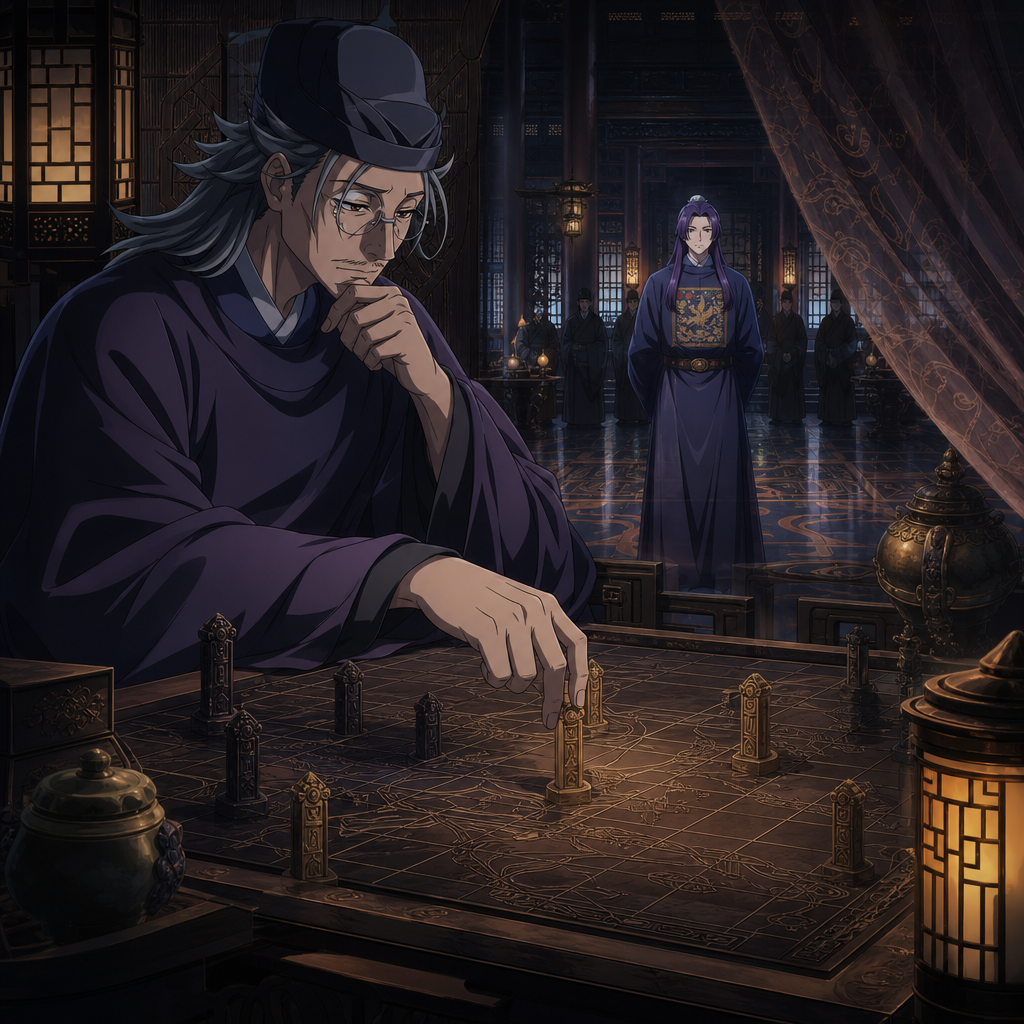
Before the ritual, he does not simply stand around being eccentric. He watches people, follows traces, visits key places, and treats the palace like a board game where human positions matter as much as evidence. That is different from Maomao's method. Maomao studies the clue. Lakan studies the arrangement around the clue.
That distinction matters. A normal investigator might ask, "What happened?" Lakan is more likely to ask, "Who benefits if this person stands here, that person is delayed, and this object is misunderstood?"
In a story full of poison, medicine, and court procedure, Lakan's weapon is positioning.
The Clue Chain: Poisoned Food, Warehouse Fire, and Metalwork
Small Incidents Become One Map
The assassination attempt against Jinshi does not appear from nowhere. It is the endpoint of smaller incidents that look separate until Maomao starts fitting them together.
The poisoned food case teaches her to question the tools and environment around formal events. The warehouse fire introduces a suspicious accident that feels too convenient. The metalworker's inheritance brings in technical knowledge that most palace figures would dismiss as craft trivia. The low-melting metal clue then changes the meaning of the ritual danger.
Each case can be enjoyed as its own mystery. Together, they become a route map.
That is why Lakan's move matters. He does not need to solve the final case in front of everyone. He only needs to make sure Maomao reaches enough of the route to see where it leads.
Why Jinshi Matters to Lakan's Board
Jinshi Protects Maomao's Current Place
Lakan's interest in Jinshi is not sentimental. That is what makes the theory uncomfortable. Jinshi is not Lakan's friend, son, or emotional priority. To Lakan, Jinshi is valuable because Jinshi's position affects Maomao.
At this stage of the story, Maomao's safety is tied to Jinshi's authority. She may complain about him, resist him, and refuse to behave like a romantic heroine, but his status keeps her close to power without making her completely disposable. If Jinshi dies, Maomao's position becomes much more dangerous.
She could be blamed for knowing too much. She could be pushed away by the palace. She could lose the unusual protection that lets her investigate instead of simply obeying.
Lakan understands that Maomao will not willingly come under his control. So instead of dragging her across the board, he preserves the current arrangement. Jinshi survives, and Maomao's chosen position remains possible.
Maomao Reads Evidence, Lakan Reads Position
This is the cleanest way to separate their roles. Maomao reads evidence. Lakan reads position.
Maomao notices the material facts: symptoms, smells, objects, tools, habits, timing, and bodily reactions. Lakan notices how people are placed: who has access, who is blocked, who can be pressured, who can open a door, and which piece becomes powerful if moved one square forward.
Neither skill replaces the other. In the ritual incident, they overlap. Maomao's evidence gives the rescue its truth. Lakan's positioning gives that truth a chance to reach Jinshi.
That is also why Lakan feels so different from characters who simply hide secrets. His knowledge is active. He may not explain the board, but he keeps moving pieces until the board produces the result he wants.
The Door Problem: Knowledge Is Not Enough
Truth Still Needs Permission to Move
The most important part of the rescue may be the moment before Maomao reaches Jinshi. She understands enough to act, but the palace does not care that she is right. Guards block her. Rank blocks her. The ritual setting blocks her.
This is one of the cruelest rules in The Apothecary Diaries: truth does not automatically grant access.
That is where Lakan's status matters. When Maomao's intelligence hits the wall of hierarchy, someone with a different kind of power can change the situation. Lakan does not need to become the hero. He only needs to make the final path possible.
Seen this way, the ritual incident has two layers of rescue. Maomao saves Jinshi directly. Lakan saves the possibility that Maomao can reach him at all.
Why This Makes Lakan More Dangerous
Useful Does Not Mean Innocent
This interpretation does not soften Lakan. If anything, it makes him more dangerous.
A generous character would save Jinshi because a life is at stake. A loyal character would save Jinshi because the court needs him. Lakan's logic is colder. Jinshi matters because Maomao's position matters. The rescue is emotionally connected to Maomao, but it is not emotionally generous toward Jinshi.
That is why Lakan remains such a difficult character to discuss. He can protect the outcome viewers want while still behaving in a way that feels manipulative. He can be useful without being comforting. He can understand Maomao better than many people while still treating the world around her like pieces.
The same tension appears in larger Jinshi family and court questions. If you are tracing how hidden bloodlines and palace positions make personal relationships dangerous, the analysis of Jinshi's journey and Ah-Duo's secret connects well with this side of the story.
FAQ
Does Lakan personally save Jinshi?
No. Maomao is the direct rescuer in the ritual incident. Lakan's importance is more indirect: he helps create the conditions where Maomao's deduction can become action.
Is this theory meant to excuse Lakan?
No. The point is not that Lakan is morally clean. The point is that his strategic reading of people and positions can still protect the outcome he wants, even when his motives remain uncomfortable.
Why does this matter for Jinshi's character?
It shows how vulnerable Jinshi is despite his rank. His survival depends not only on status, but on whether people around him can move through palace barriers quickly enough.
Conclusion: Lakan Saves the Possibility of Rescue
So why does Lakan's move matter to Jinshi's survival?
Because The Apothecary Diaries is not only asking who solves the mystery. It is asking who has the power to move truth into action.
Maomao is the direct savior. She reads the evidence, understands the danger, and reaches Jinshi when it matters. But Lakan may be the hidden strategist who makes sure she encounters the right clues, stands close enough to the right door, and gains the opening she needs at the final moment.
That is a more unsettling kind of rescue. It gives Maomao the victory without making Lakan innocent. It keeps Jinshi alive without pretending Lakan cares about him in a simple way. And it turns the ritual incident from a single dramatic save into a quiet chess game that began long before Maomao started running.