Spoiler Warning
This article discusses major story details from The Apothecary Diaries, including character identities, political secrets, light novel developments, or future anime-relevant plot points. If you are anime-only and want to avoid spoilers, bookmark this page and return after catching up.
Scene Locator
Volume 13, Chapter 14 is the clearest starting point because it reveals why a direct Jinshi-Ah-Duo conversation would carry more danger than comfort. The missing conversation is part of the story's structure: the truth arrives through intermediaries, records, and controlled disclosure.
Later Volume 15 material shows that the silence is not a loose plot gap. It protects the imperial family from forcing a private truth into a public role, while leaving Jinshi to process the consequences without the simple emotional closure a direct meeting might provide.
Continue with Jinshi's discovery of Ah-Duo's secret and the Anshi secrets guide for the surrounding evidence trail.
Volume-level entry only. The source is community-hosted; availability and rights status may vary.
There is a very specific kind of frustration The Apothecary Diaries gives its readers. It is not confusion. It is not bad pacing. It is the feeling that two people are standing close enough to change everything, yet the story keeps a paper wall between them.
Jinshi and Ah-Duo are one of the clearest examples. Once you understand the truth behind Jinshi's birth, their lack of a direct, emotionally honest conversation becomes impossible to ignore. Fans can point to glances, shared rooms, careful manners, and the strange warmth around Ah-Duo. But the clean scene people want - Jinshi and Ah-Duo speaking directly about what they are to each other - never quite arrives.
That absence is not a mistake. It is one of the most deliberate emotional choices in the series.
This article discusses light novel identity material, including Jinshi's parentage and Ah-Duo's position in the palace. For a broader parentage breakdown, read the related guide to Jinshi's journey and Ah-Duo's secret first.
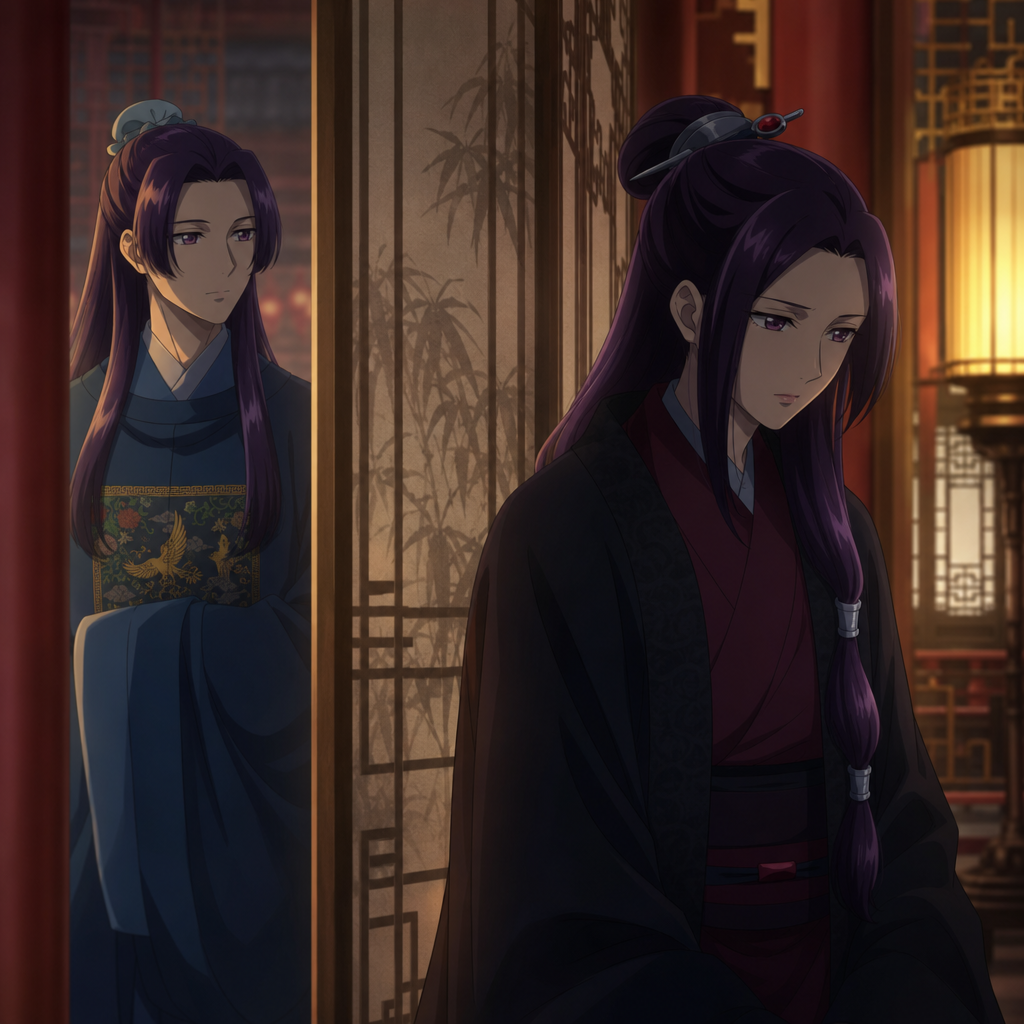
The Strange Absence: Two Characters Who Should Speak, But Do Not
The Missing Scene Is the Clue
In a simpler story, Jinshi and Ah-Duo would eventually get a private scene where the truth comes out. He would ask. She would answer. Someone would cry. The audience would finally receive the emotional release it has been waiting for.
The Apothecary Diaries is not built that way.
The series often treats silence as evidence. A character avoiding a subject can matter as much as a confession. A servant's reaction, a noble's pause, or a change in address can carry more weight than a dramatic speech. That is why the missing Jinshi and Ah-Duo conversation feels so loud. The story keeps asking readers to notice the shape of the gap.
Jinshi is not an ordinary son looking for a mother. Ah-Duo is not an ordinary mother who can claim him. Their relationship is trapped under court rank, succession politics, and a secret that would endanger more people than just the two of them.
Court Etiquette Makes a Private Conversation Dangerous
Every Meeting Can Become Evidence
The palace is not a place where private feelings stay private. A conversation between Jinshi and Ah-Duo would not be judged only by what they say. It would be judged by who saw them, who arranged the meeting, how long they were alone, and whether their expressions looked too familiar.
That matters because Jinshi's public identity is political theater. He cannot freely behave like Ah-Duo's son without making people ask why. Ah-Duo cannot freely behave like his mother without drawing attention to a past the palace has already buried.
Even a harmless conversation could become material for factional gossip. In The Apothecary Diaries, gossip is not background noise. It is a weapon. A rumor can move faster than proof, and once a rumor touches the imperial line, it becomes dangerous.
This is why the absence of a direct scene fits the logic of the Inner Court. Emotional honesty is expensive there. The characters who survive are often the ones who know when not to speak.
The Hidden Parentage Problem
Private Truth, Public Risk
The central issue is not simply that Jinshi and Ah-Duo have complicated feelings. The problem is that the truth about Jinshi's birth is politically explosive.
Jinshi's official place in the imperial family is not the same as his biological place. That gap affects the throne, the Emperor, Ah-Duo's past, and the people who helped keep the story intact. If Jinshi and Ah-Duo spoke directly as mother and son, they would not just be having a personal conversation. They would be acknowledging a dangerous version of history.
The series has already trained readers to understand why names and ranks matter. Jinshi's identity is not just a private label. It shapes where he can go, who can approach him, and what others are allowed to believe about him. If you want that side of the issue in more detail, the site's guide to Jinshi's real name and hidden rank explains why one identity can carry so much political risk.
A direct conversation would make the hidden parentage feel settled. But the story needs that truth to remain unstable. It is known, suspected, avoided, and protected at the same time.
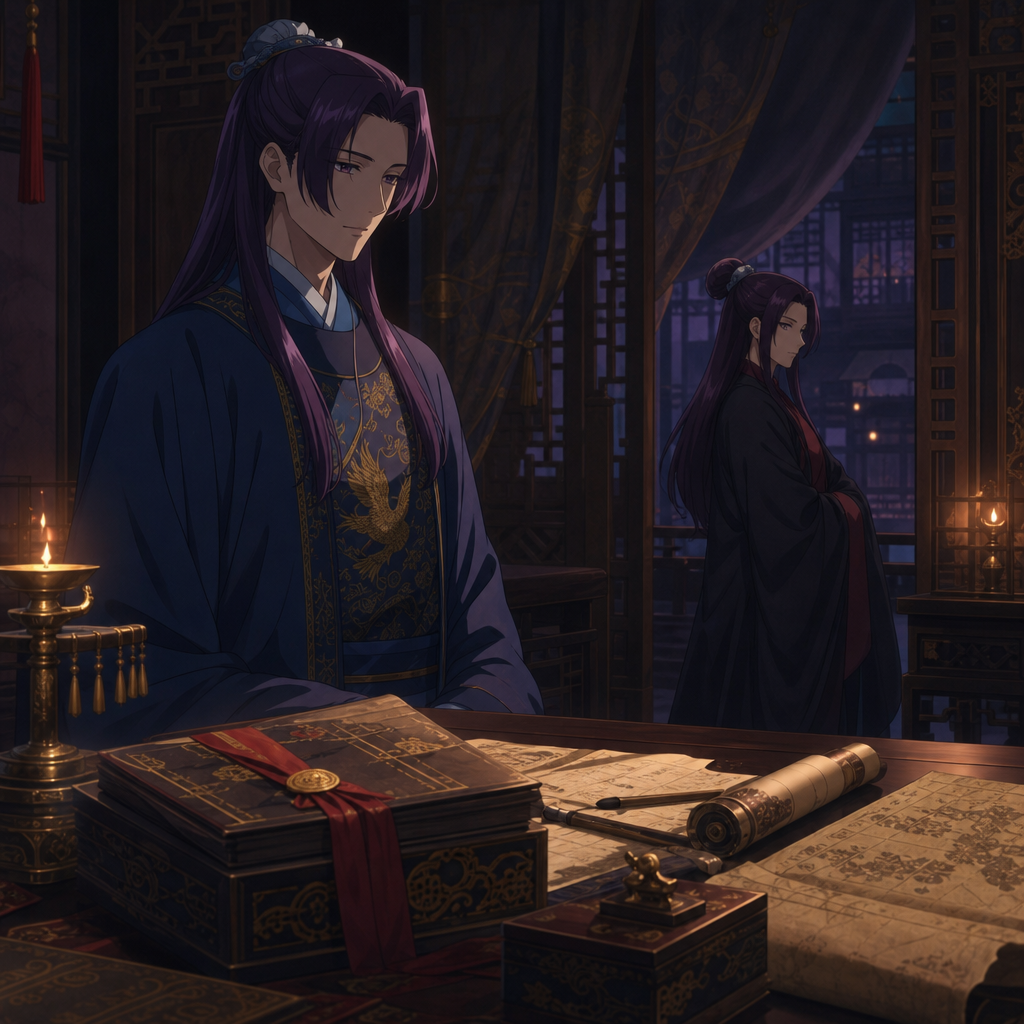
Ah-Duo's Silence Is Protection, Not Distance
Restraint as Motherhood
Ah-Duo's restraint can look cold if you only read it on the surface. Why not speak? Why not claim the person she lost? Why keep everything so formal?
Because Ah-Duo understands the palace too well.
Her silence is not a lack of feeling. It is a survival strategy. If she acts too maternal, she risks placing Jinshi under a brighter lamp. If she pushes for a private confession, she risks turning an old secret into an immediate crisis. If she asks for emotional closure, she may be asking Jinshi to carry a burden he is already trying not to show.
That is what makes Ah-Duo such a painful character. She is not passive. She is choosing restraint with full knowledge of what it costs her. Her motherhood, if we can call it that inside the palace's rules, exists through distance.
This also connects with the way the court treats women whose bodies, pregnancies, and positions are turned into political facts. The article on Anshi's palace secrets explores another angle of how motherhood, status, and silence can become part of imperial survival.
Jinshi's Silence Is Self-Control
Asking Would Force an Answer
Jinshi's side is just as complicated. He is intelligent enough to read the clues. He is emotional enough to be affected by them. But he is also disciplined enough to understand that wanting an answer and being allowed to demand one are not the same thing.
A direct question to Ah-Duo would not be a small act. It would force her to either deny him, confess to him, or answer in a way that confirms more than she can safely say. Jinshi's restraint protects her as much as it protects himself.
That is easy to miss because Jinshi often hides his seriousness behind charm, irritation, or theatrical beauty. But his deepest conflicts are not shallow. He is a person constantly negotiating between what he wants and what his position requires.
This is why a single private conversation would feel almost too simple. Jinshi does not need one line of dialogue to prove he cares. His self-control is the proof.
Why Maomao Can Notice What They Cannot Say
Maomao is the perfect observer for this kind of relationship because she does not need people to confess in order to draw a conclusion. She watches bodies, habits, timelines, medicines, court routines, and the tiny inconsistencies people leave behind.
That makes her valuable to the reader. She can stand near the silence and make it legible without destroying it.
Jinshi and Ah-Duo cannot easily speak the truth aloud. Maomao can notice the truth from the side. She can interpret the awkwardness, the medical history, the family resemblance, and the strange privileges around Jinshi without forcing the story into melodrama.
It is also why Maomao and Jinshi's relationship has such a different texture. With Maomao, Jinshi often pushes, teases, negotiates, and loses control of the mask. With Ah-Duo, he must remain careful. For more on that contrast, see the analysis of Jinshi and Maomao's dynamics.
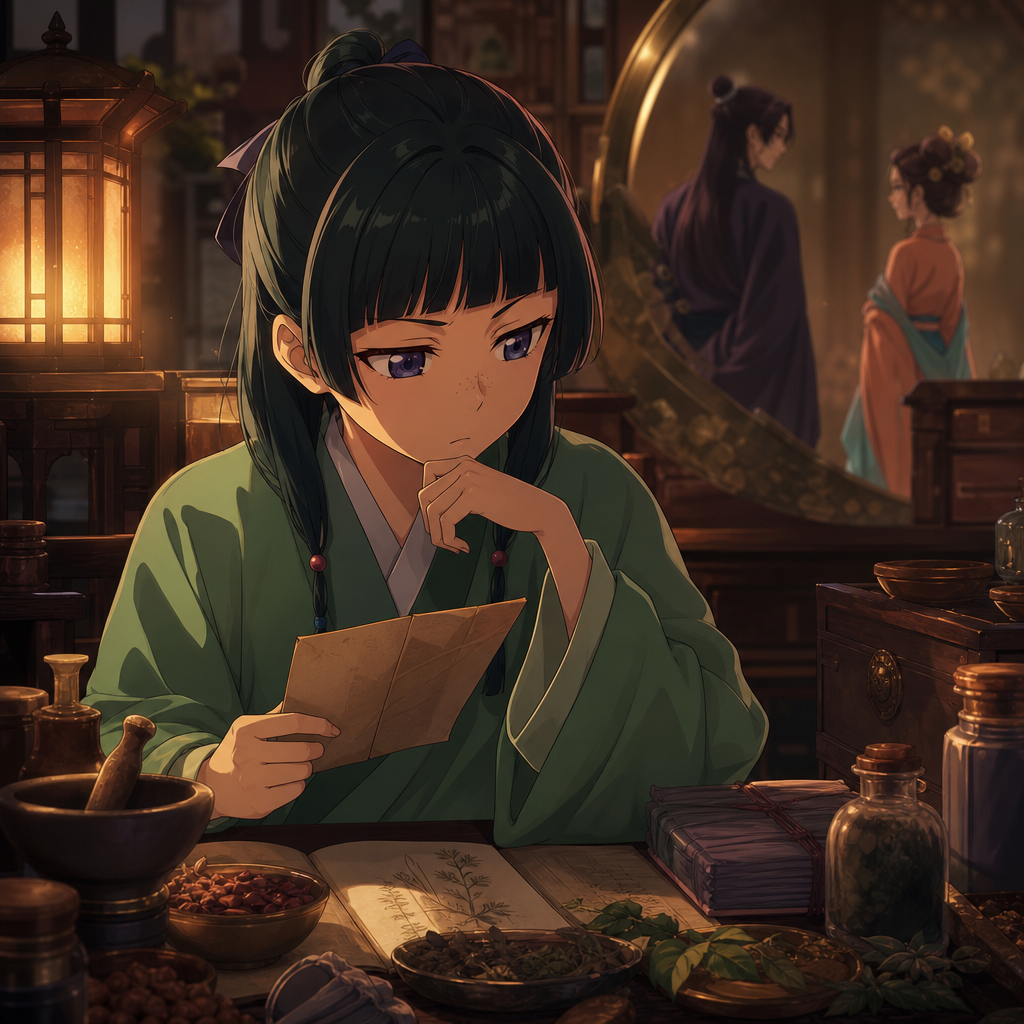
Would a Direct Conversation Break the Story's Tension?
The Story Protects the Pressure
Honestly, yes. At least too early.
The emotional tension around Jinshi and Ah-Duo depends on restraint. If the story gave readers a clean mother-son conversation, it would satisfy one kind of curiosity but flatten another. The mystery would become a scene. The pressure would become an answer. The characters would be pushed into clarity before the political world around them can survive it.
The Apothecary Diaries is unusually good at making readers wait for the right kind of payoff. It does not always reward attention with immediate confession. Sometimes it rewards attention by letting you understand why a confession cannot happen yet.
That is the stronger choice here. The missing conversation keeps both characters tragic without turning them helpless. Ah-Duo keeps choosing caution. Jinshi keeps choosing control. The reader keeps noticing how much feeling is packed into what remains unsaid.
What Fans Should Watch For in Future Volumes
If the story ever does bring Jinshi and Ah-Duo into a more direct exchange, the most important part may not be a dramatic reveal. It may be a change in address, a softened refusal, a shared memory, or a line that seems ordinary to everyone except readers who know the truth.
Watch for three things:
- Whether Jinshi allows himself to ask anything personal without hiding behind official business.
- Whether Ah-Duo responds as a former consort, a political survivor, or someone much closer than either role permits.
- Whether Maomao notices a shift that other characters miss, especially in tone, timing, or body language.
The series may never give fans the exact confrontation they imagine. But that does not mean the relationship will stay static. In this story, even a small change in distance can be a major event.
FAQ
Do Jinshi and Ah-Duo know the truth?
The story strongly invites readers to track what each character suspects, knows, and chooses not to say. The tension comes from how dangerous open acknowledgement would be.
Why does Maomao matter to this relationship?
Maomao can read clues without forcing a confession. She lets readers understand the hidden family pressure while the characters themselves remain trapped by rank and etiquette.
Would a direct conversation ruin the story?
Not forever, but too early it would flatten the political and emotional pressure. The silence keeps the relationship painful, unstable, and narratively alive.
Conclusion: Silence Is Their Sharpest Dialogue
Jinshi and Ah-Duo never having a direct conversation is frustrating because it feels like the story is holding back the scene everyone can picture. But that restraint is the point.
Their relationship is shaped by hidden parentage, imperial etiquette, old grief, and the danger of letting private truth become public evidence. Ah-Duo's silence protects Jinshi. Jinshi's silence protects Ah-Duo. Maomao's observations let readers understand the emotional reality without forcing the characters to say what the palace cannot safely hear.
That is why the missing conversation works. In The Apothecary Diaries, silence is not empty. Sometimes it is the most honest language the court allows.