Spoiler Warning
This article discusses major light novel spoilers for The Apothecary Diaries, including Jinshi's official identity, Ah-Duo's hidden connection to him, the Emperor's succession calculations, the Shrine of Choosing, and later pressure around Jinshi not wanting the throne. Anime-only readers should stop here.
Scene Locator
The clearest fixed starting point is Volume 3, Chapter 12, the Shrine of Choosing sequence. It makes the succession question visible: Jinshi is placed in a ritual space where imperial identity and the throne cannot be treated as abstract rumors.
The article's father-and-brother reading is broader than that single scene. Follow the identity and succession consequences through Volumes 3-15; the Emperor's public treatment of Jinshi, Ah-Duo's hidden history, and Jinshi's reluctance to become emperor belong to a cross-arc analysis, not one private conversation.
Continue with the Shrine of Choosing analysis and Jinshi's real-name guide for the surrounding evidence trail.
Volume-level entry only. The source is community-hosted; availability and rights status may vary.
The Short Answer
The Emperor publicly treats Jinshi as a younger brother because Jinshi's official place in the imperial family is built that way. In court language, Jinshi cannot openly be treated as the Emperor's son without tearing open the old baby-switch secret and destabilizing the palace record.
Privately, however, the Emperor's choices often place Jinshi in a son-like position. He protects Jinshi's identity, keeps him close to imperial ritual, uses trusted retainers such as Gaoshun around him, and repeatedly moves him toward succession problems that Jinshi himself would rather avoid.
So the cleanest reading is this: Jinshi is the Emperor's brother in official identity, but he is treated as a hidden son in political pressure. The relationship is not warm domestic fatherhood. It is palace fatherhood, where care, secrecy, inheritance, and state survival all sit in the same locked room.
That is why this question connects directly to Jinshi's real name and hidden identity, Ah-Duo's secret, and the Shrine of Choosing succession test.
Why the Emperor Must Treat Jinshi as Brother
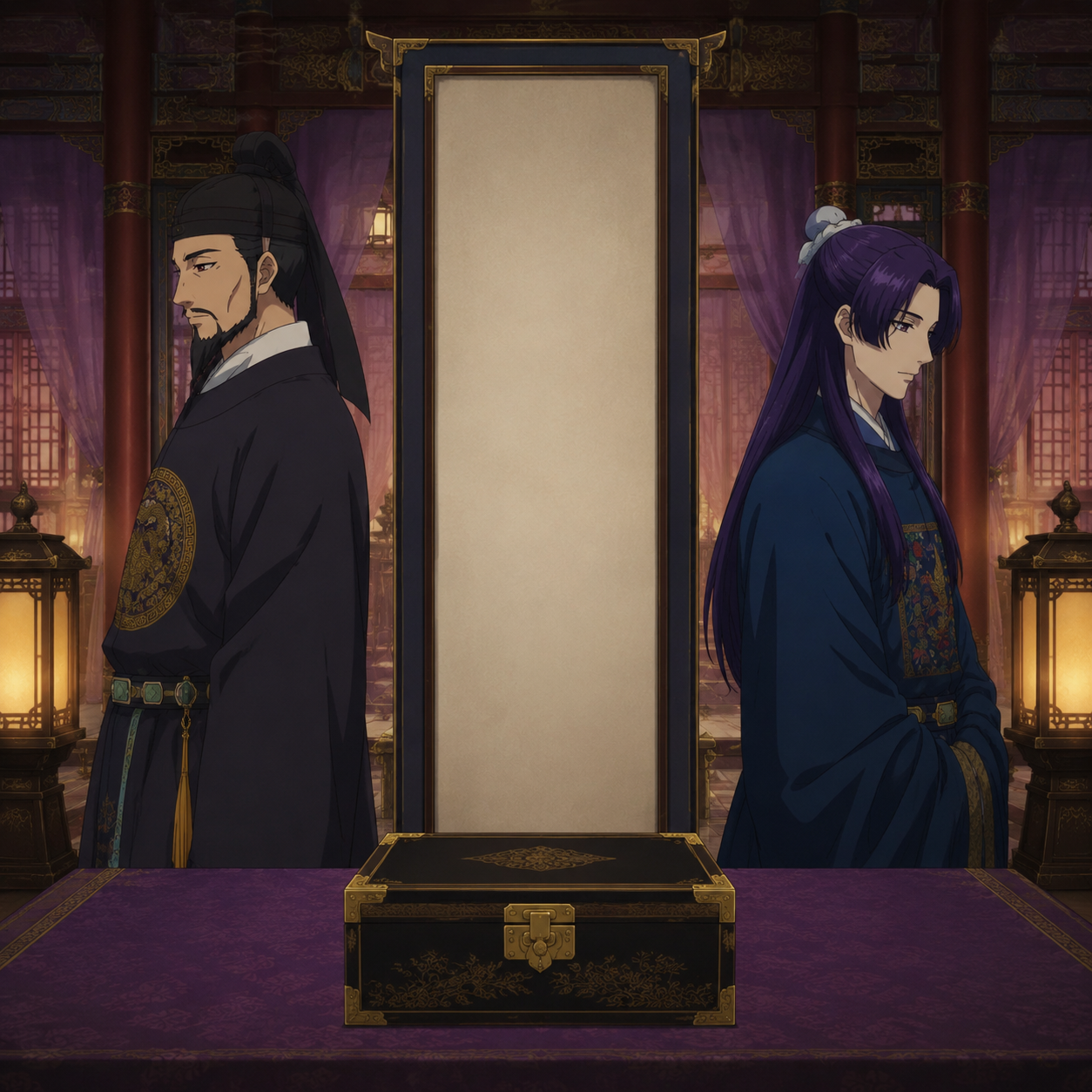
In public, Jinshi is not the Emperor's son. He is the Emperor's younger brother, a beautiful and politically delicate imperial relative whose rank is dangerous enough even before the deepest secret is considered. The court record gives him a place, and everyone powerful survives by respecting that place.
This is why the Emperor cannot openly speak to Jinshi as a father. A single public gesture in the wrong direction would invite questions about Jinshi's birth, Ah-Duo's lost child, the Empress Dowager's past, and the legitimacy of the people who built the current arrangement.
The palace is not a modern family living room. It is a machine for turning bloodline into rank. Once a person is officially recorded as one relation, changing that relation is not an emotional confession. It is a political explosion.
The Brother Role Protects the Secret
Calling Jinshi "brother" in practice keeps the secret from becoming a public succession crisis. It lets Jinshi remain close to power without forcing the court to explain why he matters so much. It also protects Ah-Duo, whose silence is one of the story's most painful forms of loyalty.
This is the same silence explored in why Jinshi and Ah-Duo never have a direct conversation. The truth may matter personally, but saying it out loud would change everyone's political position.
The Brother Role Also Keeps Jinshi Useful
As the Emperor's younger brother, Jinshi can move near the throne without being announced as its next occupant. That ambiguity is useful. He can serve in ceremonial and administrative spaces, absorb pressure, and remain available as a possible answer if succession becomes unstable.
But that usefulness is also cruel. Jinshi's official role protects him from one danger while keeping him available for another. He is hidden from the truth, then surrounded by the consequences of that truth.
Why the Relationship Feels Like Father and Son
The Emperor's private treatment of Jinshi becomes harder to read as simple brotherhood once the succession thread is visible. He does not merely keep Jinshi nearby as a sibling. He measures him, shields him, and places him in scenes where the question of inheritance cannot be avoided.
That does not mean the Emperor behaves like an openly affectionate father. The Apothecary Diaries rarely gives power that kind of clean emotional shape. His father-like behavior is filtered through secrecy and rule. He expresses concern by managing positions, arranging tests, and relying on people who can keep Jinshi alive without making the truth loud.
In other words, the Emperor treats Jinshi like someone whose future matters to the state. That is the part that feels paternal: not softness, but investment.
A Father Can Want Safety and Succession at the Same Time
The Emperor's contradiction is that he can want Jinshi protected and still push him toward a role Jinshi hates. In a normal family story, that might look hypocritical. In a palace story, it is almost expected. A hidden son is not only a child. He is also a possible solution to the empire's future.
This is why the relationship can feel uncomfortable. The Emperor's care for Jinshi is real enough to notice, but it is never free from use. Jinshi is protected because he is precious, and he is precious partly because he can be used.
Gaoshun Shows How Serious the Emperor Is
Gaoshun's position helps explain the Emperor's attitude. The Emperor trusts Gaoshun because the Ma clan's service is built on quiet competence and secrecy. When Gaoshun is near Jinshi, he is not only a servant keeping a noble comfortable. He is part of the structure that keeps an imperial secret steady.
That makes Gaoshun's relationship with the Emperor important background for this question. The Emperor's treatment of Jinshi is not just personal. It is supported by a whole web of retainers who understand when not to speak.
A specific example is the request to choose a consort in Volume 5. Our analysis of why Jinshi's father wants him to choose a flower follows the marriage politics, Ah-Duo's remembered promises, and the limits of Jinshi's freedom. Novel spoilers through Volume 8.
Ah-Duo's Secret Changes the Reading
Once Ah-Duo's secret enters the picture, the brother-or-son question changes shape. The issue is not whether the Emperor has a warm private nickname for Jinshi. The issue is that Jinshi's official brother status covers a hidden parentage truth that the palace cannot safely acknowledge.
Ah-Duo's silence is not passive. It is an act of protection. If the truth around Jinshi becomes public, it could harm Jinshi, Ah-Duo, the Emperor, the Empress Dowager, and anyone whose power rests on the current version of the family tree.
That is why the Emperor's public brother role and private son-like pressure can coexist. The truth is present enough to shape his choices, but forbidden enough that he must pretend it is not shaping them.
Jinshi Is Loved Through Distance
One of the cruelest parts of Jinshi's story is that the people connected to his birth often protect him by staying distant. Ah-Duo cannot claim him. The Emperor cannot plainly father him. The court cannot openly rewrite him. Jinshi is surrounded by care that must disguise itself as procedure.
This is why the Emperor's treatment can feel cold even when it is not indifferent. The system gives him tools for secrecy, rank, and succession, but not many tools for honest family feeling.
The Secret Makes Every Test More Personal
If Jinshi were only an official younger brother, the Emperor's succession interest would still be political. With the hidden birth truth underneath, it becomes personal as well. The Emperor is not only testing a prince-like relative. He is testing the future of someone who may be closer to him than the official record allows.
That double meaning is why Jinshi's identity articles are so central to reading later politics. The court sees rank. The reader sees the pain behind the rank.
The Shrine of Choosing Makes the Pressure Visible
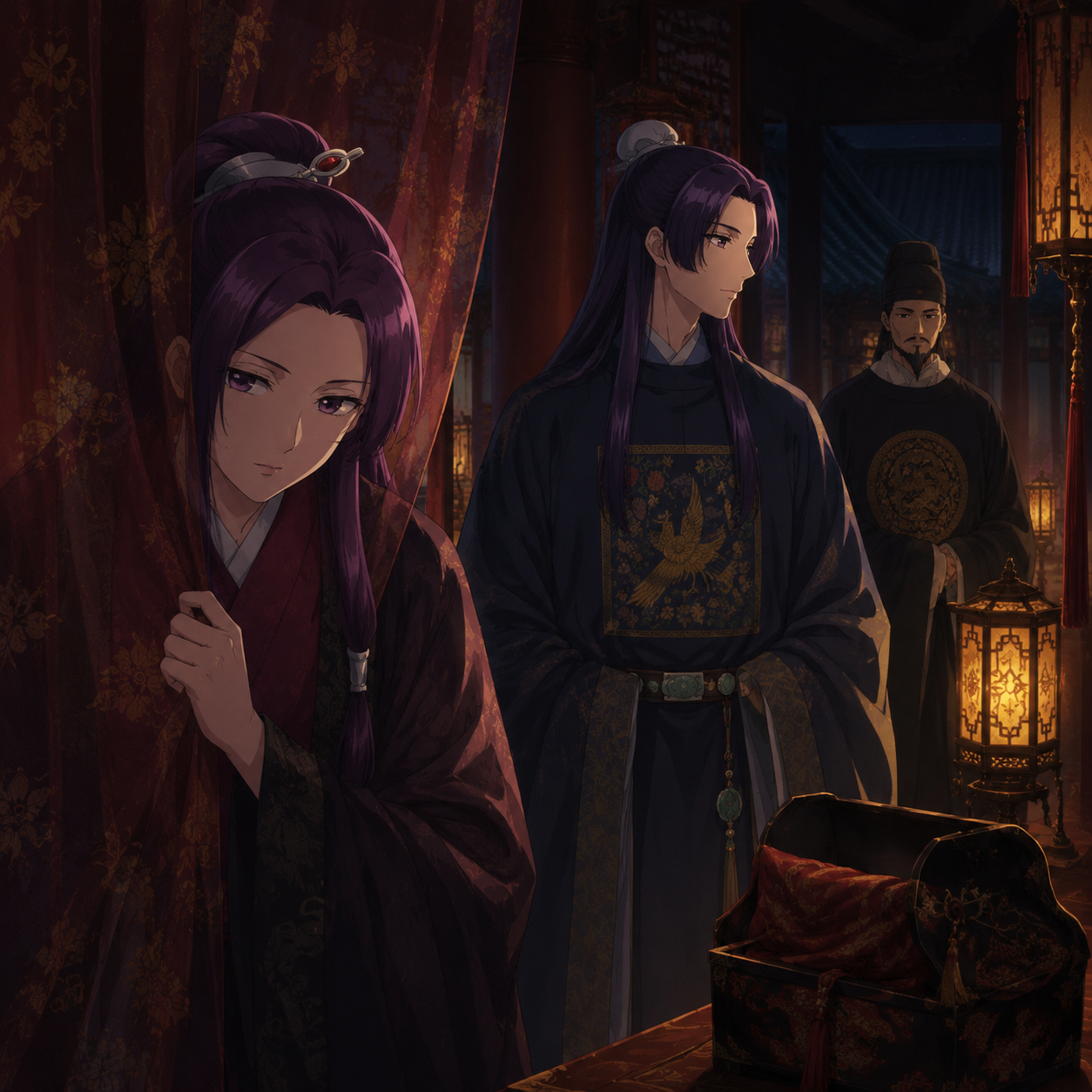
The clearest evidence that the Emperor sees Jinshi as more than a younger brother is the Shrine of Choosing scene. The shrine is tied to an old ruler-selection rule: the person who clears the correct path can be treated as fit to rule. Bringing Jinshi there is not casual curiosity.
In that scene, the Emperor brings Jinshi into a ritual space where succession can be tested without a formal declaration. Maomao's medical reasoning explains the color-vision mechanism, but Jinshi is the one placed in the role of possible chosen candidate.
This is why the shrine article matters so much: the Emperor takes Jinshi and Maomao to the Shrine of Choosing because Jinshi's future is being measured against an older legitimacy system.
A Brother Can Be Tested, But a Hidden Son Can Be Pressured
If the Emperor were treating Jinshi only as a younger brother, the shrine would read as an imperial relative being used for ritual support. But the scene is sharper than that. Jinshi is not just present. He becomes the person whose possible succession path the Emperor is quietly examining.
That is son-like pressure. The Emperor is not simply asking whether his brother can help him. He is asking whether Jinshi can become the answer after him.
Maomao Makes the Test Dangerous
Maomao's presence adds another layer. She can explain the shrine scientifically, which means she can also expose how the old ritual works. The Emperor gains information, but he also gives Maomao a view of the mechanism behind imperial legitimacy.
That trust in Maomao's usefulness shows how carefully the Emperor is managing the problem. Jinshi alone would make the shrine a symbolic test. Maomao makes the test understandable.
Why the Emperor Cannot Simply Act Like a Father
The Emperor cannot openly treat Jinshi as his son because the truth would reorder too much. It would raise questions about Ah-Duo, the Empress Dowager, the official family tree, and the legitimacy of everyone who benefited from the old arrangement.
Even private affection has limits. Servants listen. Factions infer. Consorts calculate. A ruler's body language can become evidence. In that environment, acting too much like a father is not just emotional risk. It is a leak.
Public Language Wins Over Private Truth
The court survives by insisting on the official story. That means the Emperor's public treatment of Jinshi must remain brotherly, ceremonial, and controlled. He can give Jinshi tasks, status, and proximity, but he cannot give him an openly acknowledged father-son place.
This is why readers should avoid judging the Emperor only by whether he says the right family words. In The Apothecary Diaries, power often proves itself through who is protected, who is tested, and who is allowed to remain unspoken.
Succession Makes Affection Look Like Strategy
Because Jinshi can become a succession symbol, almost any concern for him becomes political. If the Emperor protects him, it may be care. If the Emperor tests him, it may be planning. Usually it is both.
That bothness is the heart of the relationship. The Emperor's treatment of Jinshi cannot be separated into clean boxes labeled family and politics. The palace mixes them until every gesture carries two meanings.
Why Jinshi Resists the Role
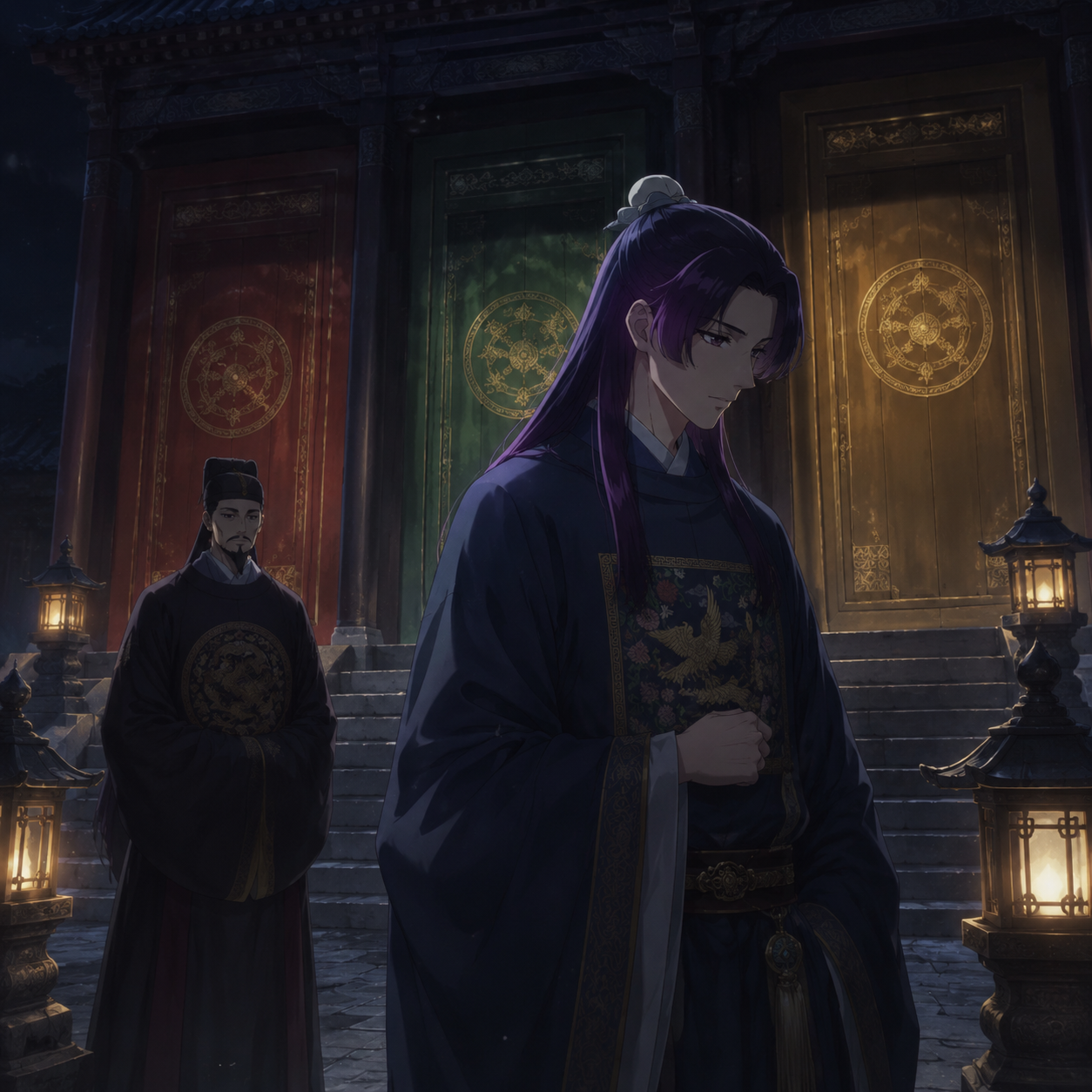
Jinshi's own resistance is the strongest proof that being treated as a possible son-heir is not a simple privilege. He does not want to become emperor. He understands that being turned into a succession answer would also turn people around him into political opponents, targets, or tools.
This is why his relationship with Gyokuyou matters. If Jinshi is made into a rival imperial symbol, then Gyokuyou's empress path and her children's future become harder to separate from him. That is the pressure behind why Jinshi does not want to become Gyokuyou's enemy and whether Gyokuyou becomes Jinshi's enemy.
Jinshi is not rejecting a father's love. He is rejecting the machinery attached to that love. If the Emperor's private treatment makes Jinshi look like a son, it also makes him look like a candidate. Jinshi knows those two things cannot be separated at court.
Maomao Sees the Human Cost
Maomao often cuts through court romance and court rank by looking at what a situation does to a body and a life. Around Jinshi, that means seeing the exhaustion beneath the beauty and the danger beneath the privilege.
That is why Jinshi and Maomao's dynamic gives this political question emotional weight. Maomao is not impressed by the title game. She notices what the title game costs.
Final Verdict: Brother in Law, Son in Pressure
The Emperor treats Jinshi as a brother when the court is watching because that is the only safe official identity. The public record requires brotherhood, and the palace's stability depends on everyone performing that truth.
But underneath that performance, the Emperor repeatedly treats Jinshi like a hidden son whose future could solve or worsen the succession problem. He does not simply love Jinshi from a distance; he places Jinshi near imperial tests, keeps him inside a network of trusted silence, and lets old legitimacy questions gather around him.
So the answer is not "brother" or "son" as a simple choice. The Emperor treats Jinshi as a younger brother by law and etiquette, but as a son-like heir by action and pressure. That contradiction is exactly why their relationship is so tense.
FAQ
Does the Emperor know the truth about Jinshi?
The light novel strongly frames the Emperor's behavior as informed by the hidden truth around Jinshi's birth and Ah-Duo. The important point is that knowing and publicly acknowledging are very different things in the palace.
Is Jinshi officially the Emperor's brother?
Yes. Publicly and officially, Jinshi is treated as the Emperor's younger brother. That official identity is why the Emperor cannot simply act as his father in front of the court.
Why does the Emperor seem to push Jinshi toward succession?
Because Jinshi is politically useful as a possible successor, especially when old legitimacy systems such as the Shrine of Choosing are involved. The Emperor's treatment places Jinshi under heir pressure even when Jinshi does not want the throne.
Is the Emperor affectionate toward Jinshi?
He is not affectionate in a simple modern father-son style. His care is filtered through rank, secrecy, testing, and state duty. That makes the relationship feel restrained rather than openly warm.
What should I read next?
Read Jinshi's real name and identity, Jinshi and Ah-Duo's secret, the Shrine of Choosing analysis, and the character relationship map.
Related analysis: For the later political work behind this relationship, read how Jinshi begins to understand his father's burden in Volume 15.