Spoiler Warning
Major light novel spoilers through Volume 13. This analysis discusses Ah-Duo's Western Capital visit in Volume 5, Chue's mission in Volume 12, Chapter 27, and Ah-Duo's conversation with Maomao in Volume 13, Chapter 14. It reveals Jinshi's biological parents, the infant exchange, and Ah-Duo's response to his relationship with Maomao. Anime-only readers should stop here.
What Does Ah-Duo Want for Jinshi?
Ah-Duo wants Jinshi to have a life he can be happy living. The clearest evidence is the mission she gives Chue: to make the Moon Prince happy. In Volume 13, Chapter 14, she confirms that order and explains its personal foundation. Jinshi is her biological son. Her concern reaches beyond the safety of an imperial relative or the success of a possible heir.
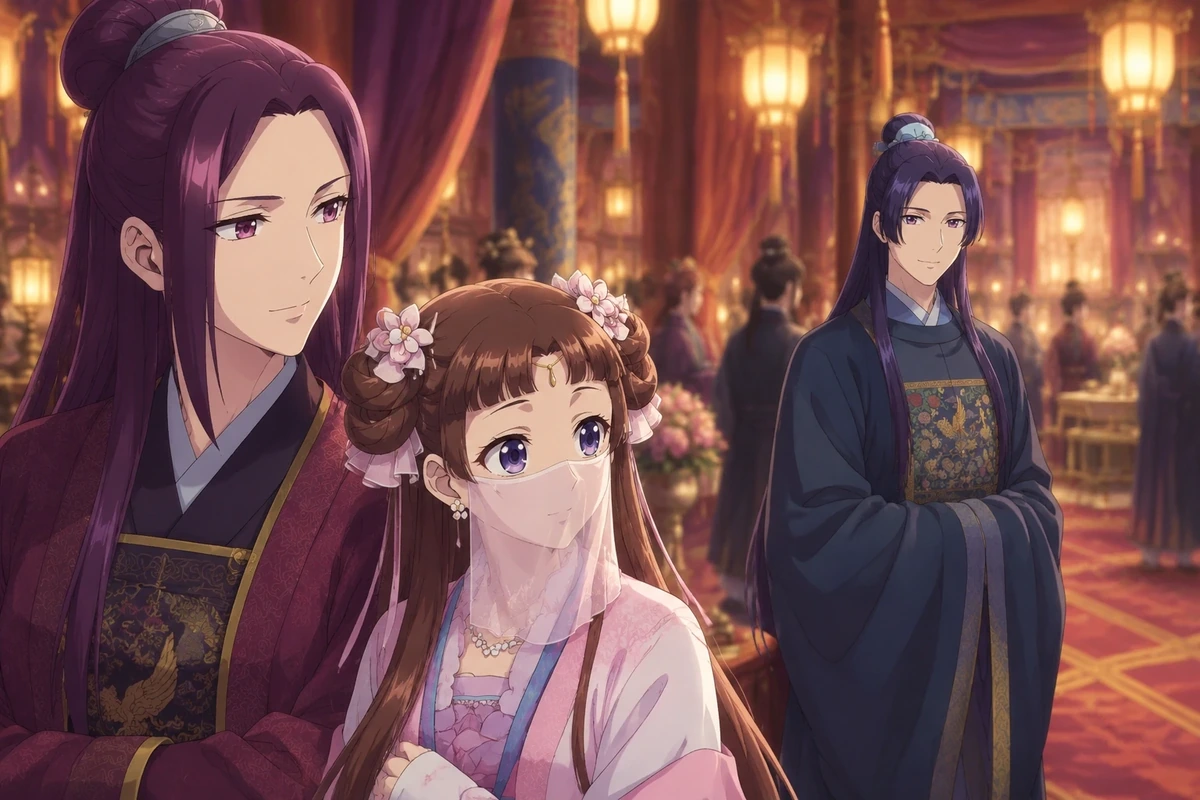
Her interest is visible much earlier. In Volume 5, she travels to the Western Capital, attends the banquet where prospective partners gather around Jinshi, and privately considers whom he might choose. By the time she explains Chue's mission, she has already been watching over this part of his future herself.
But the same chapter places a limit on what she will do for that wish. Ah-Duo offers to help Maomao leave, even though she knows Jinshi cares for her. She refuses to treat another person's freedom as something her son may take simply because it would make him happy.
“Ah-Duo wants Jinshi to always be happy” is the theme of this reading, not a verbatim novel quotation or a promise about the ending. Her order is explicit. The deeper interpretation is that she hopes her son can find lasting contentment without repeating the Emperor's habit of binding the people closest to him.
Scene Locator: Where the Novel Establishes Her Wish
- Volume 5, Chapter 15 and the final chapter: Ah-Duo attends the Western Capital banquet with Lishu. The final chapter turns to her perspective as she considers the possible women in Jinshi's future and decides to watch whom he chooses.
- Volume 12, Chapter 27: Chue discusses her assignment with her master. She identifies the Moon Prince's happiness as her first mission and connects her actions to protecting Maomao, despite the serious injury to her right arm.
- Volume 13, Chapter 14, “Ah-Duo's Truth”: Ah-Duo and Chue explain who Chue serves. Ah-Duo confirms the mission, tells Maomao that Jinshi is her son, offers Maomao a way out, and responds when Chue points out the apparent contradiction.
- The closing pages of Volume 13, Chapter 14: Maomao's practical response changes Ah-Duo's understanding of her. Their discussion ends with Ah-Duo hoping Jinshi will not follow the same path as his father.
Volume 5 shows her personal interest in Jinshi's choice; Volume 12 introduces Chue's unusual assignment; Volume 13 identifies its source and tests its meaning. The later chapter also recalls the Western Capital banquet. Ah-Duo's confession is made to Maomao with Chue present; it is not a scene in which she tells Jinshi directly.
Volume-level entry only. The source is community-hosted; availability and rights status may vary.
Volume-level entry only. The source is community-hosted; availability and rights status may vary.
Volume-level entry only. The source is community-hosted; availability and rights status may vary.
Chue's Mission Makes Happiness a Serious Responsibility
A palace assignment usually has a concrete object: protect someone, deliver information, investigate a threat. Chue's assignment is stranger. Happiness cannot be secured as neatly as a room or a route. In Volume 12, Chapter 27, even the conversation with her master acknowledges how difficult the instruction is to interpret.
That uncertainty gives Ah-Duo's wish its weight. She has not simply asked for Jinshi to survive. She has asked a trusted person to consider the quality of his life. Chue therefore has to judge what matters to him, including people who do not possess his rank. Her conviction that protecting Maomao was the right choice shows one way she interprets the mission.
The novel also makes that protection costly. Chue suffers a grave injury to her right arm. When Ah-Duo meets her again in Volume 13, she recognizes what her obedience has cost. The order is not a sentimental phrase floating above the plot; it operates through someone's labor, judgment, and bodily risk.
Still, Chue's decisions should not all be treated as Ah-Duo's detailed instructions. The mission gives her an objective, not a script for every action. This distinction becomes important when the two women disagree about whether helping Maomao escape can fit that objective.
A Mother Who Cannot Publicly Claim Her Son
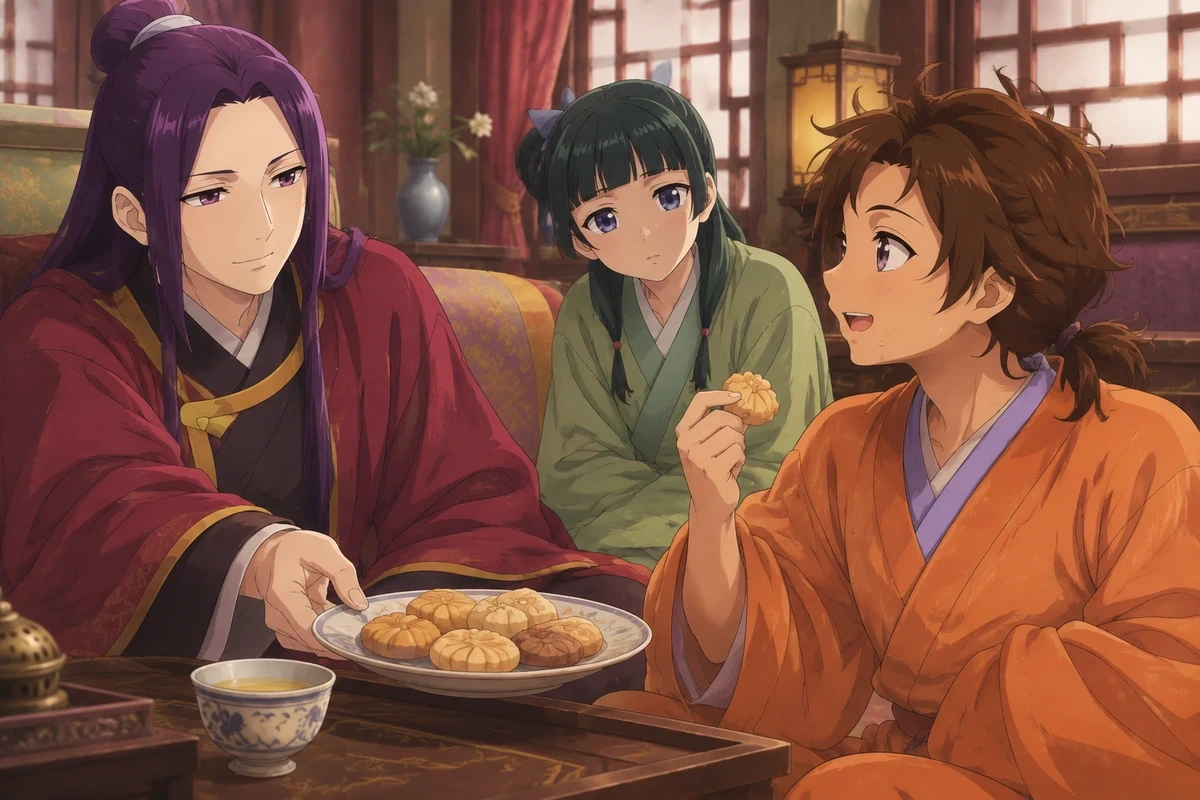
Volume 13, Chapter 14 gives the assignment an unmistakably maternal meaning. Chue explains that Ah-Duo is her real mistress, and Ah-Duo confirms it. The Emperor has instructed Chue to prioritize Ah-Duo's commands. What Ah-Duo chooses to do with that arrangement is direct attention toward Jinshi's happiness.
Ah-Duo then tells Maomao that Jinshi is her biological son. She also confirms the exchange of infants planned with the Empress Dowager. Readers who want the identity evidence in detail can follow the separate analysis of Ah-Duo's direct confession about Jinshi. Here, the consequence for her wish matters most: she cares for a son whose public family relationship differs from the truth.
She cannot simply make the problem disappear by announcing herself. Recognizing Jinshi as the current Emperor's grown son would affect succession, court loyalties, and the position of Gyokuyou's young heir. Maternal recognition and political safety do not line up neatly. The private confession does not resolve that conflict or create a public reunion.
Her arrangement with Chue offers a narrower kind of agency. Ah-Duo can place someone capable near the life she wants to protect, even while she remains outside an ordinary mother-and-son relationship. This makes her distance emotionally different from indifference. The chapter shows continued concern through an actual instruction, rather than asking readers to infer love from silence alone.
She Goes to the Western Capital to See His Possible Partners
Ah-Duo's concern also takes a very recognizable form: she wants to see the people who might become part of her son's life. In Volume 5, she travels to the Western Capital and attends the banquet with Lishu, wearing men's clothing. Around them, richly dressed young women and their families are watching for Jinshi. Ah-Duo is there in person, able to observe the marriage prospects surrounding him.
The final chapter makes that interest clearer by moving into her perspective. She thinks through the women who might enter his future, including a foreign princess, women from Gyokuyou's family, Lishu, Maomao, and Suirei. These are possibilities in her mind, not an official list of approved brides. Her thoughts settle on watching which person Jinshi will choose.
Volume 13, Chapter 14 returns to the same occasion and describes the banquet as something close to a matchmaking event. Ah-Duo remembers that the prospective partners there wanted to become the imperial younger brother's consort. As she understood the situation, choosing one of them would also fulfill that woman's wishes, so she saw no reason to object.
This makes her later response to Maomao more revealing. Once she learns whom Jinshi loves, she feels reassured that he will not be deceived by a malicious woman. Yet knowing Maomao also awakens a different concern: could this young woman lose her freedom as Ah-Duo once did? Her attention expands from whether a partner will be good for Jinshi to whether life beside Jinshi will be good for that partner.
The visit gives her wish a history of personal involvement. She observes, considers, and waits for her son's choice. By Volume 13, that same maternal concern has to make room for Maomao's choice as well. The tension between those two freedoms gives her offer to help Maomao leave its emotional weight.
Why She Offers to Help Maomao Leave
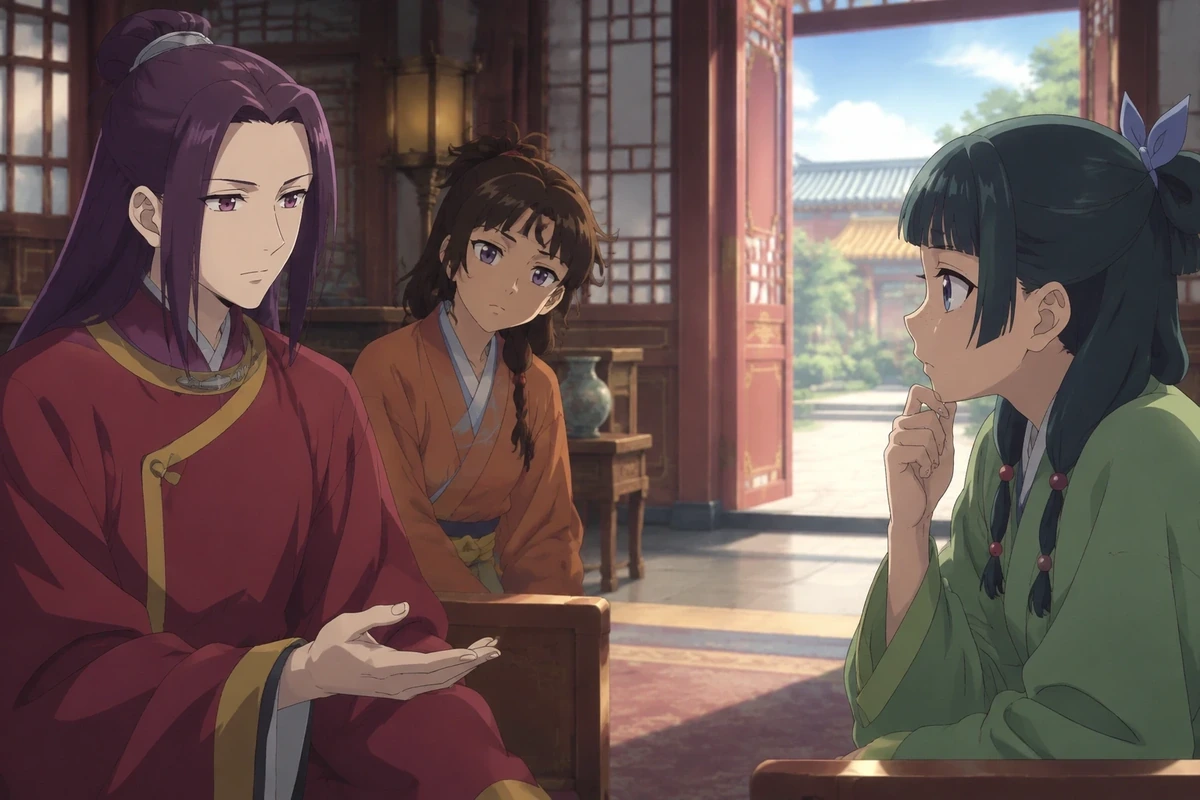
The strongest test of Ah-Duo's love comes when she gives Maomao a choice that could disappoint Jinshi. She explains the restrictions surrounding an intimate connection to someone of his bloodline and offers her help if Maomao wants to get away. The offer is real within the conversation, although the novel does not show an escape being carried out.
Chue immediately notices the problem. If Maomao leaves, how is she supposed to fulfill the instruction to make Jinshi happy? This objection puts the romantic reading of the mission into words: Jinshi wants Maomao, so keeping Maomao near him seems to be the obvious route to happiness.
Ah-Duo rejects that as the only route. Her response is that a man whose life becomes unhappy solely because one woman leaves would be showing very limited resilience; a good servant should look for other ways to support him. This is an original paraphrase of her argument, not a claim that she expects heartbreak to be painless.
She therefore refuses to make Maomao responsible for Jinshi's entire future. Loving him does not require Maomao to surrender every possible life outside his orbit. For the other side of that conversation, see why Ah-Duo fears Maomao will follow her path.
That limit keeps the article's central wish from becoming possessive. Ah-Duo wants happiness for her son, but she does not define it as permanent access to the person he desires. Her willingness to accept his possible disappointment suggests a longer view of his well-being than the immediate success of his romance.
She Wants Jinshi to Avoid His Father's Mistake
Ah-Duo's warning grows out of her own history with the Emperor, whom she calls Yang. She remembers the companionship they shared before their unequal positions determined her future. The friendship she valued could not protect her freedom once a royal demand carried more force than her wishes.
Her account is painful because she understands both sides of that inequality. An emperor is constrained by his role, yet he can also restrict the lives of people close to him. Being trapped himself does not prevent him from becoming the person who traps someone else. Ah-Duo recognizes this pattern in her past and fears its repetition around Jinshi and Maomao.
The chapter ends with her hoping Jinshi will not take the same road as Yang. That is the most precise boundary for interpreting her wish. She is not merely hoping that Jinshi finds someone who will stay beside him. She also hopes he becomes someone whose closeness does not demand another person's confinement.
This does not prove that Ah-Duo has a complete plan for Jinshi to abandon royal life. Nor does it establish that he has already overcome every imbalance with Maomao. It identifies the danger she wants him to avoid. The background is explored further in Ah-Duo's account of how Yang has bound her freedom.
Maomao Gives Her a Different Reason to Hope
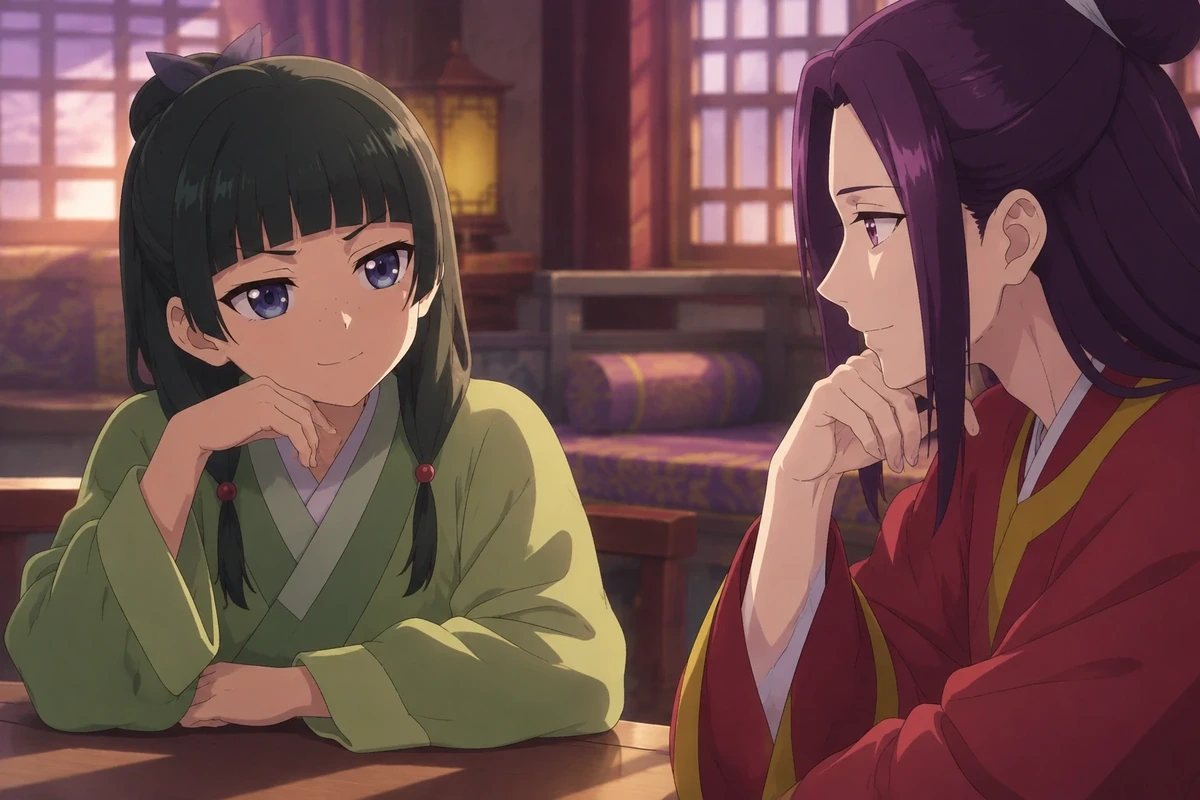
Maomao does not accept the offer to escape. She tells Ah-Duo that she understands the situation and intends to get Jinshi to make concessions, so that she will have less reason for regret later. Her answer is practical rather than a declaration that love has removed the risks.
The conversation then turns to a greenhouse and an orchard. These are suggestions and jokes, not buildings the chapter confirms have been constructed. Their importance is that Maomao can imagine negotiating for things she values. She is neither pretending the constraints are harmless nor treating flight as the only possible response.
Ah-Duo realizes that she has misjudged her. She had projected her own experience onto someone who approaches difficulty differently. Maomao can look for room to act inside a restrictive situation, and Ah-Duo finds the conversation unexpectedly reassuring. The later exchange about jewelry likewise emphasizes that Maomao's priorities remain distinctly her own.
That response gives Ah-Duo hope without giving her certainty. Maomao is choosing the relationship with some understanding of its price, while keeping her own interests in view. For a broader account of how attraction, work, and unequal status interact, see the Jinshi and Maomao relationship analysis.
The scene also changes Ah-Duo's role. She cannot decide Maomao's future any more than she can guarantee Jinshi's happiness. What she can do is make the stakes visible, offer support, and then take the younger woman's answer seriously.
Happiness Is Not the Same as Rank or a Guaranteed Romance
Jinshi's bloodline makes it easy to read every private decision as a move toward power. Ah-Duo's stated mission uses a different measure. She does not tell Chue in these scenes to make him emperor, secure a particular marriage, or obtain public recognition for herself. The objective she names is his happiness.
It would go too far to turn that wording into proof that she opposes every possible succession outcome. The chapters do not provide a complete political program. They do, however, support a distinction between Jinshi's position and Jinshi as a person. A higher title would not automatically answer the concerns she voices about coercion, affection, and freedom.
The same distinction applies to romance. A relationship with Maomao may be deeply important to him, but Ah-Duo will not treat its continuation as an unconditional right. For her wish to have lasting meaning, it must survive the possibility that other people make choices he would not have chosen for them.
“Always” therefore describes the reach of a mother's hope, not the novel's confirmed outcome. These scenes do not announce a wedding, an escape from imperial obligations, or an untroubled future. They show Ah-Duo trying to give Jinshi a better chance at a life that remains worthwhile beyond immediate approval, status, or desire.
Her love is most moving where its power ends. She can give Chue a mission, tell Maomao the truth, and offer assistance. She cannot manufacture lasting happiness for her son. She can only hope that he learns to build it without taking someone else's freedom in exchange.
FAQ
Does Ah-Duo explicitly want Jinshi to be happy?
Yes. In Volume 13, Chapter 14, Chue identifies Jinshi's happiness as the mission Ah-Duo gave her, and Ah-Duo confirms it. Volume 12, Chapter 27 introduces that mission earlier.
Why does Ah-Duo care so much about Jinshi?
She is his biological mother. She confirms this privately to Maomao in Volume 13, Chapter 14. His public identity and the political consequences of the infant exchange prevent that relationship from being straightforward.
Does Ah-Duo personally observe Jinshi's marriage prospects in the Western Capital?
Yes. Volume 5 places her at the banquet and shows her considering his possible partners in the final chapter. Volume 13, Chapter 14 recalls that gathering as a near-matchmaking event and explains why she did not object to the willing prospective partners there.
Why would she help Maomao leave if it could hurt Jinshi?
She does not believe one woman's continued presence should be the sole condition of his happiness. She also fears Maomao could lose her freedom in a way that repeats Ah-Duo's experience with the Emperor.
Does Ah-Duo want to separate Jinshi and Maomao?
She offers Maomao a choice; the scene does not establish a scheme to break them up. Maomao chooses to stay involved and seek concessions, and Ah-Duo recognizes that Maomao's approach differs from her own.
Is “Ah-Duo wants Jinshi to always be happy” a direct quote?
No. It summarizes the theme explored here. The explicit mission concerns making the Moon Prince happy; the wish for an enduring, less restrictive life is the interpretation developed from Ah-Duo's words and decisions.