Spoiler Warning
This article discusses Volume 15 light novel spoilers, including Ah-Duo's childhood friendship with Yang, her loss of freedom in the rear palace, the hidden history connected to Jinshi, and the conversation surrounding the Emperor's operation. Anime-only readers should stop here.
Scene Locator
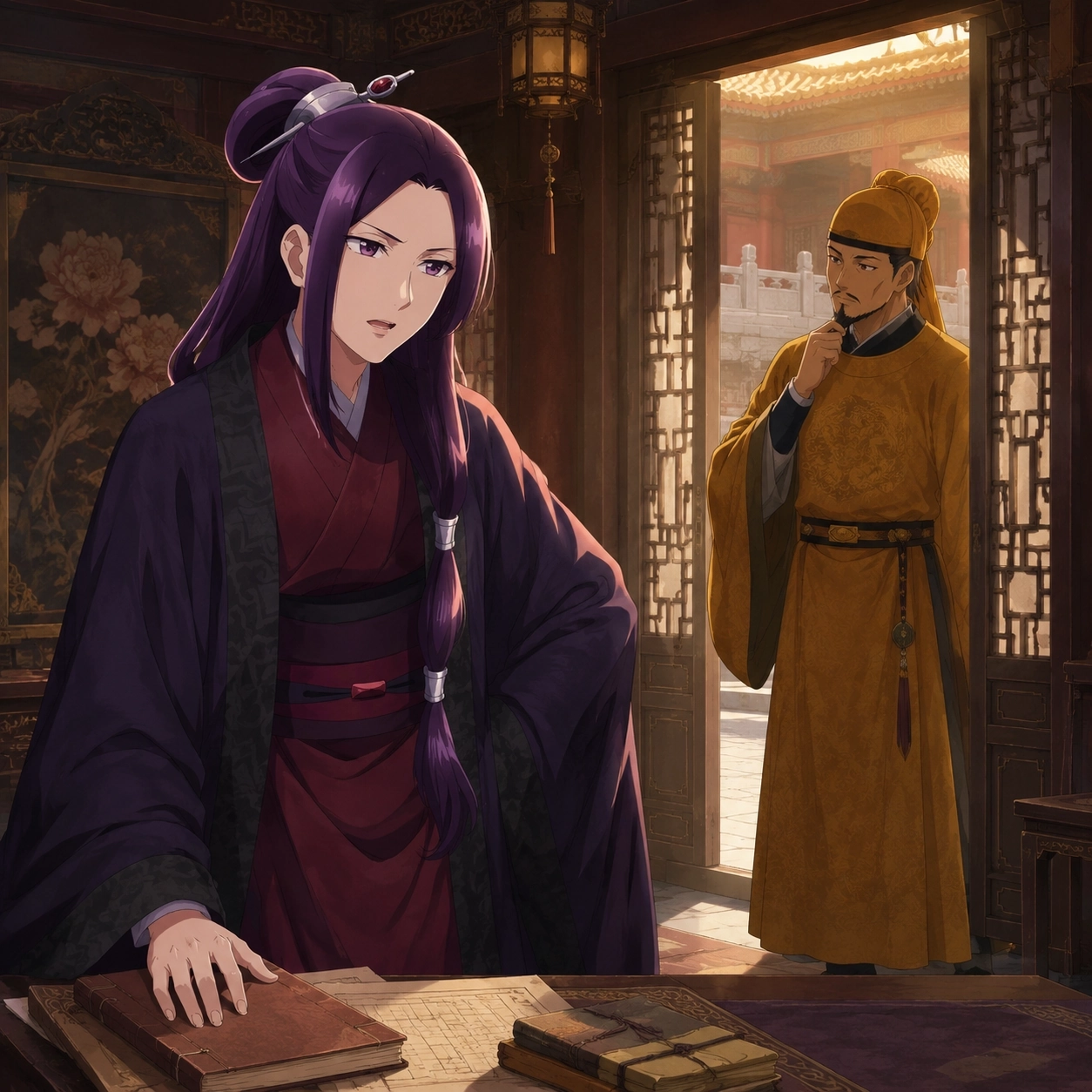
The direct source scene is in Volume 15, Chapter 16, the continuation of the confession sequence. Before the Emperor's operation, Ah-Duo and Yang speak privately after Jinshi and Maomao leave the room. Ah-Duo challenges the way his old promise has kept her tied to the palace.
The local novel text makes the setting unusually clear: Ah-Duo remembers that becoming the prince's attendant meant losing the ability to continue as a merchant and even losing the freedom to step outside the rear palace. She also explains that she had no power to summon Yang; she could only wait for the Emperor to summon her.
For the connected parentage thread, read Ah-Duo's confession about Jinshi. For the silence that survives between Ah-Duo and Jinshi, see why Jinshi and Ah-Duo never have a direct conversation.
Volume-level entry only. The source is community-hosted; availability and rights status may vary.
The Short Answer
Ah-Duo Is Complaining About a Power Imbalance
When Ah-Duo says that Yang has always bound her freedom, she is not claiming that he never cared for her. The opposite is part of the pain. Yang treated her well, protected her material life, and continued to look after her after she left the rear palace. Yet his care existed inside a hierarchy in which he could decide her role, summon her, and keep her from simply walking away.
Ah-Duo and Yang began as friends. In the scene's own logic, Yang was once a boy and Ah-Duo was one person among other people. After he became the Emperor, he became the court's "Heaven," while she remained a person whose life was shaped by his decisions. The same relationship could therefore feel warm in private and coercive in structure.
That is the meaning of the complaint. Yang's affection did not cancel the fact that his position made ordinary freedom impossible for Ah-Duo.
The Friendship Came Before the Palace Role
Ah-Duo's memory of her younger life is important because it gives her complaint a clear baseline. She had imagined a future in which she could work as a merchant. She did not dream of becoming the Emperor's grand romantic reward; she wanted a life in which she could move, trade, and keep an equal friendship with the person she had known before the throne.
The court changed the terms without changing the emotional memory. Once Ah-Duo entered the role of a consort, her body and movement became part of palace administration. Her friendship with Yang could no longer operate as a private bond between two children. It was now surrounded by rank, succession, and the expectation that she would remain available.
Yang's Kindness Is Not the Same as Freedom
One reason Ah-Duo's anger is easy to misunderstand is that Yang is not indifferent to her. The novel says that he arranged her life carefully, made sure she had food and shelter, and continued to care for her after her departure from the rear palace. From the Emperor's perspective, that may look like proof that he never abandoned her.
From Ah-Duo's perspective, however, being provided for is not the same as being allowed to choose. Yang could give her almost anything, but he could not give her the ordinary access that friends take for granted. He could be generous while still being the only person who controlled the door between them.
This distinction is central to the scene's emotional precision. Ah-Duo is not denying Yang's kindness. She is refusing to let kindness erase the cost of dependence.
The Promise Became a Form of Control
The old promise is the mechanism that keeps returning in their conversation. Yang has tried to keep it, but his idea of keeping a promise assumes that Ah-Duo will remain where he can protect her. Ah-Duo understands that the promise has become a reason for him to postpone the moment when she might finally choose another life.
She therefore describes the gap between intention and result. Yang may think he is preserving their bond. Ah-Duo experiences the same preservation as an enclosure. He is trying not to lose her, while she is trying to explain that never being allowed to leave is already a kind of loss.
The complaint becomes sharper because Yang is the Emperor. A private promise backed by an ordinary friend can be negotiated. A promise backed by the ruler's authority can shape an entire lifetime, even when the ruler believes he is acting out of care.
Recognition and freedom also diverge in the promise of a higher title. Our reading of Ah-Duo’s unfulfilled future as empress connects the Emperor’s old promises with her concern for Jinshi and Gyokuyou in Volume 15. Includes spoilers beyond this scene.
This Is Not a Simple Love Story
Ah-Duo's own words keep the relationship from becoming a conventional romance. She calls Yang a friend and speaks to him like the younger companion she once knew. She can tease him, pull his beard, argue with him, and still tell him that he has done her wrong. Familiarity makes the confrontation possible; it does not turn the relationship into a love story.
The pain comes from the fact that friendship was the dream. Ah-Duo wanted to stay beside Yang without becoming an imperial instrument. Her complaint is therefore about the destruction of equality, not about failing to obtain a romantic future.
This also explains why she speaks so directly about the practical consequences of becoming a court woman. The loss is measured in work, movement, and the right to initiate contact. Those are freedoms a romantic reading can overlook, but they are the freedoms Ah-Duo is naming.
Jinshi and Maomao Make the Question Visible
Jinshi and Maomao are present because Ah-Duo is testing whether the same structure might repeat itself. She wants to know whether Jinshi will treat Maomao as a person who can decide her own future or as someone whose closeness can be secured by rank and obligation.
Her concern is not that Jinshi is identical to Yang. The point is that a sincere feeling can still become dangerous when it is carried by imperial power. Ah-Duo's history gives Maomao a warning before the palace turns a private attachment into a permanent arrangement.
That warning connects naturally to Ah-Duo's explanation of why her dream was shattered at fourteen and to the later questions around how the Emperor treats Jinshi.
What Ah-Duo Keeps for Herself
Ah-Duo does not finish the conversation by escaping. She withdraws the old promise on her own terms, but she still chooses to remain for the people who depend on her. The children and vulnerable people under her protection are part of the reason that freedom cannot be reduced to simply walking through a gate.
That choice does not disprove her complaint. It shows how limited choices become once the palace has made a person responsible for everyone around her. Ah-Duo can reject one agreement and still carry duties that make departure impossible.
Her later protection of younger women follows the same pattern. Her relationship with Lishu is easier to understand when read beside Ah-Duo and Lishu's protective connection. Her arrangement with Suirei likewise shows how shelter and surveillance can exist together; compare why Ah-Duo keeps Suirei close.
What the Complaint Reveals About Yang
Yang is not best read as a flat villain who consciously planned every restriction. The text gives him fear, attachment, confusion, and genuine care. It also gives him the power to turn those feelings into rules that another person must live under.
That combination is what makes Ah-Duo's complaint strong. She is asking him to recognize that good intentions do not change the effect of unequal power. He may have wanted to keep a friend. He still kept her inside a life she could not freely leave.
Common Misreadings
Does Ah-Duo hate Yang?
No. She says that she has reason to resent him, but the scene is built from familiarity, grief, and an old friendship. Her anger is evidence that she still expects him to understand her, not proof that she feels nothing for him.
Is Yang's care proof that Ah-Duo was free?
No. Material protection and freedom are different things. The Emperor can keep Ah-Duo safe and comfortable while still controlling access, movement, and the terms of her public life.
Is this the same as Ah-Duo loving the Emperor?
The scene does not require that reading. Ah-Duo's language centers friendship. The tragedy is that the court destroys the equality of that friendship by placing one friend above the other as ruler and subject.
Why does the complaint matter to Maomao?
Because Maomao is close to Jinshi, Ah-Duo uses her own history to show what imperial attachment can cost. The warning asks Maomao to judge the relationship by the freedom it preserves, not only by the sincerity it displays.
FAQ
Who is Yang in this article?
Yang is the personal name used for the Emperor in this scene's context. The public role remains the Emperor, and that role is exactly what gives his care the power to restrict Ah-Duo.
Which volume contains Ah-Duo's complaint about freedom?
The direct conversation is in Volume 15, Chapter 16, in the continuation of the confession sequence around the Emperor's operation.
What freedom did Ah-Duo lose?
She lost the ability to continue her own merchant future, leave the rear palace freely, and contact Yang on equal terms. The Emperor could summon her, but she could not simply summon him.
Does Ah-Duo leave Yang after this conversation?
Not completely. She rejects the idea that remaining must be treated as proof of a promise, but she chooses to stay because other people depend on her. Her decision is constrained agency, not proof that the earlier loss never happened.