Spoiler Warning
This article discusses light novel events through Volume 16, including Maomao's medical-assistant qualification, the Hua Tuo's Book sequence in Volume 9, the Emperor's operation in Volume 15, and her continuing clinical work. Anime-only and manga-only readers should stop here.
Scene Locator
The transition begins institutionally in Volume 7, Chapters 1-4, when Maomao passes the examination for a medical officer's personal attendant and starts working as a medical assistant. Volume 9, Chapters 2-6 clarifies her limits and places Hua Tuo's Book at the center of her need for anatomical and surgical knowledge. Volume 15, Chapters 18-20 shows her clinical judgment and assistance during the Emperor's operation. Volume 16 continues to identify her as a medical assistant while showing her taking on real patient-facing work.
These are separate stages, not one scene renamed several times. The Hua Tuo's Book analysis focuses on the Volume 9 test, while the Emperor's surgery analysis focuses on Volume 15.
Volumes 7, 9, and 15 use Archive.org community-hosted volume entries. Volume 16 uses a temporary community-hosted FlipHTML5 source because an Archive.org Volume 16 entry is not currently available. Availability and rights status may vary.
The Short Answer
Yes, Maomao is moving from an apothecary-centered role toward clinical medicine. But “transition” is more accurate than “career change.” She becomes a medical assistant, learns to work inside a medical office, develops diagnostic judgment, studies anatomy, assists in major treatment, and helps with surgery and recovery.
She does not become a fully independent senior physician in the text. Her strongest foundation remains crude drugs and internal medicine. The novel repeatedly shows her knowing what she can do, what she has only learned informally, and when an experienced physician or a more technically skilled assistant must take over.
Volume 7: A Formal Medical Role
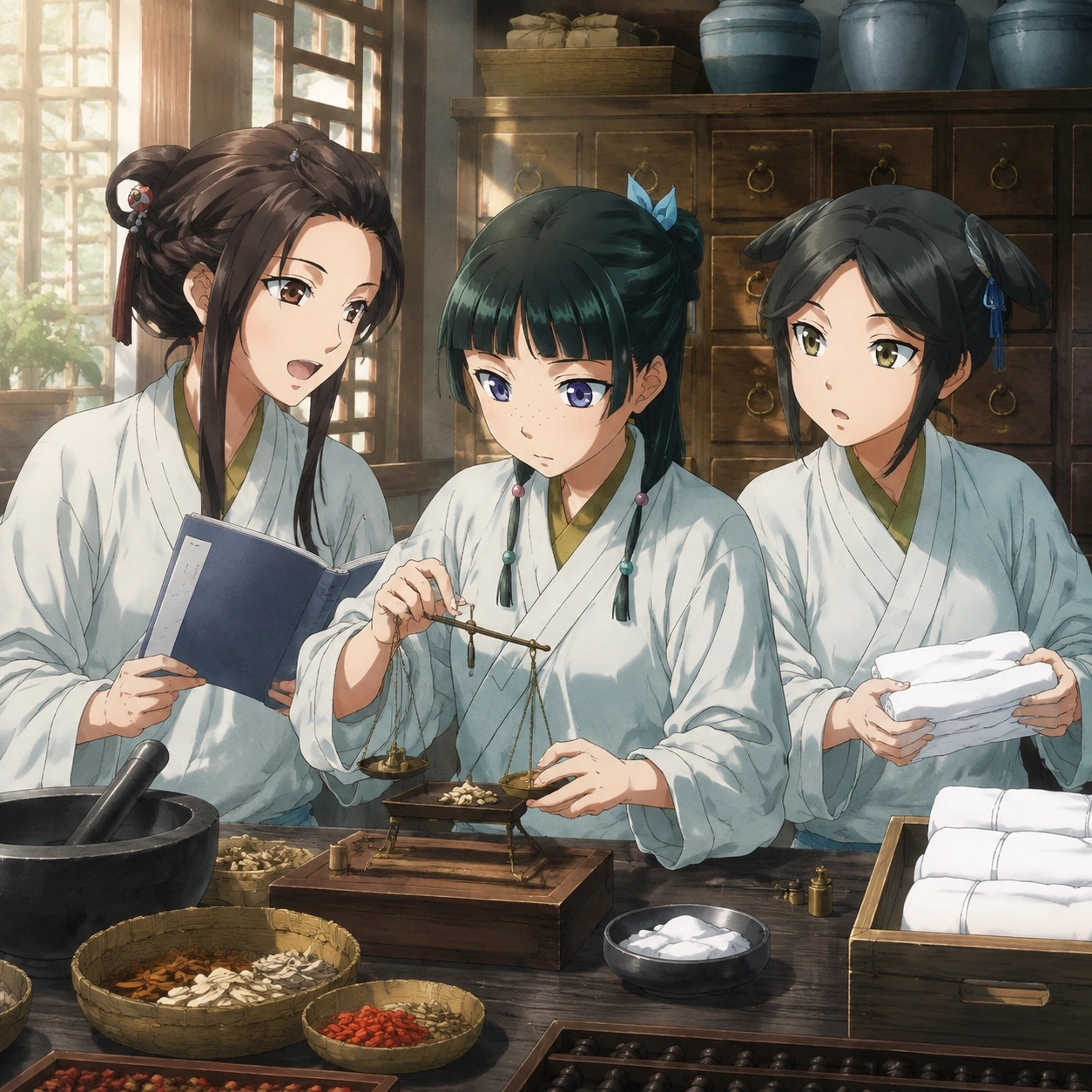
Volume 7 gives Maomao's development an official shape. She passes the newly established examination for a medical officer's personal attendant and joins the medical office as a medical assistant. This is not merely a change in title. It changes the setting in which her knowledge is used.
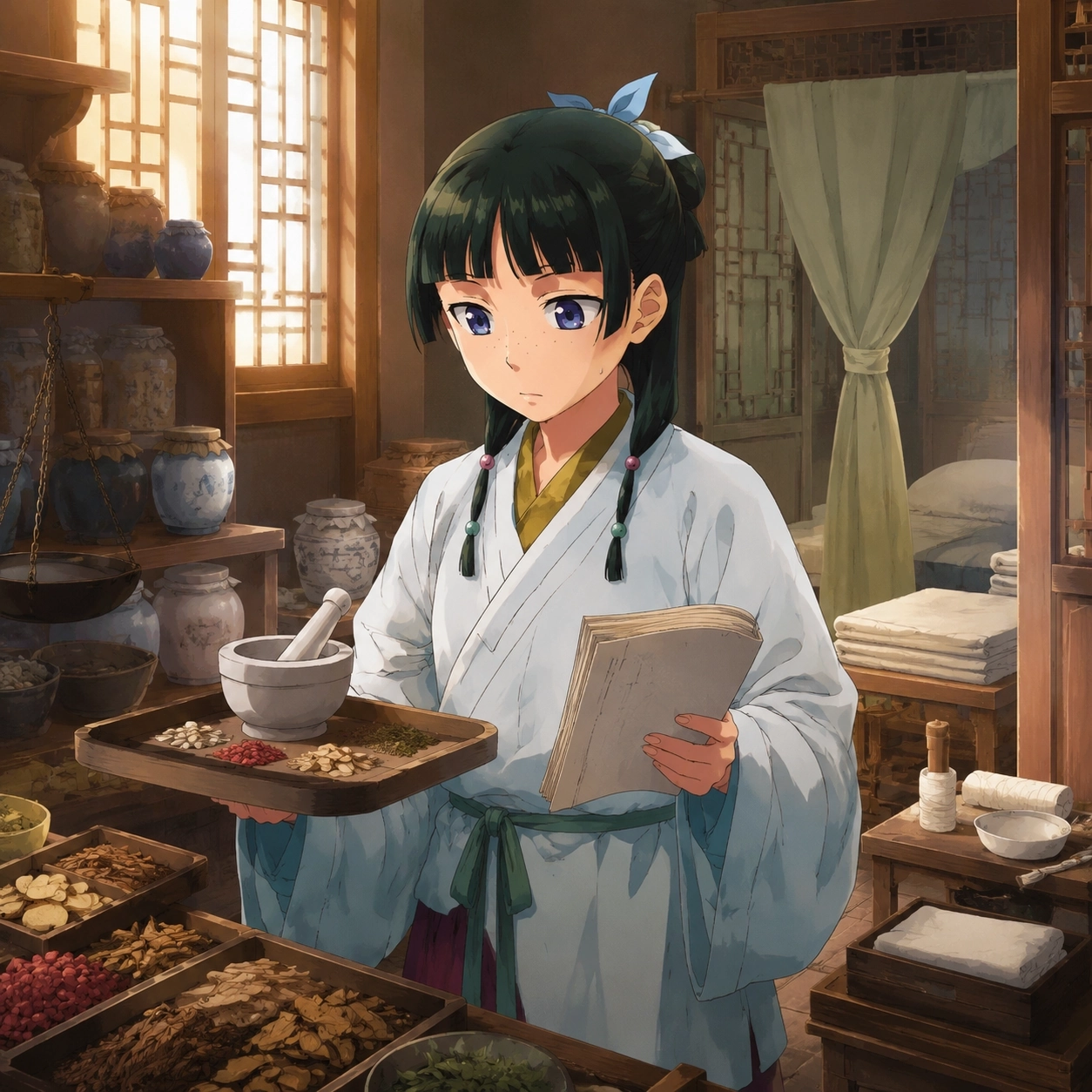
Before this point, Maomao's reputation comes from practical apothecary work, poison knowledge, observation, and problem-solving. In the medical office, she has to operate within a team. She washes and prepares clean cloth, compounds simple crude drugs, treats minor injuries, and follows the division of labor set by senior physicians.
Her Knowledge Becomes Accountable Work
An apothecary can work through ingredients and effects in a relatively self-contained way. A medical assistant must also consider patients, records, authority, colleagues, and the consequences of acting beyond her permission. Maomao's medical growth begins when her ability is no longer only her own resource; it becomes a responsibility assigned inside an institution.
Her new position also places her beside Yao and En'en. Their shared work makes medicine less like Maomao's private experiment and more like a profession with procedures, hierarchy, and people who depend on one another.
The Limits of Her Authority
The novel is unusually clear about what Maomao is not yet. She asks how much authority her position carries, and the answer is narrow: simple medicine and light injuries are within her ordinary work, while severe illness and serious cases go to experienced physicians.
Maomao later describes her own specialty just as clearly. Her main field is crude drugs and internal medicine. She can perform some external treatment when circumstances demand it, but her surgical knowledge is largely learned by watching and assisting rather than through a complete formal apprenticeship.
Knowing the Boundary Is Part of Being a Doctor
This limitation does not weaken her development. It makes the development credible. Maomao does not treat every successful improvisation as proof that she is qualified for everything. She notices the difference between saving someone in an emergency and possessing the training to take responsibility for a difficult procedure as a matter of routine.
That self-assessment is one reason her path resembles a doctor in training more than a sudden promotion. She is accumulating judgment along with technique.
Volume 9: Learning What Surgery Requires
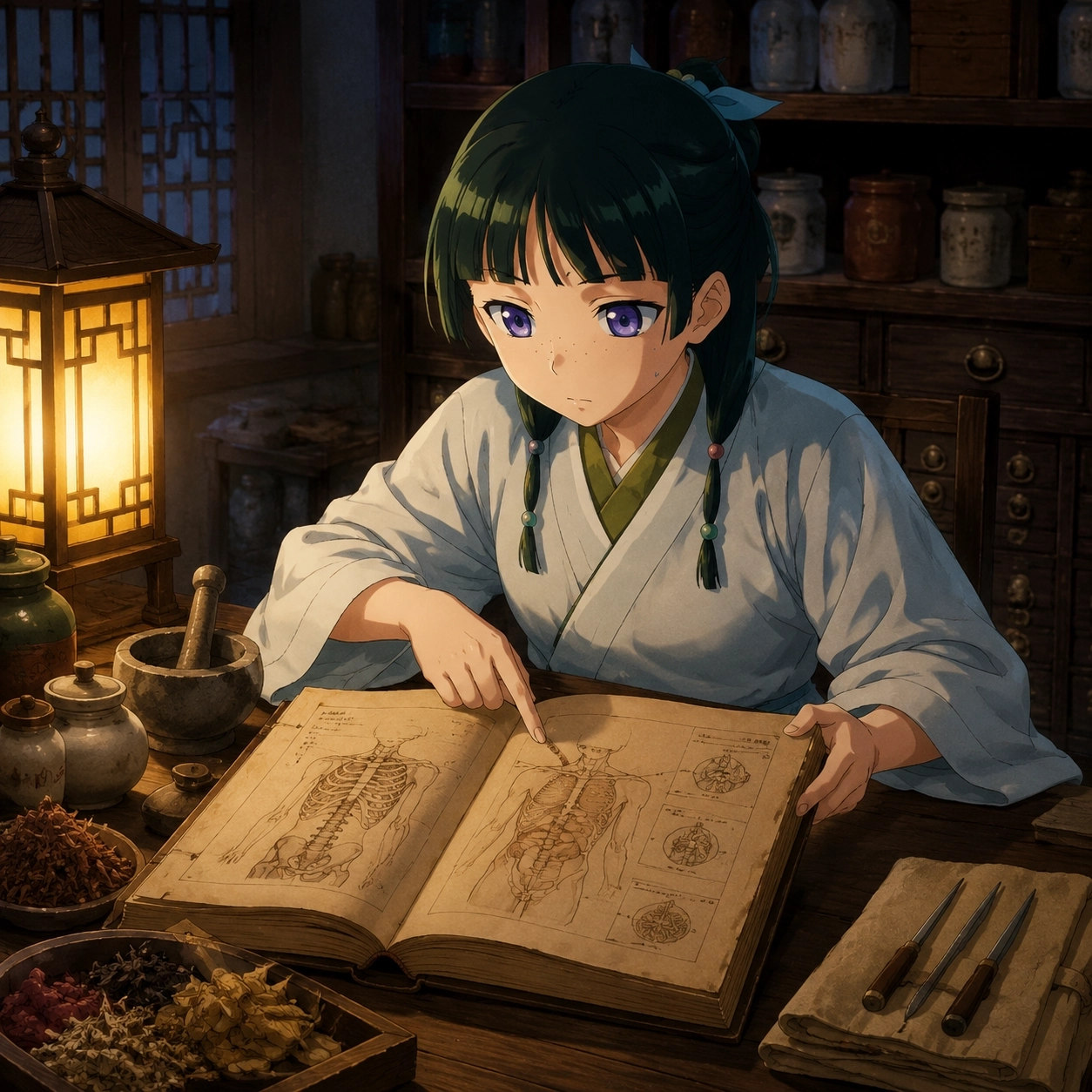
Volume 9 supplies the intellectual bridge between apothecary work and broader medicine. In the Hua Tuo's Book sequence, Maomao confronts anatomical knowledge, dissection, and the social danger attached to learning how the body is structured from the inside.
The book matters because medicine cannot remain only a list of substances and symptoms. To understand difficult cases, a practitioner needs some account of organs, injuries, and the relationship between visible signs and hidden damage. Maomao's curiosity makes her receptive to this knowledge, but the test also forces her to recognize its ethical and political cost.
The Book Does Not Instantly Make Her a Surgeon
Accepting anatomical knowledge is not the same as mastering surgery. The Volume 9 material expands what Maomao can understand and what she knows she must learn. It gives direction to her medical ambition without erasing the gap between a book, observation, supervised practice, and independent authority.
This is why the book belongs in the story of her transition. It changes the ceiling of her thinking. Maomao can no longer pretend that her apothecary specialty is enough for every patient, especially when a case involves structural injury or an operation.
Volume 15: Clinical Judgment Under Pressure
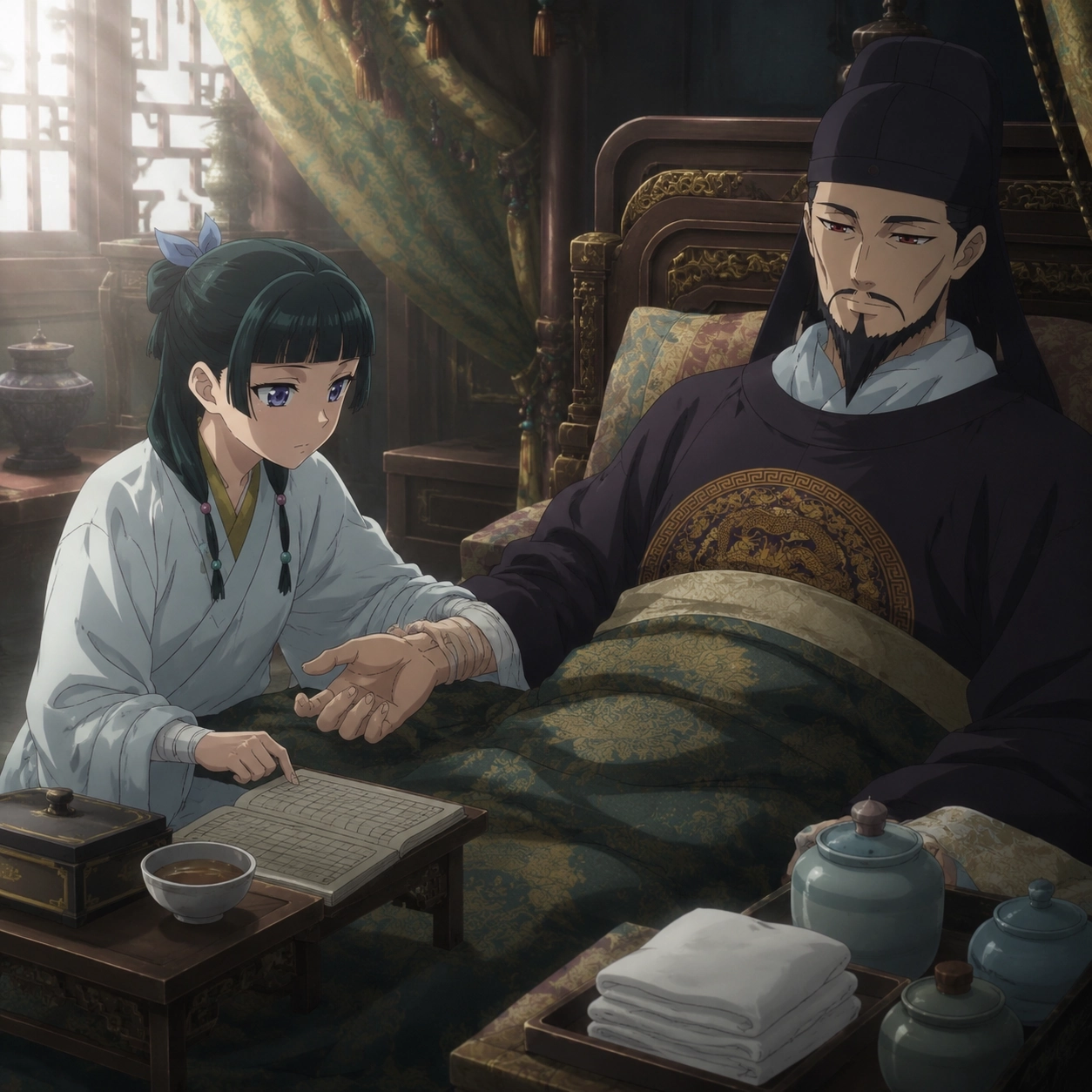
The Emperor's illness shows how far Maomao has moved beyond simply preparing medicine. When his pain disappears unusually quickly, she does not accept relief as automatic proof of recovery. She considers the possibility that the appendix has ruptured and that the apparent improvement is a warning.
That is a clinical act: she connects timing, symptoms, anatomy, and risk, then communicates the consequence to the people responsible for treatment. Her judgment helps move the operation forward before the abdominal contamination becomes even more dangerous.
She Works Inside the Surgical Team
During the operation, Maomao prepares medicines and clean materials, supports Luomen when he takes over, and remains attentive to the work still required. When closure becomes necessary, she prepares to suture, but her arm has lost sensation after holding Luomen upright. She recognizes that forcing the task would put the patient at risk.
Tianyu completes the suturing, while Maomao assists and observes. Later, she joins postoperative care. Her contribution is therefore clinical from beginning to end: preparation, warning, assistance, restraint, and recovery.
Why Maomao Is Not Yet the Main Surgeon
Calling Maomao “the doctor who performed the Emperor's surgery” would flatten the scene into a misleading achievement claim. Physician Liu begins the procedure. Luomen removes the diseased appendix after Liu is injured. Tianyu completes the final suturing. Maomao is indispensable, but she is not the person who performs every surgical step.
This distinction actually strengthens the character arc. A doctor is not defined by taking over every task. Maomao proves her maturity by identifying the urgent problem, helping the right specialist continue, and yielding the final closure when her own hand is not reliable enough.
Her Strength Is Hybrid
Maomao's value comes from the combination of skills that the other members do not share in exactly the same way. She understands drugs and contamination, notices patterns, tolerates unpleasant evidence, and can translate a change in symptoms into an actionable warning. Surgery makes those skills more visible; it does not replace them.
In that sense, she is developing into a hybrid clinician: an apothecary who can diagnose, assist, and learn procedures while still thinking first through medicines and the body's response to them.
Volume 16: The Role Continues
Volume 16 prevents an easy conclusion that the transition has already finished. Maomao is still referred to as a medical assistant, yet she is trusted to see patients, support the medical office, and take responsibility when senior physicians are away or unavailable.
She can examine a patient, notice a possible poisoning or infectious threat, and coordinate with more experienced practitioners. Her growing authority is practical before it is formal. The title remains behind the ability, which is consistent with the series' interest in the difference between competence and social permission.
From Private Skill to Public Care
The most meaningful change is not that Maomao suddenly wants prestige. She remains skeptical of status. What changes is the range of people she is willing and able to care for. Her apothecary knowledge increasingly serves diagnosis, treatment planning, surgical support, and follow-up care rather than isolated experiments or palace puzzles.
What the Transition Really Means
She Is Expanding, Not Replacing, Her Identity
Maomao's path is not “apothecary first, doctor later” in the sense that one identity disappears. Her drug knowledge is the reason she notices details other practitioners may miss. It gives her a practical understanding of dosage, ingredients, contamination, and adverse effects. Clinical medicine gives that knowledge a wider field of responsibility.
Luomen's Influence Remains Visible
Luomen's approach helps explain the direction of her growth. He combines deep medical knowledge with awareness of the danger surrounding the profession. Maomao's movement toward diagnosis and surgery is therefore not a rejection of his apothecary education. It is an extension of what he taught her, including the humility to know where her training ends.
Her Progress Is Measured by Judgment
The strongest evidence of development is not a dramatic instrument or a new title. It is Maomao's judgment: she investigates instead of guessing, prepares before acting, asks for authority, learns from specialists, and stops when continuing would be unsafe. Those habits make her increasingly doctor-like while keeping the character's original intelligence intact.
Her growth also changes her relationship with her first teacher. Will Maomao take Luomen's place? examines the medical judgment and responsibility she is beginning to inherit, while distinguishing that legacy from an official appointment. Includes novel spoilers through Volume 16.
Conclusion
Maomao is indeed transitioning from an apothecary toward a doctor-like clinical role, but the light novel presents that change as a gradual expansion. Volume 7 gives her a formal medical-assistant position. Volume 9 forces her to confront anatomy and the knowledge surgery requires. Volume 15 proves that she can make a decisive clinical judgment and function inside a high-risk operation. Volume 16 shows that this work continues even though her official status remains that of a medical assistant.
The fairest description is that Maomao is becoming a pharmacology-based clinician: a practitioner whose apothecary foundation now supports diagnosis, treatment, surgical assistance, and postoperative care. She has not abandoned who she was. She is learning how much more that foundation can do.
FAQ
Is Maomao officially a doctor?
Not in the sense of becoming a senior independent physician. The novel continues to identify her as a medical assistant, even while she performs increasingly advanced clinical work.
When does Maomao become a medical assistant?
In Volume 7, she passes the examination for a medical officer's personal attendant and begins formal work in the medical office.
Does Maomao perform the Emperor's surgery?
No. She detects the rupture warning, prepares materials, supports Luomen, assists the team, and joins postoperative care. Physician Liu begins, Luomen removes the appendix, and Tianyu completes the suturing.
Why is Hua Tuo's Book important to her development?
The Volume 9 book introduces anatomical and surgical knowledge that extends beyond her original apothecary specialty. It expands her understanding, but it does not instantly qualify her as a surgeon.
What kind of doctor could Maomao become?
The text points toward a hybrid practitioner grounded in pharmacology and internal medicine, with growing skills in diagnosis, clinical care, and necessary surgery.
Which related articles should I read?
Start with the Hua Tuo's Book analysis for the Volume 9 knowledge threshold and the Emperor's surgery analysis for her Volume 15 clinical role.
Continue the character discussion