Spoiler Warning
This article covers the Emperor's illness and operation in Volume 15, including the suspected ruptured appendix, the surgical team's mid-operation crisis, and the political consequences if the Emperor died. Anime-only and manga-only readers should stop here.
Scene Locator
The medical and political setup begins in Volume 15, Chapter 6, when the Emperor's chronic abdominal condition returns and his possible death is treated as a succession emergency. Chapters 11-12 form the special surgical team and explain the risks. Chapter 18 contains Maomao's decisive warning that the appendix may already have ruptured. Chapters 19-20 cover the operation and immediate recovery.
The closest companion articles are who could replace the Emperor if he suddenly died and why Maomao had to accept Hua Tuo's Book. The first explains the succession stakes; the second explains why anatomical knowledge could no longer remain merely forbidden knowledge.
Volume-level entry only. The source is community-hosted; availability and rights status may vary.
The Short Answer
The Emperor's surgery had to succeed because his life held the court's current balance together. His death could place the young Crown Prince on the throne under a regency or make Jinshi the only immediately usable adult royal alternative. Medically, Maomao mattered because she prepared medicines and sterile materials, recognized that the sudden disappearance of pain could signal rupture rather than recovery, supported Luomen when he took over the operation, and assisted Tianyu during closure.
She was not the primary surgeon. Physician Liu began the procedure, Luomen removed the diseased appendix after Liu was injured, and Tianyu completed the suturing. Maomao's importance lies in observation, readiness, physical support, and clinical judgment rather than in receiving credit for work performed by the surgeons.
Why Failure Was More Than a Medical Risk
The Throne Could Not Absorb a Sudden Death Cleanly
The Emperor has heirs, but they do not offer a simple transition. The Crown Prince is still a child. His accession would require adults to rule around him, turning treatment failure into a contest over regency, access, and factional influence. The novel has already shown how dangerous a court becomes when a child's title is stronger than his practical authority.
Jinshi creates the second pressure point. His real place in the imperial family makes him an adult option even though he has repeatedly resisted becoming the successor. That is why the operation also belongs beside the question of whether the Emperor treats Jinshi as a brother or a son. Saving the Emperor protects Jinshi from being pushed into a role through catastrophe.
Medical Failure Would Become Political Accusation
An operation on the sovereign also exposes every participant. A poor outcome would not be treated like an ordinary clinical failure. Physicians, assistants, guards, and the people who approved an unfamiliar procedure could all become targets for blame. The team therefore has to succeed medically while surviving the court's need to assign responsibility.
Maomao's Actual Assignment
When the special team is assembled in Chapter 11, Maomao's defined responsibilities center on crude drugs and postoperative observation. She also receives the explanation needed to serve as an assistant if required. This fits her abilities: she understands medicines, notices physiological changes, and can keep working when a case becomes unpleasant.
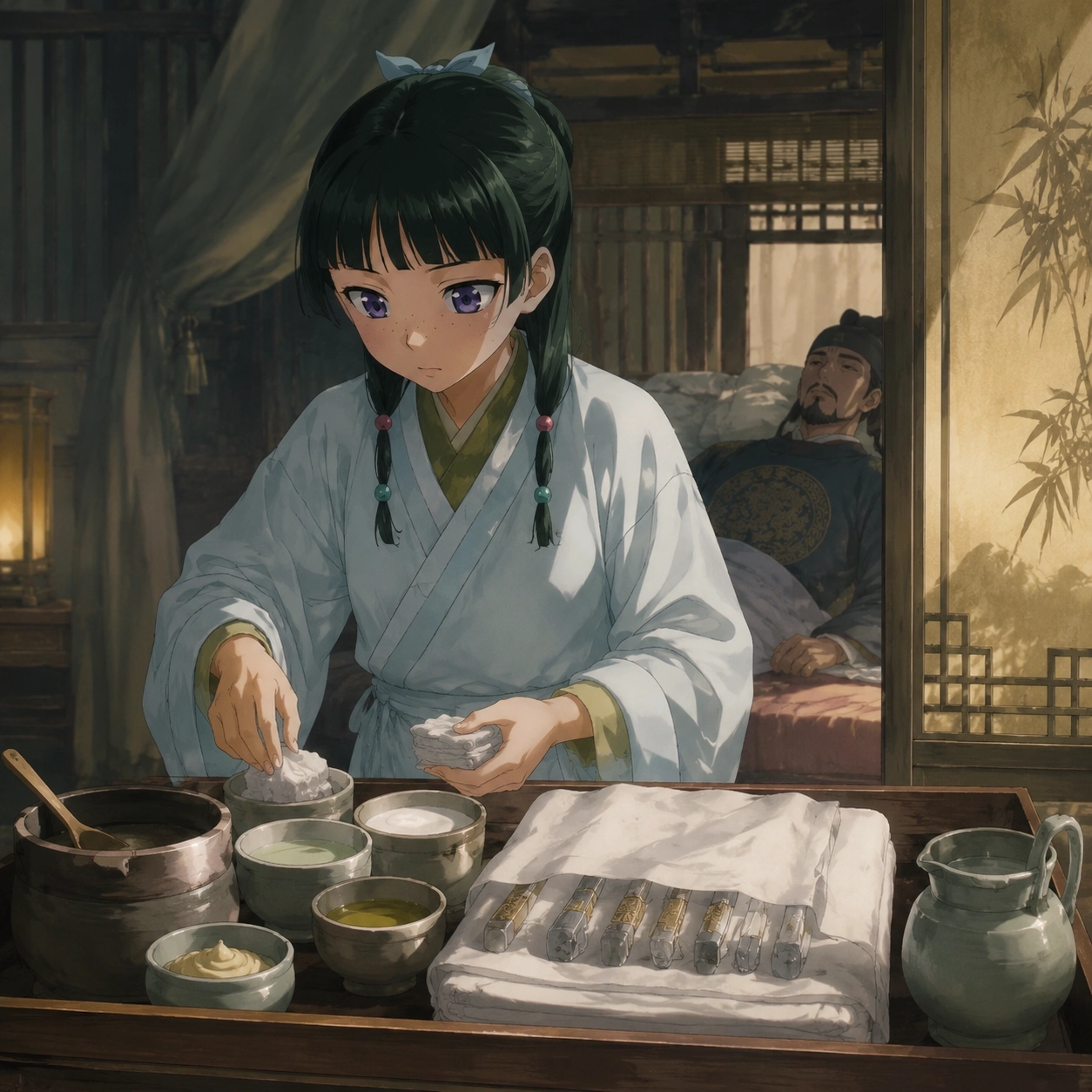
Before the operation, she prepares ointment, boiling water, clean white cloth, and the recovery room. These tasks may look less dramatic than cutting, but abdominal surgery cannot succeed through technique alone. Contamination, insufficient supplies, or poor postoperative care could kill the patient after the diseased tissue had been removed.
Preparedness Is Part of the Surgery
Maomao's contribution begins before anyone picks up a blade. Her work turns an improvised palace procedure into something closer to a controlled operation: useful medicines ready, cloth boiled, space prepared, and the patient's condition watched closely enough for a change in timing to be noticed.
The Warning Sign Maomao Caught
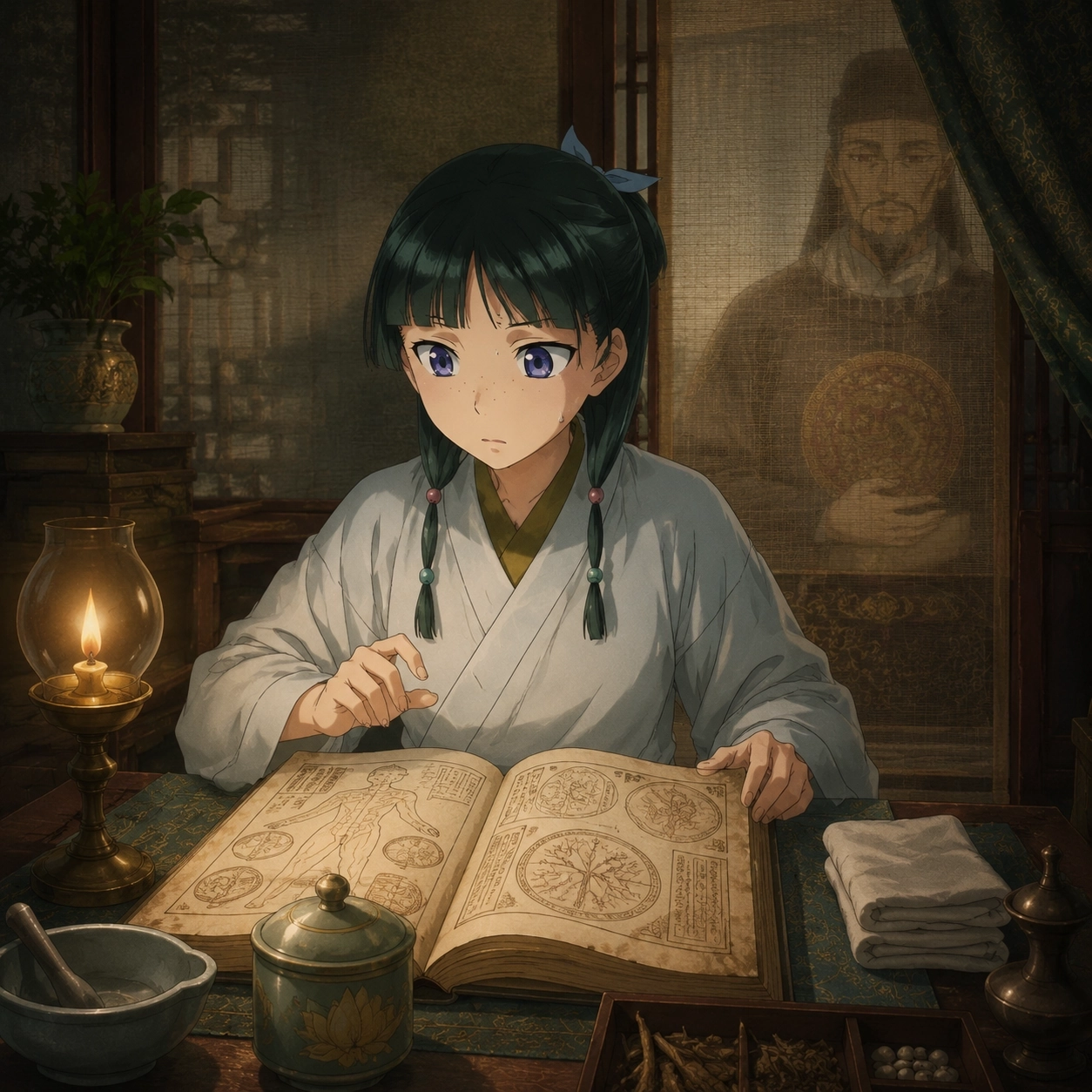
The most important diagnostic moment arrives when the Emperor's pain fades faster than expected. Relief could be mistaken for improvement. Maomao instead checks the anatomical knowledge preserved in Hua Tuo's Book and considers the more dangerous explanation: the inflamed appendix may have ruptured.
That possibility changes the schedule immediately. A ruptured appendix can spread contamination through the abdomen, so waiting is no longer the cautious choice. Maomao reports the concern, the operation is moved forward, and more gauze is prepared. Her value here is not supernatural certainty. It is the discipline to distrust a convenient improvement when the disease pattern points elsewhere.
This is the practical payoff to the earlier medical taboo explored in the Hua Tuo's Book analysis: anatomical knowledge gives Maomao a way to interpret a symptom that surface observation alone could misread.
How the Operation Nearly Collapsed
Physician Liu begins as the principal surgeon, with Luomen present to supervise. The plan fails in motion rather than on paper. When the Emperor moves under insufficient anesthesia, the confusion leads to Physician Liu's right hand being injured by an assistant. The team suddenly loses the person expected to continue the procedure.
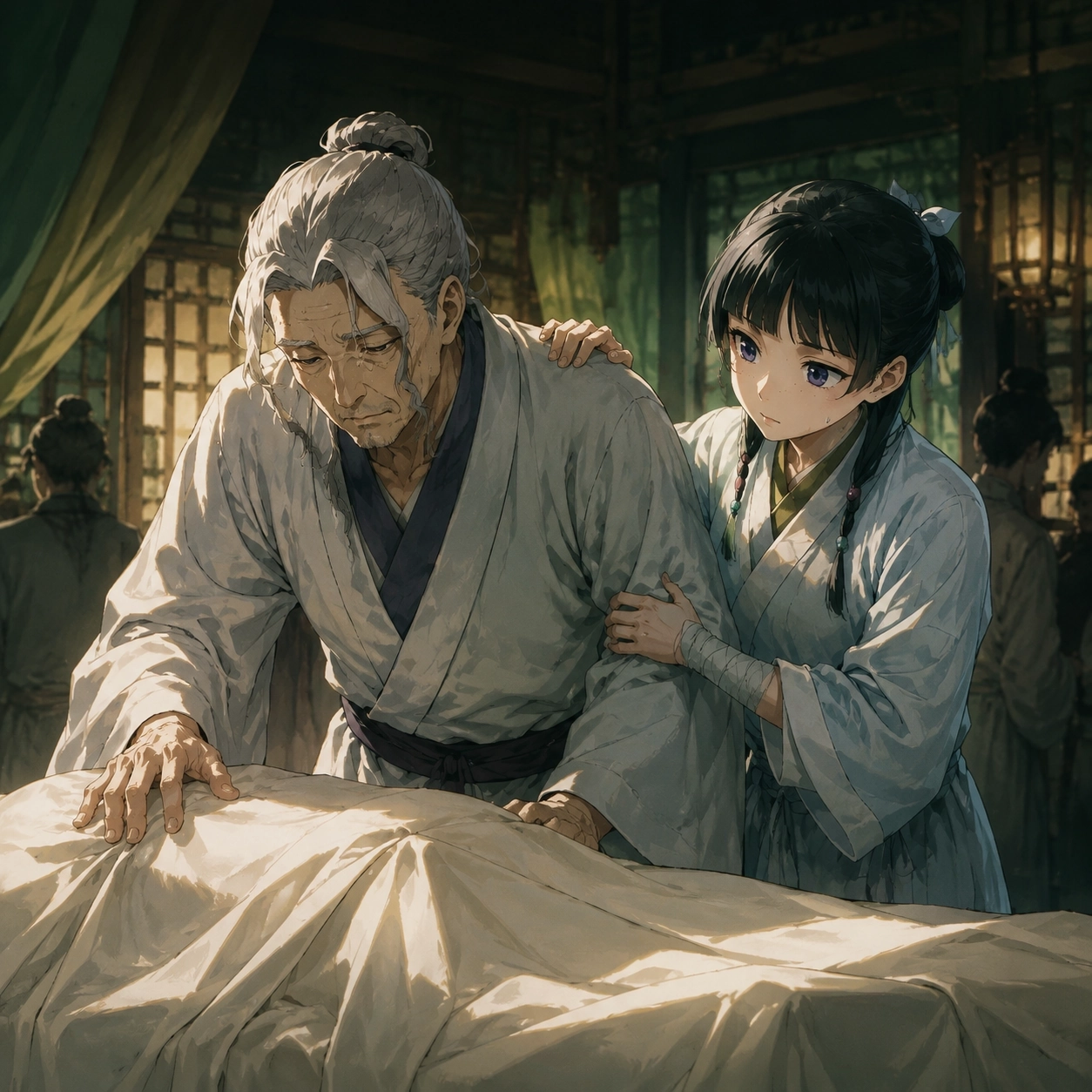
Tianyu does not immediately rescue the situation. His temperament and loss of interest make him refuse the main task at first. Luomen therefore takes over despite his damaged knee and limited endurance. Maomao braces him so that he can remain upright long enough to remove the appendix.
No Single Person Saves the Emperor
This sequence matters because the successful operation is genuinely collective. Liu opens the path, Luomen supplies the decisive surgical judgment and removal, Maomao keeps Luomen physically functional and tracks what remains to be done, and Tianyu later contributes the fine motor skill needed to close the wound. Calling Maomao the surgeon would erase the point: the team survives because different strengths cover different failures.
Why Maomao's Support Mattered
Maomao's most literal contribution during the operation is easy to underestimate: she holds Luomen up. His expertise is useless if his leg cannot support him. By becoming his brace, she converts knowledge into a completed procedure.
After Luomen is exhausted, Maomao prepares to take over the suturing herself. That willingness shows how thoroughly she has accepted responsibility, but the scene also establishes her physical limit. Her left arm has gone numb from supporting Luomen, making delicate closure unsafe. She recognizes the problem rather than forcing herself to finish for pride.
That judgment is as important as courage. The Emperor does not need the most emotionally satisfying person to complete every step; he needs the person whose hands can do the work correctly at that moment.
Why Tianyu Still Became Necessary
Tianyu finally takes over the suturing, while Maomao assists and watches him. His attitude is difficult, but his technical ability is real. The closure is exceptionally clean. Volume 15 does not ask readers to choose between Maomao and Tianyu as if only one can matter. Maomao gets the team to the point where closure is possible; Tianyu supplies the precision her exhausted arm cannot.
This division of labor protects the factual boundary around Maomao's role. She participates throughout the crisis and is prepared to suture, but Tianyu is the person who actually completes the final closure.
Postoperative Success Was Part of the Victory
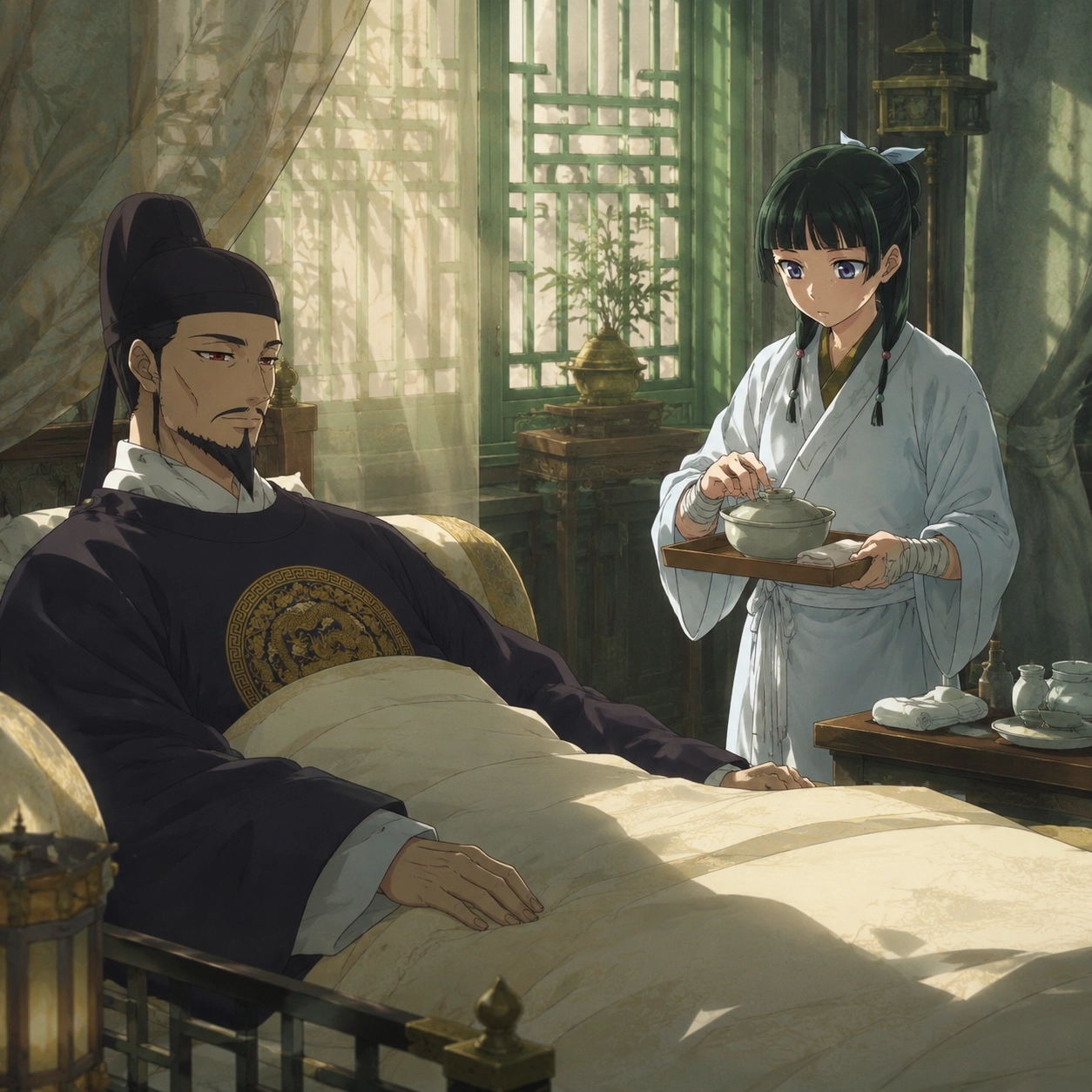
The operation is not truly successful when the incision is closed. Maomao joins the postoperative care, where cleanliness, quiet, observation, and infection control remain decisive. Chapter 20 shows the Emperor recovering without the feared complications, and the final chapter reaches the point where the sutures can be removed and the medical team can celebrate.
The early Volume 16 follow-up confirms the result: roughly half a month later, the Emperor's postoperative treatment can be handed to the senior physicians. That continuation matters because it proves the team did not merely survive the operating room. The patient survived the recovery period as well.
What the Surgery Changes About Maomao
Her Medical Knowledge Becomes Institutional
Maomao is no longer solving a poison puzzle at the edge of court. She is trusted inside a medical team treating the sovereign. Her knowledge of drugs, anatomy, symptoms, and sanitation becomes part of an organized procedure with consequences for the entire state.
She Accepts Responsibility Without Pretending Omnipotence
The operation demonstrates both her reach and her limits. She catches the rupture warning and supports the procedure at several critical points, yet she cannot replace every specialist. Her maturity lies in doing what the case requires and yielding a task when another person's hands are safer.
Saving One Patient Stabilizes Many Lives
Keeping the Emperor alive also protects Gyokuyou's young heir from an immediate accession crisis and keeps Jinshi from being forced toward the throne by a vacuum. For that wider court structure, see Gaoshun's relationship with the Emperor, which explains how personal service and state continuity overlap.
Conclusion
The Emperor's surgery had to succeed because a death on the operating table would have become a succession crisis before the medical team had even finished grieving. Maomao helps prevent that outcome through preparation, diagnosis, adaptability, and postoperative care. She is indispensable without being rewritten as the primary surgeon.
That distinction makes the sequence stronger. Volume 15 does not produce a lone medical hero. It shows how Liu, Luomen, Maomao, Tianyu, and the wider team keep one another's weaknesses from becoming the Emperor's death.
FAQ
What illness required the Emperor's surgery?
Volume 15 treats the condition as recurrent chronic appendicitis that may have progressed to rupture, turning a planned operation into an emergency.
Did Maomao perform the Emperor's surgery?
No. Physician Liu begins the procedure, Luomen takes over and removes the appendix, and Tianyu performs the final suturing. Maomao prepares supplies and medicine, detects the rupture warning, supports Luomen, assists Tianyu, and helps with recovery.
Why did the Emperor's pain suddenly disappear?
Maomao recognizes that the rapid relief may not mean healing. It may indicate that the appendix has ruptured, which increases the danger and makes immediate surgery necessary.
Why did the operation have political importance?
The Crown Prince is still young, while Jinshi is the court's immediately available adult royal alternative. The Emperor's death could therefore trigger a regency struggle or force Jinshi into succession.
Which volume contains the operation?
The illness, preparation, operation, and early recovery are in Volume 15, especially Chapters 6, 11-12, and 18-20.
Who completed the suturing?
Tianyu completed the closure, with Maomao assisting and supervising after her own left arm had become too numb for safe precision work.