Spoiler Warning
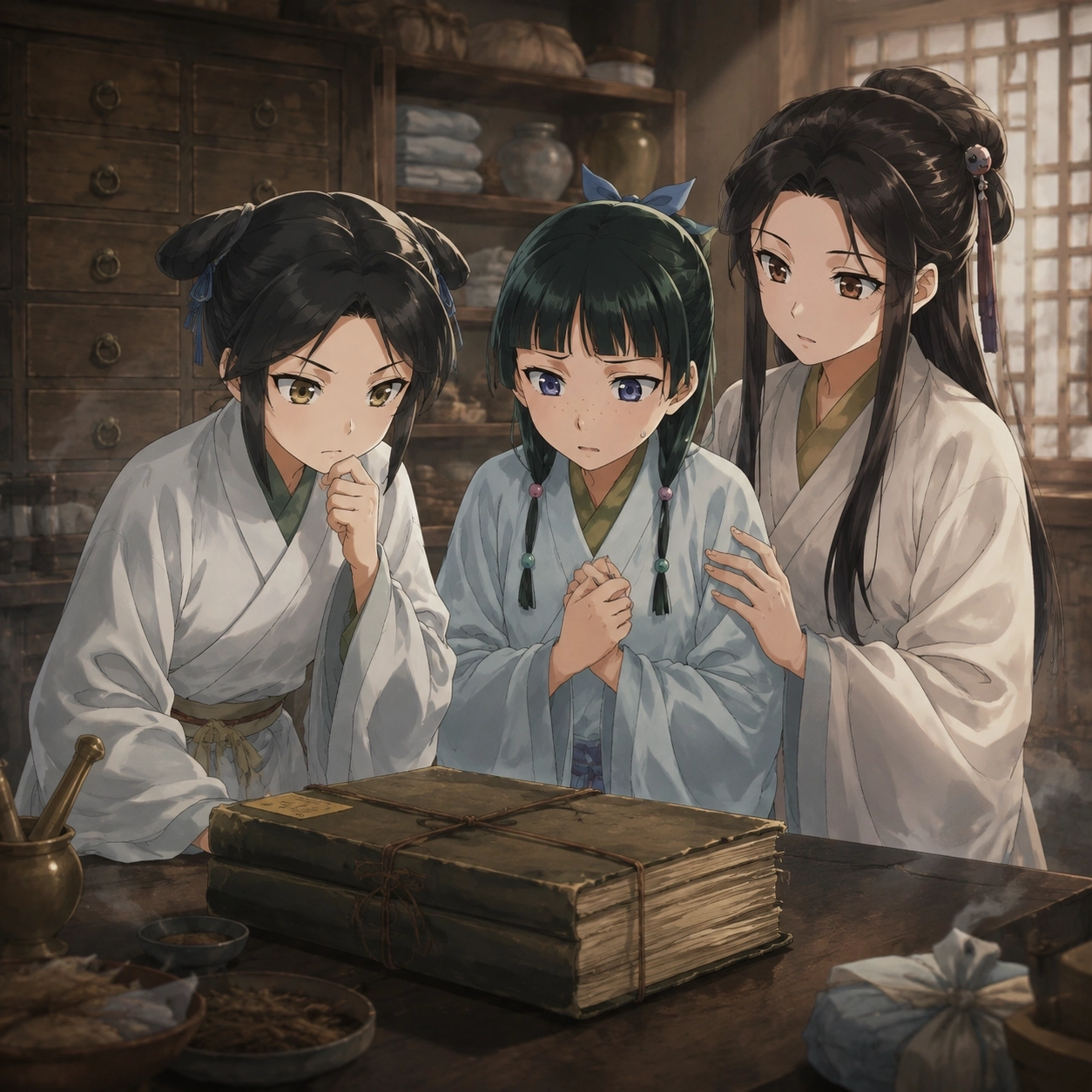
This article discusses light novel spoilers from Volume 9, especially Chapters 3-6: Luomen's qualification test, the search for Hua Tuo's Book, the hidden anatomical text, Yao's shock, En'en's decision to keep the book, and Luomen's explanation of why forbidden medical knowledge can save lives and destroy the person who uses it.
Scene Locator
The core material is in Volume 9, Chapters 3-6. Chapter 3 begins the test when Luomen says the qualification is to accept a certain medical book hidden in the room. Chapters 4 and 5 turn the search into a puzzle of language, book numbers, diagrams, and the room itself. Chapter 6 explains what accepting the book really means after the hidden text is found.
Use these chapters as the article's canon boundary. Earlier medical-office material can explain why Maomao, Yao, and En'en are on this path, but the Hua Tuo's Book test itself belongs to Volume 9, Chapters 3-6. It should not be treated as a general medical assistant exam scene from another volume.
Volume-level entry only. This source is community-hosted; availability and rights status may vary.
The Short Answer
Maomao, Yao, and En'en have to accept Hua Tuo's Book because Luomen is testing whether they can face the real foundation of advanced medicine: the human body, the evidence gained from opening it, and the social punishment attached to that knowledge. Passing does not mean smiling at a grotesque book. It means understanding why a physician might need such knowledge and what it would cost to use it.
That is why the word accept matters. Luomen is not asking whether they can receive a physical object. He is asking whether they can accept the contents, the method behind those contents, and the danger of becoming the kind of practitioner society may call heretical even when the goal is to save lives.
The three women answer differently. Maomao accepts through curiosity and practical reasoning. En'en accepts through protection, preservation, and loyalty to Yao's future. Yao accepts more slowly, through shock, revulsion, and the painful realization that wanting to practice medicine means confronting things she once could not bear to see.
Why Luomen Makes It a Test
Luomen's gentleness can make this scene easy to misread. He is not being cruel for the sake of drama. He knows what medical knowledge can demand from a person because his own career has been shaped by exile, punishment, childbirth trauma, and knowledge that society prefers to keep hidden.
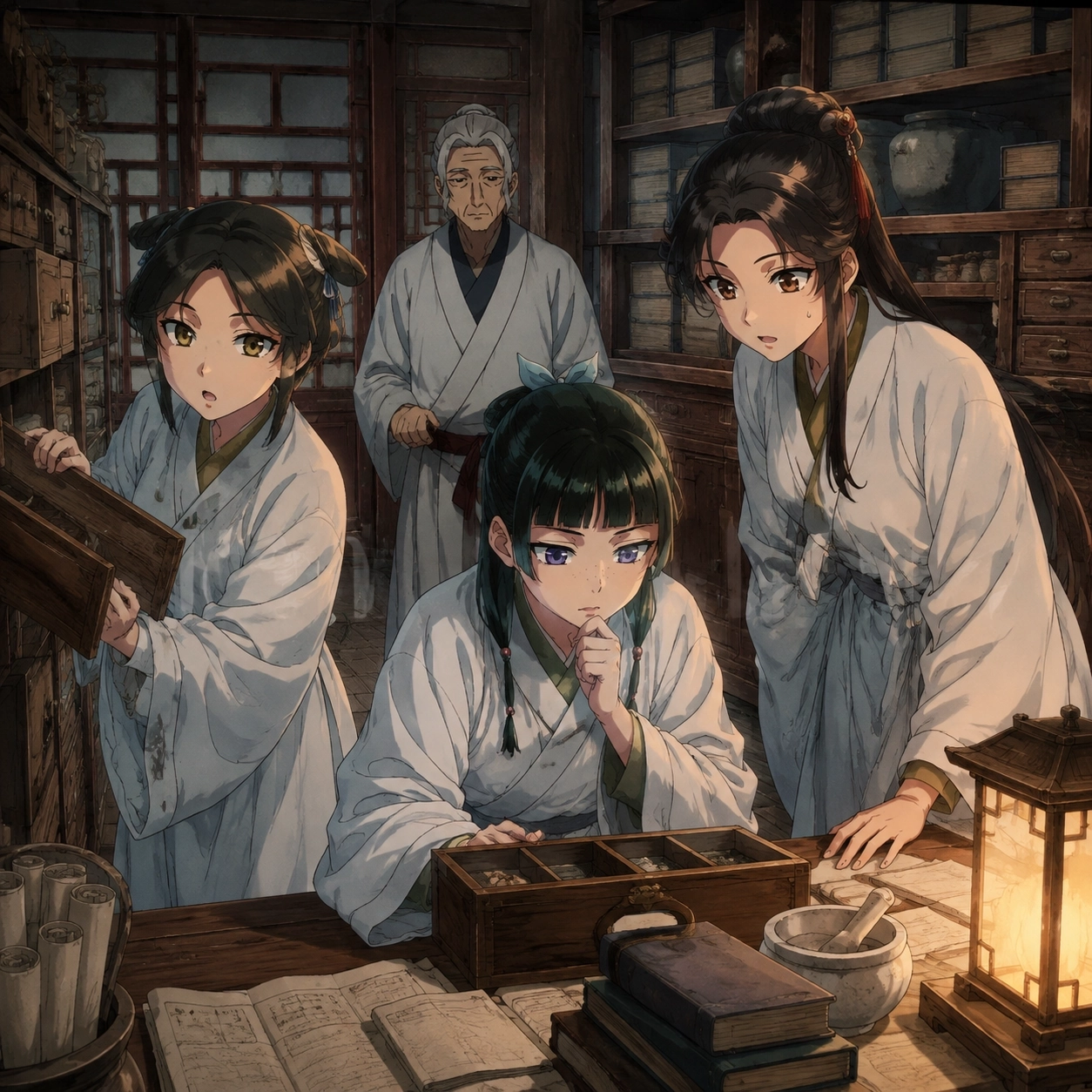
When Maomao asks what qualification they need, Luomen could simply teach or refuse. Instead, he sets a test that forces the students to discover the answer themselves. This matters because no lecture can fully prepare them for the moment when medicine crosses from clean theory into bodies, taboos, and consequences.
The Test Protects Them as Much as It Challenges Them
Maomao suspects that Luomen may not actually want them to walk deeper into the medical path. That suspicion is important. His test has two edges: if they cannot accept the book, they can step away before the road harms them; if they can accept it, they prove they understand that medicine is not only herbs, diagnosis, and cleverness.
This is also why the scene pairs well with the wider historical setting of The Apothecary Diaries. In this world, official rank, gender, taboo, and medical authority decide who is allowed to know what. The test exposes that structure instead of pretending talent alone is enough.
Why the Search Matters
The search for Hua Tuo's Book is not filler before the reveal. It shows what kind of thinking Luomen wants. The women do not just pull books from shelves. They question the name, the form of the book, the state of the old collection, the room's layout, the numbered volumes, the foreign-language clues, and the diagrams built into the space.
Maomao and En'en understand enough foreign writing to see that the answer may be more dangerous than an ordinary medical manual. Yao does not begin with the same language advantage, which makes her later reaction more direct. She reaches the hidden truth without the same warning buffer.
The Room Becomes a Diagnosis
Luomen's old room works like a patient. The obvious shelves are symptoms, not the disease. The missing numbers, paired images, and concealed location all teach the same habit: a practitioner must observe the whole system before cutting toward an answer.
That is very Maomao-like, but it is also bigger than Maomao. Yao and En'en are being trained to read evidence rather than rely on status. In that sense, the test belongs beside other source-grounded Maomao deduction articles, such as the Maomao and Jinshi dynamic guide, where observation changes what powerful people think they can hide.
What Hua Tuo's Book Contains
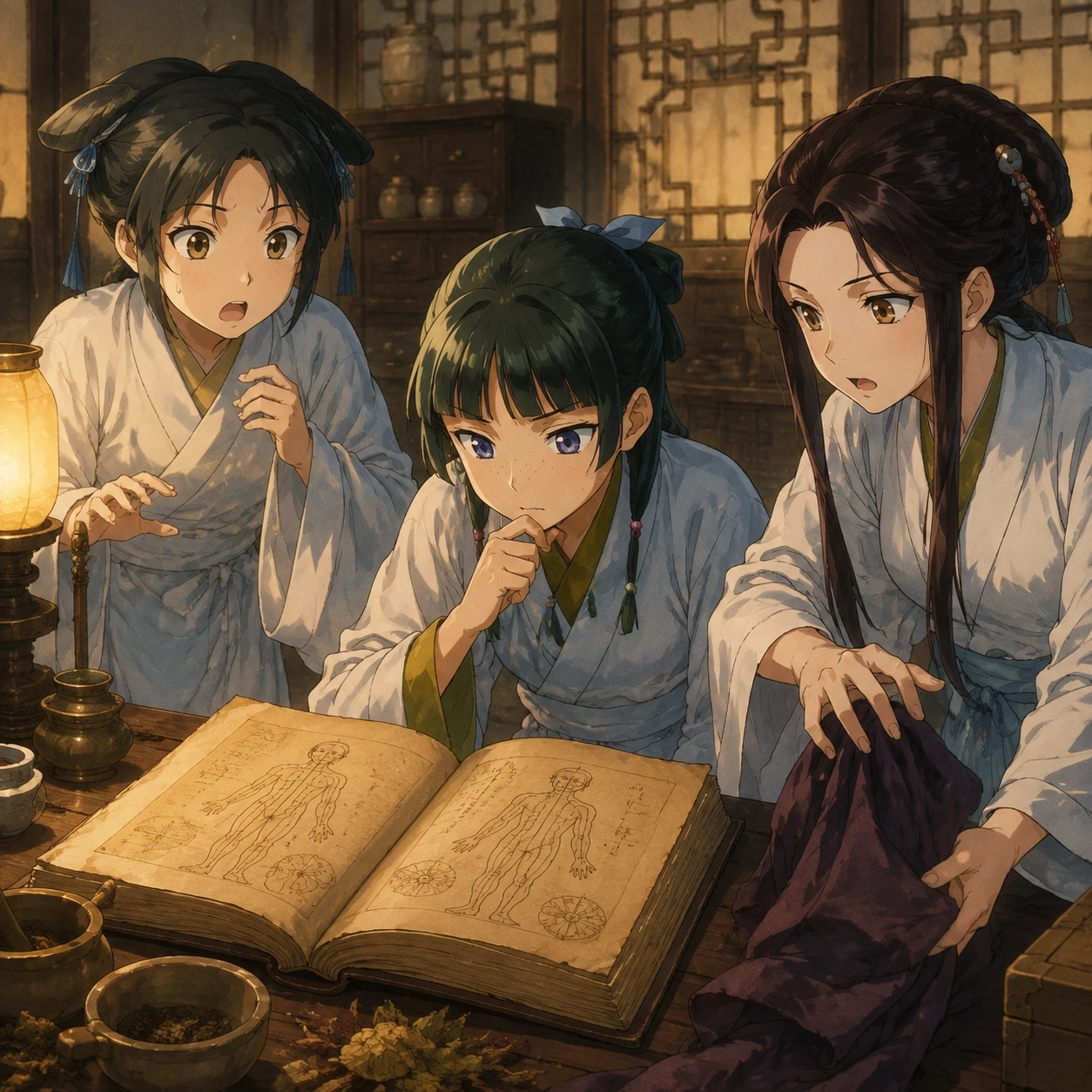
The hidden book is shocking because it presents the human body with a precision that ordinary medicine in Li does not openly permit. It includes anatomical illustrations that expose muscles, organs, and the inner structure of the body. In the local moral world, that knowledge is tied to dissection and therefore to religious and legal taboo.
The foreign word on the book's back makes the danger even clearer. The point is not that the book is magic. The point is that society may label knowledge as magic when it cannot bear the method used to obtain it. For a physician, that distinction can decide whether a life is saved or a healer is destroyed.
Why It Is Called Hua Tuo's Book
Luomen later explains the name through the memory of a historical medical figure associated with dissection and forbidden research. The lesson is double. The old Hua Tuo advanced medicine, but he also crossed a line that made the ruler erase his name and burn his works. Luomen's book inherits both sides of that legacy: life-saving knowledge and political danger.
This is why the book cannot be treated as a simple treasure. It is a warning disguised as a manual. Anyone who wants its power must also accept its risk.
How the Three Women Accept It
The best part of the sequence is that Maomao, Yao, and En'en do not react the same way. The test is fair because it allows different forms of acceptance. Luomen is not looking for a single personality type. He is checking whether each woman can face the truth from her own position.
Maomao Accepts Through Practical Curiosity
Maomao is disturbed less by the anatomical content than by the social implications around it. She already treats the body as evidence. She experiments on herself, notices causes, and values useful knowledge even when others find it unpleasant. For her, the book confirms why Luomen wanted her to become an apothecary rather than rush toward the public role of physician.
That does not make Maomao careless. Her reaction is not blind fascination. She understands why the book was hidden, why it could be burned, and why teaching from it could endanger the people who read it.
Yao Accepts Through Shock and Growth
Yao's reaction is the most visibly painful because she encounters the book without the same preparation. The anatomical drawings strike her first as something repulsive and taboo. That response does not make her unworthy. It shows exactly why the test is necessary.
What matters is that Yao does not remain the girl she was when Maomao first met her. Her time as a medical-office attendant has made her more capable of sorting fear, pride, disgust, and ambition. The test reveals that growth while still respecting the emotional cost of what she sees.
En'en Accepts Through Custody and Protection
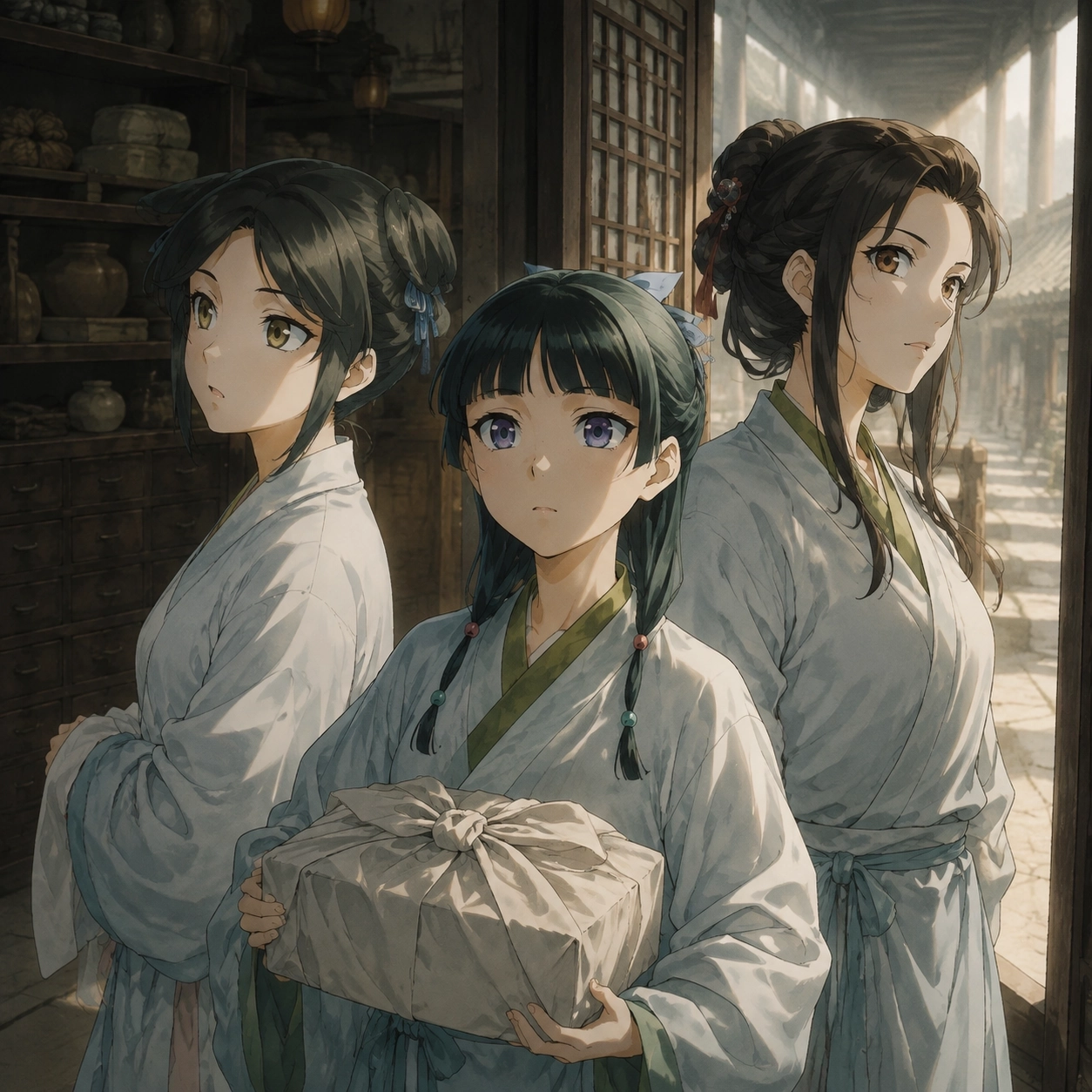
En'en's acceptance is quieter. She is attentive to Yao's wishes, but she is also capable of understanding the book's danger. When she wraps and keeps the book, that action matters. She does not merely hide it away. She becomes the person willing to preserve dangerous knowledge without letting it become a reckless object.
That role suits En'en. Her strength is not loud ambition. It is controlled devotion, practical judgment, and the ability to hold a burden so Yao can keep moving.
Why the Test Is Harder for Women
Luomen's warning is not abstract. In Li, women already face limits in official medicine. Even if a woman has the ability to heal, society may deny her title, authority, protection, and legal permission. If she also accepts forbidden anatomical knowledge, the danger becomes sharper.
This is why Hua Tuo's Book becomes more than a technical manual. For Maomao, Yao, and En'en, accepting it means accepting that their medical future may never be socially clean. They may help people, but they may also be suspected, dismissed, or punished because the knowledge they need sits outside what respectable people want to acknowledge.
Medicine Is Not Innocent in This Scene
The scene refuses the comforting fantasy that healing is always welcomed. A doctor can save lives and still be called dangerous. A woman can be correct and still be punished for knowing too much. Luomen knows this because his own past is filled with examples of useful knowledge becoming evidence against the person who holds it.
That makes the test one of Volume 9's clearest statements about the series as a whole. The Apothecary Diaries often turns mystery into politics. Here, it turns medicine itself into a political risk.
Why It Becomes a Medical Qualification
Hua Tuo's Book is necessary because it separates three levels of desire. Wanting to help people is the first level. Wanting to learn difficult medical knowledge is the second. Accepting that such knowledge can make you feared, blamed, or isolated is the third. Luomen is testing the third level.
That is why the qualification cannot be reduced to intelligence. Maomao is intelligent, Yao is determined, and En'en is observant, but the book asks whether those qualities can survive contact with something morally contaminated in the eyes of their society.
The Test Also Explains Luomen
The more the scene reveals about the book, the more it reveals about Luomen. He is not simply withholding knowledge. He is measuring whether teaching it would be an act of mentorship or an act of harm. His reluctance comes from responsibility, not indifference.
That makes the article a useful companion to the Volume 9 analysis of Maomao's later directness. Both threads show Maomao learning that adults she respects can carry dangerous habits of self-sacrifice and secrecy, and that caring about someone sometimes means refusing to let that secrecy pass unchallenged.
That choice has consequences beyond accepting the book. Our analysis of Maomao as a possible successor to Luomen follows their changing partnership and asks what she can carry forward from his work. Contains later novel spoilers through Volume 16.
Conclusion
Maomao, Yao, and En'en had to accept Hua Tuo's Book because the book is the threshold between safe learning and dangerous medicine. It asks whether they can face the body without flinching, understand why taboo knowledge exists, and still choose a path where saving people may not protect the healer from suspicion.
Maomao passes by understanding the practical value and danger of the knowledge. Yao passes by confronting shock without abandoning growth. En'en passes by taking custody of the burden. Together, their responses show why Luomen's test is not a riddle about finding a book. It is a test of whether they can stand near the truth that medicine sometimes needs most and society most wants to hide.
FAQ
Which volume contains Hua Tuo's Book?
The core Hua Tuo's Book sequence is in Volume 9, Chapters 3-6. Other volumes may provide medical-office background, but the test itself should be located in Volume 9.
What does Luomen mean by accepting the book?
He means accepting the contents, method, and ethical burden behind the book. It is not just receiving a physical object.
Why is Yao shocked by the book?
Yao encounters anatomical images and the taboo surrounding dissection without the same preparation Maomao and En'en have. Her shock is part of the test because it shows the emotional cost of entering serious medicine.
Why does En'en keep the book?
En'en's custody of the book shows practical acceptance. She protects dangerous knowledge instead of treating it as a curiosity or letting it become reckless.
Does the book prove that dissection is accepted in Li?
No. The point is the opposite: the book contains knowledge that can save lives while still being socially and legally dangerous.
What should I read next?
For Maomao's wider role as a medical observer, read the Maomao and Jinshi dynamic guide. For another Volume 9 emotional shift, read how Jinshi's self-harm changes Maomao. For setting context, start with the setting guide.
Continue the character discussion