Spoiler Warning
Major light novel spoilers through Volume 16. This analysis discusses Luomen's medical past, Maomao's official status, the origins of Hua Tuo's Book, the Emperor's operation, and their later work. It also mentions Jinshi's abdominal injury. Anime-only readers should stop here.
Will Maomao Take Luomen's Place?
Maomao is becoming someone who can carry Luomen's medical work forward, but she has not been appointed his replacement through Volume 16. Luomen still works as a physician in the rear palace. Maomao remains a medical assistant, even as senior physicians entrust her with increasingly difficult tasks.
The question becomes more interesting when we ask what, exactly, she would inherit. Luomen has an official position, a body of medical knowledge, a habit of questioning incomplete information, and a willingness to stay with a patient when other people cannot act. Those things do not pass to a successor all at once.
The novels give the strongest support to a gradual transfer of responsibility. During the Emperor's operation, Maomao literally holds her adoptive father upright so that he can continue working. When he can no longer operate, she prepares to take on the unfinished task. That is a powerful image of succession, even though the scene does not make her the surgeon who completes the operation.
Our broader account of Maomao's transition from apothecary to medical practitioner follows her professional development. Here, the central question is more personal: which parts of Luomen's place in the world is she already learning to occupy?
Scene Locator: Luomen's Legacy and Maomao's Changing Role
- Volume 4, Chapter 7: Luomen's qualifications and his decision to practice medicine because of the suffering he encountered.
- Volume 7, Chapter 1: the legal obstacle to a woman becoming a physician and the newly established assistant role offered to Maomao.
- Volume 9, Chapters 2 and 7–8: Maomao asks to learn surgery, Luomen explains the history behind Hua Tuo's Book, and she confirms her resolve to continue.
- Volume 13, Chapter 12: Sazen runs the pleasure-district pharmacy while Maomao and Luomen serve at court.
- Volume 15, Chapters 1–3 and 19–20: Luomen tests and teaches several younger practitioners; the Emperor's operation exposes both Maomao's commitment and her remaining limits.
- Volume 16, Chapters 1, 14 and 19: their current duties, Luomen's continuing rear-palace service, and an explicit reminder that Maomao is not a physician.
These references follow the light novel volumes. The argument treats scenes of learning and responsibility as evidence of a developing legacy; it does not turn them into an announced future appointment.
Volume-level entry only. The source is community-hosted; availability and rights status may vary.
Luomen Has More Than One Place to Leave Behind
For Maomao, Luomen is first the man who raised her and taught her about medicine. His importance does not begin with his court credentials. Long before her own official employment, his knowledge gives her a way to understand illness, earn a living, and decide when an apparent explanation is insufficient.
Volume 4 adds an important detail to that inheritance. Luomen qualified both for medical service and through the civil examinations. The account links his choice of medicine to seeing sick children by the roadside. His career represents a decision about where his abilities could help, rather than simply the most prestigious use of those abilities.
This makes his professional legacy larger than a vacancy in the palace. Taking his place could mean treating patients who need someone careful and capable, preserving knowledge that would otherwise disappear, or teaching the next person. None of those roles requires Maomao to become identical to him.
The old pharmacy also complicates a simple inheritance story. By Volume 13, Sazen is managing the shop and using the former family home while both Maomao and Luomen work at court. The novel distinguishes keeping a practice running from succeeding to an official rank. Maomao's future is already connected to a wider group of people who can continue different parts of that work.
She Is Already Inheriting His Way of Asking Questions
The opening examination in Volume 15 gives a particularly clear measure of what Luomen has passed on. Presented with a young woman's symptoms through her husband, several candidates begin preparing medicine. Maomao and some of the others first seek more information, including whether pregnancy could affect the choice of treatment.
The point is not that the quickest candidate remembers the most recipes. A prescription can be familiar and still be wrong for the patient in front of the practitioner. Luomen tests whether his students notice what the initial account leaves out.
Maomao recognizes the method because she knows her father's teaching. He does not merely hand over instructions and reward obedience. He expects questions about a patient's account, checks how medicines are prepared, and makes the learners think about their use. Later, when Maomao and the other selected workers prepare repeated variations of a medicine, their curiosity turns toward the patients receiving it.
This is a more substantial inheritance than a collection of secret remedies. A recipe answers a familiar problem. Judgment helps when the problem has been described badly, when the circumstances have changed, or when an important fact is missing. Maomao can carry Luomen's work forward because she is learning how to notice those gaps.
Even here, the novel leaves room for growth. In Volume 16, Physician Liu has to encourage her to voice a hypothesis during a private discussion. Her caution bears Luomen's influence, but a working physician also needs to discuss possibilities before they are certain. Learning from other teachers can help her use his lessons more flexibly.
Luomen Did Not Simply Train Her to Replace Him
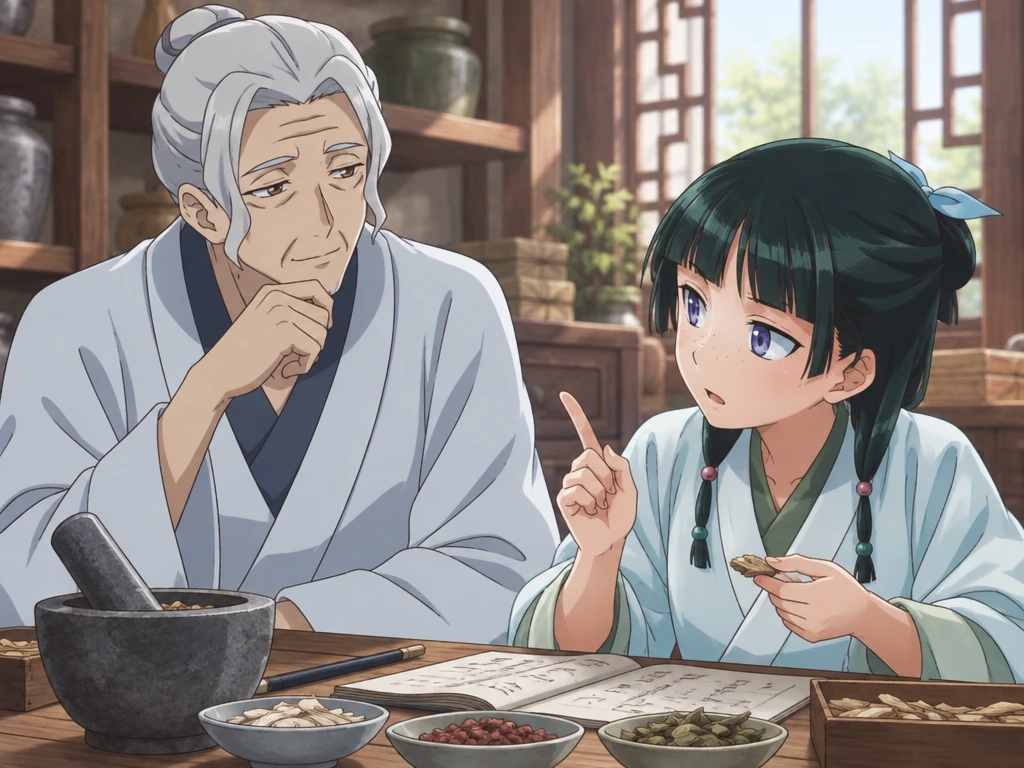
Volume 9 makes the relationship more complicated than a master selecting an heir. After treating Jinshi's abdominal burn, Maomao admits the limits of her surgical knowledge. She has learned parts of the work by watching, and cannot confidently promise that what she has done is sufficient. She wants more training.
Her first choice of teacher is Luomen. Yet she worries that asking him will make him sad. He has taught her extensively about medicines while limiting what he teaches her about surgery. Maomao understands this restraint as an attempt to protect her from the contempt and danger attached to that work.
The history behind Hua Tuo's Book explains why those fears are concrete. Luomen identifies the anatomical material as work he compiled during his time abroad. He also describes a woman who taught him medicine and was killed after being accused of witchcraft. Her knowledge helped him save lives; the society around her still treated her as a threat.
Passing on that knowledge therefore carries a painful double meaning. He can give Maomao more ways to help a patient, but he cannot promise that the world will reward her for learning them. The same concern extends to Yao and En'en, whom he also asks to confront what accepting the book means.
Maomao subsequently writes to confirm that she still wants to learn. That choice matters. Her path is not an obligation imposed on a daughter to finish her father's career. She understands more of the cost and chooses to continue. The analysis of why Maomao, Yao and En'en had to accept Hua Tuo's Book explores the earlier test that leads into this decision.
Volume 15 Makes the Transfer of Responsibility Visible
The Emperor's operation is the clearest scene for imagining Maomao as Luomen's successor. Its force comes from the precise division of work. Physician Liu begins the operation. After his hand is injured, the remaining team struggles to continue, and Tianyu initially refuses to take over. Luomen steps forward because the patient cannot be left untreated.
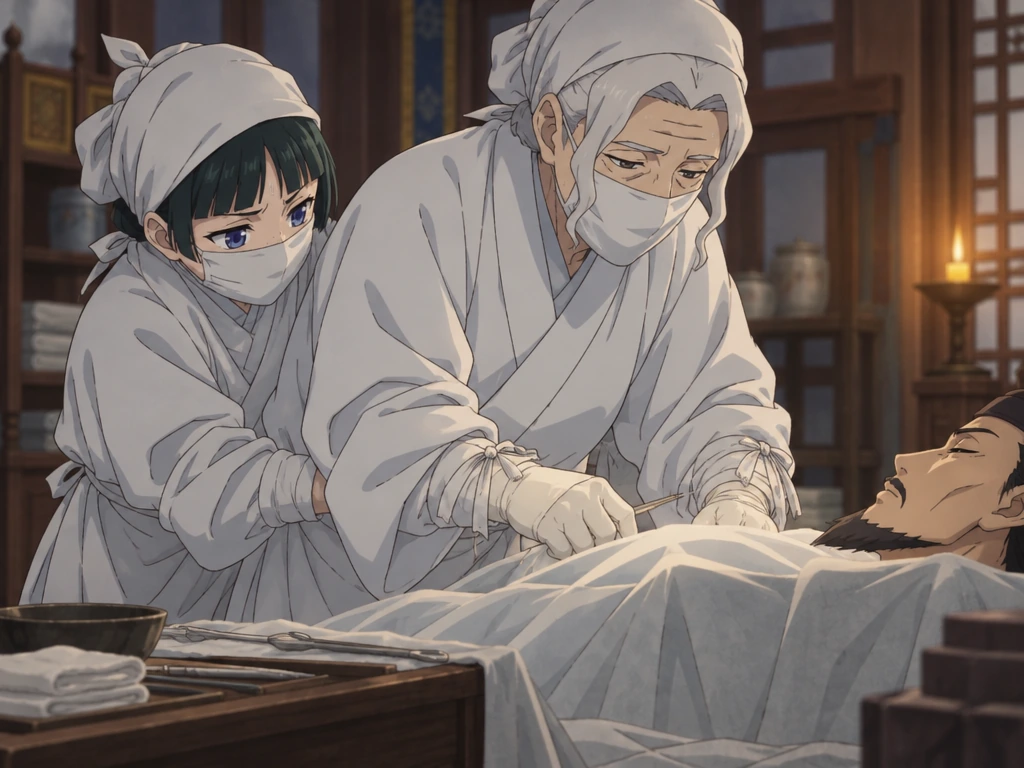
His knowledge has not disappeared, but his body has limits. His damaged leg makes sustained operating difficult. He asks Maomao to support him, and she does. Her familiarity with caring for him allows his expertise to remain useful at the moment it is most needed.
Read as an image of medical inheritance, this is unusually moving. The younger practitioner does not prove her worth by pushing the older one aside. She helps him do something neither could manage alone in quite the same way. Their relationship has become a form of cooperation in which her strength supports his experience.
After Luomen removes the diseased appendix, he is too exhausted to continue. The surgical wound still needs closing. Maomao prepares the needle and asks him to watch for mistakes. She knows she has never sutured a living person's abdomen, although she has treated other wounds and assisted in operations.
Her willingness is meaningful precisely because the limitation is explicit. She is not suddenly revealed to have all his skills. She sees an unfinished obligation and prepares to act under his supervision. The person who once depended on his instruction now wants to help carry a responsibility his body can no longer bear unaided.
Tianyu then takes the instruments and performs the closure, with Maomao assisting and Luomen remaining to observe. Maomao does not complete the Emperor's surgery herself. She acknowledges that Tianyu's suturing is better and watches him, determined to improve. The fuller discussion of why the Emperor's surgery had to succeed explains the pressure surrounding that shared effort.
Why Medical Succession Is Not Yet an Official Appointment
Ability and rank are separate problems in these novels. When Gaoshun approaches Maomao in Volume 7, she immediately points out that the country's law does not allow women to become physicians. The position arranged for her is a newly established female assistant role attached to the physicians, entered through an examination.
That role brings access and opportunities, but it does not erase the distinction. In Volume 9, Maomao asks how much she is permitted to do, and Jinshi says that the boundary is not strictly defined: much depends on the senior physicians. Her practical responsibilities can expand without a matching change in title.
Volume 16 supplies a useful check on any claim that the operation has already promoted her. She returns to routine duties and drug experiments after senior physicians take over the Emperor's postoperative treatment. Later, when Liu asks her to check Jinshi's condition regularly, the narration explicitly observes that she is not a physician. Trust in her work has grown; formal replacement has not occurred.
Luomen, meanwhile, continues serving in the rear palace. His expected visit to the clinic where Yao and En'en see patients does not establish retirement. There is no vacant position in these passages that Maomao has simply inherited.
An eventual appointment would require the story to resolve the institutional problem as well as her training. The existing scenes make that a worthwhile possibility to discuss, but they do not settle what the law, the court, or Maomao herself will ultimately allow.
She Can Continue His Work Without Repeating His Whole Life
Luomen's gentleness and Maomao's sharp tongue make them look different. During the operation she is furious with Tianyu, while Luomen keeps redirecting attention toward the patient. Still, her anger comes with a refusal to abandon the task. She continues assisting someone she dislikes because the work must be finished.
That is a promising foundation for succession, but the novel also shows why courage alone is insufficient. Maomao needs technical practice, other practitioners' help, and the ability to recognize when someone else can do a procedure better. Her desire to surpass Tianyu is most productive when it becomes attentive learning.
Nor does honoring Luomen require accepting every injury the court might inflict. Volume 15 explicitly connects the dangers of imperial medicine with his earlier punishment. For a daughter who loves him, carrying on his work can include wanting a future in which skilled practitioners are better protected. The pattern of a younger woman facing an older generation's constraints also appears in Ah-Duo's fear that Maomao will follow her path, although their circumstances differ.
Luomen is already teaching several people. Maomao studies alongside other medical workers; Yao and En'en pursue their own responsibilities; Sazen keeps the pharmacy operating. His contribution can survive through that shared work, without placing every task on one exceptional daughter.
The most persuasive reading is therefore that Maomao is becoming one of Luomen's medical heirs. The official destination remains open. What the novels have already shown is the change in their relationship: she can question with him, work beside him, support him, and prepare to act when he needs someone else to continue. Taking his place may begin with exactly that kind of readiness.
FAQ: Maomao and Luomen's Medical Legacy
Has Maomao officially replaced Luomen?
No. Through Volume 16, Luomen still serves as a physician in the rear palace, while Maomao remains a medical assistant. The scenes discussed here do not name her his official successor.
Does Luomen want Maomao to become a surgeon?
His attitude is protective and conflicted. Volume 9 shows that he restricted her earlier surgical learning because of the dangers surrounding the field. Maomao asks to learn more and maintains that choice after hearing his history.
Does Maomao take over during the Emperor's operation?
She supports Luomen while he operates, then prepares to suture under his supervision when he is exhausted. Tianyu actually performs the closure, and Maomao assists. The scene demonstrates her growing responsibility without making her the lead surgeon.
Who runs Luomen and Maomao's old pharmacy?
By Volume 13, Sazen manages the pleasure-district pharmacy while they work at court. Managing that practice and inheriting Luomen's official position are different questions.
Is Maomao Luomen's daughter?
She is his adopted daughter and medical pupil. Their bond is central to this reading: the person he raised is learning to help sustain the work that shaped her life.
Will Maomao eventually become a full physician?
The novels through Volume 16 leave that future unresolved. Her increasing skill and responsibility support the possibility, but a future title or appointment should remain a prediction.