Spoiler Warning
This article discusses light novel spoilers involving Loulan, Shisui, Jinshi, hidden identity, and the political tension around the Shi clan aftermath. If you are anime-only and want the reveal chain untouched, stop here and come back later.
Scene Locator
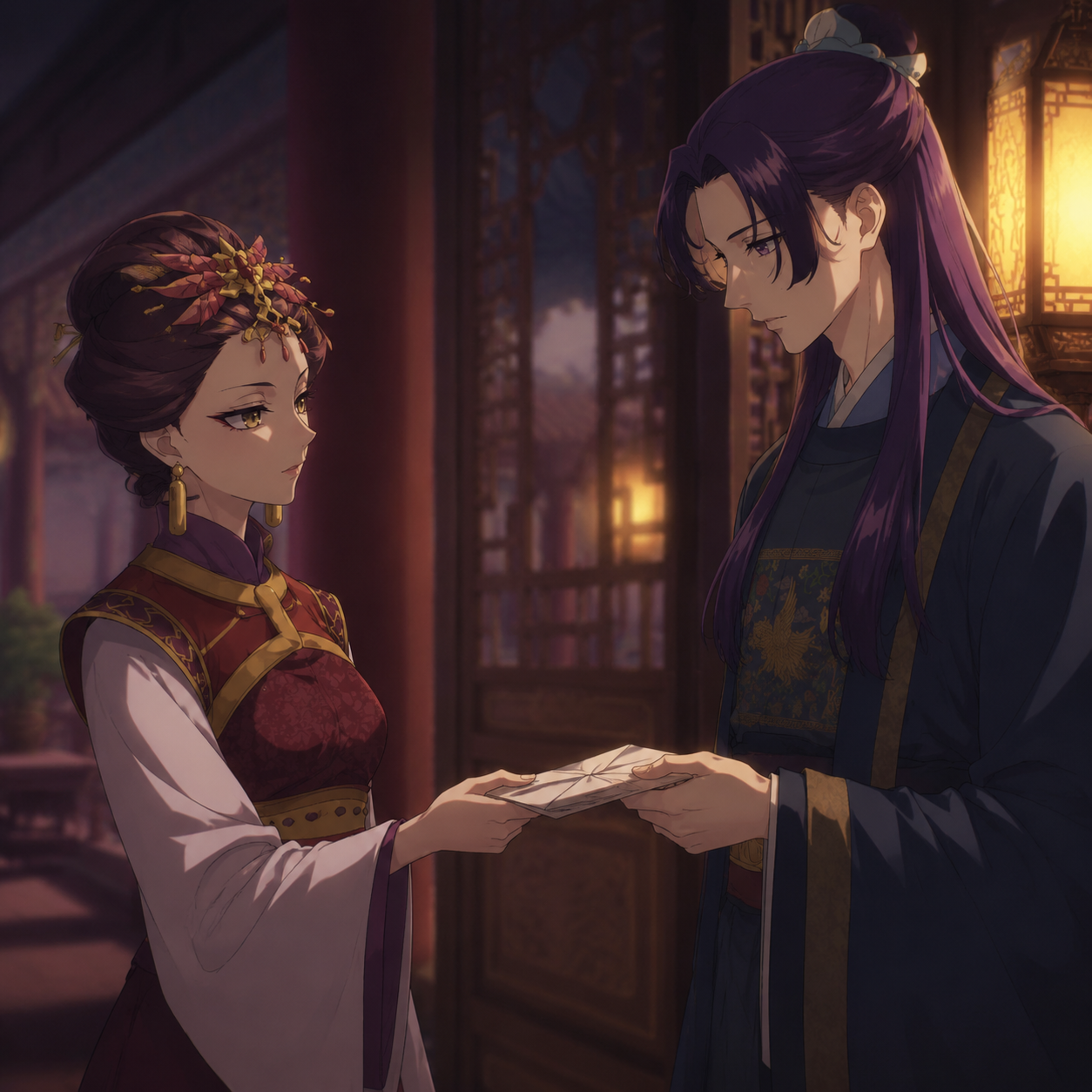
The handoff itself occurs in Volume 4, Chapter 21: Loulan takes a written paper from her clothing and gives it to Jinshi. Volume 4, Chapter 22 follows the immediate aftermath, while Volume 5, Chapter 1 shows later consequence and expansion.
Do not use Volume 5 as the delivery scene. The paper's exact handoff is a Volume 4 event; the article's discussion of Volume 5 is an interpretation of what the warning comes to mean later.
Continue with the Shisui and Loulan identity guide and why Shisui may or may not return for the surrounding evidence trail.
Volume-level entry only. The source is community-hosted; availability and rights status may vary.
In Volume 4, the detail fans keep circling back to is not a grand confession or a dramatic speech. Loulan gives Jinshi a note. That is the useful answer, but it is not the whole answer.
The sharper question is what the note allowed Jinshi to do afterward. Volume 5 gives us the better clue: Jinshi's attention moves toward a wider national problem, not merely a private Loulan mystery. That means the note should be read less like a farewell and more like intelligence.
The Apothecary Diaries cares a lot about who gets to speak, who gets overheard, and who has to communicate sideways. A note is the perfect object for that world. It is small, deniable, and private enough to carry meaning without turning the entire court into a witness stand.
If you want the identity context first, the guide to Shisui's secrets in The Apothecary Diaries explains why Loulan and Shisui are the same person behind two kinds of survival.
The Short Answer
Loulan gives Jinshi a written message, best understood as a note or paper slip. The story does not frame it like a flashy romantic token. It frames it like controlled contact.
The content is not presented as a neat public transcript for readers to quote line by line. But the later plot gives us enough to make a grounded inference: Loulan's paper likely points Jinshi toward information connected to the Shi clan aftermath, the Western Capital, and the danger that becomes impossible to ignore in Volume 5.
So the short answer is: Loulan gives Jinshi a note that functions as a warning. Not a full confession. Not a love letter. A compact piece of intelligence from someone who cannot safely stand in front of him and explain everything.
What the Note Likely Said
The safest way to read the note is not to invent a perfect sentence for Loulan, but to ask what information Jinshi appears to have after receiving it. By Volume 5, his actions suggest three layers.
A direction, not a diary entry
First, the note likely gives Jinshi a direction to investigate. Loulan does not need to write her life story. What Jinshi needs is a target: where to look, what kind of threat to take seriously, and why the Shi clan incident is not just finished business.
This fits the Western Capital movement in Volume 5. The story's scale expands from palace crime to agricultural risk, regional instability, and the possibility of a disaster that could damage the country itself. The note makes more sense if it gives Jinshi a reason to treat that movement as urgent rather than ceremonial.
In other words, the note probably does not say, "Here is every secret I know." It more likely gives him the kind of compressed clue a political survivor would write: enough to name the direction, enough to make delay dangerous, but not enough to create a document that condemns the sender if it is intercepted.
That is why the paper feels so frustrating and so clever. Readers want the whole confession. Loulan gives Jinshi something more useful than a confession: a lead.
A warning about a threat larger than one family
Second, the note likely warns that the real danger is bigger than Loulan's personal fate. Shisui's insect knowledge is not a cute character quirk anymore once Volume 5 brings crop damage, pest patterns, and a looming locust plague into focus. The story has already trained readers to notice that her interests point somewhere.
That is why the paper matters. If Loulan gives Jinshi even a narrow warning about insects, harvest risk, travel routes, or a coming disturbance in the west, she is not only protecting herself. She is pushing him toward a national-level problem before the court can reduce everything to punishment and scandal.
This is the part that makes the note feel bigger after Volume 5. A locust threat is not a normal palace mystery. It can destroy food supply, shake local order, and expose whether officials are actually governing or only performing authority. If Loulan's message points Jinshi toward that danger, then she is giving him a warning about the country's stability, not just a clue about her own escape.
That also explains why Jinshi cannot treat the note like gossip. A rumor about Loulan can be ignored, buried, or punished. A credible sign of coming famine or unrest cannot. Once Jinshi receives a clue that connects private scandal to public disaster, his duty changes.
A message that protects the messenger
Third, the note likely leaves Loulan room to disappear. A direct accusation or a full confession would make her easier to hunt, easier to use, and easier to erase. A careful note can give Jinshi enough to act while keeping the sender's exact position blurred.
That is very Loulan. She gives the person with power a clue, but she does not hand herself over as an object for the court to process.
It also protects Jinshi. If he receives a document that openly names every hidden actor, every route, and every implication, then possessing the note becomes dangerous. He would have to explain why he trusts it, who gave it to him, and what he intends to do with it. A restrained message lets him move without immediately turning the paper itself into a political trial.
That restraint is important. Loulan knows that information inside the palace is never neutral. The wrong sentence can become evidence. The wrong evidence can become a death sentence. So the likely content of the note is not only about what it says, but also about what it refuses to say.
Why Paper Beats a Public Conversation
Loulan cannot safely treat Jinshi like an ordinary person. Jinshi cannot safely answer her like one either. They live under palace rules, and palace rules turn personal conversation into evidence.
Paper helps because it does not demand an immediate reply. It does not force eye contact. It can cross a room without exposing the whole exchange to witnesses. In a court like this, that is not a style choice. It is a protection layer.
This is also why the note feels thematically close to Jinshi and Ah-Duo never having a direct conversation. The story keeps showing us that some truths can only travel when they are reduced, disguised, or delayed.
Loulan chooses paper because paper can survive the moment without forcing the palace to react to the moment itself.
What the Note Changes for Jinshi
The note matters because it changes Jinshi's next move. Without it, Loulan is mainly a dangerous loose end from the Shi clan incident. With it, she becomes a source of information.
That difference matters politically. Jinshi cannot simply grieve, pardon, punish, or chase. He has to sort the message from the scandal. If the paper points toward the west and toward a threat tied to insects or harvest failure, then Jinshi's correct response is not a dramatic confrontation. It is quiet mobilization.
This is why Volume 5 feels like the proof of the note's importance. Jinshi's role expands into a situation where court rank alone is useless. He needs Maomao's observational skill, field knowledge, and willingness to treat strange details seriously. A paper warning from Loulan gives him a reason to bring the right kind of eyes to the problem.
Jinshi's smartest move is therefore not to expose Loulan immediately. It is to act as if he has only noticed a practical concern. That kind of restraint is easy to underestimate because it is not theatrical. But in court politics, restraint can be the difference between preventing a crisis and announcing your hand to every hostile faction.
The note also pushes Jinshi into a more uncomfortable kind of leadership. He cannot solve this by being beautiful, charming, or unreachable. He has to read a hidden warning, trust uncomfortable evidence, and move through official channels without letting the wrong people understand where his suspicion began.
That is why the paper changes his agency. Before the note, Jinshi can be read as someone reacting to the aftermath of Loulan's arc. After the note, he becomes someone carrying a forward-facing clue. He is not only cleaning up the past. He is trying to get ahead of what the past has revealed.
For readers, that is more interesting than a loud scene would be. The note does not remove distance. It turns distance into a route for action.
If you want the wider identity background that makes that crossing so loaded, the article on Jinshi's journey and Ah-Duo's secret gives useful court context.
Why Volume 5 Reveals the Point
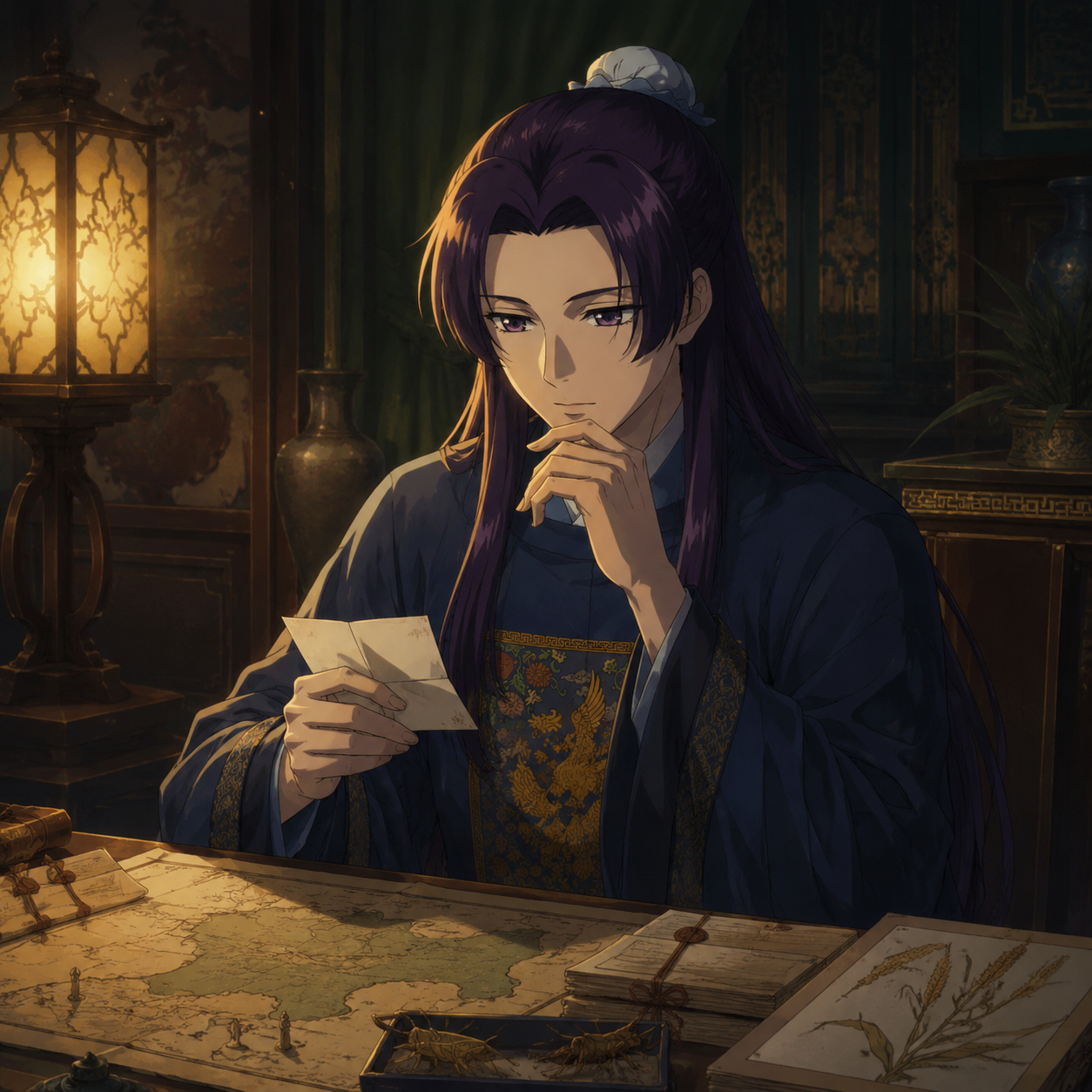
The key is that Volume 5 does not continue the story as if Loulan's note were only a private curiosity. It widens the map. Maomao and Jinshi are pulled into the Western Capital, where political performance, local power, food security, and pest danger all start pressing on each other.
That makes Loulan's note look like a hinge between arcs. The Shi clan incident leaves behind more than emotional damage. It leaves information. Loulan, as Shisui, is one of the few people whose insect knowledge and hidden position could connect palace intrigue to a coming environmental threat.
So the paper likely affects Jinshi in two ways at once. Strategically, it tells him that the next danger is not sitting neatly inside the capital. Emotionally, it tells him that Loulan chose to pass on useful truth instead of only saving herself.
This is also why the note should be read beside Shisui's earlier behavior, not apart from it. Her interest in insects looks eccentric when the story is still centered on court gossip and rear-palace mysteries. Once Volume 5 makes pest movement and agricultural collapse part of the political landscape, that eccentricity becomes foreshadowing.
The story is good at doing this. It lets a detail look like personality first, then later reveals that personality was also data. Shisui liking insects is funny, memorable, and slightly odd. Loulan leaving Jinshi a warning makes that oddness practical. Volume 5 is where the reader realizes the joke may have been carrying an alarm bell.
That gives the note a double function. It bridges Loulan's disappearance and Jinshi's western movement, but it also bridges two genres inside the series: intimate palace mystery and large-scale political disaster. The paper is tiny because the story wants the transition to feel quiet. The consequence is huge because the world outside the palace is huge.
This is why the note should not be treated as filler. It is a small object that explains a large pivot: Jinshi moves from cleaning up an incident to anticipating a crisis.
How Maomao Reads It
Maomao is the kind of observer who notices what a scene is trying not to say. So even if she is not holding the note herself, she would understand the pattern around it. A small message, a careful route, and a sender who cannot afford directness all point to the same thing: Loulan is choosing survival over spectacle.
But Maomao would also notice the practical side. If Shisui's insect knowledge suddenly becomes relevant to a western crisis, then the note is no longer just personal communication. It is a case clue. It tells Maomao that Loulan's odd interests were not decorative traits. They were part of how she understood danger.
In practical terms, the note helps point Maomao and Jinshi toward the right category of problem: not only "Who betrayed whom?" but "What is coming next, and who noticed it first?" In emotional terms, it gives Maomao another reason to respect what Loulan had to hide.
Maomao would probably be more interested in the shape of the clue than in the sentiment behind it. Who could know this? Why send it now? Why send it to Jinshi instead of someone else? Why make the message small enough to pass quietly? Those are Maomao questions, and they lead away from romance and toward motive.
That is also why the note is not only Jinshi's clue. It becomes the kind of clue Maomao can use once she sees the surrounding pattern. A high-ranking man may receive the warning, but the apothecary is the one best suited to understand why insects, crops, terrain, illness, and politics belong in the same conversation.
Why This Fits Loulan and Shisui
Loulan's note fits her character because indirect contact is how she survives. She is most visible when she is disguised, and most protected when she is unreadable. A note is both those things at once: visible enough to matter, opaque enough to keep her safe.
That is also why the note should not be over-romanticized. It is not just a cute hidden message. It is a character move. Loulan is telling the story that she can still act, but only within the narrow space the palace leaves open.
The earlier guide to Shisui's secrets matters here because it shows how much of Loulan's personality has always been built around concealment, play, and layered intention. The note is simply the clearest written version of that habit.
As Shisui, she could hide seriousness under harmlessness. As Loulan, she has to hide intention under formality. The paper slip sits between those two selves. It is playful only in the sense that it refuses to behave like an official report, but it is deadly serious in what it may allow Jinshi to prevent.
That is what makes the character compelling. Loulan does not need a speech to prove she understands the board. She moves one small piece and trusts that the right reader will understand the board has changed.
What Fans Usually Miss
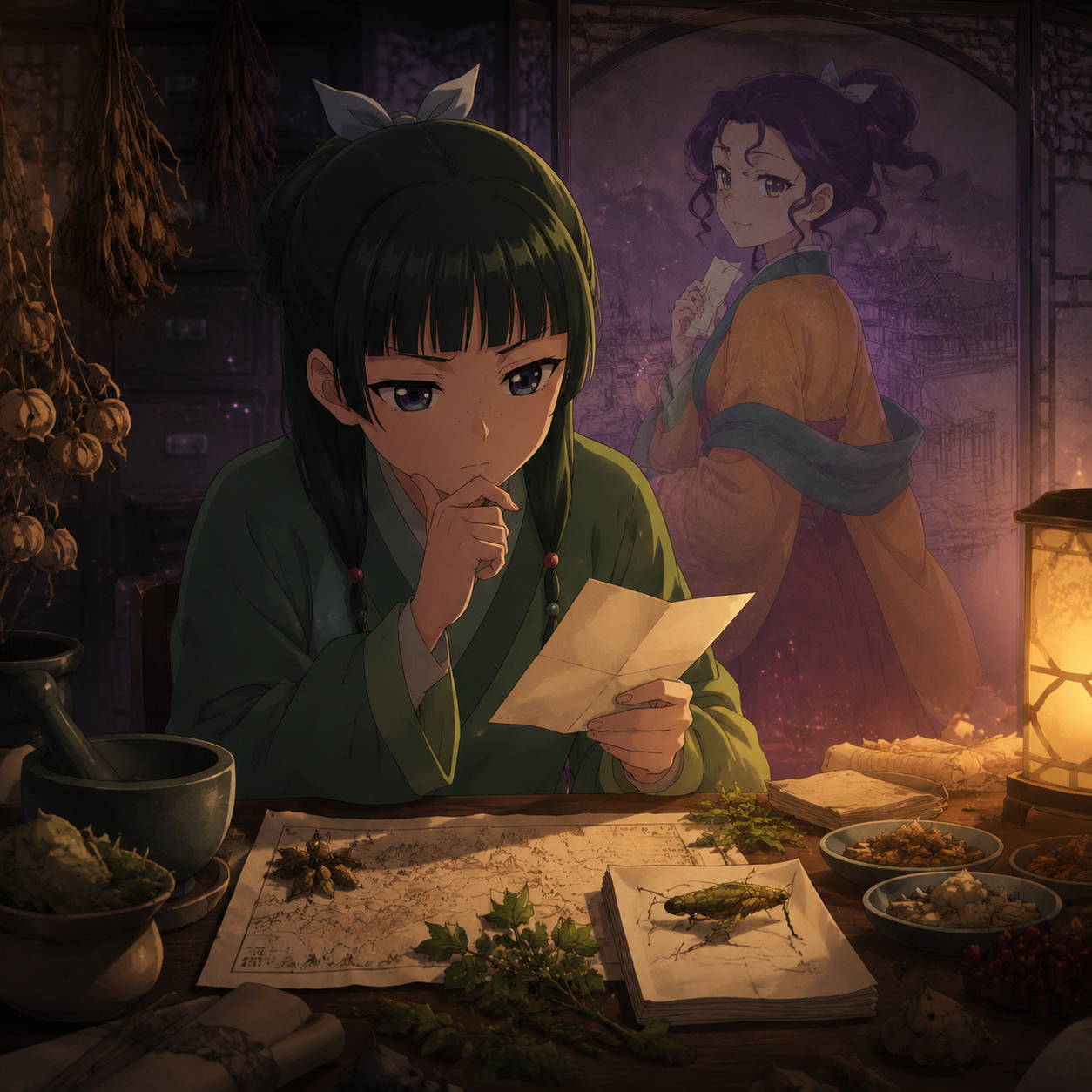
What fans often miss is that the note is not only about content. It is about usable content. Loulan is not just giving Jinshi a message. She is deciding how much truth can safely reach the one person positioned to act on it.
That is why this small scene matters so much. It turns a tiny object into a court strategy, a relationship clue, a survival signal, and a Volume 5 plot trigger all at once. In this series, those things are rarely separate.
So if you are asking what Loulan gave to Jinshi, the clean answer is a note. The better answer is that she gave him a controlled warning: enough to redirect his attention, not enough to expose everything in one fatal burst.
The note is also a test of Jinshi. If he treats it as a personal curiosity, he misses the point. If he treats it as evidence without context, he may expose the sender. If he treats it as a lead that requires patience, discretion, and Maomao's kind of intelligence, then he is finally reading the situation the way Loulan needs him to read it.
That is the real reason the scene stays interesting. The paper is not powerful because of its size, wording, or drama. It is powerful because it asks the right person to become quiet enough to understand it.
FAQ
Was Loulan's note a love note?
No. It is better read as a private, high-risk warning that carries emotional weight because Loulan chooses to pass useful information to Jinshi instead of staging a dramatic confession.
Does the story spell out every word in the note?
No full public transcript is treated as the point. The stronger reading comes from Volume 5: Jinshi's later movement toward the Western Capital and the locust-plague threat suggests that the note contained actionable warning, not just personal farewell.
Why is this scene important if it is so small?
Because The Apothecary Diaries often hides major plot movement inside small objects. A note can reveal more about identity, trust, power, and the next crisis than a loud confession ever could.
What should I read next?
Start with Jinshi's real name and hidden rank if you want the larger identity frame, or read the Ah-Duo silence analysis if you want the same theme from another angle.