Spoiler Warning
This article discusses light novel spoilers for The Apothecary Diaries Volumes 5 and 6, including Maomao and Lahan's western banquet work, Lahan using her as a La family relative, the later visit to his biological father's estate, the La family reaction to Lahan, Lakan's confinement, Fengxian's Go records, and the sweet potato negotiations that follow.
Scene Locator
The relationship evidence starts in Volume 5, when Lahan brings Maomao into the western entertainment and banquet material. He wants her eyes as an apothecary, a poison-risk observer, and a convenient La family relative. Maomao notices the usefulness of the arrangement, but she also notices how naturally he turns her identity into a tool.
The strongest follow-up comes in Volume 6 during the La family chapters, after Maomao and Lahan return from the west. Lahan takes Maomao to a rural estate near the landing point because he wants to see his biological father and investigate a crop lead. That practical errand turns into a family crisis when they discover Lakan has been confined there.
For Maomao and Lahan specifically, the important moments are not romantic or sentimental. They are tactical: Lahan trying to frame Maomao as family in Volume 5, Maomao refusing that emotional framing, both of them reading family reactions in Volume 6, Lahan calculating around Go and sweet potatoes, and Maomao stepping in when she thinks his numbers may become too convenient for his gentler father.
Volume-level entry only. The source is community-hosted; availability and rights status may vary.
The Short Answer
She Does Not Treat Him as a Real Brother
Maomao does not think of Lahan as a true brother in the emotional sense. Volume 5 already makes this clear: when Lahan tries to use a sibling-style label so she can accompany him at the western banquet, Maomao rejects the framing hard enough that he has to soften it into a vaguer "relative" cover. Volume 6 repeats the same pattern in a more serious form.
That reaction matters because it separates Lahan from both Lakan and Luomen. Lakan is the biological father Maomao keeps at a distance. Luomen is the father who actually raised her. Lahan sits in a third category: a useful La clan oddity who can travel with her, irritate her, and help solve a crisis without earning emotional family status.
So if the question is "Does Maomao like Lahan?" the answer is more precise than yes or no. She tolerates him better than Lakan, recognizes his usefulness, and can work with him, but she does not romanticize him, trust him blindly, or accept his sibling joke as a real bond.
She Thinks He Is Useful, Weird, and Too Comfortable With Numbers
Maomao's core judgment of Lahan is practical: he is strange, but he is not useless. In Volume 5, he can arrange access to a delicate banquet, handle foreign-facing business, and recognize when Maomao's poison knowledge is the right tool. In Volume 6, the same talent moves toward records, crop value, family procedure, and administrative openings.
At the same time, Maomao sees the cost of that talent. Lahan can turn family wounds into accounting problems so quickly that he barely notices why people are angry. His birth family sees betrayal; Lahan sees structure, evidence, and an outcome that made sense on paper.
That is why Maomao's view of him has a little bite. She does not think he is evil. She thinks he is a La clan person through and through: clever, oddly shameless, hard to embarrass, and capable of making human feelings look like messy arithmetic.
Volume 5 Sets Up Her Opinion Before the Estate Visit
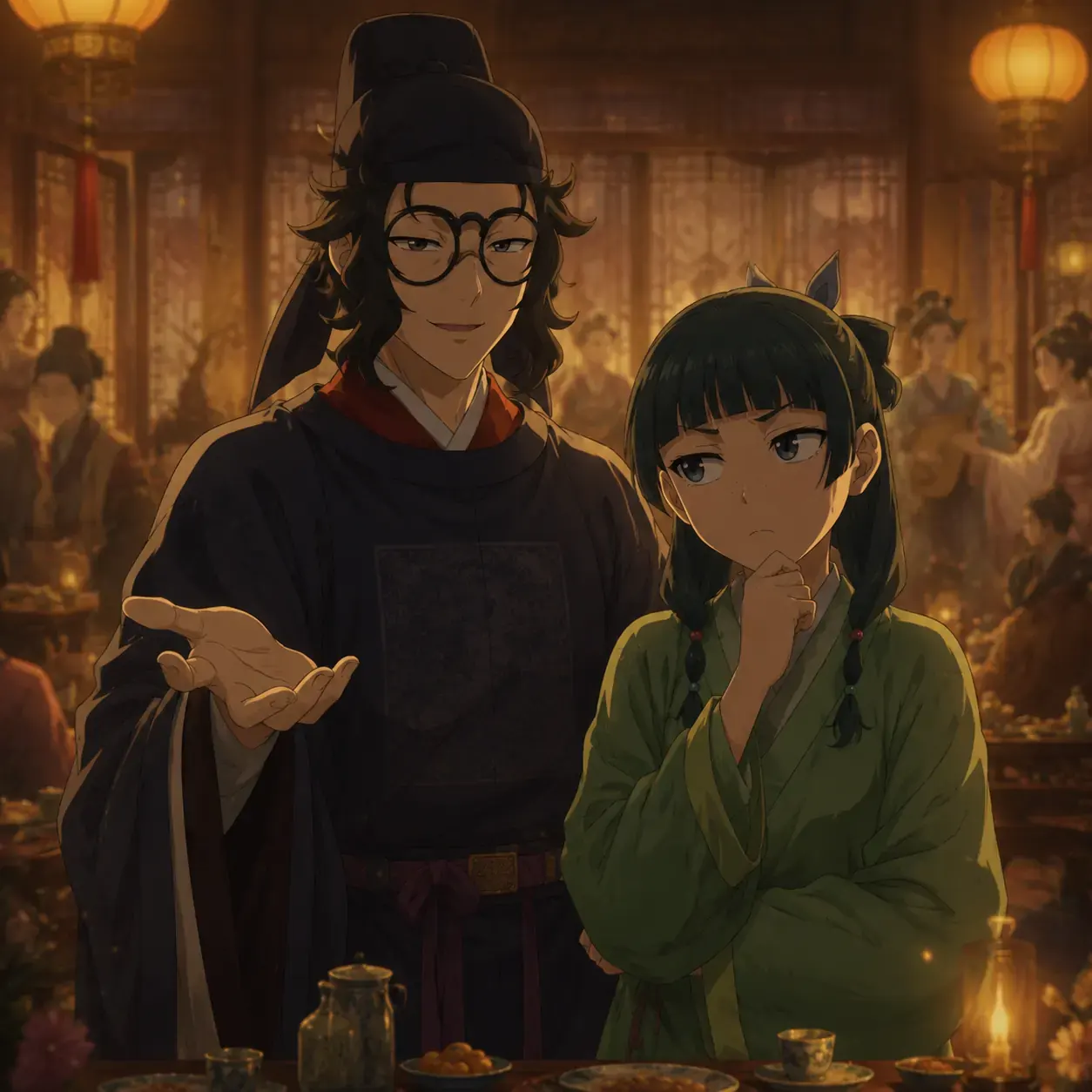
Volume 6 is where Maomao and Lahan's dynamic becomes easiest to summarize, but Volume 5 is where Maomao first gets enough evidence to classify him properly. Lahan does not approach her like a warm relative. He approaches her like someone who has already calculated that her curiosity, poison knowledge, and awkward La family status can solve several problems at once.
At first, that makes Maomao suspicious. She knows Lahan well enough to assume he is not inviting her anywhere without a reason. When he asks her to look into the suspicious entertainment troupe and later draws her into the western banquet, she understands that his politeness is attached to profit, access, and risk control.
She Notices That He Uses Family Labels as Tools
The clearest Volume 5 evidence is the banquet cover. Lahan wants Maomao present because a woman can move through that setting as a guest, a poison taster, and a harmless-looking companion. To make that work, he frames her through the La family. When he tries to call her a younger-sister figure, Maomao rejects the label so forcefully that the public explanation gets softened into "relative."
That reaction is not a throwaway joke. It tells us exactly what Maomao thinks of Lahan's claim on her: useful in public if it solves a problem, unacceptable if he expects her to emotionally accept the role. She will borrow the cover when needed, but she will not let the cover rewrite her actual feelings.
She Thinks He Is Competent Enough to Be Annoying
Volume 5 also shows why Maomao does not simply dismiss him. Lahan can arrange clothing, access, witnesses, and social positioning. He can talk business with western guests, recognize when a trade conversation hides political risk, and use Maomao's expertise without needing to explain every danger to her. That is real competence.
But his competence comes with a personality cost. He treats beauty, bloodlines, foreign trade, and even Maomao's social usefulness as things that can be sorted into patterns and returns. Maomao's irritation comes from seeing that he is often right about the practical angle while still being deeply unpleasant about how he gets there.
Her Trust Is Transactional from the Start
By the end of the Volume 5 banquet material, Maomao understands that Lahan is willing to use her presence as social camouflage. That does not make him her enemy. It does mean she will bargain for payment, watch for hidden motives, and punish his worst ideas in the simplest way available: by making it physically clear that he has crossed a line.
This is the foundation for Volume 6. When Lahan later appears inside his biological family's mess, Maomao is not meeting a new type of person. She is seeing the same Lahan in a harsher setting: useful, calculating, weirdly perceptive, and dangerously casual about what family language does to other people.
The Volume 6 Estate Visit Confirms It
The rural estate scene is the best place to test Maomao's attitude toward Lahan because it puts their Volume 5 pattern under family pressure. Lahan brings her to a house full of people who resent him. His brother panics. His mother and grandfather treat him like a traitor. Maomao watches all of it with the same dry attention she gives to poisons and palace gossip.
What she sees is not simply "poor Lahan." She understands why his family reacts badly. From their perspective, he crossed over to Lakan's side, helped expose the old family head's weaknesses, and benefited from the adoption that moved him into the winning branch. Maomao may not share their emotional intensity, but she does not dismiss the logic of their resentment.
She Reads His Lack of Self-Awareness
One of the funniest parts of Lahan is that he can be brilliant with records and nearly hopeless with emotional consequences. When his brother's anger becomes obvious, Lahan can still act as if the situation is somehow surprising. Maomao notices that gap immediately.
That gap is her real criticism of him. He is not stupid. He is too good at one kind of intelligence and too bad at another. He can see the beautiful shape of numbers, but not always the ugly shape of resentment.
She Can Still Work With Him
Maomao does not need Lahan to be emotionally normal to work with him. In fact, Volume 6 shows that his abnormality is useful. He can stay relatively calm inside family chaos, talk through court procedure, calculate Go outcomes, and move quickly once the sweet potato issue becomes more than a household curiosity.
This is why their dynamic is not warm but effective. Maomao observes the body, the room, and the social pressure. Lahan observes the records, numbers, and political utility. Between them, they turn a bizarre family visit into information.
Why Lahan's Family Problem Changes the Reading
Maomao's opinion of Lahan becomes sharper once she sees him inside his birth family. Away from that house, Lahan can look like comic relief with a monocle-like obsession for numbers. Inside the La family estate, his comedy gains a cost.
His brother is not merely being rude. His mother is not only dramatic. The old branch of the family has a reason to see Lahan as someone who left them behind and made himself useful to Lakan. Maomao understands that Lahan is not innocent in the emotional sense, even if his actions may have been logical or useful.
She Sees Why They Call Him a Traitor
This is where the article on why Lahan is treated like a traitor matters. The "traitor" label is family language, not a state crime. Maomao reads it as the old household's reaction to Lahan choosing Lakan's side and helping the evidence chain that broke the old headship.
Her view is not sentimental. She does not rush to comfort Lahan or declare him misunderstood. She simply recognizes the structure: Lahan is useful because he can detach from blood loyalty, and that same detachment is exactly why his birth family cannot forgive him.
She Also Sees That Lahan Is Not Lakan
At the same time, Maomao does not react to Lahan the way she reacts to Lakan. Lakan's attention feels invasive because he wants a father-daughter bond Maomao never agreed to give him. Lahan's "sister" language is annoying, but it does not carry the same emotional force.
That makes Lahan easier for her to handle. He is not safe in the sense of being normal, but he is safer because his demands are more practical. He wants information, numbers, crops, leverage, and occasionally a joke. Lakan wants recognition from Maomao's heart. That is a much bigger problem.
The Sweet Potato Deal Is the Clearest Proof
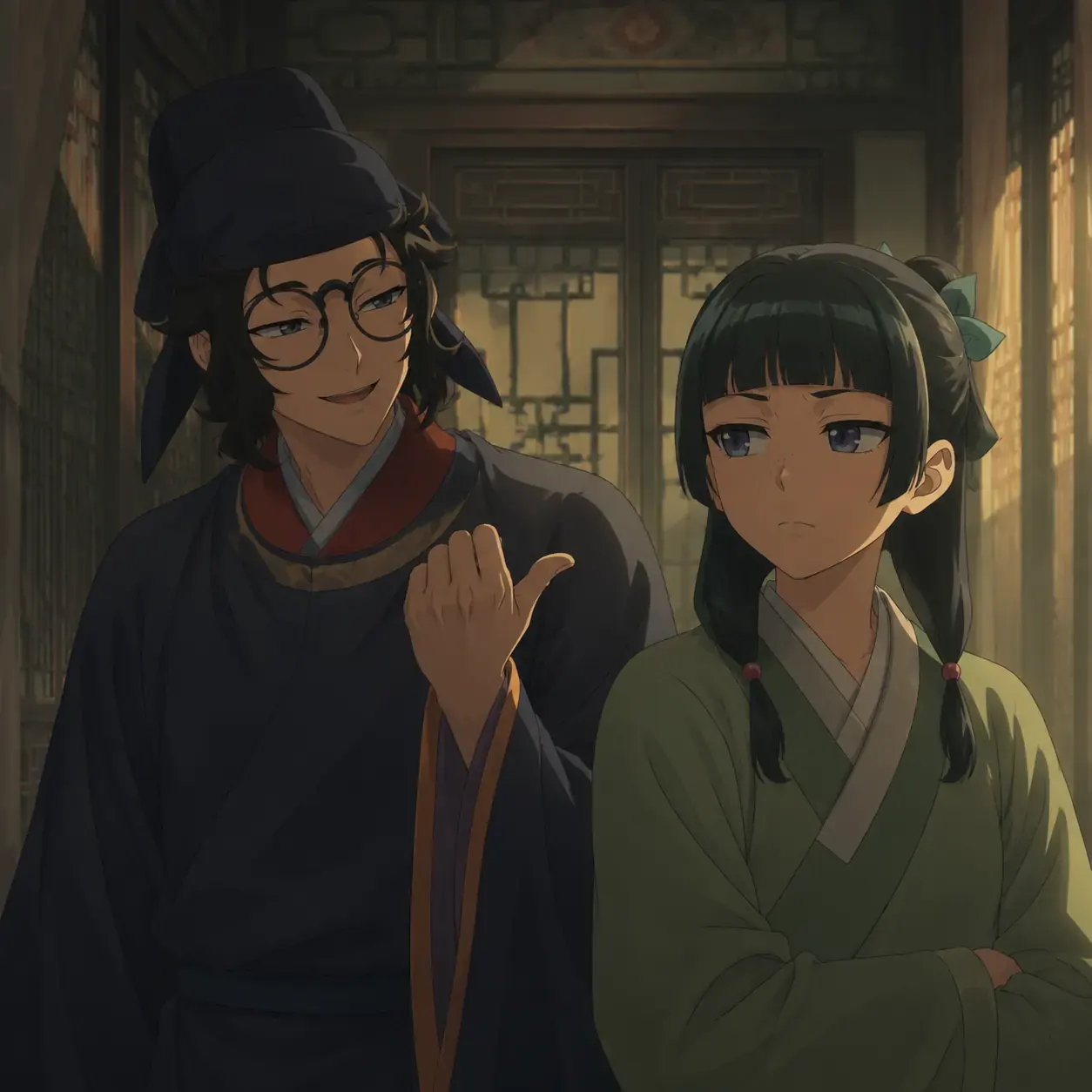
The sweet potato section is the cleanest window into Maomao's opinion of Lahan. Once Lahan realizes the crop's value, the family drama becomes an economic and political opportunity. His father has been growing a high-yield crop that can survive poor soil and multiply through vines. In the context of food risk and possible locust trouble, that is not a cute rural hobby. It is a strategic resource.
Maomao understands the value too, but she also understands Lahan. When his father agrees too easily to hand over crop material and cultivation knowledge, Maomao intervenes by writing terms. That action says more than a paragraph of inner monologue could.
She Expects Lahan to Be Fair Only If the Terms Are Clear
Maomao does not assume Lahan will be pointlessly cruel. She does assume he may take the best possible deal if no one stops him. That is a very specific kind of distrust. It is not fear. It is professional caution.
She sees that Lahan's father is gentle and too ready to give. She sees that Lahan is calculating and too ready to use. So she puts writing between them. In Maomao's world, affection is unreliable, but clear terms can keep people from quietly being consumed by someone else's cleverness.
She Respects Competence, Not Sentiment
This is also why Maomao does not dismiss Lahan. If he were only greedy, he would be simple. He is not simple. He recognizes the crop's value, thinks in scale, and connects a family field to a larger food-supply problem. Maomao respects that kind of practical competence even when she dislikes the personality attached to it.
For the wider western crisis behind the crop issue, read why Jinshi had to go west. That context explains why Maomao and Lahan's sweet potato discovery is bigger than a country-house subplot.
Does Maomao Trust Lahan?
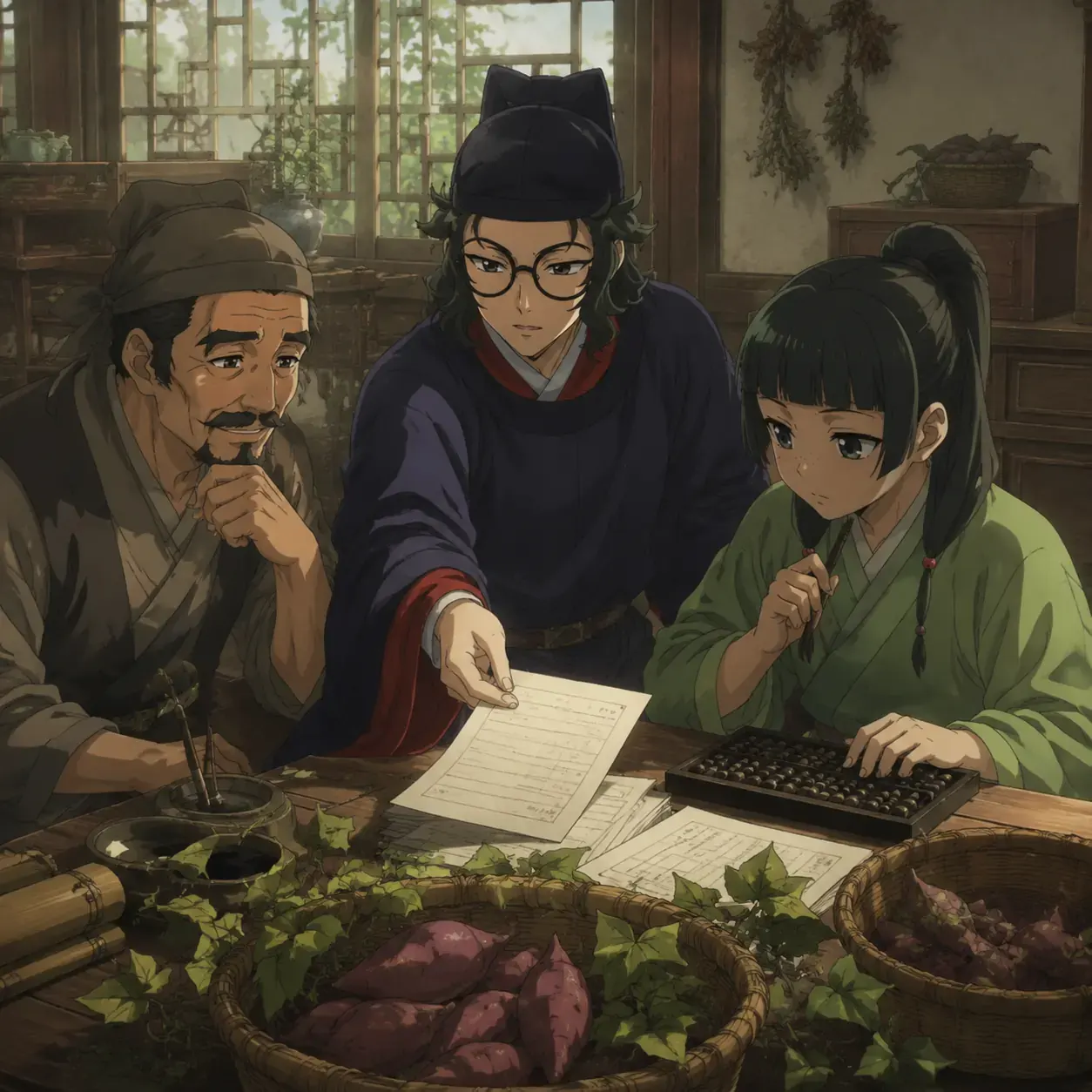
Maomao trusts Lahan in a limited, task-based way. She can travel with him, follow his lead to the estate, share information with him, and rely on his ability to read numbers or family procedure. But she does not trust him in the soft emotional sense.
That distinction is important. Maomao's trust is usually earned by competence and bounded by caution. Lahan has enough competence to be useful, but enough La clan strangeness to require supervision.
He Is a Colleague Before He Is Family
The best label for Lahan from Maomao's point of view is not "brother." It is something closer to "annoying but useful colleague from the La family." He can help solve problems. He can also create problems by assuming other people will follow his logic.
That is why Maomao's attitude toward him feels less hostile than her attitude toward Lakan. Lahan does not demand her heart. He demands that reality be made numerically interesting. That is irritating, but manageable.
She Knows When to Stop Him
The contract scene proves that Maomao's trust has a boundary. She does not let Lahan's father be swept up by family generosity, and she does not let Lahan's calculation decide the entire shape of the deal. She steps in because she knows exactly what kind of man Lahan is.
That is one of Maomao's quiet strengths. She does not need to accuse Lahan of wrongdoing to protect the situation. She simply makes the arrangement harder to abuse.
Why This Dynamic Matters
Lahan Shows Maomao's Practical Social Intelligence
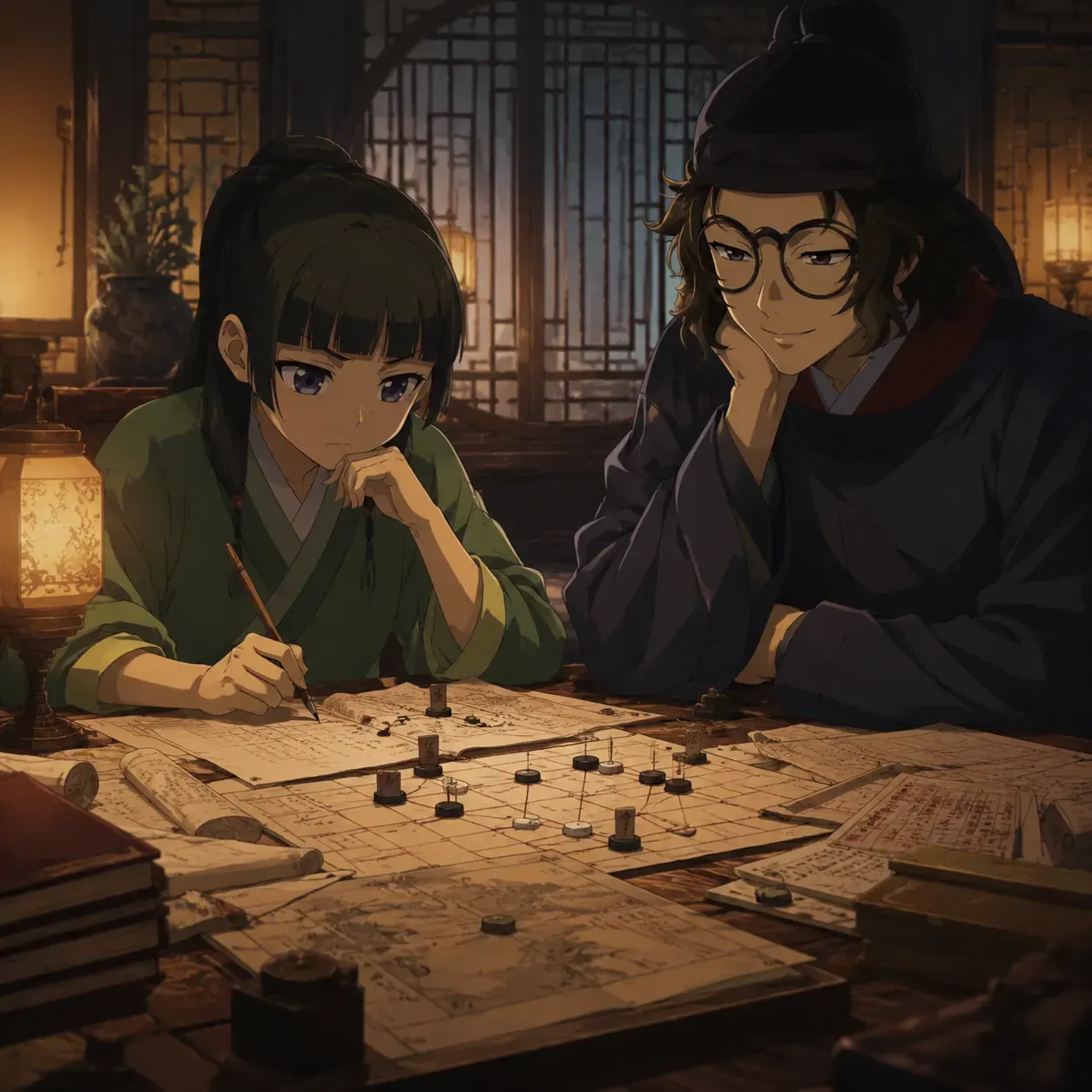
Maomao's view of Lahan reveals how good she is at sorting people by function without becoming naive about them. She knows he is not normal. She knows he is not harmless. She also knows he is not simply a villain.
That is a very Apothecary Diaries kind of judgment. People are rarely useful because they are pure. They are useful because their damage, talent, and incentives point in a direction that can be managed.
He Mirrors Lakan Without Triggering the Same Boundary
Lahan is connected to Lakan by adoption, family politics, and a shared talent for reducing messy life into patterns. But Maomao's reaction to him is different because he does not occupy the same wound. Lahan may call her sister, but he does not carry Lakan's claim of fatherhood.
That makes him a more flexible figure in Maomao's world. He can be a nuisance, a guide, a witness, a negotiator, and a source of dry comedy. Lakan, by contrast, is always emotionally loaded.
Maomao's Final Judgment Is Balanced
Maomao thinks Lahan is useful enough to keep around, strange enough to watch, and shameless enough to require written terms. She does not hate him. She does not warmly accept him as family. She treats him as a clever tool that sometimes needs a guardrail.
That is why their Volume 5 and Volume 6 material works so well. Volume 5 shows the social cover and transaction. Volume 6 shows the family wound and economic opportunity. Maomao and Lahan are not intimate, but they are legible to each other. In a story full of hidden motives, that kind of dry legibility can be almost comforting.
FAQ
Does Maomao like Lahan?
She seems to tolerate and respect his usefulness more than she emotionally likes him. Lahan is strange and annoying to her, but he is competent enough that she can work with him.
Does Maomao see Lahan as her brother?
No, not emotionally. In Volume 5, she pushes back when Lahan tries to use a sister-like public cover for the western banquet. Later, she still treats herself as an outsider and does not accept that as a real sibling bond.
Why does Volume 5 matter for Maomao and Lahan?
Volume 5 shows the pattern before the rural estate incident: Lahan uses Maomao's La family connection as social cover, relies on her poison knowledge, and proves useful enough that she cooperates while staying irritated and cautious.
Why does Maomao travel with Lahan in Volume 6?
The trip begins as a practical visit tied to Lahan's biological father and a crop lead. Maomao goes along, and the visit unexpectedly exposes Lakan's confinement and the La family headship crisis.
Does Maomao trust Lahan?
Only in a limited way. She trusts his competence with numbers, records, and logistics, but she still watches him carefully, especially when his father's sweet potatoes become valuable.
Why does Maomao write terms for the sweet potato deal?
She sees that Lahan's father is generous and that Lahan is calculating. Writing terms protects the father from being underpaid or quietly used by Lahan's larger plans.
What should I read next?
Read did Lahan know Lakan was at the residence? for the immediate estate mystery, then read why Lahan is treated like a traitor for his family background.