Spoiler Warning
This article discusses light novel spoilers for Volume 5 and Volume 6, including Lishu's family background, the attempted southern governor marriage, Ah-Duo's intervention, the question of Lishu's paternity, her return to the rear palace, and the Volume 6 aftermath.
Scene Locator
The main evidence begins in Volume 5, when Lishu tells Maomao that her attendants were sent by her father and then asks whether Maomao can judge whether the man presented as her father is truly her parent. The question looks awkward on the surface, but it lands in the middle of an unusually dangerous family puzzle.
Volume 5 also reveals the larger pattern around Lishu. Her mother is dead, her father is not described as a warm guardian, and Lishu has already been used as a court asset once. After the former emperor dies and Lishu leaves the rear palace, her father tries to reuse her through another marriage arrangement, this time with a much older southern governor. Ah-Duo and the emperor block that path.
Volume 6 then shows what is left after the western journey. Lishu returns to the rear palace, still surrounded by servants who are not fully on her side. The later tower incident, the emperor's handling of her position, and Basen's rescue make the same point from another angle: Lishu's life has been moved by fathers, patrons, ranks, and rumors before she ever learns how to move it herself.
Volume-level entry only. The source is community-hosted; availability and rights status may vary.
The Short Answer
Not a Perfect Mastermind
Lishu's father should not be read as a flawless mastermind who controls every accident in Volume 5 and Volume 6. The novels do not prove that he arranged every danger around Lishu, and it would be too much to blame him for unrelated schemes simply because he is unpleasant. The better reading is sharper and more realistic: he is an opportunist.
His plan is not one clean plot. It is a habit. Whenever Lishu's status changes, he tries to turn that status into leverage for the family. If the old emperor's rear palace can raise the family's position, Lishu is sent there. If a southern governor can create a useful alliance, Lishu becomes marriage material. If Ah-Duo and the emperor intervene, that intervention itself may become another opening. If Jinshi's western trip creates marriage talk around the imperial younger brother, Lishu can be placed near that possibility too.
The Family Asset Logic
The simplest answer is this: Lishu's father was planning to keep Lishu usable. Not necessarily happy, not necessarily safe, and not necessarily loved. Usable.
That is why his behavior feels so cold. He does not need one villain speech. The pattern is already visible in the choices around her: a daughter is a route back into power; a bad marriage is still useful if it creates rank, protection, money, or political favor; a rumor about bloodline can be dangerous, but also valuable if handled carefully.
This is also why the companion article on whether Lishu was forced to go west matters. Lishu's western journey is not just a travel event. It is another scene where her future is being negotiated by people with more authority than she has.
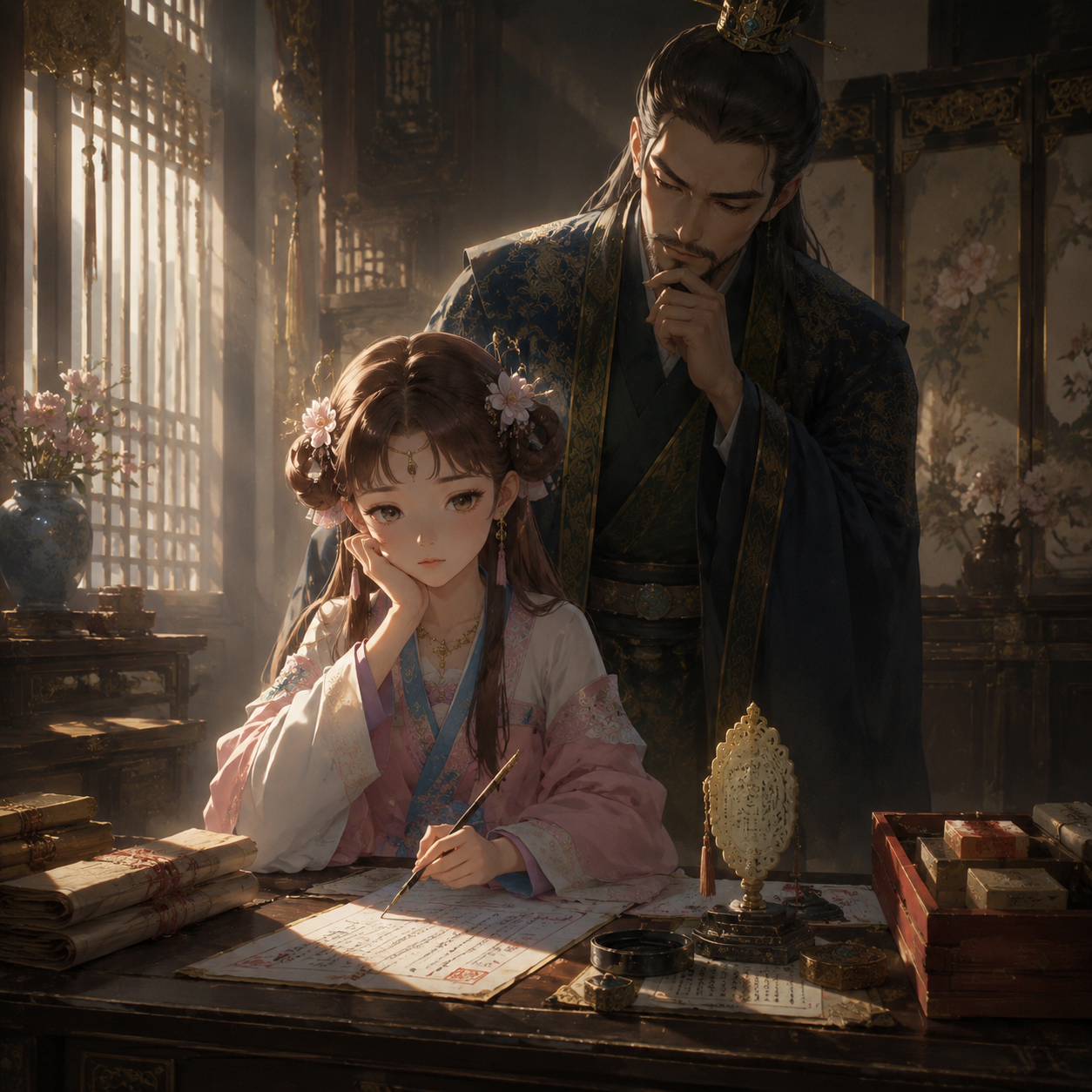
Plan One: Turn Lishu Into a Palace Asset
The first part of the plan happens before the western arc. Lishu is placed in the rear palace when she is far too young to understand the full political weight of that role. That alone tells us a lot about her household. A protective family might have hesitated. A family hungry for restoration sees court placement as an investment.
Lishu's family background makes this more plausible. She comes from a line with prestige attached to it, but the family is no longer secure enough to live on prestige alone. That is exactly the kind of house that turns a daughter into a ladder. The girl does not need to be personally ambitious for the family to use her rank as proof that the family still belongs near the center.
The rear palace is not a safe school
Readers should remember what the rear palace is. It is not a finishing school where noble daughters politely wait for romance. It is a battlefield wrapped in etiquette, beauty, and rank. A girl placed there becomes part of succession politics, faction politics, sexual politics, and household competition. Lishu is not built for that environment, but her father sends her into it anyway.
That choice explains why Lishu often looks weak. She is not simply born foolish. She has been asked to perform adulthood before she has enough internal structure to survive adulthood. Her timid personality becomes worse because the systems around her reward aggression and punish uncertainty.
Her father's plan begins with access
From his perspective, the rear palace placement gives the family access. Even if Lishu never becomes politically powerful herself, her title, her proximity, and her symbolic connection to the court can be exploited. She becomes a family credential.
That is why the later marriage pressure should not surprise us. Once a family learns to see a daughter as a credential, it keeps asking where that credential can be spent next.
Plan Two: Use a Bad Marriage as Leverage
The proposed southern governor marriage is the clearest sign that Lishu's father is not acting from ordinary parental concern. A marriage to a much older man with existing women around him is not a humane answer to Lishu's problem. It is a transaction. The fact that Ah-Duo and the emperor stop it tells readers the match was bad enough to require high-level intervention.
But the interesting question is whether the bad match was only greed, or whether it also functioned as pressure. Maomao considers the possibility that if a marriage is almost arranged and then must be stopped, the people stopping it need a serious alternative. In other words, the father may not need the southern governor marriage to succeed. He may benefit if it creates a crisis that forces a better patron to step in.
The ugly match creates an excuse for powerful intervention
This is the most interesting reading of Lishu's father. He may be a weaker player than Ah-Duo or the emperor, but weak players can still manipulate the board by creating embarrassing problems. If he offers Lishu to a terrible match, the court has to respond. If the court responds, Lishu is pulled back into higher-level political handling. Either way, the family keeps her on the board.
That does not mean the father knew exactly what Ah-Duo would do. The novels do not give him that much confirmed control. It means he understands the value of making Lishu difficult to ignore. A bad marriage is not only a destination. It is leverage.
Ah-Duo's rescue may still serve the family by accident
Ah-Duo's intervention is emotionally protective, but politically it can still be useful to Lishu's household. If Ah-Duo takes charge of Lishu, then Lishu is no longer just a girl being thrown at a southern governor. She becomes a girl personally handled by one of the most important women connected to the imperial family.
That is the cruel elegance of court politics. A rescue can become another form of value. Even when Ah-Duo is trying to save Lishu from being sold cheaply, the mere fact that Ah-Duo steps in raises Lishu's political temperature.
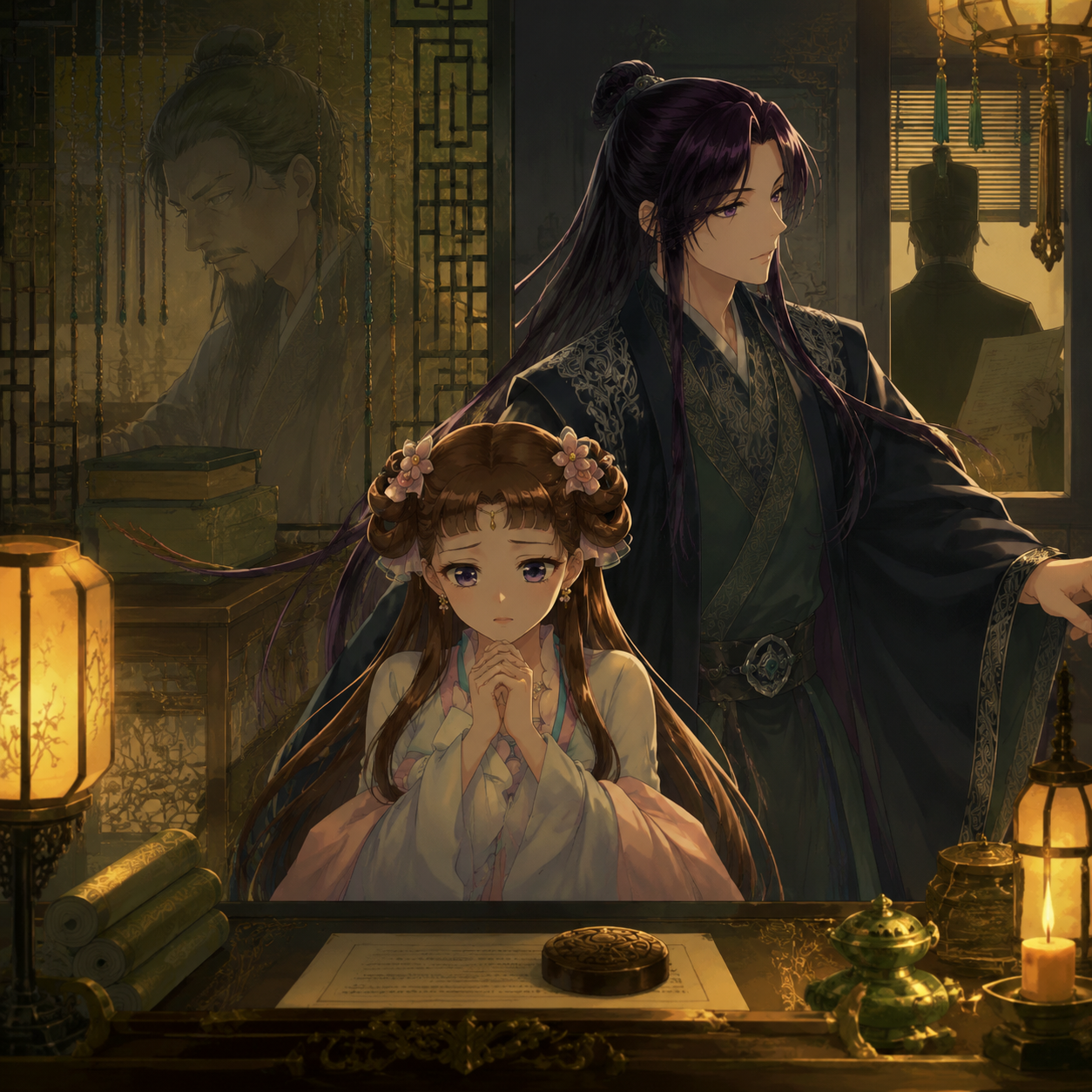
Plan Three: Keep Control Through Servants
Lishu says her attendants were sent by her father. That small detail matters more than it first appears. Servants in The Apothecary Diaries are rarely just furniture. They carry loyalties, information, family orders, resentment, and surveillance. A father who sends attendants with his daughter has not released her. He has extended the household's eyes into her new space.
Volume 6 makes this even more unsettling because Lishu's attendants do not feel like a protective circle. The behavior around her suggests contempt, pressure from family factions, and possible obedience to people who dislike her. Whether the servants are directly following her father, an older half-sister, or household expectations, the effect is the same: Lishu's own staff does not fully belong to her.
Servants turn family power into daily pressure
For a vulnerable noblewoman, servants can either become a shield or a cage. Lishu needs people who understand her fears, protect her reputation, and help her navigate court rules. Instead, she is surrounded by people who can shame her, report on her, isolate her, or simply fail to protect her when the palace becomes dangerous.
This is one of the reasons Lishu's story feels so suffocating. She cannot even assume that the people brushing her hair and managing her rooms are on her side. Her father's influence does not need to appear as a dramatic command. It can appear as a servant quietly deciding that Lishu's comfort does not matter.
The plan depends on Lishu staying dependent
If Lishu became decisive, socially skilled, and independently protected, her father would lose influence over her. But as long as she remains frightened and dependent on the household network, the family can keep positioning her. Her weakness is not only unfortunate for him. It is useful to him.
That is why the story's sympathy for Lishu is so important. It asks readers to see the difference between a character who is naturally helpless and a character who has been trained into helplessness by a family that benefits from her not being able to choose.
Plan Four: Gamble on Jinshi's Marriage Politics
The western arc raises the stakes because Ah-Duo's side of the journey is tied to the possibility of selecting a consort for the imperial younger brother. That means Lishu is not only escaping a bad marriage. She may be redirected toward a far more valuable one.
For Lishu's father, this possibility would be enormous. A daughter connected to an old southern governor is useful. A daughter connected to Jinshi's public role as the imperial younger brother is in a different category. Even if the plan is never cleanly stated as his goal, the logic of his past behavior points toward the same conclusion: if a higher alliance becomes possible, he would have every reason to prefer it.
Why Jinshi changes the value of Lishu's position
Jinshi's identity and public status make every marriage possibility around him politically loaded. An ordinary noble match can enrich a family. A match near Jinshi can reshape a family's standing at court. This is why Lishu's placement near that discussion cannot be treated as harmless matchmaking.
The article on Jinshi's real name and hidden position explains why his identity is never just personal. In Lishu's case, that matters because her father is operating in a world where a single marriage rumor can be worth more than years of ordinary service.
Lishu is not emotionally ready for the role
Volume 6 shows that Lishu has enough insight to realize Jinshi's smile was not special affection for her. This is a quiet but important development. She does not become a scheming rival. She becomes a girl beginning to understand that she has been placed near a role she cannot truly own.
That makes the father's possible ambition look even colder. He does not need Lishu to understand Jinshi. He only needs her to be eligible enough, visible enough, and movable enough for other people to consider.
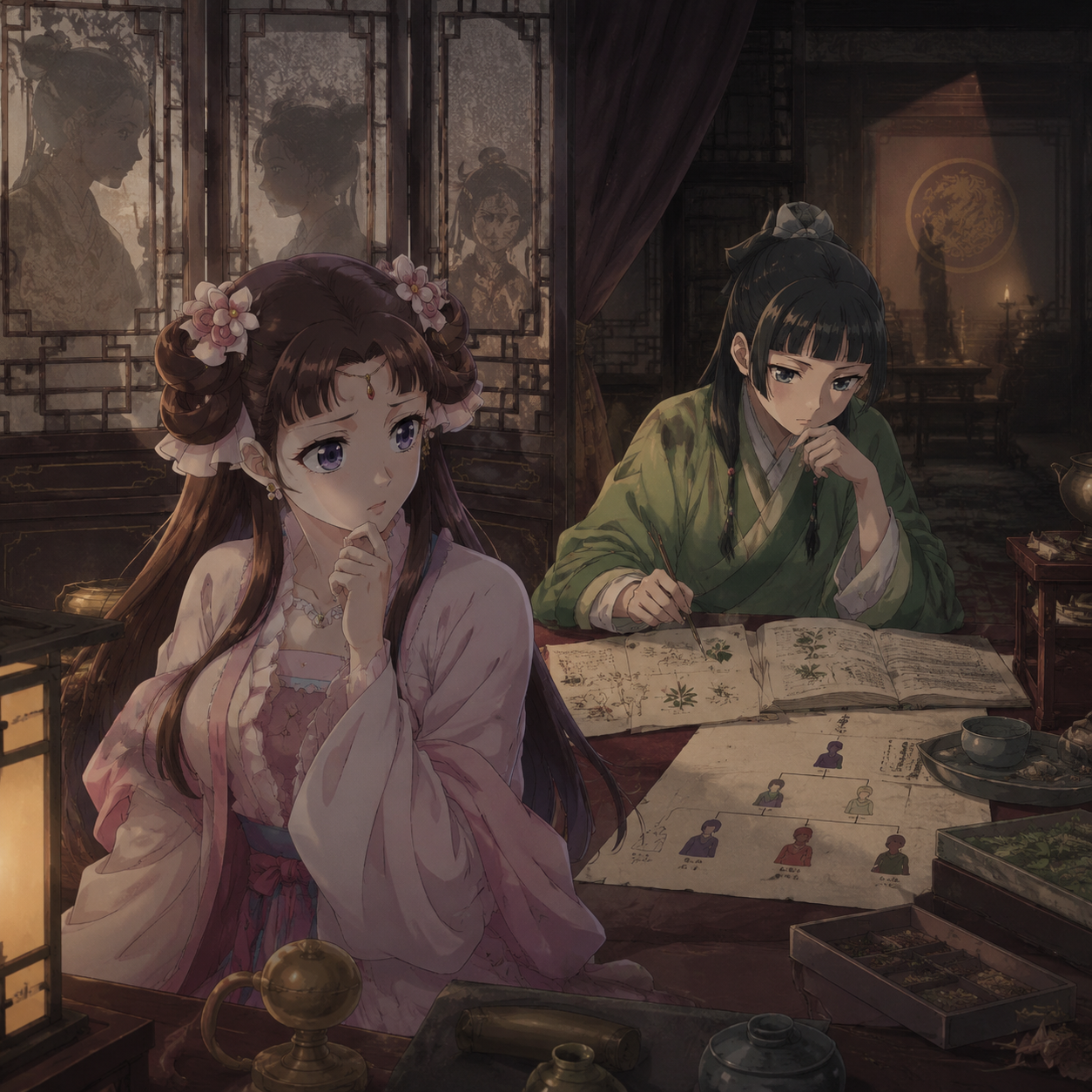
Why the Paternity Question Matters
Lishu's question to Maomao about whether the man called her father is truly her father is not a random insecurity. It is a political bomb wrapped in an embarrassed conversation. Her mother had connections to Ah-Duo and the emperor. Her father stands in a more complicated family position. Lishu herself suspects that the truth of her birth may not be as simple as the household says.
The important point is not to declare that one theory is proven. The important point is that uncertainty itself becomes dangerous. If Lishu is possibly connected by blood to the emperor, then any discussion of placing her near Jinshi becomes far more delicate. A marriage that looks politically brilliant from one angle may become taboo or explosive from another.
Ambiguity can be used even before it is proven
Court politics does not always need certainty. Sometimes rumor is enough. A family can benefit from hinting at closeness without proving it. A household can keep a girl valuable by allowing ambiguity to linger. The father may not know the full truth, but he can still exploit the fact that Lishu's background is unusual enough to make powerful people cautious.
That is why Maomao's role is so fitting. Maomao is asked a biological question, but the real issue is social and political. Blood can answer one kind of question. It cannot answer whether a family has loved someone, protected someone, or merely used her.
Ah-Duo and the emperor read the danger differently
Ah-Duo's protection of Lishu is easier to understand once this uncertainty is on the table. She is not only saving a timid girl from a bad marriage. She is managing a person whose presence touches older palace history, imperial memory, and dangerous assumptions about legitimacy.
The emperor's later handling of Lishu also makes more sense through this lens. He treats her as someone who should be protected and quietly removed from the worst parts of the system, not as a disposable pawn. That difference is where the father's plan begins to fail.
Why Volume 6 Breaks the Plan
By the end of Volume 6, Lishu's father has not achieved a triumphant outcome. Lishu does not become Jinshi's bride. She does not remain safely useful as a high-ranking consort. She is sent away for another period of religious retreat and then stripped of her consort position before returning to her family. The family avoids severe punishment, but the grandest political possibilities around Lishu are cut down.
This outcome is important. It suggests the emperor is not rewarding Lishu's father. He is containing damage. He wants Lishu protected, the scandal controlled, and the family kept from exploding into a larger political problem. That is not the same as letting the father win.
The emperor protects Lishu by lowering her political value
Removing Lishu from the consort role may look like punishment, but it also lowers the pressure around her. A high consort can be used, envied, targeted, or turned into a symbol. A former consort returned to her family has less immediate court value. It is not perfect freedom, but it reduces the number of people who can profit from keeping her in the palace game.
That is why Volume 6 feels bittersweet. Lishu is not handed a modern happy ending. She is given a quieter, less dangerous arrangement inside a world that does not offer many clean exits. For someone whose father kept trying to spend her position, becoming less spendable may be a form of survival.
Basen's role points toward a different future
Basen's rescue also matters because it reframes Lishu's value. Her father treats her like a strategic asset. The palace treats her like a rank and a risk. Basen treats her, in the crucial moment, like a person whose life matters immediately.
That contrast is why readers often respond strongly to Lishu's Volume 6 arc. It is not just about who she might marry. It is about whether anyone can see her without first calculating what she is worth.
Common Misreadings
Misreading 1: Lishu's father only wanted a good marriage
The southern governor match makes that reading hard to defend. A good fatherly match would prioritize Lishu's safety, age, temperament, and future. This arrangement looks more like the family trying to convert her into political advantage.
Misreading 2: Lishu's father planned every later disaster
The text does not prove that. He is better read as an opportunist than an omniscient mastermind. He creates pressure, uses leverage, and keeps influence around Lishu, but other dangers in Volume 5 and Volume 6 have their own causes.
Misreading 3: Ah-Duo uses Lishu the same way
Ah-Duo also makes decisions around Lishu, but motive matters. Ah-Duo appears to be reducing harm inside a cruel system. Lishu's father appears to be extracting value from that system. Both limit Lishu's agency, but they are not morally identical.
Misreading 4: The paternity question proves the whole answer
The paternity question is important because it reveals political danger, not because it gives readers a single confirmed solution to every mystery. The ambiguity itself is what makes Lishu valuable and vulnerable.
FAQ
What was Lishu's father planning?
He appears to be planning around opportunity rather than one fixed scheme. His pattern is to keep Lishu politically useful: first as a rear palace consort, then as marriage material, and later as someone who might be placed near higher imperial marriage politics.
Did Lishu's father arrange the southern governor marriage on purpose?
Yes, the novels frame that marriage as part of the family pressure around Lishu. What remains uncertain is whether he expected Ah-Duo and the emperor to block it. A strong reading is that the bad match created leverage even if it did not succeed.
Was Jinshi part of Lishu's father's plan?
Jinshi may not have been the original plan, but the western arc gives Lishu's father a reason to hope for a better political outcome. If a connection to the imperial younger brother became possible, it would fit the father's pattern of using Lishu's status for family advancement.
Did Lishu's father know the truth about her birth?
The text does not prove exactly what he knew. The safer answer is that he may have exploited uncertainty around Lishu's background, while the story leaves room for danger without confirming a complete hidden master plan.
What should I read next?
Read whether Lishu was forced to go west for her agency question, why Jinshi had to go west for the wider western arc, and Jinshi and Ah-Duo's secret for the older palace history behind Ah-Duo's protectiveness.