Spoiler Warning
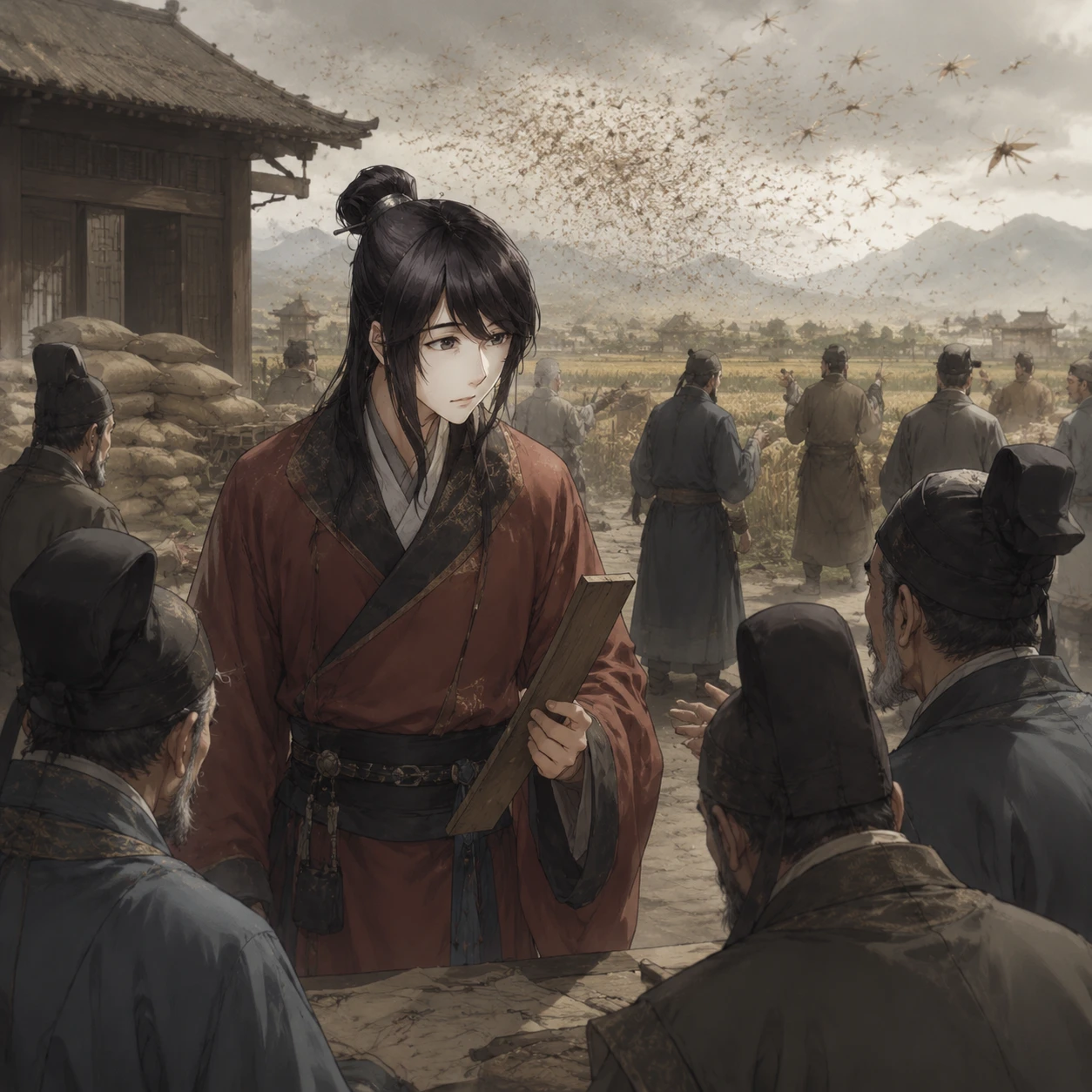
This article discusses light novel events from the western locust crisis, including the difference between ordinary locusts and flying locusts, the famine risk, Jinshi's emergency decisions, and Rikuson's later administrative role. It goes beyond the anime's currently established material.
Scene Locator
Volume 10 is the source checkpoint for Rikuson's concrete response: Chapters 2-3 establish his rural inspections, Chapters 9 and 14 deepen the investigation around the western countryside, and Chapters 16-20 show the grain checks, village pressure, locust work, and aftermath. Read those scenes beside the site's locust evidence guide and the analysis of why Jinshi had to go west.
Volume-level entry only. The source is community-hosted; availability and rights status may vary.
The Short Answer
He Was Not the Insect Researcher
Rikuson did not identify the dangerous flying-locust pattern from the market food, and he did not write the insect guide that explains color, wings, generations, and the danger of a small outbreak becoming a larger one. Those discoveries belong to Maomao's investigation and the knowledge preserved in the western records.
This distinction matters because a tempting summary would make Rikuson look like the person who solved every part of the crisis. The novel is more interesting than that. Rikuson is valuable precisely because he works on a different layer of the problem.
He Read the Crisis Through Rural Administration
The detailed Volume 10 scenes begin with paperwork rather than spectacle. Rikuson explains that agricultural documents were mixed into his miscellaneous duties, so he started checking grain reserves and looking into the countryside instead of treating each report as an isolated clerical task.
That is the source-backed version of his strength: he notices that a food emergency has to be investigated where the crops and people actually are. Maomao later judges that he has real guidance ability in the locust response, while still questioning whether he is the right permanent successor for the region.
What Rikuson Actually Did
He Checked Grain and Rural Conditions
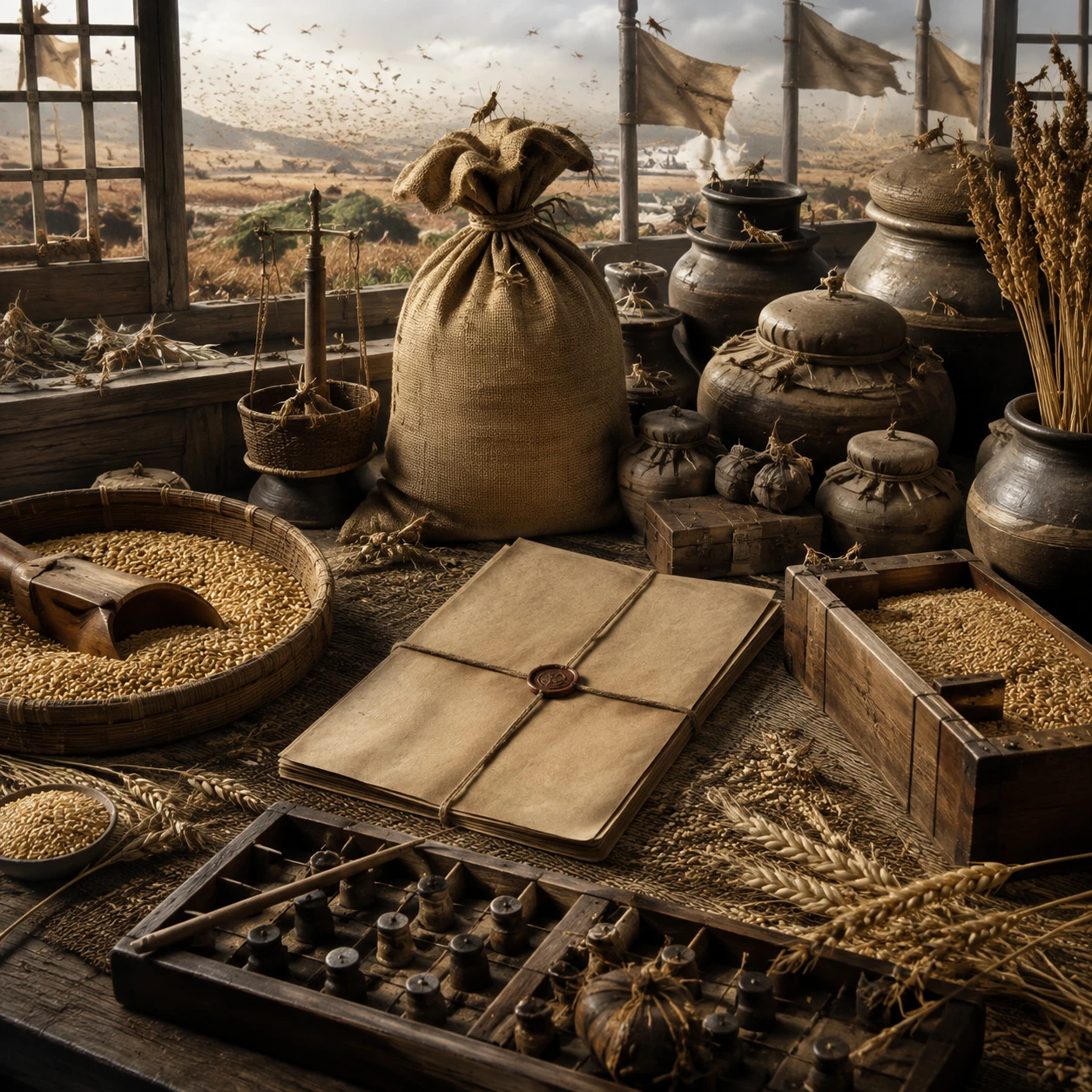
In Volume 10, Rikuson connects routine documents to the possibility of a larger rural problem. He checks grain reserves, visits farming areas, and investigates conditions that a desk-bound official could easily overlook.
The novel does not present him as a universal administrator who personally solves every problem. It shows something more specific: he uses his bureaucratic position to find the places where food security is already failing, then goes close enough to verify what the reports mean.
He Pressed Villages to Act Before the Swarm
One concrete measure is uncomfortable but effective: Rikuson tried to move villagers who were too slow to act by offering to buy their wheat at double the price. The point was to get the harvest secured before the locusts could take it, not to stage a heroic battle after the fields were already lost.
This also explains why his response cannot be reduced to insect-killing. He used money, timing, local observation, and pressure on people who were hesitating. The novel presents a practical intervention with a visible cost, not an abstract theory of perfect governance.
He Stayed with the Aftermath
Volume 10 continues to show Rikuson in the field after the first warning. He remains involved while people are still dealing with flying locusts, damaged crops, and the question of what the remaining grain can be used for. The village scenes are not a clean victory parade; they are negotiations inside an ongoing disaster.
That is why Maomao can call his guidance effective. Rikuson does not vanish once the first decision is made. He stays close to the places where the response has to be adjusted, even when the work is exhausting and politically inconvenient.
Who Did What During the Crisis?
Maomao Built the Evidence Chain
Maomao's contribution begins with observation. She notices that the insects sold as food are not all the same, learns that flying locusts are the worse-tasting and more alarming category, and connects an unusually high ratio with the possibility of a harsher following year. The insect illustrations then add the biological pattern: color and wing changes can mark stages on the road toward a large-scale plague.
Her later suggestions, such as removing young insects, protecting useful birds, and using court prestige to encourage people to catch flying locusts, belong to her practical imagination. They should not be reassigned to Rikuson simply because he later helps the region survive the consequences.
Jinshi Opened the Central Support Line
Jinshi's part is political and logistical. He recognizes that a western disaster could become a test of the central government's legitimacy, discusses the danger with the Emperor and senior officials, and acts early enough to make emergency support possible. His decisions connect a regional warning to the resources of the capital.
That is why the Rikuson response should be compared with the reason Jinshi takes Maomao west. Jinshi creates the channel through which help can arrive; Rikuson works inside the damaged region where help has to be distributed and converted into stability.
Rikuson Worked at the Field Level
Rikuson's role is more concrete than the phrase "crisis coordinator" suggests. Volume 10 places him in rural inspections, grain decisions, conversations with villagers, and the continuing work of dealing with flying locusts. He is not merely sending elegant instructions from a distant office.
The novel's judgment of him is revealing: Maomao sees genuine guidance ability in his disaster response, yet considers him too weak a candidate to replace the regional head permanently. Emergency usefulness and long-term political legitimacy are different tests.
Why His Response Matters
He Treats Food Security as Political Security
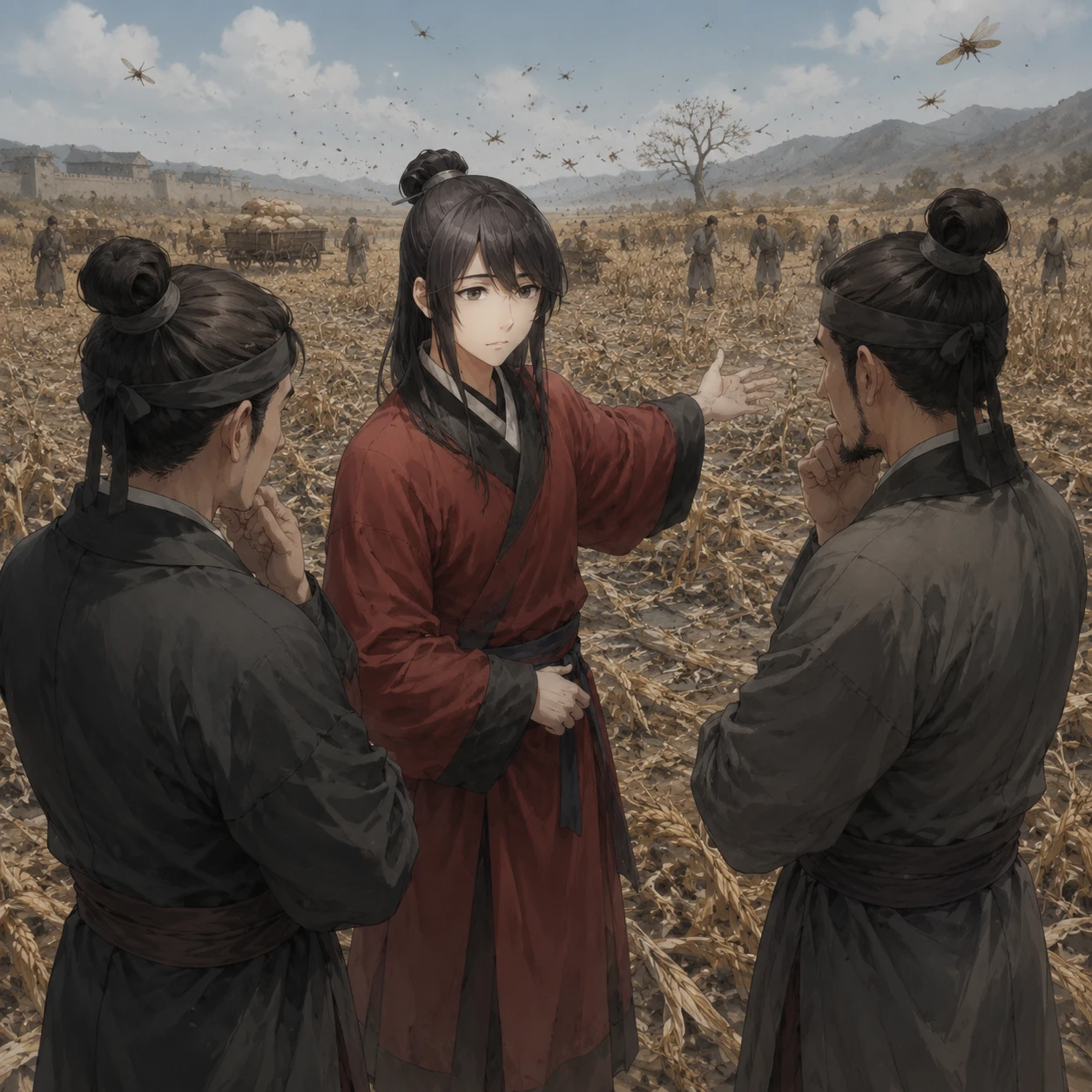
Rikuson's response shows why the locust arc belongs in the political story of The Apothecary Diaries. Food is not background scenery. When grain disappears, people sell property, leave villages, join criminal groups, blame officials, or become vulnerable to foreign pressure.
By checking reserves, pushing a harvest decision, and staying with rural consequences, Rikuson helps keep the food crisis from becoming even worse. The political meaning is an interpretation of those actions, not a claim that the novel gives him a single speech about legitimacy.
He Uses Competence Without Claiming the Throne
Rikuson's behavior also fits his wider characterization. He is clever, socially agile, and good at seeing what other people overlook. In the locust arc, that intelligence appears as investigation and timely pressure rather than as a bid to claim the whole western government for himself.
That restraint is important in the western setting, where any central official who appears too eager to rule can create suspicion. Rikuson helps the region without pretending that his competence automatically gives him the right to own it.
He Understands That Recovery Is Longer Than the Swarm
The first swarm is not the end. Volume 10 keeps Rikuson in contact with the damaged villages while crops, grain, and human exhaustion remain unresolved. The response therefore continues after the dramatic arrival of the insects.
Rikuson's value is clearest in that long tail. He keeps working inside the unfinished problem, which is why Maomao can respect his guidance while still questioning whether he should become the region's permanent head.
Common Misreadings
Misreading 1: Rikuson personally solved the locust problem
No. Maomao supplies the crucial insect reasoning, Jinshi handles central political support, and Rikuson is shown in Volume 10 doing rural investigation, grain-related work, village pressure, and field-level follow-through. Many unnamed or secondary people carry out the wider response.
Misreading 2: Rikuson invented the plague-prevention methods
The suggestions about removing young insects, protecting birds, burning or cultivating breeding areas, and making flying locusts into a court dish come from the investigation and policy discussion around Maomao and Jinshi. They are not Rikuson's private invention.
Misreading 3: A good emergency leader must be the permanent ruler
Maomao's evaluation rejects that shortcut. Rikuson is very capable at guiding people through danger, but permanent leadership asks different questions about legitimacy, local acceptance, and the future after the emergency.
FAQ
How did Rikuson respond to the locust plague?
His detailed response appears in Volume 10: he checked grain reserves, inspected rural conditions, pushed villagers to secure wheat before the swarm, and stayed involved while the villages dealt with the aftermath.
Where are Rikuson's detailed locust-response scenes?
They are in Volume 10: Chapters 2-3, 9, 14, and 16-20 provide the relevant investigation, rural work, locust response, and aftermath.
Where is the clearest source for Rikuson's response?
Volume 10 is the relevant source: Chapters 2-3, 9, 14, and 16-20 contain the investigation, rural work, grain decisions, locust response, and aftermath connected to Rikuson.
Did Rikuson discover the difference between ordinary locusts and flying locusts?
No. Maomao makes that distinction after observing the food being sold in the west, and the insect records explain why the ratio and physical changes matter.
Was Rikuson the main person responsible for the western relief effort?
He was an important local figure, but not the only person responsible. Jinshi connected the region to central support, Maomao supplied evidence and ideas, and local officials and workers carried out much of the response.
Why does Maomao respect Rikuson's crisis leadership?
Because he stays useful under pressure. He notices practical needs, guides people, and understands that a disaster continues through its social and administrative consequences.
Why is Rikuson not automatically the best permanent successor?
Emergency guidance and long-term rule require different strengths. Rikuson can coordinate a crisis very well, but a permanent regional head also needs public legitimacy, local roots, and a stable political mandate.
What should I read next?
Continue with the difference between locusts and flying locusts, whether Rikuson deliberately provokes Jinshi, and why Jinshi had to go west for the connected evidence trail.