Spoiler Warning
This article discusses light novel spoilers for The Apothecary Diaries Volume 5 and later western locust-crisis material, including Shisui/Loulan's insect clues, Maomao's investigation, Jinshi's western response, famine risk, and the political consequences of a swarm. Anime-only readers should stop here.
Scene Locator
The locust thread begins before it looks important. The story first lets readers notice flying locusts as background texture around the Shisui/Loulan material: insects near festival paths, edible skewers, and a character who knows far too much about bugs for that knowledge to stay cute forever.
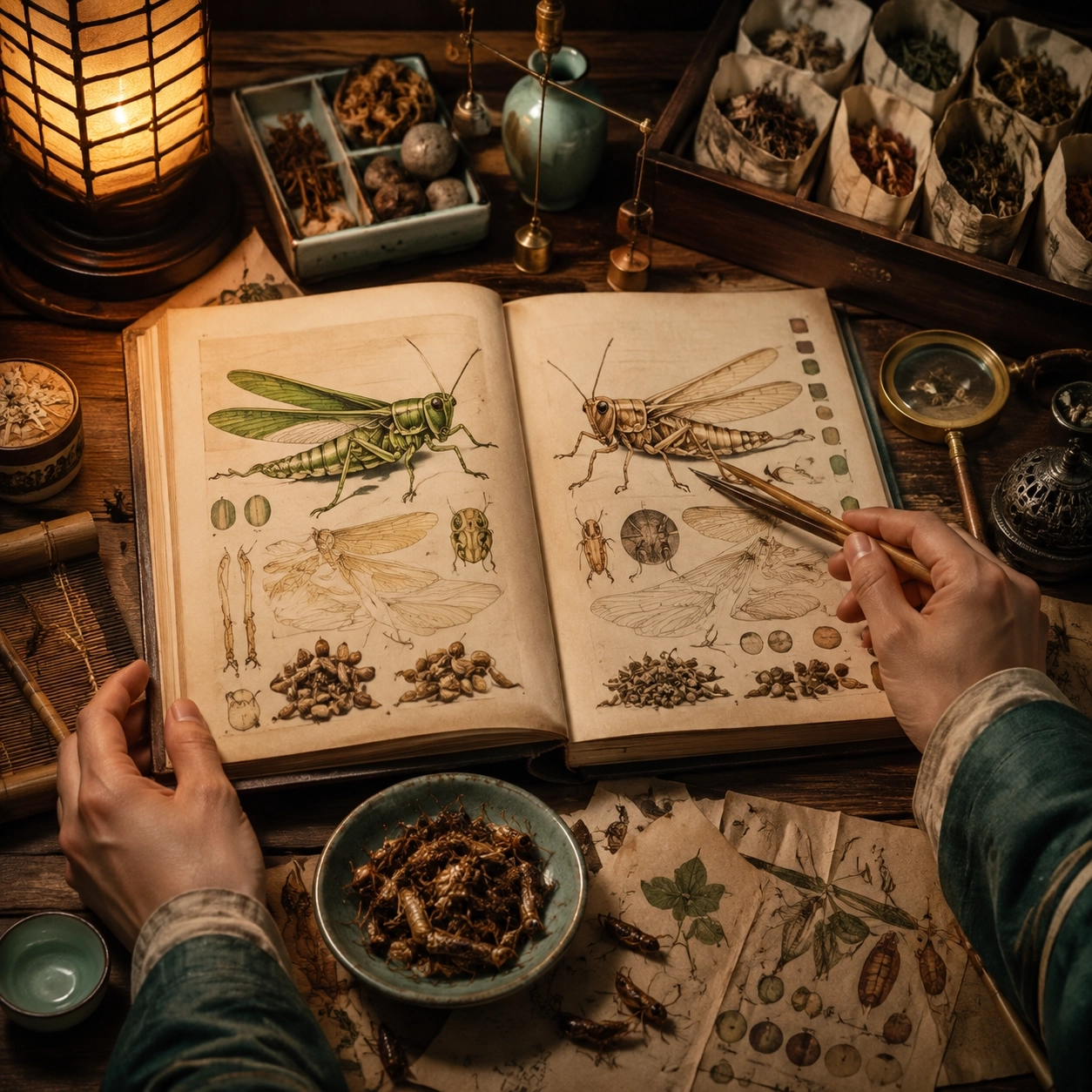
Volume 5 turns that background into structure. Maomao encounters dried locusts in the pleasure district, learns that farmers distinguish ordinary locusts from flying locusts, and realizes the wrong ratio in a food pile can be a clue about the next harvest. Later, insect guide drawings classify flying locust forms by body color and wing length, linking small physical changes to the danger of larger swarms.
That is why this topic belongs beside the Light Novel 5 guide, Loulan's warning to Jinshi, and Jinshi's westward assignment. The insects are not decoration. They are the bridge between palace mystery and state crisis.
Volume-level entry only. The source is community-hosted; availability and rights status may vary.
The Short Answer
Ordinary Locusts Are Manageable Pests
Ordinary locusts in the novels sit inside familiar rural life. They damage crops, but they can also be caught, cooked, sold, and treated as part of the seasonal economy. That does not make them harmless. It means they belong to a scale that farmers already understand.
This is why the food scenes matter. A skewer of locusts or a plate of dried insects is not only a shock gag for city readers. It shows a practical rural logic: pests become food, and selling them can soften the blow of insect damage. In ordinary years, people can fight back with labor, appetite, and local knowledge.
Flying Locusts Are a Warning Signal
Flying locusts mean something darker. In the story, farmers separate them from ordinary locusts because they taste worse, behave differently, and point toward a more dangerous pattern. When flying locusts become too common, they stop being a nuisance and start becoming a forecast.
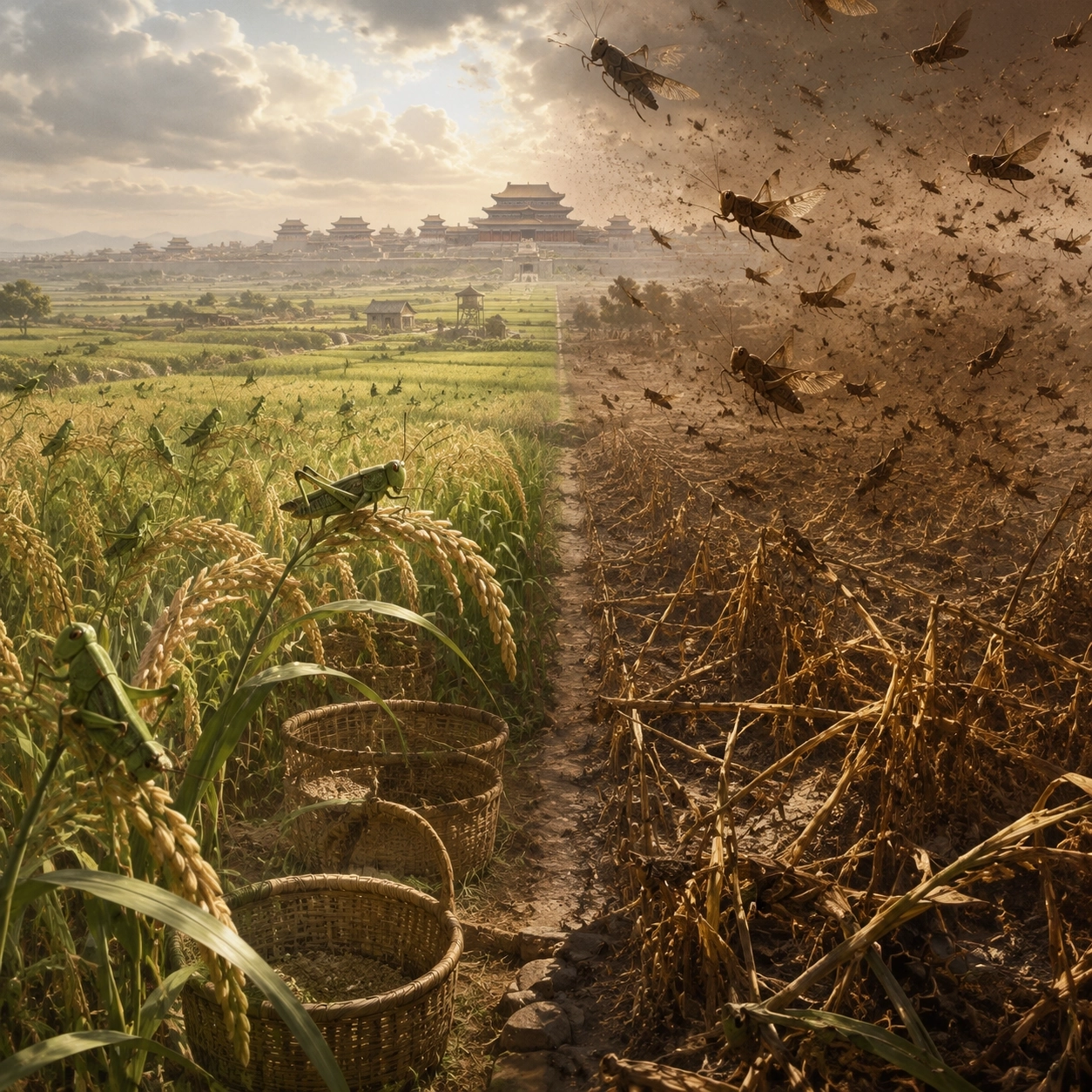
The key difference is scale. An ordinary pest outbreak hurts fields. A flying locust swarm can cross fields, villages, roads, and administrative boundaries. Once the insects become a moving mass, the problem is no longer "how do we save this crop?" It becomes "how does the empire survive the food shock that follows?"
The Difference Changes the Scale of the Story
The Apothecary Diaries uses that difference to expand the series. Inside the rear palace, Maomao solves human mysteries with medicine, poison knowledge, and observation. With flying locusts, the same skills move outward. A detail on a plate becomes a clue about fields. A bug drawing becomes a policy problem. A warning from Shisui/Loulan becomes a reason for Jinshi to move before the crisis is publicly obvious.
Why the Snack Scene Matters
The story first teaches the reader through appetite. Shisui can tell when a seller has mixed flying locusts into ordinary locust skewers, even after the legs and wings have been removed. Maomao admits that to an untrained eye they look nearly the same, which is exactly the point. The difference is not obvious to palace people, city people, or casual readers.
That scene quietly establishes three rules. First, Shisui's insect knowledge is practical, not ornamental. Second, farmers and rural people already have categories the capital may ignore. Third, a cheating vendor is funny only until the same confusion hides a national warning sign.
In hindsight, the scene is a miniature of the whole locust plot. The capital sees "bugs." Shisui sees a species difference. Maomao learns that the difference has economic meaning. Later, Jinshi has to learn that it has political meaning. That is the clean little chain the novels build from street food to statecraft.
This is also why Maomao's connection with Shisui matters beyond emotion. Shisui leaves behind a way of noticing the world that Maomao can use when the court is still trying to fit the danger into normal paperwork.
How Maomao Reads the Evidence
The Ratio Matters
The major clue is not simply that flying locusts exist. It is that too many of them are mixed into what should be ordinary dried locusts. A farmer's practical comment gives Maomao the missing frame: years with a higher proportion of flying locusts can be followed by serious insect damage.
That is very Maomao. She does not need a royal decree to begin thinking. She needs an anomaly, a witness with grounded knowledge, and enough stubborn curiosity to connect a bad-tasting food pile to a future crop crisis. The scene also shows why expertise in the series often lives outside rank. The farmer can see something a palace official might miss because his life depends on knowing it.
Shape and Color Matter
The insect drawings sharpen the evidence. The novels separate common greenish flying locusts from more dangerous brown forms, and they point to changes in wing length and body condition. In modern terms, the story is gesturing at phase change: under the right conditions, locusts can shift from a scattered state into a swarm-forming state.
The important point for the article is not modern taxonomy. It is narrative logic. The series makes the insect's body into a document. Maomao reads legs, wings, color, density, taste, and timing the way she would read symptoms in a patient. The patient is no longer one person. It is the land.
The Missing Guide Matters Too
The missing insect guide is another warning sign. If an earlier apothecary studied locust disasters and the key volume is not where it should be, then the court is missing the exact knowledge it needs. That absence matters as much as any visible swarm. A state can be endangered not only by bad weather, but by lost records, hidden research, and officials who do not know which question to ask.
Impact on an Ancient Empire
A flying locust outbreak threatens an ancient empire because food is the empire's quiet foundation. Court rank, marriage alliances, palace etiquette, and military power all rest on the assumption that grain keeps moving. Break the harvest, and the political surface starts cracking.
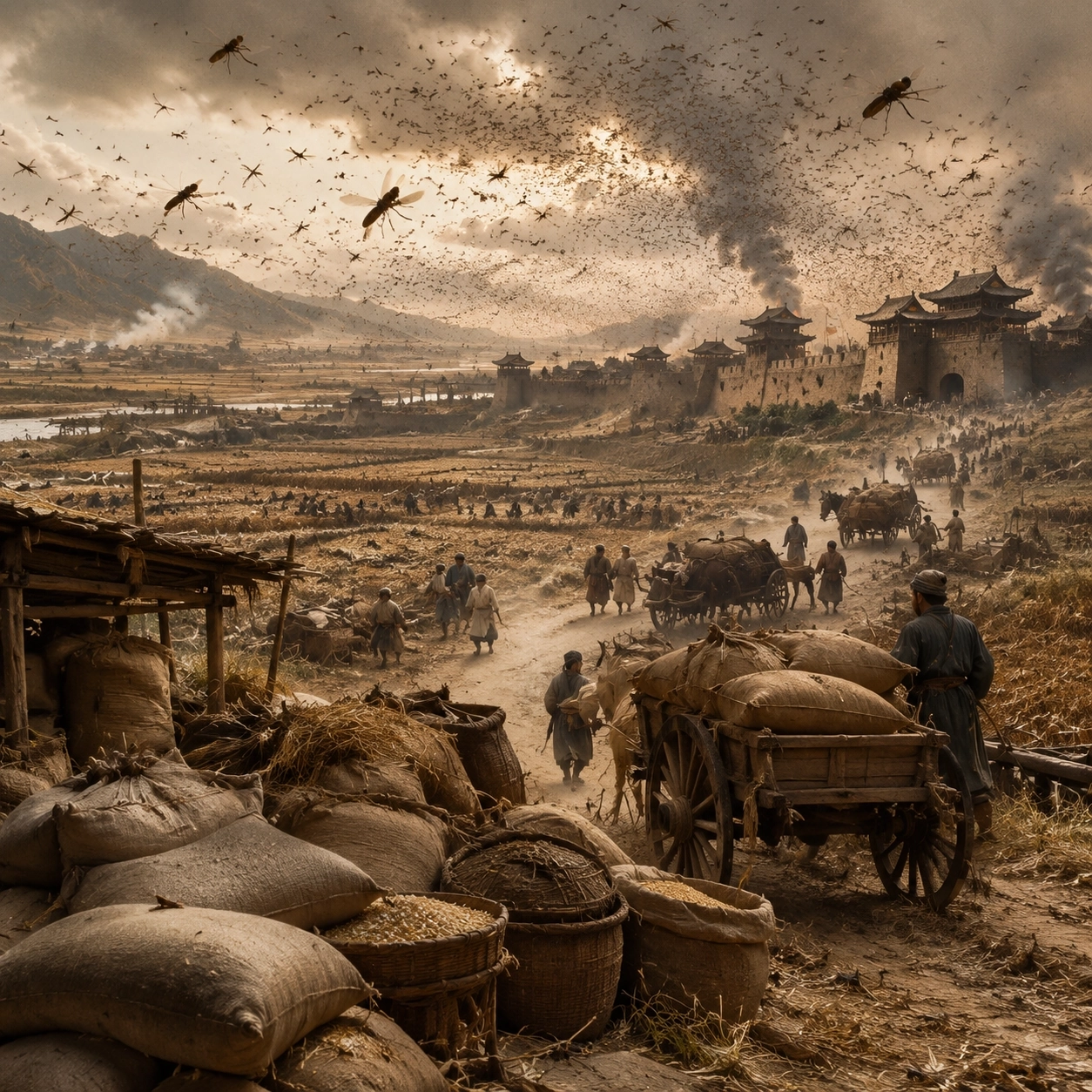
The first impact is direct hunger. A swarm can strip wheat, millet, vegetable fields, fodder, and even material people expected to use later. That means families lose food before taxes, merchants lose goods before profit, and local officials lose the numbers they promised the capital.
The second impact is price pressure. Grain shortages make ordinary life more expensive, and the novels repeatedly connect locust damage with strained markets, poor trade, and families trying to survive on substitutes. When food prices rise, loyalty becomes a luxury. People who are hungry will not care that the paperwork says the harvest is technically acceptable.
The third impact is movement. Famine creates refugees, stranded travelers, labor disruption, and bandit opportunities. Later western material shows exactly that kind of damage: routes become unsafe, villages empty out, and food scarcity creates room for violence. A swarm does not need a sword to break public order.
The fourth impact is legitimacy. The novels are explicit that people can read a locust disaster as a sign of imperial failure. In a world where omens still shape political feeling, a plague after the fall of a powerful clan can become more than weather. It can become a story enemies tell about the ruler.
That is why the flying locust thread belongs with larger setting pieces like the setting of The Apothecary Diaries. The series is not using historical flavor as wallpaper. It is showing how medicine, agriculture, rumor, administration, and dynastic anxiety all sit inside one fragile system.
Why the Court Must Act Before Certainty
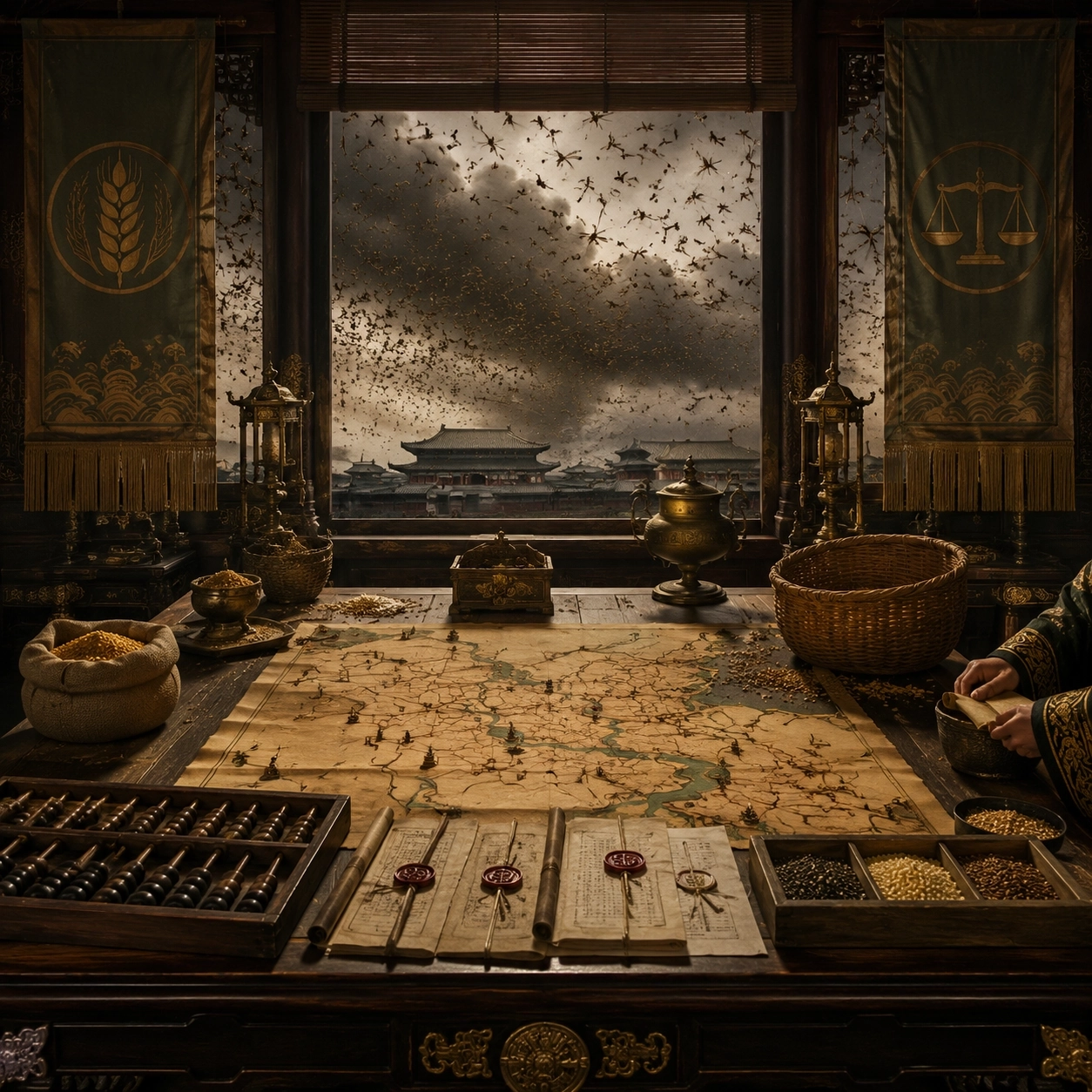
The cruel part of a locust disaster is timing. If the court waits until everyone agrees there is a crisis, then the crisis has already eaten the fields. If it moves too early, officials can call it panic, expense, or superstition. That is why Maomao's evidence puts pressure on Jinshi. He has to act inside uncertainty.
The practical responses in the novels are not glamorous. They involve warnings, record searching, field observation, pest control, food substitutes, transport planning, and ugly tradeoffs. That makes the plot feel more realistic than a simple "find the villain" arc. A person may start the damage, worsen it, or hide it, but the swarm itself cannot be arrested.
Jinshi's western role becomes important here. As discussed in why Jinshi takes Maomao west, he needs people who can read symptoms that ordinary officials miss. Maomao's value is not only poison expertise. It is her willingness to believe small evidence before powerful people are ready to be embarrassed by it.
How the Later Crisis Proves the Warning
Later western material proves that the warning was not an academic exercise. Flying locusts do come in devastating numbers, fields are stripped, and the threat spreads into hunger, trade disruption, social anger, and security collapse. By then, the distinction between locusts and flying locusts has become painfully concrete.
The novels also make prevention feel human. Lahan's brother, with his agricultural persistence and unpopular warnings, helps reduce the death toll by pushing people to prepare. He is easy to underestimate because he is socially awkward and not polished for court, but the locust arc rewards exactly his kind of grounded expertise. For related family and food-security threads, see Maomao's view of Lahan and why Lahan is treated like a traitor.
That is the real answer to the title. Ordinary locusts are pests the local world can name and absorb. Flying locusts are the sign that the problem may jump scale. Once they gather, the ancient empire is no longer defending one field. It is defending food, order, credibility, and the idea that the court can protect people beyond the palace walls.
Common Misreadings
Misreading 1: The locust scenes are just gross-out comedy
The food scenes are funny, but they also train the reader. The story uses taste, disgust, and Shisui's confidence to teach the category difference before the political danger is obvious.
Misreading 2: Flying locusts are just bigger ordinary locusts
The novels treat flying locusts as a different warning category. What matters is not only size, but behavior, proportion, body change, and the possibility of a swarm that moves beyond one farm.
Misreading 3: A locust disaster is only a natural disaster
It is natural, but it is never only natural in the story. Once reports, food prices, refugees, factions, and omen politics enter the picture, the disaster becomes a test of government.
Misreading 4: Maomao solves the locust problem alone
Maomao reads evidence sharply, but the response needs farmers, officials, records, transport, substitute crops, and people willing to warn others before they are thanked for it.
For the adaptation of this investigation, see how S3EP1 rearranges Volume 5’s insect clues and palace politics, including its medicine opening and the Emperor’s closing conversation with Ah-Duo. Light novel spoilers through Volume 5.
FAQ
What is the difference between locusts and flying locusts in The Apothecary Diaries?
Ordinary locusts are treated as familiar field pests that can even become food. Flying locusts are a more dangerous warning sign, especially when their numbers rise and their form points toward swarm behavior.
Why does Shisui know the difference?
Shisui's insect knowledge is practical and unusually deep. Her ability to notice flying locusts before others care is part of why her later warning has such large consequences.
Why does Maomao take the dried locusts seriously?
Because the pile contains too many flying locusts, and a farmer explains that this ratio can point toward severe insect damage in the following year. Maomao treats that as evidence, not trivia.
How can locusts threaten an empire?
A major swarm can destroy crops, raise grain prices, create refugees, disrupt trade, empower bandits, and damage belief in the ruler's ability to protect the country.
What should I read next?
Read the Light Novel 5 guide, the Loulan note analysis, and why Jinshi had to go west for the larger political context.