Spoiler Warning
This article discusses light novel spoilers from The Apothecary Diaries Volumes 1, 5, 13, and 14, including Joka's position at Verdigris House, her relationship with Maomao, her mother's story, the jade tablet, the danger around her room, and her decision to step away from the royal-blood rumor.
Scene Locator
Volume 1 introduces Joka as one of the Verdigris House's three courtesans. Volume 5 gives the clearest contrast between her literary talent, her dislike of men, and the different paths available to Joka and Maomao. Volume 13, Chapters 11-12, returns to Joka's connection with Maomao and explains why their shared origin does not produce identical lives.
For the later danger plot, start with Volume 14, Chapters 7-10. The stolen or sought-after jade tablet turns Joka's carefully maintained story about her birth into a genuine security problem. Volume 14, Chapter 18 adds the family and physician-history context behind the tablet without turning Joka's rumored royal identity into a confirmed fact.
Volume-level entries only. These sources are community-hosted; availability and rights status may vary.
The Short Answer
Joka is special because she is not merely beautiful or commercially successful. She is a cultivated woman who has built a sharp mind, a formidable memory, and a controlled public persona inside a system that gives women very little room to define themselves.
She is tragic because those achievements do not create a truly open future. They make her more valuable within the system, but they do not remove the system's limits. Joka can improve her position, protect her dignity, and make people respect her. She cannot simply choose a completely different life whenever she wants.
The most painful part of Joka's story is therefore not a single dramatic misfortune. It is the recognition that women like her are everywhere in the background of the novel, each adapting to the same pressures with different tools and different amounts of luck.
Special Through Learning
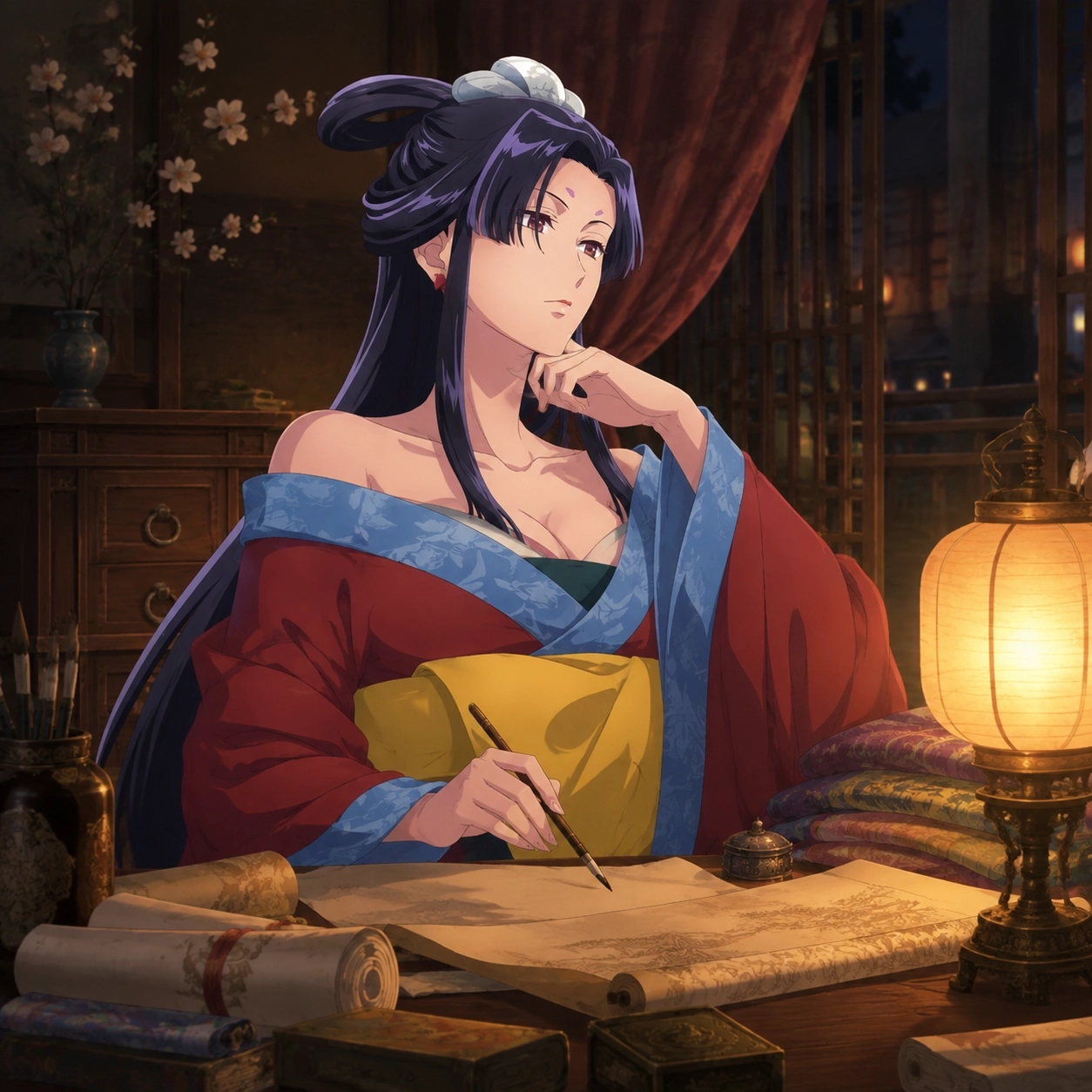
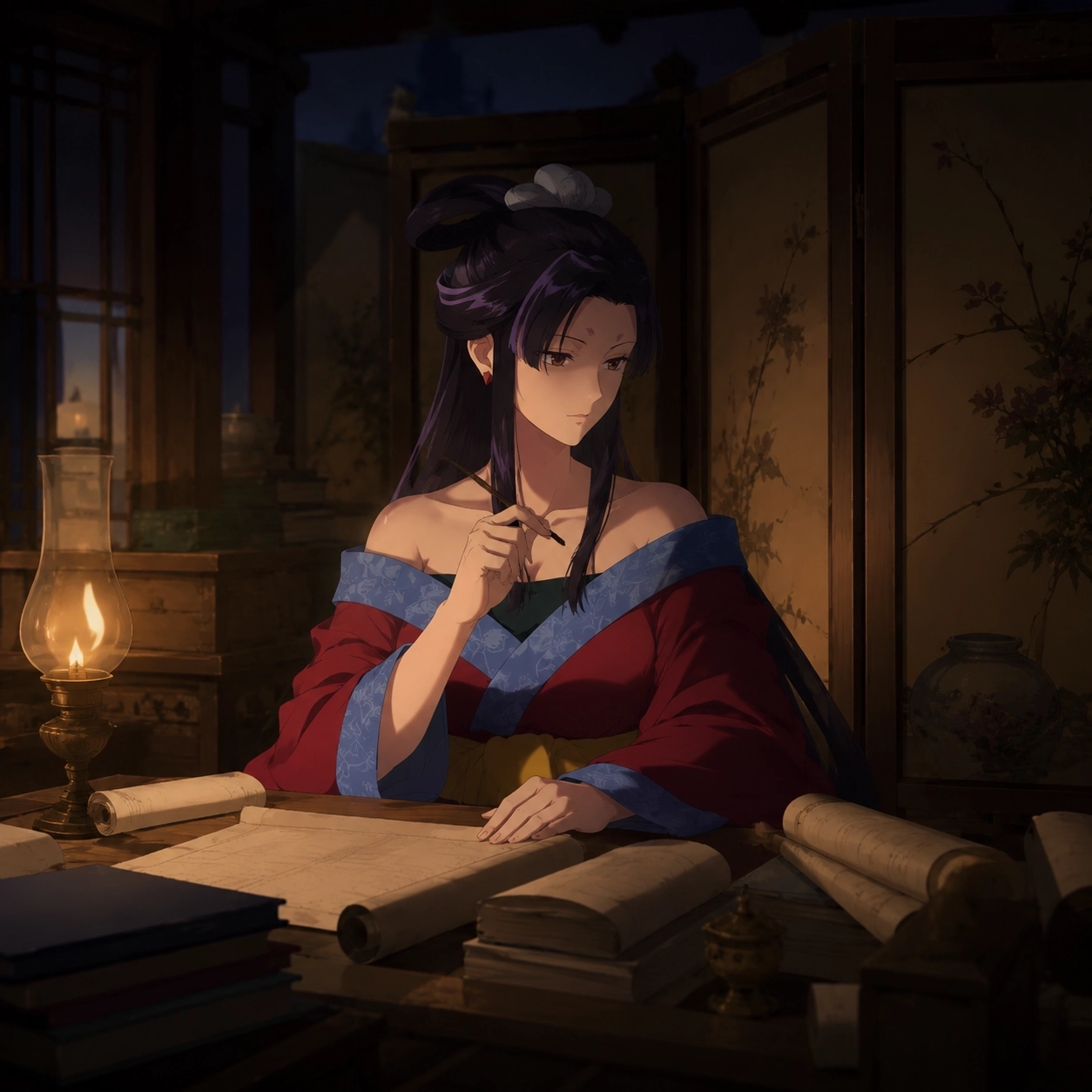
Joka is described as a younger member of the Verdigris House trio and as a literary talent. She remembers the Confucian classics and attracts examination candidates who admire her learning. She is not defined by dancing or by the conventional performance expected from every courtesan. Her strongest appeal is the world she can build with language and knowledge.
That matters because her education is not a decorative hobby. It is the skill she has turned into a livelihood. Joka studies because she needs a way to remain distinctive, respected, and economically useful. The novel lets that effort count as intelligence while also showing the pressure beneath it.
Special Without Romantic Illusions
Joka's coldness toward men is often easy to misread as simple arrogance. The novel gives it a history. Her mother was a courtesan who was deceived by a man, became pregnant, and eventually died after a painful life. Joka therefore does not treat male attention as proof of safety or love.
Her perspective is not a romantic rejection of the world. It is a survival rule. She understands that customers may admire her mind and still see her as something they can purchase. She also understands that a story about desire can be profitable without being emotionally trustworthy.
Joka and Maomao: Two Lives From One World
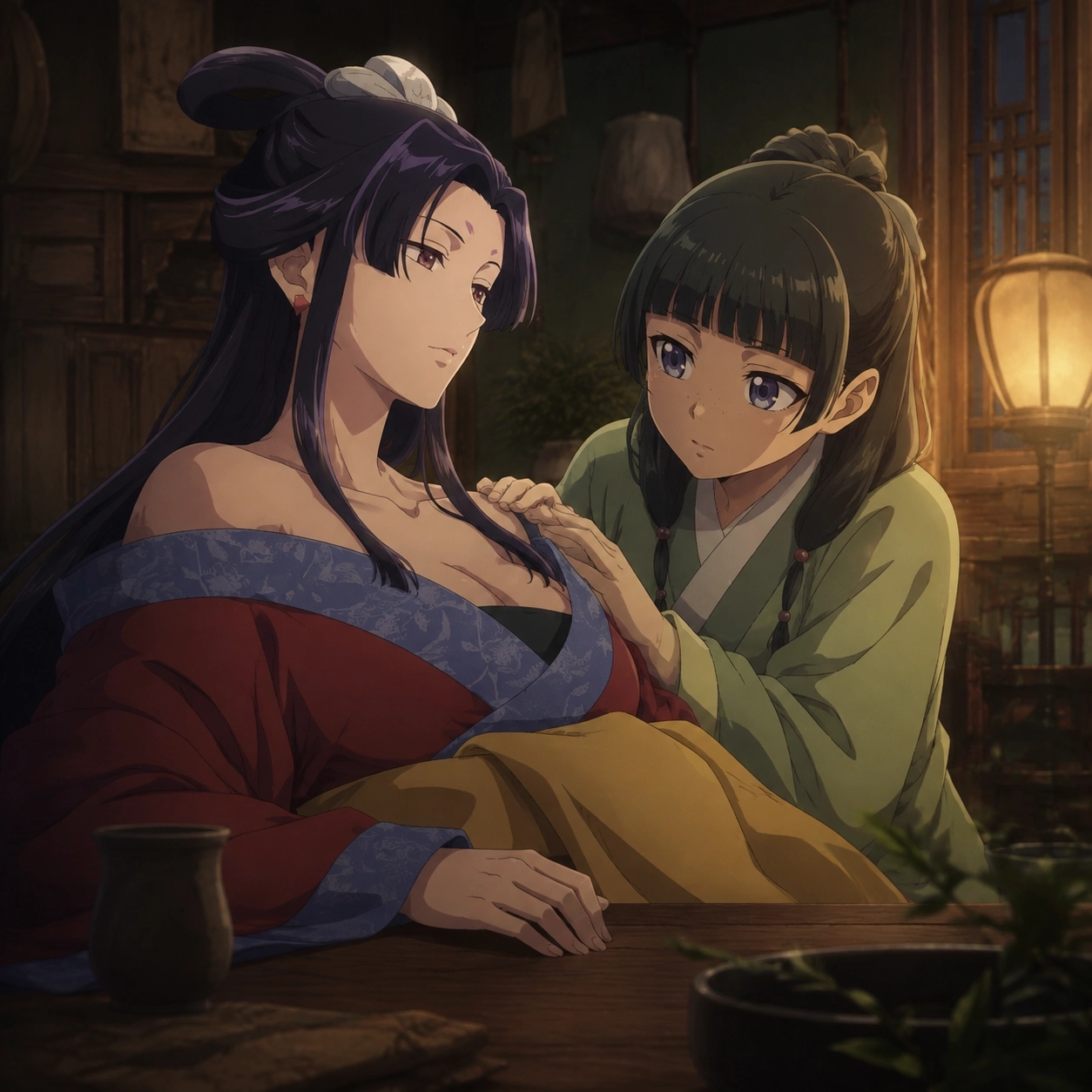
Joka and Maomao are connected by the Verdigris House. Before Maomao was taken in by Luomen, the women there helped raise her, and Joka treated her as a younger sister. That relationship gives Joka a warmth she does not show to most men and lets Maomao see a side of the pleasure district that outsiders usually miss.
They also share an important resemblance: both are observant, difficult to impress, and capable of learning far beyond what their circumstances seem to allow. But the novel does not use Joka to suggest that every woman can simply work hard and escape. Their different outcomes depend on different openings.
The Sister She Protects
Joka protects Maomao's privacy. She does not force Maomao to confess her feelings, explain every palace connection, or turn her into a story for other people. That restraint is a form of affection. Joka understands what it means for a woman to be watched, evaluated, and interpreted by men who believe they are entitled to an answer.
She also gives Maomao a hard lesson: a woman cannot only accept what other people give her. She must make herself valuable enough to negotiate with the world. The advice is practical, but it is not cynical for its own sake. Joka is trying to give Maomao a shield that she herself had to build without much protection.
Value Is Not the Same as Freedom
Joka's advice reveals the central tension of her character. Becoming valuable can improve a woman's bargaining position, but it does not automatically free her from the structure that prices her value. A famous literary courtesan still has to think about customers, age, contracts, reputation, and the house that controls the conditions of her work.
Maomao eventually receives another route through Luomen and through the palace's demand for her medical knowledge. Joka does not receive the same kind of opening. That difference is not proof that Maomao is morally better or that Joka failed to try hard enough. It is the difference between talent and access.
This is one reason Joka is such a useful contrast to Ah-Duo's account of a dream destroyed by palace life. Both women show that a sharp mind cannot always overcome the institution that claims ownership of their future.
Why Joka Is So Tragic
Calling Joka tragic does not mean that the novel gives her a confirmed death or a fully written collapse. Her tragedy is more structural. She is close to thirty, she knows that the professional lifespan of a courtesan is limited, and she can see that the examination candidates who form her audience will eventually become fewer.
She has spent years converting intelligence into market value, but time keeps changing the market around her. Even a woman who has done everything well can reach a point where her strongest skills no longer guarantee security. That is a quiet kind of danger, and it is exactly why her story feels larger than one character.
A Life With Too Few Alternatives
Joka understands that she has very few alternatives. Her mother had already been trapped in the same profession, and Joka does not inherit a stable family position, a recognized profession, or a man she can trust to build a future with her. Her learning helps her survive, but it does not magically create a new social category for her.
That limited choice should change how readers judge her. If she uses a sharp tongue, a carefully controlled image, or a doubtful story about her birth, those actions are not evidence that she is shallow. They are ways of making a dangerous position less dangerous.
The Cost of Aging Inside the System
Joka's age is not a moral flaw, but the institution treats it as an economic fact. The older she becomes, the more pressure there is to secure a future before her current advantages fade. The novel makes this especially painful because she is not losing her intelligence. She is losing the time during which the world is willing to reward it in the same way.
Her situation echoes the broader women-centered tragedy of the series. The Ma clan women preserve family power through household authority, while Joka has to preserve herself through performance and knowledge. Both are capable. Their institutions simply assign different prices to their capabilities.
The Jade Tablet and the Danger of a Story
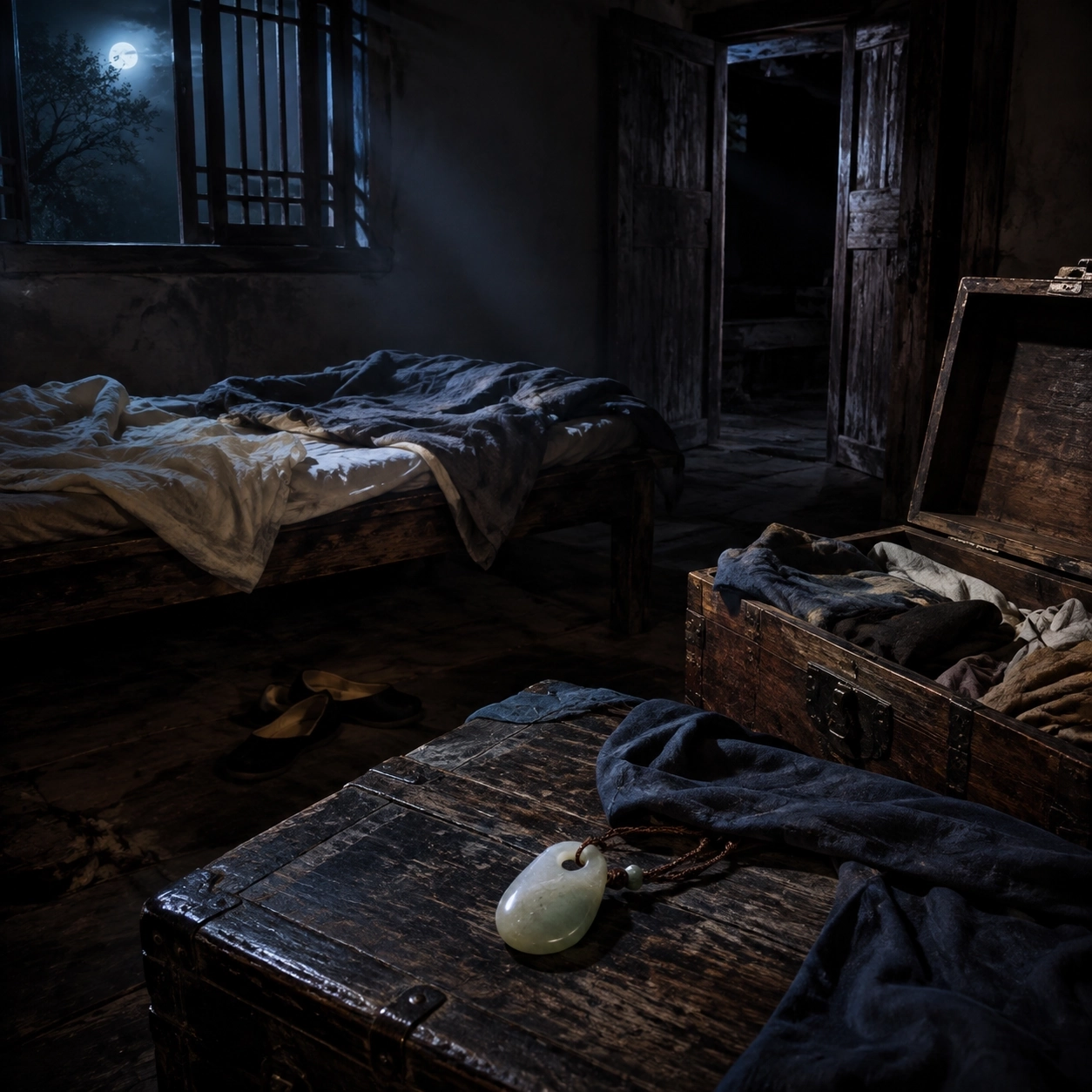
Joka's jade tablet is one of the clearest examples of how a useful story can become a threat. She uses the object and the rumor around it to support the idea that she may be connected to the imperial family. The novel does not confirm that she truly has a royal identity. Joka herself treats the claim with doubt, and its value lies partly in the mystery it creates.
For a long time, the rumor is a tool. It gives her a stronger position and makes customers treat her as more than an ordinary courtesan. But once people begin searching for the tablet, the same rumor changes shape. What helped create status now invites surveillance, theft, and possible violence.
The Object Becomes Real Danger
In Volume 14, Joka realizes that the tablet cannot remain a harmless prop. A person connected to the investigation is killed, someone later enters her room looking for the object, and Joka has already hidden it beneath her bedding. The danger is not theoretical anymore.
Her response is practical. She decides to stop relying on the royal-blood story and gives the tablet to Maomao so that it can reach someone trustworthy. This is not a triumphant escape from the system. It is a careful attempt to remove the most dangerous part of the identity she built.
Her Father's History Does Not Erase Her Uncertainty
Later information connects the tablet to the descendants of Hua Tuo and to a family relationship involving Tianyu's household. That context explains why the object matters, but it should not be flattened into a simple confirmation that Joka was secretly a princess.
The distinction is important. Joka's life is shaped by what people believe, what she performs, and what the object may prove. Her specialness does not depend on a hidden royal bloodline. The novel gives her importance before the tablet's history is understood.
For another article about a woman using communication and private information to survive a dangerous political situation, see Baiyu's role in Gyokuyou's palace network. The circumstances differ, but both stories show how women carry information because formal power is not equally available to them.
Her Fate Is Not an Isolated Fate
The deepest reason to feel sorry for Joka is that the novel does not present her as the only woman forced to make a life from an unfair starting point. The Verdigris House is full of women whose bodies, labor, beauty, and knowledge are negotiated by other people. Some gain protection. Some gain customers. Some gain family ties. None of those advantages should be mistaken for complete freedom.
Joka's tragedy is representative rather than exceptional. There are many women who are clever enough to understand their situation but not powerful enough to rewrite it. Some become skilled at negotiation. Some become indispensable to a household. Some endure by keeping their feelings hidden. The fact that Joka is unusually talented makes the system look more unjust, not less.
Why Joka's Talent Makes the Tragedy Sharper
If Joka were careless or incapable, readers could wrongly treat her outcome as a personal failure. She is neither. She reads, remembers, evaluates, protects Maomao, and recognizes danger before it fully arrives. Her intelligence gives her clarity, but clarity can be painful when the available exits remain narrow.
That is why her story belongs beside the series' other women rather than beneath them. Maomao's relationship with Shisui shows another kind of female recognition, while Joka shows what it costs when recognition does not become a new life.
Not Every Survivor Gets a New Beginning
The Apothecary Diaries often rewards observation, but it does not promise that observation will produce a clean escape. Joka sees the truth about men, work, age, and danger. She makes rational choices within those facts. The novel's compassion comes from allowing that to be meaningful even when it is not a fairy-tale liberation.
What Joka Chooses
Joka's final important choice in this arc is not to cling to the most glamorous version of her story. She lets go of the claim that she may be connected to the imperial family because the claim has become too dangerous to carry. She asks Maomao to help place the jade tablet where it can be handled safely.
That decision is consistent with the woman the novel has shown from the beginning. Joka prefers what can be examined to what must be believed. She can use a rumor when it protects her, but she does not confuse the rumor with her own worth. When the rumor becomes a weapon pointed back at her, she is willing to surrender it.
Special, But Not Untouchable
Joka is special because she has built an identity from knowledge, not because the story secretly owes her rescue. She is tragic because the world can admire her mind and still leave her with too few safe choices. Those two truths are meant to exist together.
That is also why Joka stays in the reader's mind. She is not a symbol of helplessness, and she is not a fantasy of perfect independence. She is a capable woman making precise decisions in a world that keeps narrowing the space in which those decisions can matter.
Her story asks a difficult question: how many women in the same era could have been just as remarkable if they had been given even one more safe path?
FAQ
Why is Joka special in The Apothecary Diaries?
Joka is a highly educated literary courtesan who uses memory, classical learning, and a controlled public image to build value and protect her dignity at Verdigris House.
Why is Joka's story tragic?
Her tragedy comes from having very few alternative futures. Her talent improves her position, but it does not remove the economic, gender, age, and safety limits placed on women in her world.
What is Joka's relationship with Maomao?
Joka treats Maomao like a younger sister. She helps protect Maomao's privacy and gives her practical advice about becoming valuable enough to negotiate with the world.
Is Joka really an imperial descendant?
The novel connects the jade tablet to a significant medical family history, but it does not turn Joka's rumored royal identity into a simple confirmed fact. The rumor is part of her survival strategy and later becomes dangerous.
What happens to Joka in Volume 14?
Joka faces a security threat connected to the jade tablet. She hides the object, recognizes that the royal-blood story has become dangerous, and gives the tablet to Maomao for safer handling. The text does not justify inventing a later tragic death for her.
What should I read next?
Use the Joka Scene Locator for the chapter leads, then compare Joka's limited choices with Ah-Duo's lost dream and the women who sustain the Ma clan.