Spoiler Warning
This article discusses late light novel spoilers for The Apothecary Diaries, including Ah-Duo's childhood friendship with the future Emperor, her hidden connection to Jinshi, the loss of her freedom at fourteen, and the conversation in which she warns Maomao that there is still time to leave the court's orbit. Anime-only readers should stop here.
Scene Locator
The exact source scene is Volume 13, Chapter 14, Ah-Duo's Truth. Ah-Duo says that her dream ended at fourteen while explaining that she had treated the Emperor as a childhood friend before imperial rank made the relationship unequal.
The rest of the article analyzes that conversation and its warning to Maomao; it is not a separate event in another chapter. Maomao matters because Ah-Duo is speaking to someone already entangled with a person carrying rank, secrets, and the power to reshape her life.
For the surrounding identity thread, read Jinshi's journey to Ah-Duo's secret. For the silence between them, read why Jinshi and Ah-Duo never have a direct conversation.
Volume-level entry only. The source is community-hosted; availability and rights status may vary.
The Short Answer
Ah-Duo's Dream Was an Equal Friendship
When Ah-Duo says her dream ended at fourteen, she is not describing a love that failed. Her dream was more specific and more painful: she wanted to remain close to the future Emperor as his friend, speak freely, stand beside him as an equal, and preserve the easy companionship they had before the palace converted their friendship into a political arrangement.
She knew him before the imperial role swallowed the young man she knew. In that earlier friendship, trust did not automatically mean obedience. A conversation could be a conversation. A disagreement did not have to become a threat to succession. The future still belonged to the two people involved, at least in imagination.
Fourteen is the age at which the court stopped treating Ah-Duo as a girl with a private future and started treating her as a body with dynastic value. Once she was made into the Emperor's consort, their friendship could no longer remain private or equal. Her dream ended because her freedom ended.
Why Fourteen Changed Everything
Ah-Duo's age matters because it exposes the scale of the coercion. The court did not wait for her to grow into an adult decision-maker with room to refuse. It placed her inside an institution while she was still young enough to imagine that personal closeness could survive political rank.
From that point forward, even ordinary companionship was interpreted through the palace. Her closeness to the Emperor could produce an heir, strengthen a faction, threaten another faction, or be used to justify a public story. The court took a friendship that had belonged to two people and made it answer to an entire state.
That is why calling the event a broken romance is wrong. Ah-Duo did not lose a lover; she lost the right to keep an ordinary friendship on her own terms. The court took a bond of trust and turned it into a role she could not freely define.
The "Mother of the Nation" Line Is a Mask
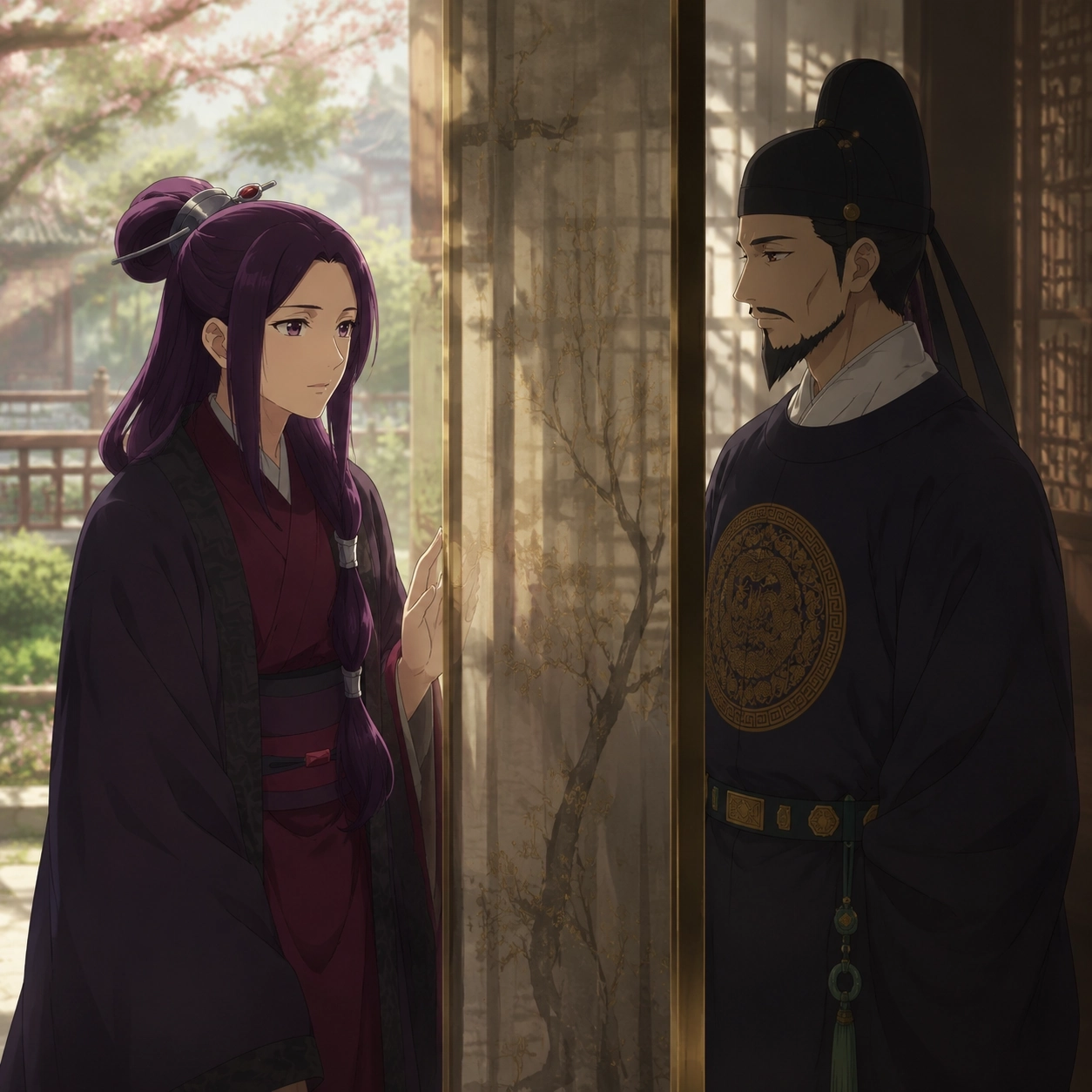
One of the most revealing details is that Ah-Duo once presented her wish as something grander: she could say that she wanted to become the mother of the nation. On the surface, that sounds like ambition. It sounds as if she wanted the highest public role connected to the Emperor.
But the later explanation shows that this was not the whole truth. The grand title was a safer way to describe a much more private desire. If she became the Emperor's official consort, she might still be allowed to remain near her friend. She could disguise the wish to continue as his friend inside the language of rank, motherhood, and national duty.
That is a distinctly Ah-Duo form of self-protection. She does not deny what she wants; she translates it into words the court can hear. The problem is that the court accepts the political translation and ignores the person underneath it. Ah-Duo receives the role, but not the future she thought the role might preserve.
She Wanted Her Friend, Not the Throne
Ah-Duo's tragedy is easy to miss because the title of empress sounds powerful. In a court story, it can look as though she was rewarded with the most prestigious position available. Yet status does not restore the freedom that was taken from her. The court can give her a title while removing her ability to stand beside her friend as an equal.
That contrast is why her later words feel so restrained. She does not describe a love that ended. She describes the moment when an ordinary friendship was forced to live inside an institution. The dream was not "I will have nothing to do with him." The dream was "I can remain his friend without becoming one of the palace's instruments."
Jinshi's Hidden Parentage Makes the Loss Even Heavier
The later revelation around Jinshi adds another layer. Ah-Duo's place in the palace is connected to a secret that can destabilize the royal family, and the public relationship between her, the Emperor, and Jinshi can never be explained without opening dangerous questions.
That means Ah-Duo did not only lose a private future. She also had to survive as part of a public fiction. Her silence protects Jinshi, protects the Emperor's position, and protects the court from a succession crisis. The cost is that she cannot speak about the original dream in ordinary language. She can only leave fragments for someone like Maomao to understand.
The identity pressure around Jinshi is explored in the guide to Jinshi's real name and the analysis of whether the Emperor treats Jinshi as a brother or a son. Ah-Duo's sentence at fourteen is the emotional cost behind that political structure.
Why Ah-Duo Tells Maomao to Escape
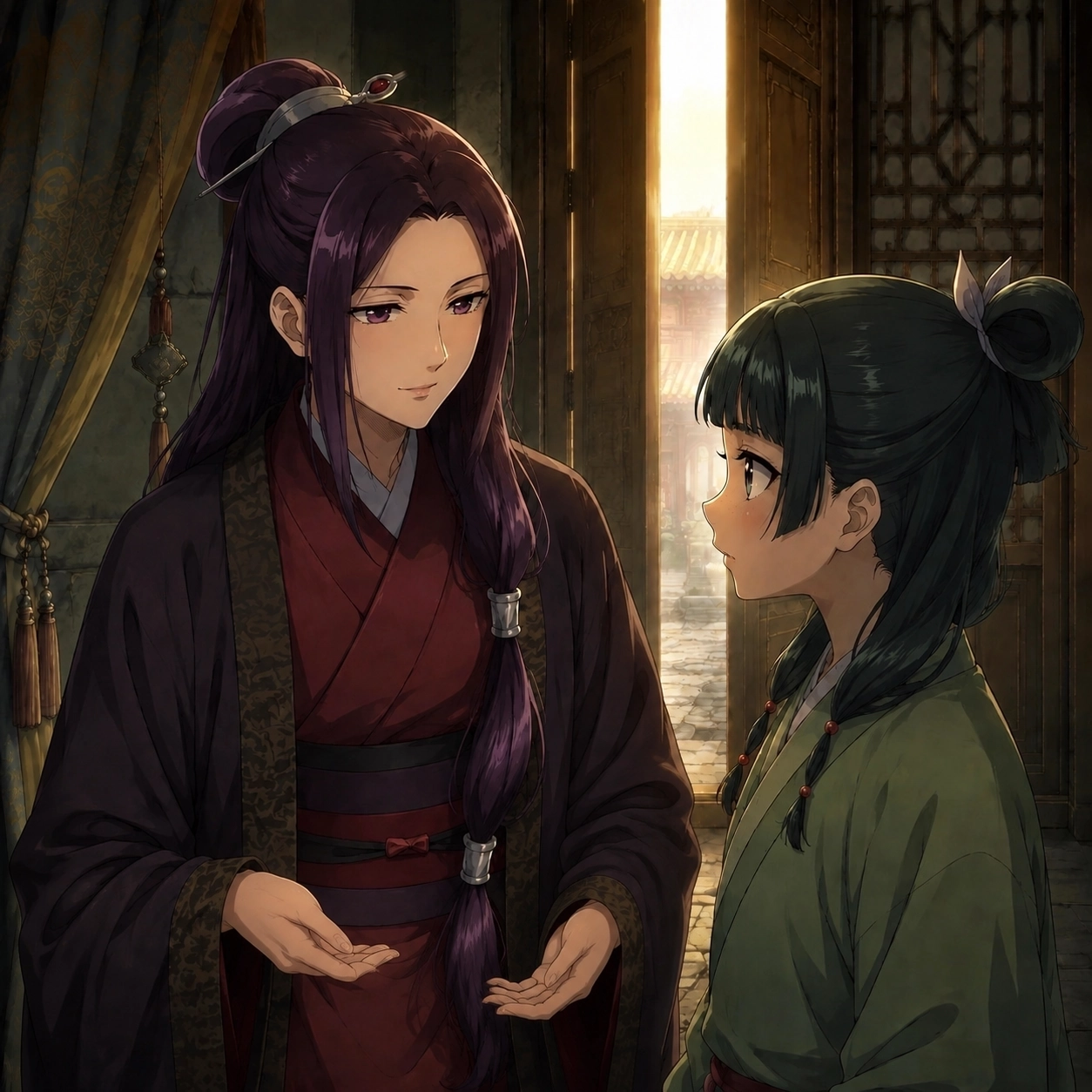
Ah-Duo's conversation with Maomao is not only an account of the past. It is a warning about the future. She sees that Maomao is already close to someone whose position can pull her into a world where personal attachment and command are difficult to separate.
Ah-Duo therefore tells Maomao that there is still time to leave. The line is powerful because it is practical rather than theatrical. Ah-Duo is not asking Maomao to prove her love, and she is not condemning Jinshi as a monster. She is telling Maomao that the choice is still hers now, before the court makes the choice irreversible for her.
This is the kindness Ah-Duo was not given at fourteen. Someone finally names the exit. Maomao is allowed to hear that remaining near Jinshi is not an obligation and that a relationship with an imperial figure can cost more than a person first expects.
Ah-Duo Does Not Want Maomao to Turn Her Loss Into a Romance
Ah-Duo's story could easily be turned into a romantic tragedy: two childhood friends separated by a crown, one girl turned into a consort, and a hidden child carrying the secret forward. The novel resists that reading. Ah-Duo's pain is not a story about sacrificing herself for a man she loves. It is a warning about what happens when a girl's friendship and future are used to make an institution look humane.
That is why she speaks to Maomao in such a direct way. Maomao is unusually good at reading poison, but she also has to read the conditions around a choice. Ah-Duo wants her to understand that being desired by a powerful person is not the same as being free beside him.
Her Warning Also Protects Jinshi
Ah-Duo's warning is not anti-Jinshi. She knows that Jinshi is shaped by the same system that shaped her. He can be sincere and still be dangerous to another person's freedom because of the rank and obligations attached to him.
In that sense, Ah-Duo is protecting both sides of the relationship. Maomao needs to know what she is entering. Jinshi needs someone who will not let his feelings erase the consequences of his position. The warning puts responsibility back into the room.
Why Maomao Does Not Run
Maomao hears the warning, but she does not take the simplest exit. That does not mean she fails to understand Ah-Duo. It means she makes a different kind of choice. She stays close to Jinshi while refusing to surrender the practical independence that makes the relationship bearable to her.
Maomao is not trying to recreate Ah-Duo's dream. She does not believe that affection alone can defeat court power. Instead, she treats the relationship as a negotiation. She looks at the risks, names the conditions she needs, and continues only when she can preserve some control over her own body, work, and movement.
This is where Maomao's response becomes a conversation with Ah-Duo's past. Ah-Duo lost the ability to choose before she understood what had been taken. Maomao understands the danger early enough to argue. She does not become invulnerable, but she is less willing to let the palace define every term for her.
Maomao's Choice Is Not a Rejection of Ah-Duo's Lesson
It would be unfair to say that Maomao ignores Ah-Duo. The warning changes the way she sees Jinshi. His rank is no longer an abstract inconvenience. It becomes a force that can shape her future, just as the Emperor's position shaped Ah-Duo's future at fourteen.
Maomao's later boundaries, including her insistence that Jinshi stop treating self-sacrifice as proof of devotion, grow from this awareness. Her response to his self-inflicted brand is especially important: she does not accept a beautiful wound as the final language of love. She treats it as a problem that requires accountability. Read how Jinshi's self-harm changes Maomao alongside this article.
She Stays, But She Does Not Become Court Property
Maomao's strategy is not to pretend that the court is safe. It is to remain difficult to absorb. Her apothecary knowledge gives her leverage, her bluntness protects her from some forms of manipulation, and her refusal to perform romantic obedience keeps Jinshi from mistaking proximity for ownership.
That is the key difference between the two women. Ah-Duo was placed into a role and then had to survive the role's consequences. Maomao sees the role approaching and tries to negotiate before it closes around her. The novel does not promise that her method will solve everything, but it shows why Ah-Duo's warning matters: Maomao is making a choice with her eyes open.
The Relationship With Jinshi Is Still Dangerous
Maomao's agency should not be confused with total safety. Jinshi remains connected to succession pressure, hidden family history, and the possibility that his decisions can affect entire factions. The articles on why Jinshi stops before sleeping with Maomao and why Jinshi leaves a brand on his left abdomen show how quickly private intimacy becomes a public and political problem.
Maomao stays because she judges her relationship with Jinshi worth negotiating, not because the danger disappears. That distinction is precisely what Ah-Duo was denied in her friendship with the Emperor.
What This Reveals About Ah-Duo
Ah-Duo's sentence about fourteen reframes her entire character. Her calmness is not proof that the court never hurt her. It is evidence that she learned how to live after the court took the future she imagined.
She becomes careful with language because language is one of the few freedoms still available to her. She can call a lost friendship a dream. She can call a forced role motherhood. She can leave a warning inside a conversation that sounds almost gentle. The restraint is not emptiness; it is the method of someone who has survived by saying only what can safely be understood.
This also explains why Ah-Duo can care for people who are trapped by the palace. Her connection with Lishu is protective because she recognizes how family and rank can close around a young woman. Her later role beside Suirei shows the same instinct under harsher conditions: create a livable space for someone whose identity the court cannot publicly handle. Compare Ah-Duo and Lishu's relationship with why Ah-Duo keeps Suirei close.
Her Real Victory Is Naming the Loss
Ah-Duo cannot go back to fourteen. She cannot restore her friendship with the Emperor to its earlier equality, and she cannot make the court admit that a girl's dream was sacrificed for imperial convenience. What she can do is name the moment when the loss occurred.
That naming matters for Maomao. It turns a vague feeling of unease into a historical pattern. Maomao can now see that the palace does not need to be openly cruel to take away a woman's future. It only needs to present an irreversible role as if it were an honor.
Ah-Duo's Warning Is a Gift Maomao Can Use
Ah-Duo's gift to Maomao is not a command to leave. It is knowledge. Maomao receives the information Ah-Duo never had: this kind of relationship can change shape overnight, and the person who enters the court must decide in advance what she will refuse to lose.
That is why the conversation feels so important even though Ah-Duo's own dream is already gone. The past cannot be repaired, but it can become a warning that prevents the next woman from mistaking a cage for a crown.
Common Misreadings
Misreading 1: Ah-Duo's dream was simply to marry the Emperor
Marriage and rank were the public language around her, but the private dream was friendship: remaining close to him without losing equality, privacy, and the ability to choose her own future.
Misreading 2: Ah-Duo secretly wanted a romantic relationship with the Emperor
The story does not require that reading. Ah-Duo treated him as a friend. Her grief comes from losing an equal friendship and being forced to perform a political role, not from losing a lover.
Misreading 3: Ah-Duo tells Maomao to leave because she hates Jinshi
Her warning is more responsible than that. She understands Jinshi's sincerity and still insists that sincerity does not cancel the danger created by rank.
Misreading 4: Maomao staying means Ah-Duo was wrong
Maomao staying means she chooses to negotiate with the danger rather than flee from it. Ah-Duo's warning is still correct: Maomao has to protect her freedom deliberately.
Misreading 5: Becoming the mother of the nation gave Ah-Duo what she wanted
The title gave her status, but it did not restore the private equality she had imagined. The court accepted the title and consumed the dream hidden behind it.
FAQ
What was Ah-Duo's dream before she was fourteen?
She wanted to remain close to the future Emperor as a free and equal friend, preserving the childhood friendship they had before the court turned it into a dynastic role.
Why was fourteen the turning point?
At fourteen, Ah-Duo was pushed into the Emperor's consort role. Her relationship stopped being private and became part of the palace's succession and political machinery.
Why did Ah-Duo say she wanted to become the mother of the nation?
The grand title was a safer public expression of a more personal wish: remaining beside a friend. The court heard the ambition and missed the wish for an ordinary, equal friendship underneath it.
Why did Ah-Duo warn Maomao that she could still escape?
Because Maomao was still early enough in her relationship with Jinshi to choose whether to leave. Ah-Duo wanted her to understand that affection with a powerful man can become an irreversible court role.
Why did Maomao stay?
Maomao did not ignore the warning. She chose to stay while bargaining for her own conditions, using knowledge, boundaries, and practical leverage to keep the relationship from swallowing her identity.
How does this connect to Jinshi's hidden identity?
Ah-Duo's lost freedom is tied to the secret history that surrounds Jinshi's birth and public status. That is why her past is both an intimate tragedy and a succession problem. Start with Jinshi's real name and identity for the political background.