Spoiler Warning
Light novel Volume 5 spoilers. This article examines the medical investigation, Jinshi and Basen’s office conversation, and the search for an insect reference book. It identifies where the episode stops and mentions events later in Chapter 6. Brief references to Chapters 7 and 12 explain the placement of investigation clues without retelling their later revelations.
S3EP3 vs Volume 5: The Investigation Changes Shape
The main light novel match for S3EP3 is Volume 5, Chapter 5 and the opening part of Chapter 6. For the investigation, the most useful comparison is how information moves: Maomao’s private reasoning becomes conversation, a detailed inventory becomes a focused missing-book question, and a new office scene connects the local case with Jinshi’s wider responsibilities.
Those choices change the experience of following the mystery. In prose, readers can remain inside Maomao’s assessment while the narrator supplies background. On screen, Chou-u, Ukyou, Sazen, and Basen each help carry an explanation. The episode preserves the main investigative steps while making more of them happen between people.
This analysis follows three threads: the food investigation, the search for the insect book, and the pacing between them. Our S3EP2 and light novel comparison covers the earlier setup, including how the pastry clue enters the story.
Scene Locator: Which Chapters Should You Read?
Start with Volume 5, Chapter 5 for the medical case; start Chapter 6 for Basen’s delivery and the missing-book investigation. Chapter 6 extends substantially beyond this episode’s final story scene.
- Chapter 5: Maomao accepts a house call, examines a patient, investigates the food history, and explains the illness.
- Chapter 6, opening portion: Basen brings the reference books, Maomao questions Sazen, and a visit to Suirei becomes the next investigative step.
- Chapter 6, later portion: the visit itself, further progress on the books, and the later food scene with Jinshi.
For context, Chapter 3 establishes the concern about locusts. Chapters 7 and 12 develop strands mentioned in the added office conversation. They are background for this comparison, not whole chapters adapted by the episode.
These are the prose light novel’s chapter numbers, not a manga chapter count. Descriptions are original paraphrases checked against a Chinese edition of Volume 5; chapter-title wording can differ between translations. S3EP3 is the episode label used for this comparison, not a claim about an official broadcast date.
Volume-level entry only. The source is community-hosted; availability and rights status may vary.
The Investigation at a Glance
Swipe sideways to read all three columns.
| Story element | Light novel approach | Episode approach |
|---|---|---|
| The food clue | Observations and reported history build the case. | Preserves the inquiry and gives parts of the account visual form. |
| Explaining the illness | Narration carries much of Maomao’s reasoning. | Chou-u’s questions create an explanatory exchange. |
| Nutrition | A later passage emphasizes its importance. | Moves the explanation into the care sequence. |
| Jinshi’s involvement | Earlier context connects the books with locusts. | Adds an office conversation before Basen’s delivery. |
| Ukyou’s management | The narrator explains his approach to a newcomer. | Ukyou explains the principle in dialogue. |
| The book inventory | Gives the total collection and volume details. | Highlights the missing part of a three-volume insect reference. |
| Suirei’s information | Chapter 6 proceeds into the visit and its results. | Ends with the visit being prepared. |
Medical Reasoning: From Observation to Explanation
The case begins with something Maomao can examine. She considers the patient’s condition, asks about food, and tests the household’s account against other information. The account of gifted pastries matters because another recipient has similar symptoms. Her reasoning grows from the relationship between a possible exposure and more than one illness.
The novel already supplies that investigative structure. The adaptation does not need a new solution to make the scene work differently. Its change is to arrange the available evidence around faces, questions, and remembered events, giving the viewer a sequence to follow without stopping for a long internal explanation.
One important limit survives the comparison: a suspicious gift is evidence worth investigating, but it does not automatically identify its distributor. The episode’s later discussion of the White Fairy must not be treated as proof that she is the woman in the food account. Placing two clues close together can invite a connection before the characters have demonstrated it.
Why give Chou-u the questions?
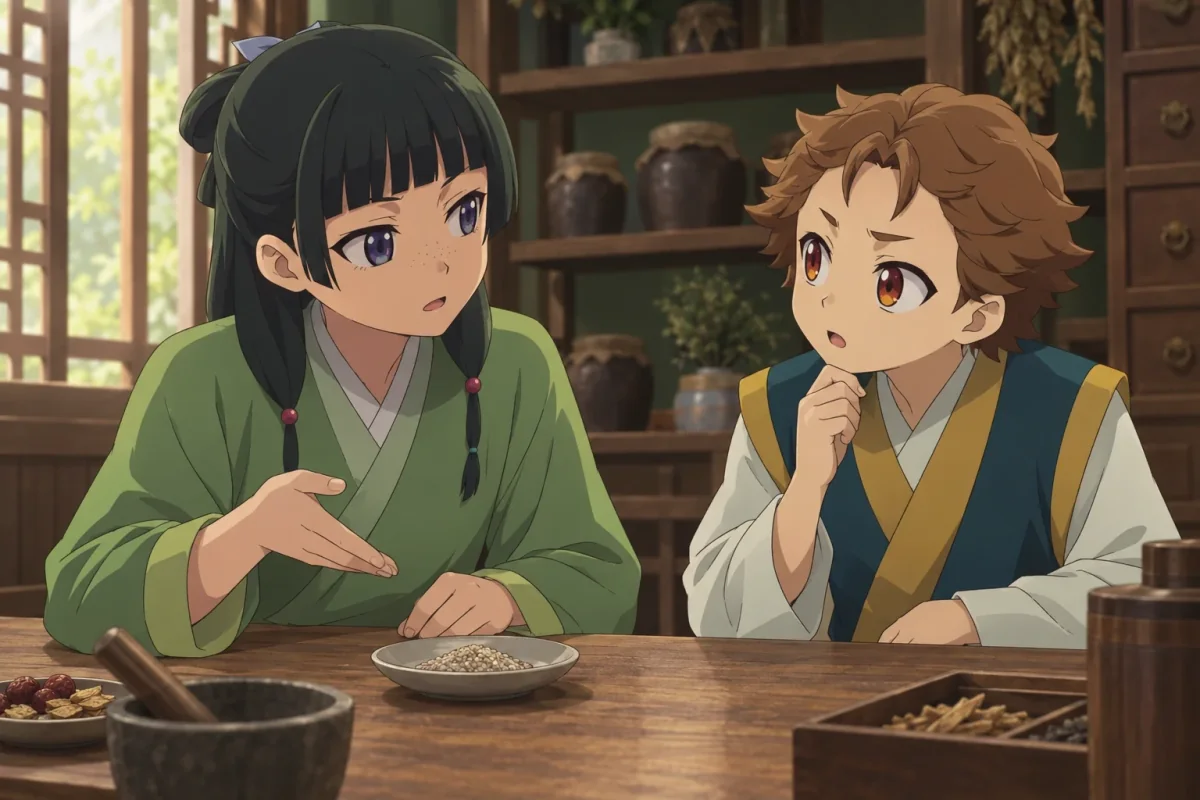
In the corresponding novel passage, much of the explanation belongs to Maomao’s reasoning and the narrator. The episode makes Chou-u a listener who can ask about what he sees. Maomao then has a reason to explain the patient’s unusual condition aloud.
That exchange gives the scientific material a social setting. Chou-u is present in the shop rather than appearing solely when the plot needs an errand. His interest in food also gives the conversation a small change of pace. Knowledge remains Maomao’s strength, but communicating it becomes part of the scene.
The compared subtitles use the term ergot; the corresponding Chinese novel passage describes toxins in coarse grain. This is a difference in explicit wording between the versions checked, not evidence that the Japanese original or every translation lacks the term. The adaptation makes the diagnosis easier to name while retaining the broader reasoning about the grain.
Why move the nutrition explanation?
The novel later identifies poor nutrition as the patient’s most serious problem. The episode brings that explanation into the care sequence. This timing helps viewers distinguish identifying a toxic exposure from understanding the patient’s overall condition.
The resulting emphasis is practical: a correct explanation is one step in caring for someone. The story spends time on recovery as well as deduction. The comparison concerns that narrative function, rather than treating the fictional case as a medical guide.
The Added Office Scene Connects Jinshi to the Search
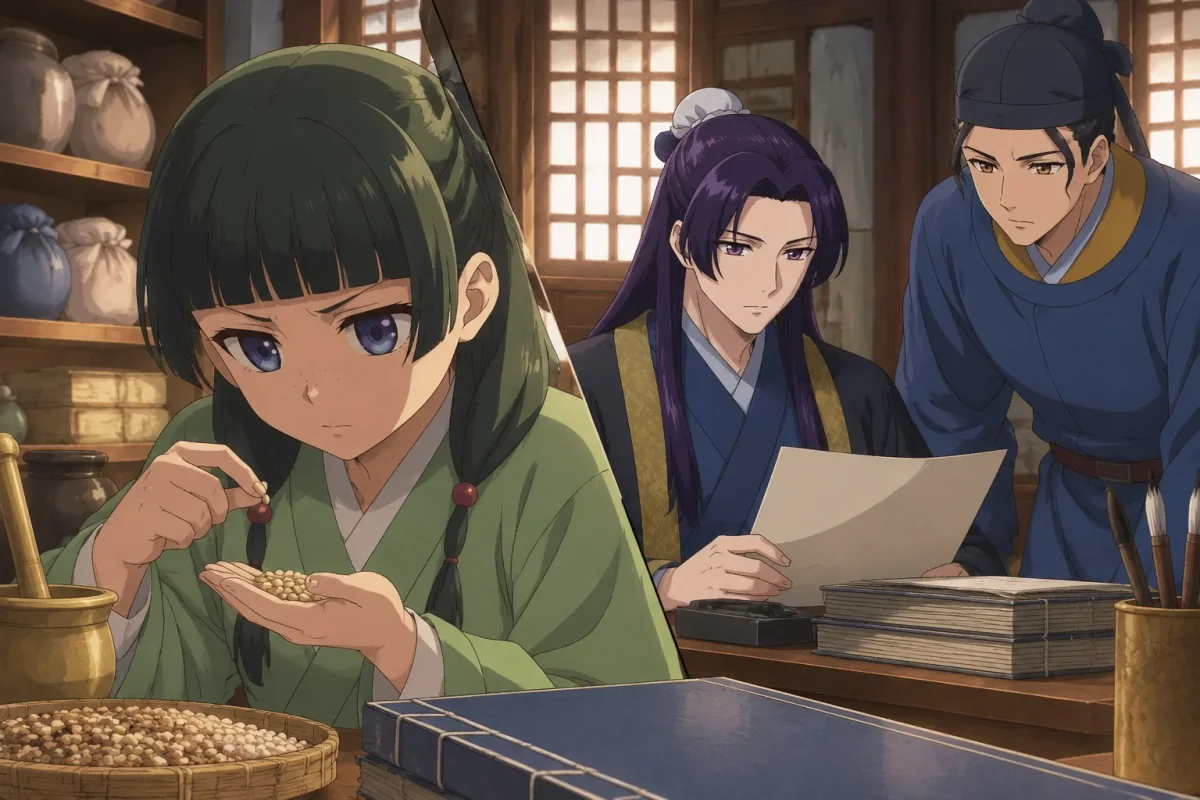
At the transition from Chapter 5 to Chapter 6, the novel moves directly to Basen bringing the books. The episode inserts an office conversation between Jinshi and Basen. It is Basen in this exchange, not Gaoshun.
Their discussion brings together suspicious drugs, the White Fairy, locusts, the books, and a prospective female medical attendant. As a complete scene at this point in the story, it is an addition. Its subjects, however, do not all begin here.
Chapter 3 already links the insect reference works to the risk of another locust disaster and to Jinshi’s workload. Chapter 7 develops the White Fairy’s reputation, while Chapter 12 takes the drug-distribution investigation further. The office sequence brings some of these concerns into proximity earlier. That is different from adapting the later discoveries in full.
For the episode, the benefit is a visible reason to care about the delivery before Basen reaches Maomao. Books become part of an official attempt to understand a threat to the harvest. The errand has consequences beyond whether Maomao can satisfy her curiosity.
The tradeoff is that the audience receives a more organized picture of the investigation sooner. Prose lets several concerns emerge in separate encounters; the office conversation places them on the same agenda. It provides orientation, while reducing some of the gradual accumulation of context.
The Missing Book Is an Evidence Problem
Basen’s arrival does not resolve the search. Having books in hand is useful only if they contain the information Maomao needs. The missing discussion of locusts makes the collection’s completeness a question in its own right.
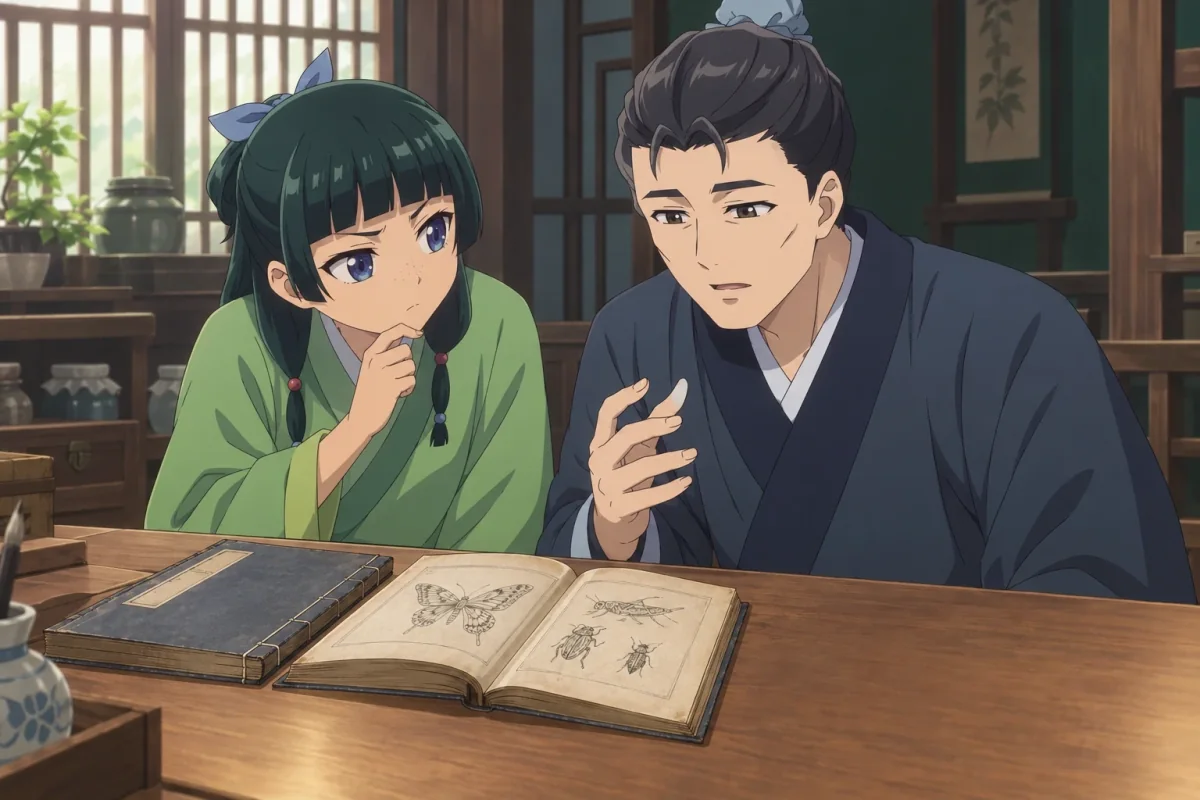
Sazen’s recollection helps narrow that question. In the novel, the accounting includes fourteen books overall and more detail about the volumes. The episode concentrates on the decisive point: the insect reference should consist of three volumes, and one was already absent before the books were retrieved.
This is a compression of the supporting inventory, not a different answer to the mystery. The inference still depends on comparing what should exist with what was recovered. It also prevents the delivery itself from becoming the sole explanation for the gap.
Why the order of questions matters
The inquiry moves from an absent topic, to an incomplete set, to people who may know where the missing volume went. Each question makes the next one more specific. Maomao is not simply sent toward Suirei because the plot needs a new location; the uncertainty about the collection provides a reason to consult another source.
The novel is more direct at this stage about some personal connections. The episode uses the account of the old apothecary’s assistant and Maomao’s reaction more economically, then lets the closing scene introduce the destination. That keeps the next conversation open rather than presenting its answers in advance.
The scientific stakes were established earlier: understanding locusts could matter to the next harvest. For a fuller explanation, read locusts and flying locusts in The Apothecary Diaries, which includes further novel spoilers.
Dialogue Redistributes the Work of Narration
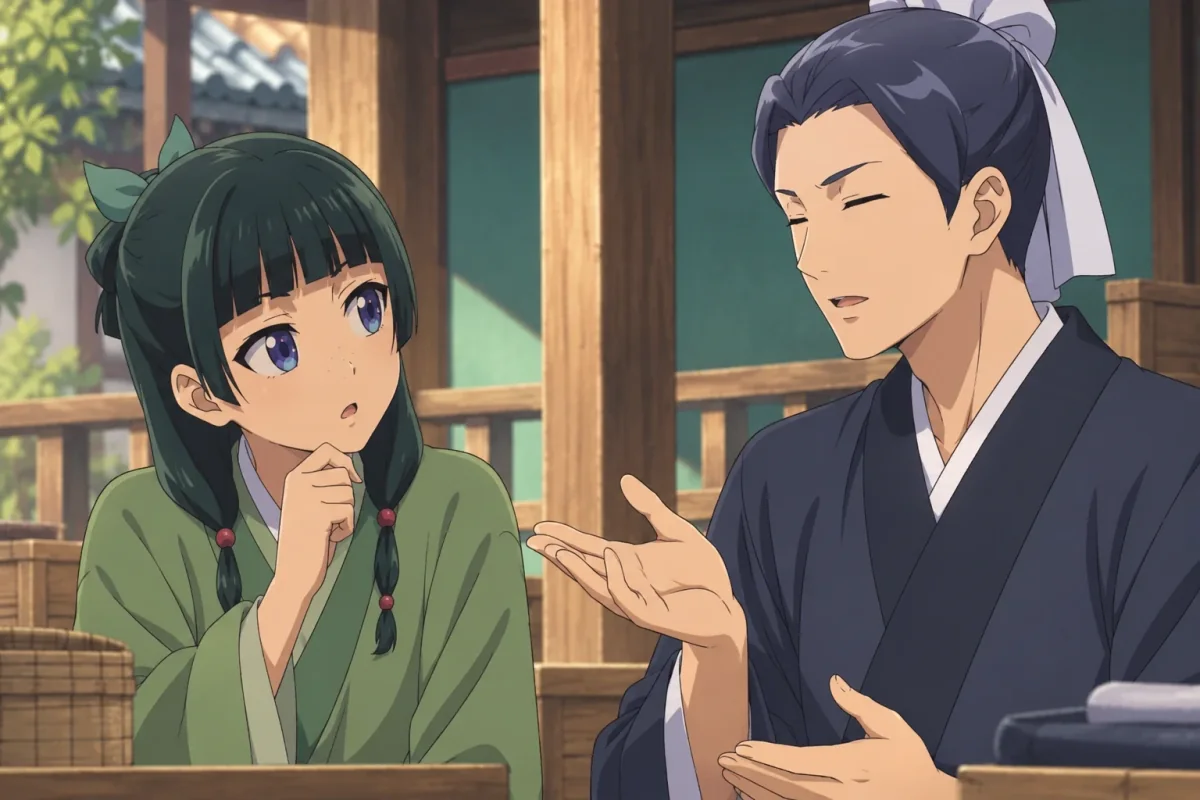
Ukyou provides a compact example of the adaptation’s method. The novel explains his practice of assigning a newcomer ordinary chores and watching for initiative. In the episode, Maomao asks about Sazen and Ukyou explains that practice himself.
The underlying information stays much the same, but its presentation changes the relationship we observe. Ukyou becomes someone who can articulate how he judges a new worker. Maomao’s question gives her an active place in learning that judgment instead of leaving the explanation entirely to narration.
Chou-u’s medical questions, Ukyou’s explanation, and Sazen’s book recollection perform different jobs. One makes specialist knowledge easier to follow; one reveals a working practice; one supplies evidence about the collection. Together they make the investigation feel distributed across a small network of people, even though Maomao remains the person joining the clues.
This approach has a limit. Spoken exchanges need time, so a compact episode cannot preserve every aside and every inventory detail at equal length. The relevant question is whether a cut removes the basis of a conclusion. Here, the three-volume discrepancy and the sequence leading to another witness remain intelligible even with the shorter accounting.
The Ending Opens a Visit; It Does Not Finish It
The final story scene sets up the visit to Suirei at Ah-Duo’s residence. Ah-Duo has a letter, and Suirei responds to the expected visit. The substantive interview with Maomao has not taken place by the episode’s ending.
This boundary matters when comparing the episode with Chapter 6. The chapter continues into that meeting, further answers about the old apothecary, progress on the missing book, and later scenes with Jinshi. Those events lie beyond the episode’s stopping point.
A preview does not move those events into the episode’s main story. Nor does their absence establish that the adaptation has removed them permanently. A chapter can span more than one episode, and a scene can be deferred without being discarded.
To continue reading, remain in Chapter 6 and find Maomao’s arrival at Ah-Duo’s residence. Start the chapter from the beginning if you want the fuller book-delivery context. Jumping straight to Chapter 7 would skip the investigation’s next steps. The related article why Ah-Duo keeps Suirei by her side supplies additional context with further novel spoilers.
What This Approach Gains—and What It Compresses
Across the medical and book investigations, the episode favors a clear chain of spoken questions. The audience can follow what Maomao notices, what she needs to ask, and which person can help with the next uncertainty. Jinshi’s office scene broadens the stakes before the delivery, while the ending postpones the next substantial answer.
The novel offers a denser account of how Maomao sorts information. Its fuller inventory and narrative asides let readers stay longer with qualifications and background. The episode gives those passages a more immediate conversational rhythm, sometimes at the cost of that density.
The most productive comparison therefore distinguishes three kinds of change: an added connecting scene, existing narration turned into dialogue, and supporting detail shortened around a retained inference. The office conversation, Ukyou’s explanation, and the book count illustrate those choices respectively. Calling all three “anime-original” would obscure how differently they use the source.
For the earlier part of this reading sequence, see S3EP1 vs light novel Volume 5. Our Season 3 story-background guide provides a broader starting point; both links carry novel context.
FAQ
Which novel volume and chapters correspond to S3EP3?
Volume 5, principally Chapter 5 and the beginning of Chapter 6. Earlier and later material in the volume helps explain the subjects brought together in the added office conversation.
Can I use manga chapter numbers for this locator?
No. This comparison uses the prose light novel’s chapter divisions. A manga volume or chapter with the same number is not automatically the same point in the story.
Who speaks with Jinshi before the books are delivered?
Basen. The office conversation is added at this point in the adaptation, and Basen subsequently brings the books to Maomao.
Does the anime change the missing-book deduction?
It shortens the inventory but keeps the central discrepancy: the insect reference should have three volumes, and one was missing before the retrieval. The next step is to seek someone who can explain the gap.
Was the later scene of Maomao feeding Jinshi cut?
It occurs later in Chapter 6, after the visit and further book investigation. This episode ends before that point, so it cannot establish that the scene has been permanently removed.
Where should I resume the novel after this episode?
Continue in Chapter 6 at Maomao’s visit to Ah-Duo’s residence. Reading from the start of Chapter 6 also restores the fuller account of the delivery and the missing volume.