Spoiler Warning
This article discusses late light novel and web novel spoilers for The Apothecary Diaries, including Suirei's role in the Jinshi assassination plot, her connection to the Shi clan crisis, her later status as a woman who cannot publicly exist, Ah-Duo's post-rear-palace household, surviving children connected to the destroyed faction, and later references to lifelong surveillance. Anime-only readers should stop here.
Scene Locator
The key evidence sits after the Shi clan crisis, once the story has moved beyond Suirei's first appearance as a palace worker and beyond the Loulan/Shisui reveal. The court cannot treat Suirei as an ordinary woman because she was involved in an attempt on Jinshi's life, carries dangerous bloodline implications, and knows too much about the people who tried to shake the imperial order.
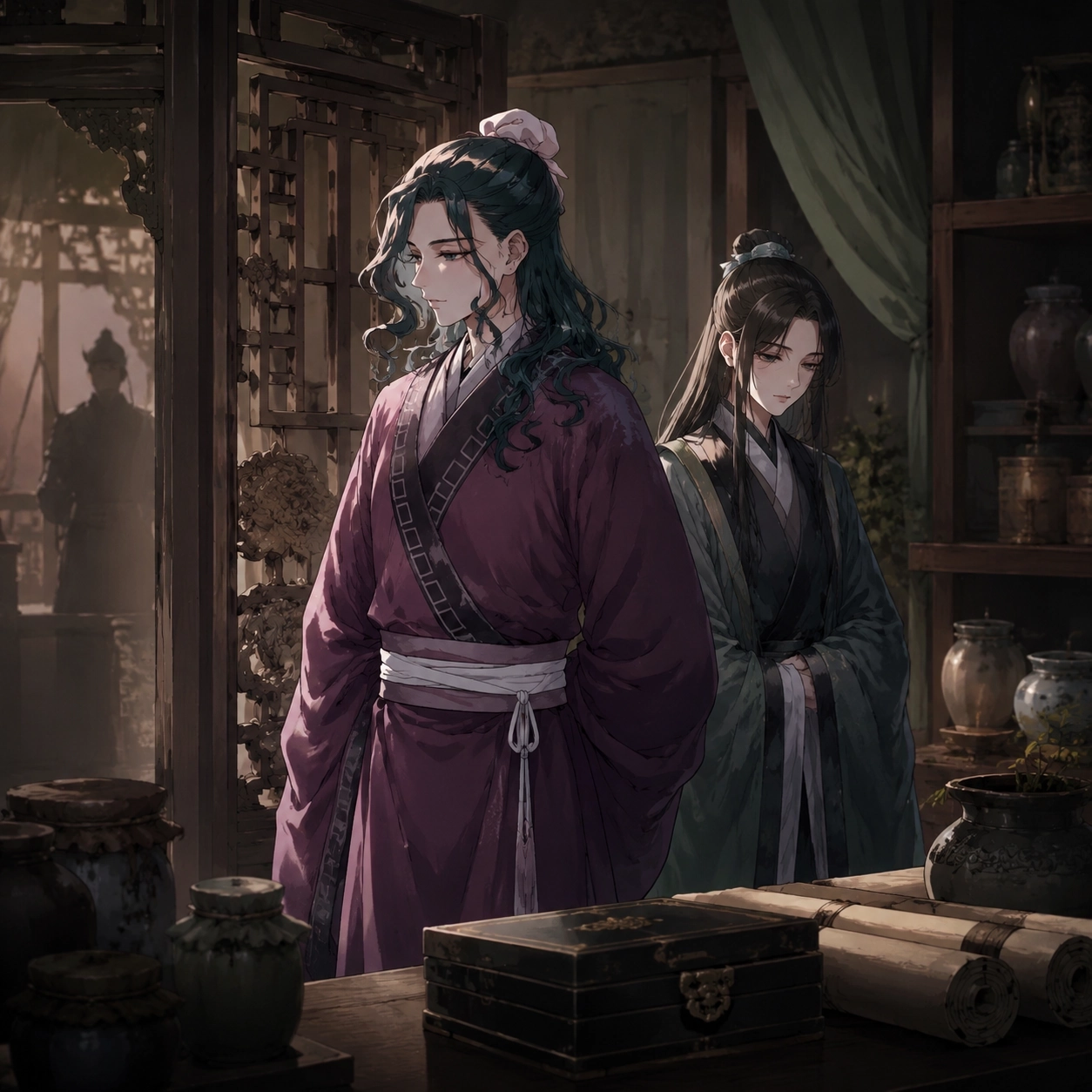
Later novel material places Suirei around Ah-Duo's household rather than back in open court life. Maomao hears that Ah-Duo is caring for children connected to the aftermath, and that Suirei also helps look after them. The same conversation frames Suirei as someone who will remain under watch for life because of who she is and what she represents.
For the surrounding Shi clan and Loulan context, start with the Shisui/Loulan identity guide and what Maomao gains from Shisui. For Ah-Duo's own political weight, pair this article with Jinshi's discovery of Ah-Duo's secret.
Volume-level entry only. The source is community-hosted; availability and rights status may vary.
The Short Answer
Ah-Duo Keeps Suirei Because Mercy Alone Is Not Enough
Ah-Duo keeps Suirei by her side because that is the safest arrangement left after the Shi clan's collapse. It is mercy, but not only mercy. Suirei is too useful to throw away, too dangerous to release, too politically sensitive to place anywhere public, and too damaged by the court's hidden history to be treated as a normal criminal.
The novels do not frame Ah-Duo's household as a simple happy ending. It is closer to a controlled sanctuary. Suirei can keep living, working, and caring for children, but she does so in a place where the court can quietly account for her. That is why the arrangement feels so characteristically Apothecary Diaries: humane on the surface, practical underneath, and never free of power.
So the answer is not "Ah-Duo is kind" or "Suirei is forgiven." The better answer is that Ah-Duo has the rare combination of imperial trust, personal toughness, political discretion, and emotional sympathy needed to hold someone like Suirei without turning her into a public scandal.
Ah-Duo's Household Is a Refuge With a Lock
The phrase "keeps her by her side" can sound warm, but Suirei's situation is darker than that. The court has reasons to watch her forever. She has old imperial blood attached to her, a record tied to treason-adjacent violence, and medical knowledge that can save lives or threaten them depending on who controls it.
Ah-Duo's household solves several problems at once. It protects Suirei from revenge, gossip, execution pressure, and exploitation by outsiders. At the same time, it prevents Suirei from disappearing into the world with a dangerous name, dangerous knowledge, and unresolved political value. That double function is the core of the arrangement.
This is why Ah-Duo's protection feels different from the softer protection she offers Lishu in the Ah-Duo and Lishu relationship. Lishu needs emotional shelter from court marriage politics. Suirei needs a place where survival and surveillance can coexist without everyone saying the quiet part aloud.
Why Suirei Cannot Simply Return to Ordinary Life
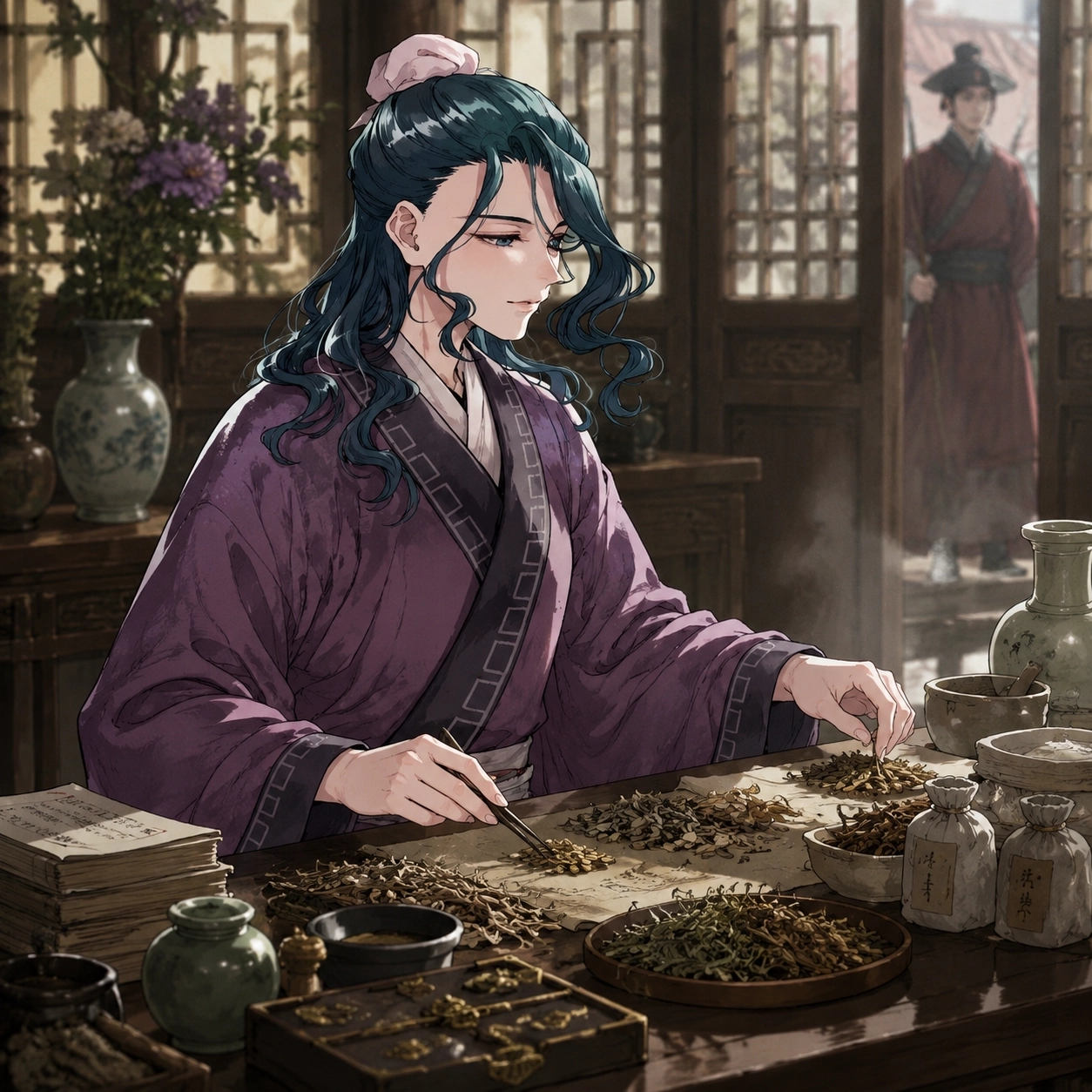
Suirei's biggest problem is that ordinary life no longer exists for her. Once she is tied to the Jinshi assassination attempt and the Shi clan crisis, the court cannot openly reassign her as if nothing happened. Even if Suirei herself is not the central architect of every disaster around her, she is attached to too many forbidden lines: imperial succession anxiety, Shi clan ambitions, secret medicine, and the lingering sins of the previous emperor's era.
The story's language around Suirei is especially cold because it treats her as someone whose existence cannot be officially permitted. That does not mean everyone literally forgets her. It means the court needs a fiction: Suirei cannot stand in normal records as a normal survivor, because acknowledging her would reopen questions the state would rather bury.
Her Bloodline Makes Her More Than an Accomplice
If Suirei were only a low-ranking accomplice, her fate might be easier to settle. She could be punished, exiled, or folded into some minor household with less political pressure. But Suirei is not merely a worker who made a bad choice. She carries bloodline implications that make her body itself a political document.
That is why lifelong surveillance makes sense in the novels' logic. Suirei does not need to be actively plotting to be dangerous. Other people could use her. A rumor could use her. A faction that wants an alternative symbol could use her. In a court obsessed with legitimacy, ancestry can become a weapon even when the person carrying it just wants to survive.
Her Crime Also Cannot Be Made Public Too Cleanly
The attempt on Jinshi creates another trap. Jinshi's own identity and position are already surrounded by layers of etiquette, rumor, and hidden truth. A public explanation of why Suirei mattered, why she targeted him, and why she is being spared would invite questions the court does not want common officials to ask.
So Suirei's survival has to be quiet. A public trial would expose too much. A clean pardon would look absurd. A simple execution would waste a useful person and might still leave loose ends. Keeping her near Ah-Duo is not romantic leniency; it is an administrative answer to a problem that cannot be solved cleanly in public.
Why Ah-Duo Is the Right Person to Keep Her
Ah-Duo is one of the few people who can shelter Suirei without looking naive. She is no longer a normal rear palace consort, but she has not lost relevance. The emperor trusts her, Jinshi's history ties her to the deepest succession secrets, and her years in the palace have made her unusually clear-eyed about how women become tools of rank, birth, and silence.
That makes Ah-Duo different from a purely kind patron. She can be compassionate without being foolish. She understands that Suirei needs walls as much as she needs mercy. She can keep a person close, assign work, limit movement, and absorb the political awkwardness because she already lives in an awkward space between private feeling and imperial order.
Ah-Duo Knows What It Means to Be Erased by Court Needs
Ah-Duo's own life gives her a particular sympathy for Suirei. Her history with the emperor and Jinshi is full of things that cannot be publicly named in a straightforward way. The court's version of Ah-Duo is always incomplete because the truth around her would destabilize more than one relationship.
That shared condition does not make Ah-Duo and Suirei the same. Ah-Duo has more rank, more trust, and more freedom of movement than Suirei. But Ah-Duo understands the emotional cost of surviving inside a political fiction. That is probably why she can make room for Suirei without pretending the arrangement is clean.
The related article on why Jinshi and Ah-Duo never have a direct conversation shows the same pattern from another angle: Ah-Duo often carries truth by managing silence, not by smashing it open.
Her Distance From the Rear Palace Helps
Ah-Duo's position after leaving the rear palace is also practical. If Suirei were placed inside the rear palace again, every movement would become gossip. If she were placed with an ordinary noble family, she might be used, hidden badly, or treated as a hostage. If she were put under harsh confinement, her medical skill and caregiving ability would go to waste.
Ah-Duo's household is quiet enough to bury scandal and important enough to be watched. That balance is rare. It is exactly the sort of place where the court can say, without saying it openly, that Suirei is alive but contained.
Suirei's Medical Usefulness
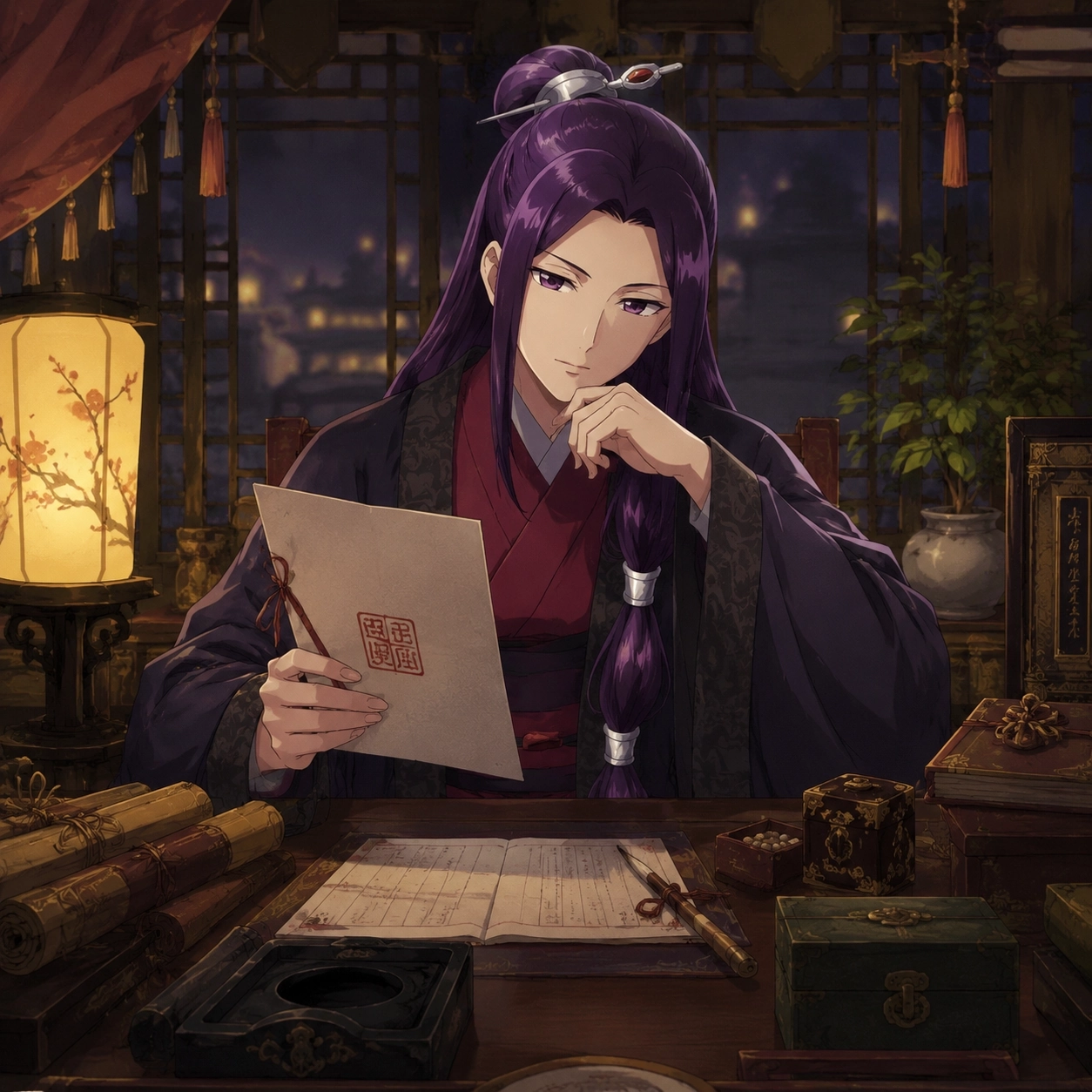
Suirei is dangerous partly because she is competent. The same knowledge that lets her work with medicine, bodies, and hidden treatments also makes her a liability if she falls into the wrong hands. The Apothecary Diaries rarely treats medical knowledge as purely good or evil. It depends on the person using it, the pressure around them, and the political purpose attached to the cure.
For Ah-Duo, Suirei's skill gives the arrangement a constructive shape. Suirei is not merely being warehoused as a secret. She can work. She can assist with care. She can help raise children who have their own trauma and political baggage. In a series where usefulness often determines survival, that matters.
Work Gives Suirei a Reason to Continue
Suirei's survival would feel hollow if she were only locked away. By placing her in a household where there is real caregiving to do, the story gives her a difficult but meaningful role. She cannot undo the past, and the court will not forget it, but she can become necessary in a smaller, quieter way.
This fits the series' moral texture. Characters are rarely saved by declarations of forgiveness. They are saved, if they are saved at all, by being made useful under conditions someone else controls. Suirei's medicine and discipline let Ah-Duo justify mercy in practical terms.
Her Knowledge Is Safer Under Ah-Duo Than Outside
If Suirei were left outside the court's trusted circle, her knowledge could be bought, coerced, or weaponized. Under Ah-Duo, the same knowledge becomes easier to monitor and harder to exploit. That does not erase Suirei's agency, but it limits the routes by which others can turn her into a tool again.
That is one reason the arrangement is more stable than exile. Exile sounds clean, but it sends a medically trained, politically sensitive survivor into a world full of ambitious people. Ah-Duo's solution is less clean but safer: keep Suirei where her skills are visible to the few people who are allowed to know.
The Children Make the Arrangement Larger
Suirei's place beside Ah-Duo is not only about Suirei. The later novels also connect Ah-Duo's household to surviving children from the destroyed factional world around the Shi clan crisis. That detail changes the emotional scale. Ah-Duo is not simply collecting one dangerous woman. She is managing the human leftovers of political disaster.
The children matter because they are not responsible in the same way adults are. The court can fear their names and origins, but it also cannot pretend that every child connected to a fallen faction deserves the same fate as the adults who made choices. Ah-Duo's household becomes a place where those children can grow under watch instead of being publicly branded forever.
Suirei Becomes Part of a Care System
Suirei helping care for children is one of the most important clues to why Ah-Duo keeps her close. It gives Suirei a role that is controlled, useful, and emotionally complicated. She is watching over children whose lives were distorted by the same political world that distorted hers.
That does not make Suirei innocent. It gives her a form of penance that the court can tolerate. She cannot become publicly free, but she can become privately responsible. In The Apothecary Diaries, that difference is often where the most interesting character writing lives.
Ah-Duo Is Absorbing Problems the Court Cannot Display
Ah-Duo's household works almost like a hidden annex of imperial responsibility. People who cannot fit cleanly into official categories can be placed near her: dangerous survivors, displaced children, and figures whose continued existence would make public politics messy. Ah-Duo can carry that mess because she has already spent her life carrying inconvenient truths.
This connects her to the wider map of late-novel politics. The west, the Shi clan, Jinshi's identity, and palace succession pressure all create people who do not fit neat boxes. The article on why Jinshi has to go west explains one side of that crisis; Suirei's placement with Ah-Duo shows what happens to some of the people left behind after the public crisis passes.
Why This Is Not Forgiveness Without Consequences
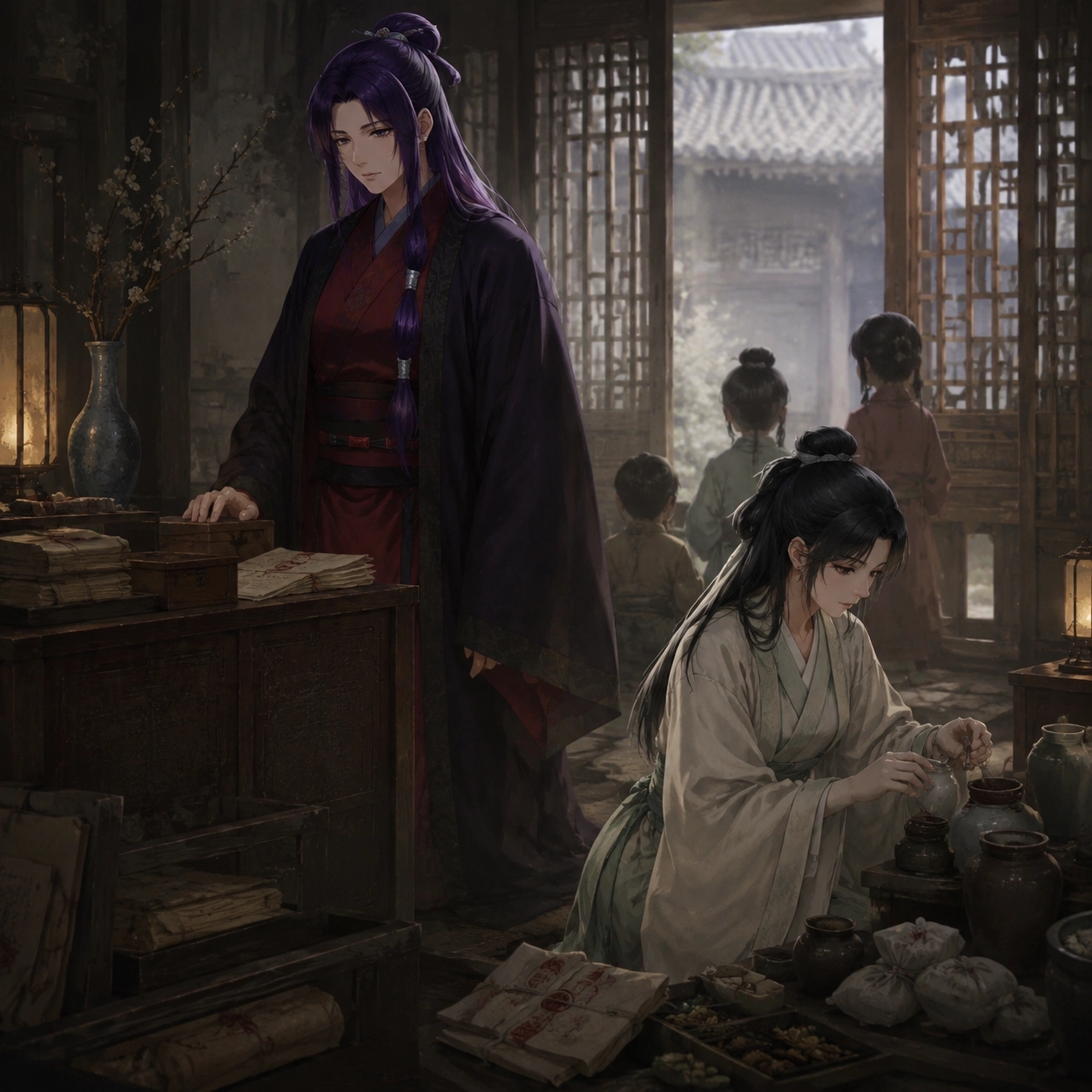
A common mistake is to read Suirei's later survival as the story letting her off. The novels are harsher than that. Suirei lives, but she does not simply reenter society. She is watched. Her public existence is restricted. Her future is not open in the way a free person's future is open.
That is why the arrangement works dramatically. It does not flatten Suirei into a villain who must die, and it does not flatten Ah-Duo into a saint who erases guilt. Instead, it puts both women in a morally cramped room. Suirei receives life, work, and a limited place. Ah-Duo accepts responsibility for keeping that place from becoming dangerous.
Mercy Has to Be Legible to Power
In a softer story, Ah-Duo might simply say that Suirei deserves another chance. In The Apothecary Diaries, that would not be enough. Mercy has to be legible to power. The emperor and the court need to see why sparing Suirei is safer than killing her or losing track of her.
Ah-Duo can make that argument without announcing it as an argument. She gives Suirei a job, keeps her near, surrounds her with responsibility, and ensures that the people who need to know can trust the arrangement. That is mercy translated into court language.
Suirei's Fate Still Has Teeth
The strongest proof that this is not consequence-free is the surveillance. Suirei's life continues, but the court's eye does not move away. That means her survival is conditional even if the condition is not shouted at her every day. She has been spared from death, not restored to a normal identity.
That tension is why her later status feels so believable. The court is capable of mercy, but only when mercy can be managed. Ah-Duo is the manager.
What This Reveals About Ah-Duo
Ah-Duo keeping Suirei near shows one of Ah-Duo's most important late-novel functions: she becomes a holder of inconvenient lives. After leaving the rear palace, she does not disappear into irrelevance. She becomes a person who can absorb sensitive people and problems the official court cannot handle gracefully.
This deepens her beyond the Jinshi secret. Ah-Duo is not only important because of who she gave birth to or what was hidden around him. She is important because she knows how to survive after formal power changes shape. She can still influence outcomes, protect vulnerable people, and make practical demands from a position that looks almost private but is politically alive.
That is why comparing Suirei with Lishu is useful. In the Lishu arc, Ah-Duo protects a timid consort from being crushed by family ambition and marriage politics. In Suirei's case, she protects a dangerous survivor from execution, exploitation, and exposure. The emotional temperature is different, but the underlying Ah-Duo pattern is the same: she sees people the palace has made into tools, then gives them a more livable arrangement without pretending the palace has become kind.
If you want the broader court setting that makes these arrangements necessary, read the setting of The Apothecary Diaries explained. The rear palace and outer court are not just scenery; they are systems that decide which truths can be spoken and which people must be tucked away.
Common Misreadings
Misreading 1: Ah-Duo keeps Suirei because she fully forgives her
The novels do not require full emotional forgiveness for the arrangement to make sense. Ah-Duo can choose mercy, usefulness, and containment at the same time. Keeping Suirei alive does not mean pretending the assassination plot and Shi clan aftermath did not matter.
Misreading 2: Suirei becomes free after the crisis
No. Suirei survives, but her freedom is limited. Her official status is damaged, her bloodline keeps her under watch, and her place beside Ah-Duo is safer than ordinary life precisely because it is not ordinary freedom.
Misreading 3: Ah-Duo only wants Suirei for medical labor
Suirei's medical ability matters, but it is not the whole reason. Ah-Duo also needs a politically discreet way to shelter a dangerous survivor and help manage children left behind by the crisis. The medicine gives the mercy structure; it does not erase the human motive.
Misreading 4: The court is simply kind to defeated enemies
The court is not kind in a modern rehabilitative sense. It is practical. Children can be watched until they grow. Suirei can be used and contained. Ah-Duo can supervise. The result may be more humane than execution, but it is still a political calculation.
FAQ
Does Ah-Duo adopt Suirei?
Not in the simple family sense. Ah-Duo shelters Suirei and keeps her near, but the arrangement is closer to supervised protection than adoption. Suirei is useful, watched, and politically sensitive.
Why does Suirei need lifelong surveillance?
Suirei is tied to the former emperor's bloodline, the Shi clan aftermath, and the Jinshi assassination plot. Even if she is not actively plotting, her name, knowledge, and ancestry could be used by other people. Surveillance keeps that risk contained.
Is Suirei forgiven for trying to kill Jinshi?
The story does not present her later life as a clean pardon. She is spared and given a role, but she remains officially constrained. The consequence is not execution; it is a life lived under watch.
Why would Ah-Duo trust Suirei around children?
Because trust here is structured, not blind. Suirei has medical knowledge and discipline, and Ah-Duo's household gives her supervised work. Caring for children lets Suirei be useful while remaining inside a controlled environment.
How is this connected to Shisui and Loulan?
Suirei's later situation belongs to the broader aftermath of the Shi clan crisis, the same political disaster that frames Shisui/Loulan's hidden identity and survival. Read will Shisui come back? and what if Shisui had not taken the abortifacient? for related late-novel fallout.
What should I read next?
Read Exploring the Secrets of Shisui for the Shi clan identity thread, then Ah-Duo and Lishu's relationship to compare Ah-Duo's softer protector role with her more political role around Suirei.