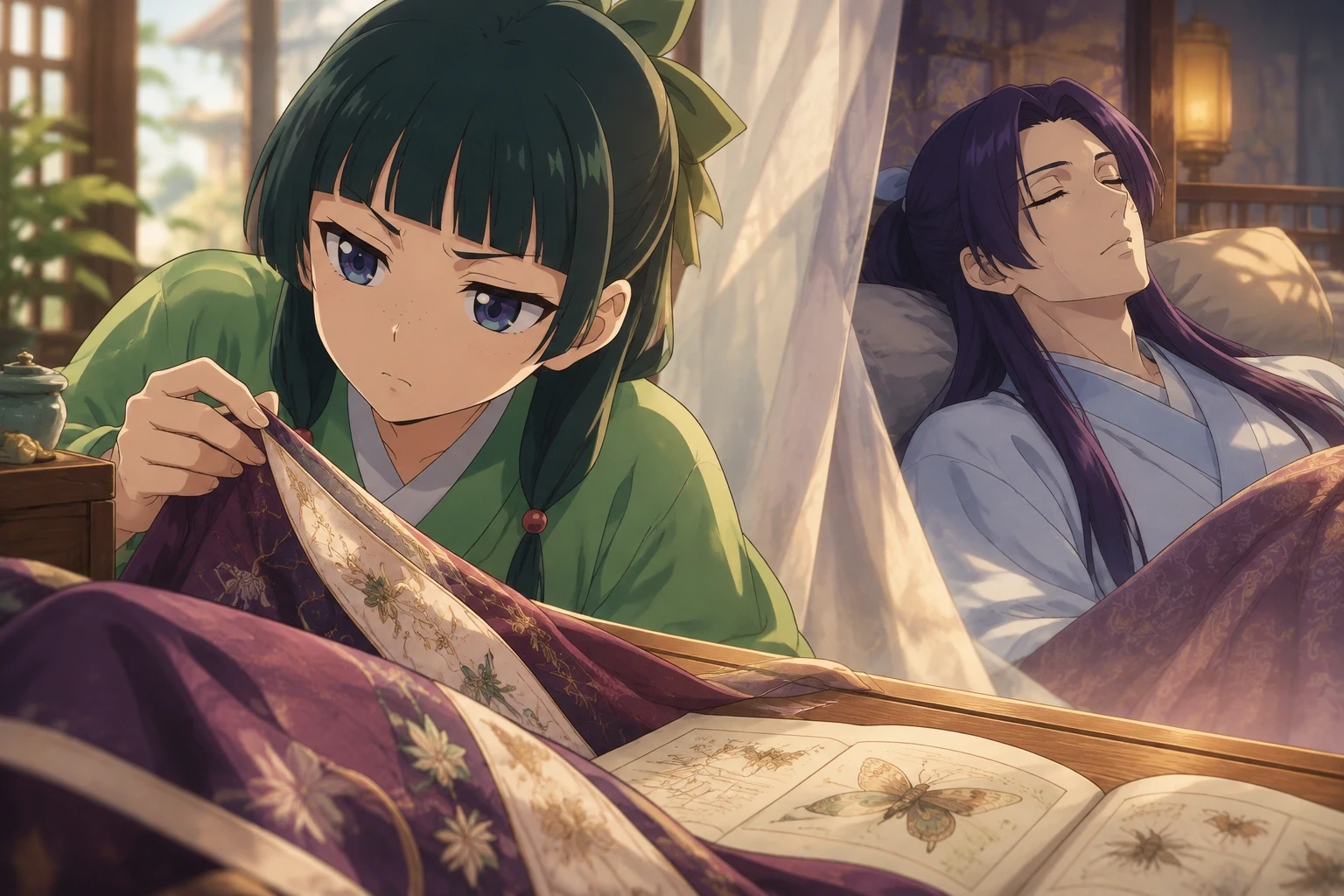
Spoiler Warning
Light novel Volume 5 spoilers. This article discusses the fire-rat robe, Sazen's new name, the locust investigation, Jinshi's rest at the Verdigris House, and the suspicious pastries connected to Chapter 5. It also briefly refers to the foreign envoys' political connections discussed later in Volume 5. Chapter numbers below refer to the light novel.
Scene Locator: S3EP2 and Light Novel Volume 5
S3EP2 mainly adapts Volume 5, Chapters 3 and 4, reversing their order. The fire-rat robe story comes first. Jinshi's visit, the discussion of locusts, and his much-needed sleep follow it. A short scene involving offered pastries draws on the investigation in Chapter 5.
- Chapter 3: stories about the rebellion, the insect encyclopedias, Sazen's new life, and Jinshi's rest at the Verdigris House.
- Chapter 4: Maomao and Chou-u buy winter clothes, hear a tale about a foreign woman, and examine an unusual robe.
- Chapter 5: a sick child and an investigation into food given to people in poverty.
- Chapter 15: later context for the foreign envoys' connections to the Shi clan, relevant to Maomao's suspicions.
The episode's robe, lullaby, and ominous ending belong to different points in the book. Keeping those sources separate helps explain its choices. For the larger arc, see our novel-based Season 3 viewing guide.
Volume-level entry only. The source is community-hosted; availability and rights status may vary.
The Biggest Change: Chapter 4 Comes Before Chapter 3
The novel takes Maomao from Jinshi's exhausting responsibilities and a surprisingly tender afternoon into the ordinary business of buying clothes. The episode arranges those experiences in the opposite direction. It completes the robe mystery, returns to the political problem of locusts, and then gives Jinshi a place to sleep.
That order makes the fire-rat robe the first substantial story and the lullaby the emotional destination. Maomao's practical intelligence holds them together. She understands what a piece of cloth can do; she also recognizes what an exhausted man needs, even while misunderstanding the company he wants.
This continues an approach visible in our S3EP1 and Volume 5 comparison: the adaptation moves information to change the audience's experience of a familiar sequence. Here, the altered order gives two largely preserved chapters a new rhythm. The pastries then interrupt the sense that the episode has safely settled into warmth.
S3EP2 vs the Light Novel: The Main Changes
On a small screen, swipe the table sideways to read all three columns.
| Story element | Light novel | S3EP2 |
|---|---|---|
| Rumors about Jinshi and Loulan | Chapter 3 describes the stories circulating after the rebellion. | Street conversation and a book presented to Jinshi turn that background into an opening scene. |
| The fire-rat robe | Chapter 4 follows Jinshi's visit and sleep. | The robe story moves ahead of the visit and occupies the first half. |
| Selling the garment | The narration returns to the sale after moving onto the journey home. | The demonstration, sales pitch, and bidding unfold as one continuous scene. |
| Sazen's name | Narration explains his new name while Maomao withholds mention of the escaped man. | A recalled conversation dramatizes the change, and Jinshi then refers to Sazen by name. |
| Locust relief | Southern reserves cover the earlier shortfall; colder weather limited the previous outbreak. | The southern source gains specific political detail, while the weather explanation is compressed. |
| Bath, tonic, and companions | The misunderstandings already form part of Chapter 3. | Facial reactions and successive reveals develop their comedy. |
| The lullaby | Maomao sings and pats the bedding; Jinshi falls asleep. | Specific lyrics and a sustained bedside sequence give the brief passage more time. |
| The pastries | Chapter 5 uncovers their troubling history through questions and testimony. | The audience sees an act of giving before the next investigation unfolds. |
The Opening Makes Jinshi's Reputation a Political Problem
In Chapter 3, Maomao looks at Jinshi's scar and thinks about the stories people have made from the rebellion. A complicated conflict has become a tale with an attractive imperial hero and a wicked Loulan. The account tells us something about public imagination: a memorable face and a visible wound can decide who becomes the villain.
The episode gives this circulation a physical presence. People talk in the street, a reader has a book, and a copy reaches Jinshi. He lets the story pass. Later, the possibility of another locust disaster gives those same publications a more dangerous meaning. A population that praises the imperial family can also blame it when crops fail.
The novel already connects locusts with judgments about the Emperor's rule. The episode strengthens the link between that belief and the books seen at the start. It gives the political danger an object viewers remember. The everyday city matters here, alongside the palace; our guide to the setting of The Apothecary Diaries provides broader context for those connected social worlds.
The Fire-Rat Robe Keeps the Novel's Layers of Explanation
The clothes-shopping trip begins with practical limits. Chou-u is cold, money must last, and Maomao sees little reason to buy expensive new clothing for a growing child. The shopkeeper's foreign robe introduces a different kind of value: an object becomes more desirable when somebody attaches a remarkable story to it.
His tale concerns a foreign woman who makes unusual garments and wants to return home. A villager wants to keep her, and others help prevent her departure. Her extraordinary escape becomes a story about a heavenly woman. The episode gives the tale a storybook texture, setting it apart from the ordinary shop where it is being told.
Maomao finds two kinds of evidence. The cloth has unusual physical properties, and the embroidery resembles foreign writing she has seen Luomen use. Decoration can carry a message to somebody capable of reading it. The mystery therefore turns on knowledge and interpretation: the villagers see a pattern, while the woman's countrymen may see a request for help.
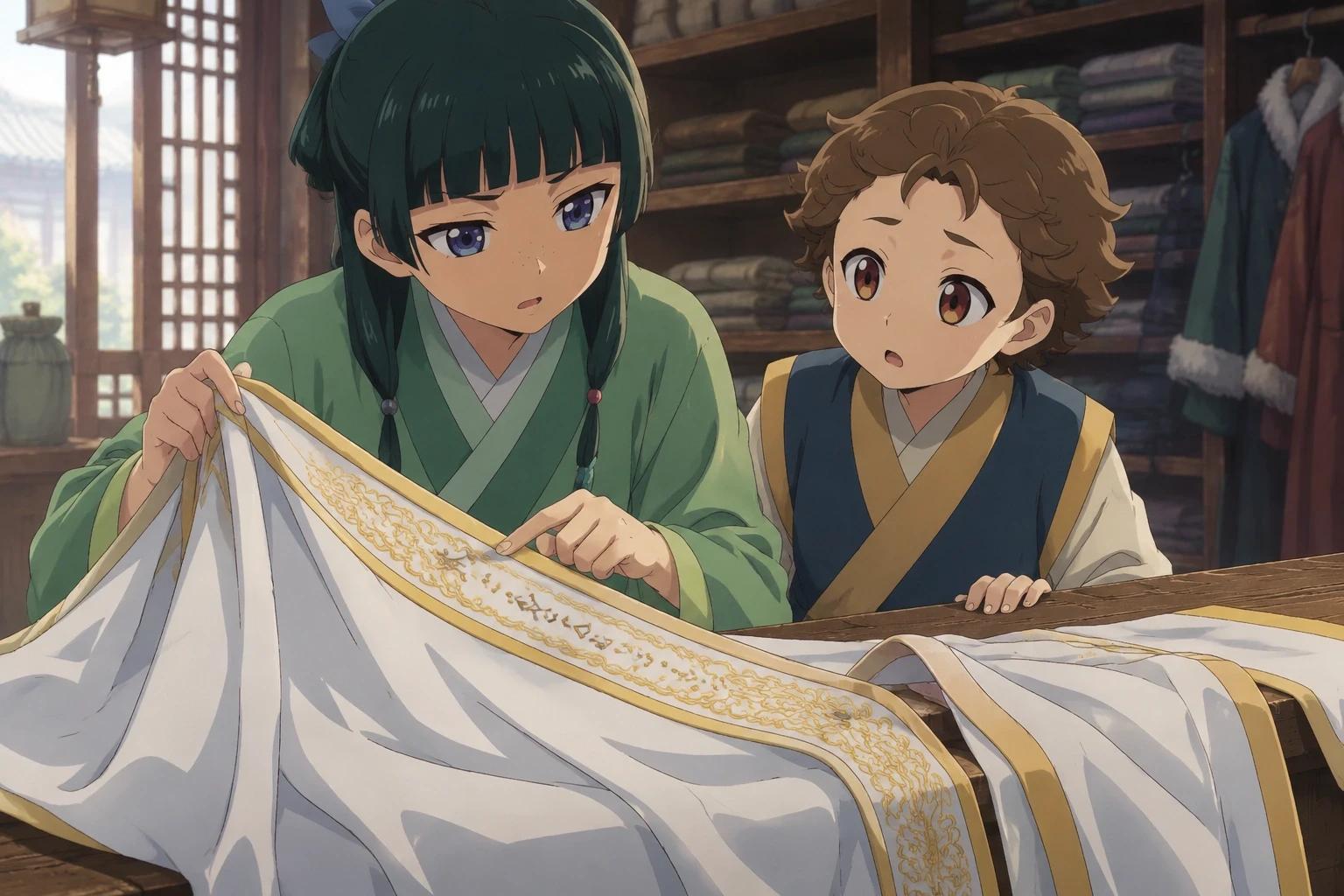
The novel already supplies Maomao's further suspicion that this woman might have been a spy. Literacy, specialist knowledge, and the nerve required for such an escape make her background worth questioning. The anime adds a more explicit connection to the foreign envoys and the Shi clan. That connection gives the scene political context, but Maomao's suspicion remains a possibility. Neither her reasoning nor the imagined images establish the woman's identity.
The sale gains its own momentum. The episode lets the demonstration attract a crowd, follows the shopkeeper's pitch, and adds successive bids. The book moves to the journey home before explaining part of this business. Keeping the sale together gives the audience an immediate reward for understanding Maomao's plan: knowledge has become useful, and winter clothing has become affordable.
Sazen and the Locust Books: Small Changes in Who Knows What
When the episode returns to Jinshi's visit, it dramatizes another piece of narrative background. Ukyou agrees to take responsibility for the former fortress guard. Chou-u's recognition could be a problem, and the man proposes a new name: Sazen. Letting him participate in that conversation gives his attempt at a new life a small, concrete scene.
There is also a subtle difference in information. The novel explicitly says Maomao does not mention the man who escaped the fortress. The anime then has Jinshi refer to Sazen as the person who sold the book. At minimum, this version gives Jinshi the name and the connection to the sale. It does not establish that he has been told every detail of Sazen's past or Chou-u's situation.
The books themselves retain their original importance. They may contain research into a recurring disaster. A meal of insects and a missing encyclopedia matter because they could help answer a problem the government cannot simply wish away. Our analysis of the locust clues follows that chain of observation in more detail.
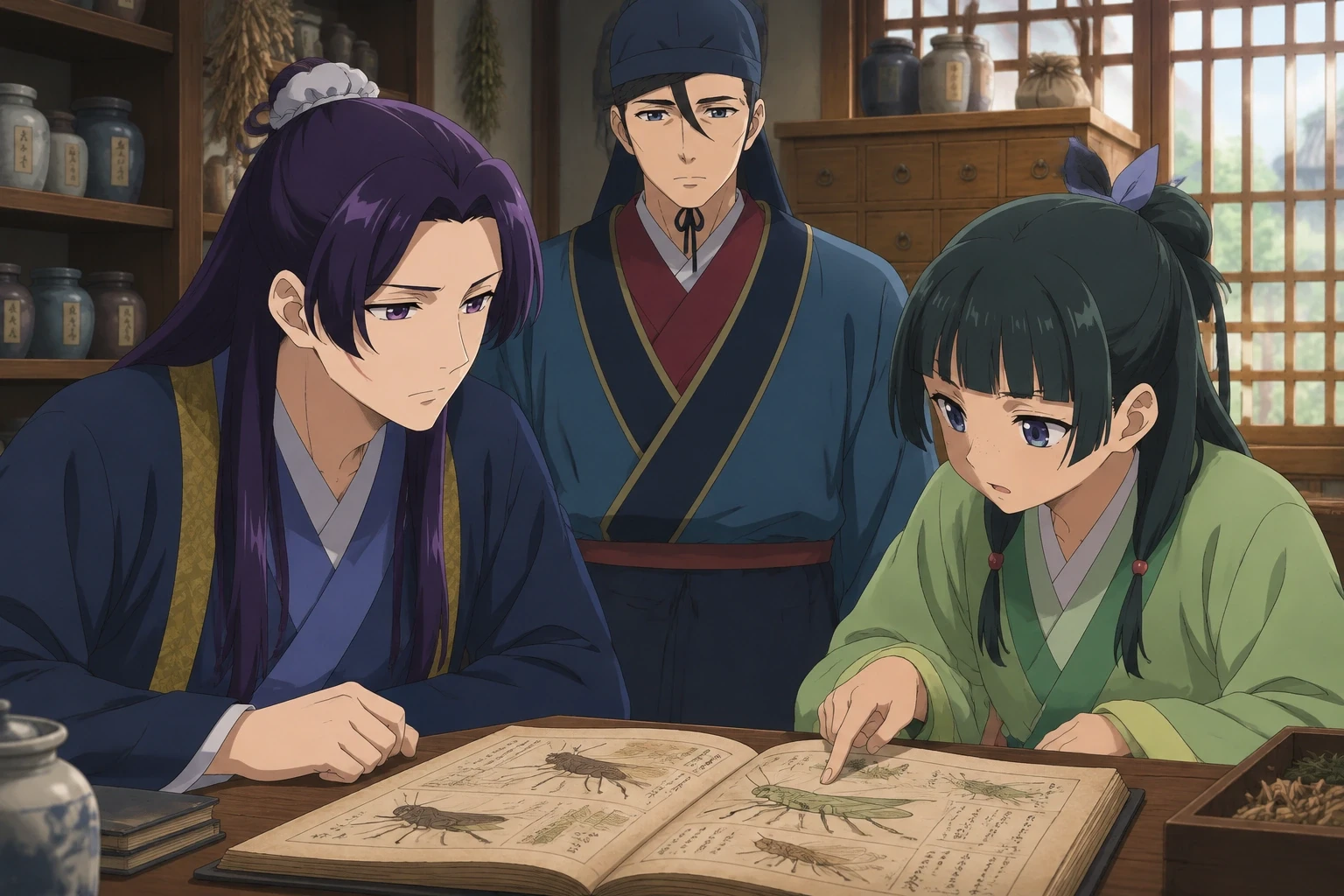
The anime makes the southern grain source more specific by naming a province and clan. The novel's corresponding line refers to southern reserves. At the same time, the episode reduces the explanation that cold weather helped limit the earlier outbreak. Political coordination becomes clearer, while some of the environmental detail falls away.
Gaoshun also stays inside the room for the conversation and can respond immediately to the instruction to obtain the books. In the novel, limited space keeps him waiting outside, and summoning him produces a small joke involving dumplings and Chou-u. Removing that detour makes the official business more direct. His role as a trusted attendant still matters; readers interested in its background can explore Gaoshun's relationship with the imperial household, which includes wider novel spoilers.
Jinshi's Rest Preserves the Novel's Comedy and Misunderstanding
Maomao's concern begins with a physical assessment. Jinshi is tired, and his assurance that he can continue does little to convince her. The same professional attention that notices an unusual garment now notices a person approaching his limits.
The bath attendants, restorative drink, prospective companions, and Gaoshun's fear of his wife's reaction all come from Chapter 3. Their humor depends on Maomao and Jinshi interpreting the same situation differently. She approaches the request through the practical arrangements available at the Verdigris House. His responses show how poorly those arrangements match what he hoped she would understand.
The episode develops this through visible reactions. Jinshi's anticipation repeatedly gives way to alarm or embarrassment. Gaoshun becomes an increasingly uncomfortable witness. In the novel, Jinshi puts his face covering back on after the bath misunderstanding; the anime lets these reactions play across his uncovered face.
Some commercial background is reduced. The novel specifies that the old madam provides her best room without charging, and Maomao considers what advantage she might see in pleasing such a guest. The episode emphasizes the speed of the preparations and the misunderstandings that follow. It gives the comedy more uninterrupted space.
Maomao's Lullaby Is in the Light Novel
Maomao singing Jinshi to sleep is an original novel event. He catches her arm as she tries to leave and asks for a lullaby. She warns him about her singing, pats the bedding, and sings a song known in the pleasure district. Soon, he is asleep.
The anime turns that short passage into a sustained bedside scene with specific lyrics. Maomao's hand on the bedding, folded clothing, Jinshi's sleeping face, and a bird at the window give the viewer time to register the change. A man whose work and position keep demanding something from him has finally stopped being required to respond.
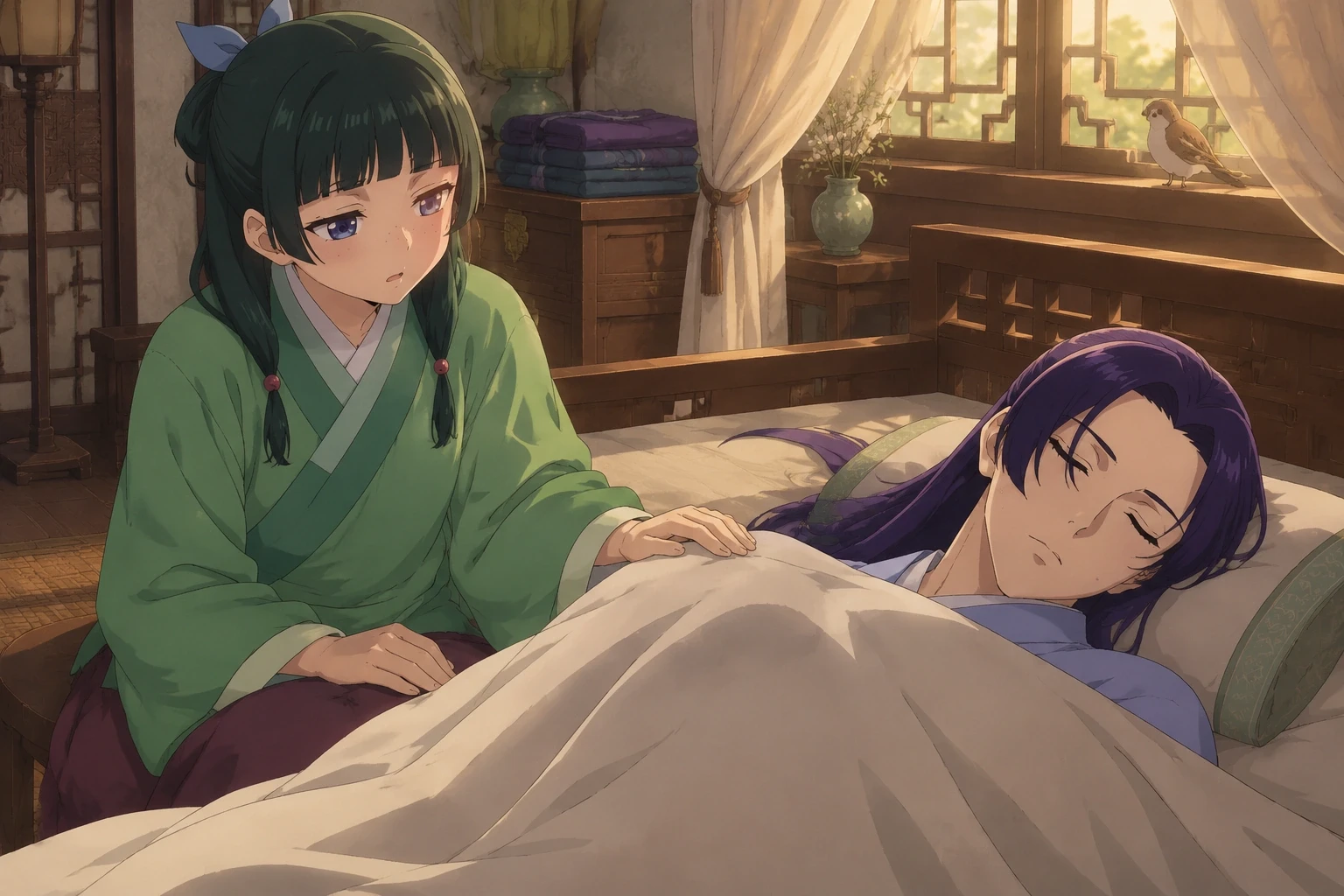
The intimacy comes from the particular person who stays. Maomao can misunderstand Jinshi's intentions and still offer care that matters to him. His wish for her presence and her practical concern coexist without resolving into an explicit confession.
Pairin's teasing after his departure preserves that uncertainty. She sees something Maomao refuses to acknowledge; Maomao answers by professing not to understand. Their exchange is also in the novel. Placing it near the episode's end gives it additional weight. For a broader reading of that difference in awareness, see our analysis of Jinshi and Maomao's relationship, which discusses developments beyond this episode.
The Pastry Ending Brings Chapter 5 into View
The episode does not finish with everyone safely restored. After the warm scenes around the Verdigris House, the setting shifts to an alley. Two hooded figures stand near an older man, and one offers him pastries. The act looks simple; its placement makes it uneasy.
Chapter 5 supplies the relevant connection. Maomao investigates a child's illness and asks about food the family received. Ukyou also questions an older man who had accepted food from a woman whose face he did not see clearly. What the novel uncovers through testimony becomes a visible encounter for the anime audience.
This changes the suspense. Readers work with Maomao to discover what was eaten and where it came from. Viewers have already been given an image of an unexplained gift, so they can watch for its consequences. The closing scene borrows the substance of a later clue while creating its own presentation.
The figures' identities are not established by this scene. It also gives no firm date for the encounter. The novel's account of the family's food reaches back roughly a month, so the anime's sunset transitions should not be used to insist that every scene happened on the same day.
What S3EP2 Gains Through Its Rearrangement
The episode's strongest changes concern emphasis. Public stories about Jinshi open the action; a story about a foreign woman becomes the main puzzle; Maomao repeatedly looks beyond appearances; and an apparently generous act closes the episode with something still unexplained. This arrangement gives the two principal chapters a shared interest in how people understand what they see.
There are costs to the compression. The novel's remark about poor-tasting bread quietly connects an ordinary meal to the harvest. Its explanation of village marriage practices adds context to the foreign woman's predicament. Those details receive less attention here, while the reference to the envoys makes the political connection more explicit.
The result keeps the main causes, discoveries, and misunderstandings while changing their rhythm. The robe story receives a complete public performance, the lullaby receives time and stillness, and the pastries keep the investigation moving beyond the episode. The clearest measure of this adaptation is how those choices alter our attention to material the novel already contains.
Follow the investigation into S3EP3 vs light novel Volume 5, covering Maomao’s medical reasoning, Basen’s book delivery, and the shift from narration to dialogue. Volume 5 spoilers.
FAQ: Apothecary Diaries S3EP2 vs the Light Novel
Which light novel chapters does S3EP2 adapt?
Its main sources are Volume 5, Chapters 3 and 4, shown in reverse order. The ending also presents a clue connected to Chapter 5, while the envoy reference has context later in Volume 5.
Is the fire-rat robe story an anime-original case?
No. The garment, the foreign woman's story, the embroidery, and Maomao's suspicion about her background are all in Chapter 4. The anime develops their presentation and expands the sale.
Is Jinshi asking Maomao for a lullaby in the novel?
Yes. Chapter 3 includes the request, her reluctant agreement, her hand patting the bedding, and his falling asleep. The episode develops the passage into a longer scene with specific lyrics.
Does the episode confirm that the foreign woman was a spy?
No. Maomao considers it a possible explanation for the woman's knowledge and behavior. The speculation should not be treated as a confirmed identity.
Where should I read to compare the episode with its source?
Read Volume 5 from Chapter 3 through Chapter 5 to see the original sequence and the pastry investigation. Reading from the beginning of the volume also preserves the earlier insect and encyclopedia clues that lead into Jinshi's visit.