Spoiler Warning
Light novel spoilers: the end of Volume 4 and developments in Volumes 5–6. This guide discusses Jinshi's public royal identity, Gyokuyou's elevation, Shisui's continuing influence, the Western Capital visit, Lishu's vulnerability, and a disturbing confrontation between Maomao and Jinshi. The relationship discussion includes non-graphic references to physical coercion. Read on only if you want novel context before watching the next season.
What Should You Know Before The Apothecary Diaries Season 3?
The story after the Shi clan crisis asks you to watch rank, family connections, and small pieces of evidence as closely as you watch the mysteries. Jinshi's position changes the meaning of his interactions with Maomao. Gyokuyou's new status connects the palace to western interests. Shisui's absence does not erase the knowledge she leaves behind, and Lishu's title offers less protection than it appears to.
The novels do not suddenly abandon medicine for politics. They show how the two meet: an insect can threaten a harvest, a household can control access to care, and a marriage proposal can turn a person into a political solution. That is the most useful preparation for this stage of the story.
This is a novel-based viewing guide, not a confirmed Season 3 episode list. The reading checkpoints below follow the books. An adaptation can rearrange scenes, shorten explanations, or choose a different stopping point; check the official anime website for broadcast and production announcements.
Scene Locator: The Novel Chapters Behind This Guide
These checkpoints let you verify the analysis without treating a future anime episode number as established. Chapter descriptions are English reading pointers; published titles can differ by edition.
- Volume 4, epilogue: Gyokuyou's elevation, the new crown prince, Maomao's return to her apothecary, and the personal aftermath of the Shi clan crisis.
- Volume 5, Chapters 1 and 6: the locust clues and the missing insect encyclopedia, including Maomao's recollection of the infirmary book.
- Volume 5, Chapters 12–16: marriage calculations, arrival in the Western Capital, Gyokuyou's family connection, and the social pressure of the banquets.
- Volume 5, epilogue: Maomao and Jinshi's confrontation after the banquet, where political reasoning and personal desire collide.
- Volume 6, Chapters 2–4 and 12–16: the continuing western visit and return, followed by the crisis surrounding Lishu and Basen's involvement.
For more chapter pointers, use the Volume 5 Scene Locator. The article stops its own plot analysis at Volume 6; links that go further are labeled below.
Volume-level entry only. The source is community-hosted; availability and rights status may vary.
Volume-level entry only. The source is community-hosted; availability and rights status may vary.
1. Start with the Aftermath, Not a Clean Reset
The end of the Shi clan story resolves an immediate rescue and rebellion. It does not restore everyone's old life. In Volume 4's epilogue, Maomao is back at her apothecary, Gyokuyou has become empress, and the children and survivors of the crisis face altered circumstances. Even Xiaolan's letters carry the sense that the old circle of friends cannot simply meet as before.
Volume 5 is the natural continuation of that novel sequence. If you want to read ahead from the Shi clan aftermath, begin there rather than jumping straight to a famous romantic scene. The early chapters supply the objects, memories, and obligations that make the western journey matter.
Keep two timelines separate while watching: the order in which events happened, and the order in which Maomao learns what they meant. An apparently small reminder of an earlier scene can change her interpretation much later. The novels often reward remembering the detail without requiring you to solve it immediately.
2. Jinshi's Identity Changes the Stakes of Ordinary Conversations
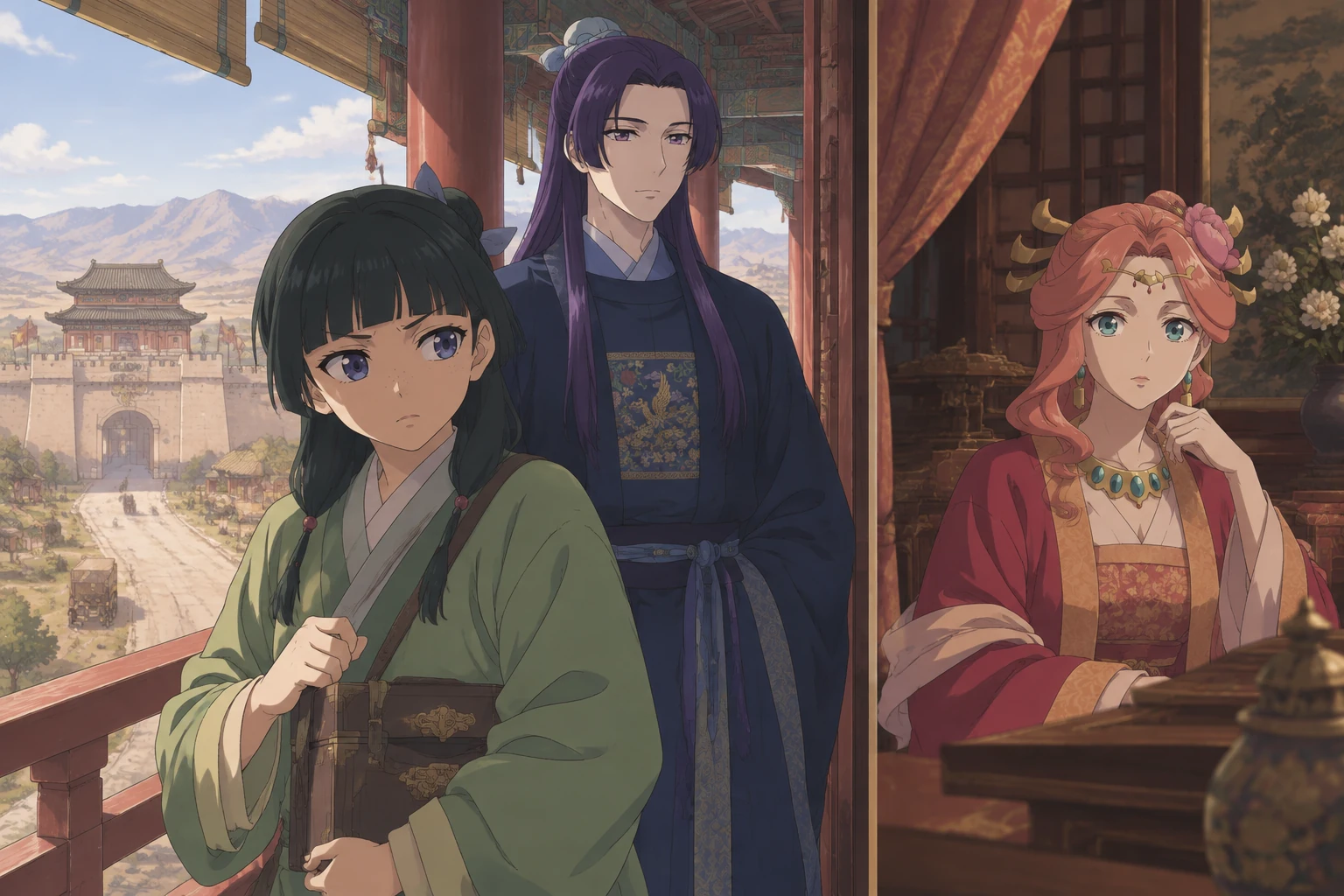
For this part of the story, the essential distinction is between Jinshi's former eunuch role and his public position as the emperor's younger brother. That public identity matters even before you consider deeper family secrets. It determines how officials receive him, which marriages can be proposed, and why his movements attract people with interests of their own.
Volume 5 makes the difference visible when the party reaches the Western Capital. People who have not recognized him react to his appearance, while his attendants are treated according to the importance of the man they serve. Maomao's unexpectedly luxurious accommodation is a small comic example with a serious point: she is being placed inside his social position whether or not she feels she belongs there.
Watch who is speaking to him, who is present, and what name or title they use. A private exchange with Maomao and a formal reception can involve the same man but very different freedoms. His beauty attracts attention; his rank gives that attention consequences.
This also explains why a character can suspect something and still avoid saying it aloud. Maomao's reluctance to enter dangerous conversations is not automatically a failure to understand them. Sometimes knowing more would make her life harder.
3. Gyokuyou's Rise Makes the West Part of Palace Politics
By the end of Volume 4, Gyokuyou is empress and her son is introduced as crown prince. These are changes to the court's future, not merely new titles in a character profile. A household Maomao once knew through food tasting, childcare, and medical work now stands at the center of succession.
The western visit gives that household a larger setting. In Volume 5, Chapter 13, Maomao meets Gyokuyou's father, the regional governor, and recognizes a family resemblance in his manner. The connection turns the journey into an encounter with the people and resources behind someone the audience already knows.
The Western Capital is not simply another name for a foreign kingdom. The western region of Li, the imperial capital, and neighboring countries are different parts of the political map. Foreign visitors and local hosts can meet in the same scene without belonging to the same faction.
You do not need to memorize every family at once. Ask three smaller questions: who is hosting, whose relative is involved, and what does that person hope to gain from the visit? The banquets become much easier to follow when an introduction is understood as a possible alliance rather than a list of new names.
For a wider view, see Gyokuyou's road to empress. That linked analysis includes later-novel political spoilers.
4. Insects, Books, and Food Are Part of the Main Plot
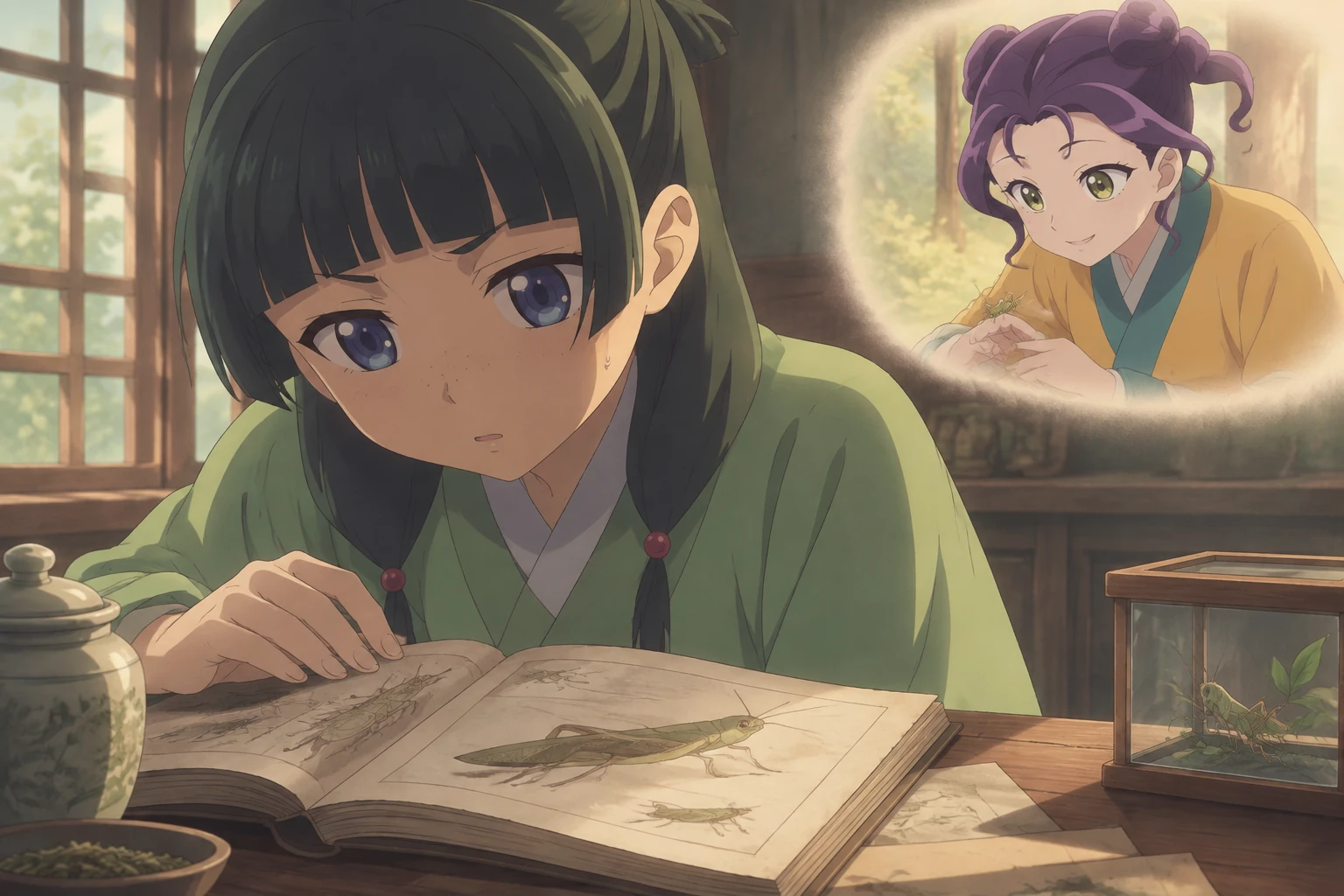
One of the easiest mistakes is to treat Maomao's fascination with an unpleasant snack or an old book as a pause between important scenes. Volume 5 makes those interests part of the investigation. The locust material begins with close observation and grows into concern about harvests and the consequences of a possible swarm.
The useful viewing habit is to follow the chain: an unusual specimen, a question, a missing reference, and a decision about what to do next. Maomao cannot protect a harvest merely by noticing a clue. She needs information, access, and people able to act beyond the scale of her apothecary.
This is why the story's expanding geography does not make her medical way of thinking irrelevant. She still asks what changed, what evidence supports an explanation, and whether an alarming claim has a physical cause. The difference is that more people may suffer if the warning is ignored.
The locust and flying-locust analysis follows this evidence in greater detail. It also discusses later western-crisis developments beyond this guide's Volume 6 boundary.
5. Shisui Can Matter Without Returning in Person
Shisui and Loulan are not two unrelated characters whose plot threads can be filed away separately. Knowing the connection changes how Maomao remembers the girl who shared her interest in insects. The cheerful friendship and the political concealment belong to the same difficult history.
Volume 5, Chapter 6 provides a concrete example of that continuing influence. While searching for an insect encyclopedia, Maomao remembers the book she saw in the infirmary before her abduction. Jinshi recovers it, and its information helps her prepare for the locust threat.
Maomao suspects that Shisui timed the encounter deliberately. The suspicion gives the scene its warmth and wit, but it remains Maomao's interpretation. The passage supports indirect help through a remembered clue; it does not establish that Shisui has personally returned, reunited with Maomao, or joined her work on the crisis.
When an adaptation revisits an earlier image of Shisui, pay attention to whose memory you are seeing. A flashback, an inference, and a new present-day appearance are different kinds of information. Keeping them separate lets the friendship remain meaningful without turning every reference into proof of a reunion.
6. Lishu's Vulnerability Is More Important Than Her Title
Lishu has rank, but that does not mean she controls the people around her. Earlier food and household incidents already show how little protection a title offers when attendants dismiss their mistress. Volumes 5–6 develop the same problem through family hostility, marriage calculations, and the worsening crisis around her.
During the western visit, Maomao considers whether a marriage outside Lishu's existing role could be better for her. The thought is not a declaration that Lishu loves the proposed man, and it is not proof that the arrangement will happen. It shows how readily political reasoning turns a young woman's future into a problem to be solved.
Watch the contrast between what would look suitable on paper and what actually makes Lishu feel safe. Ah-Duo's presence and Basen's conduct matter because practical protection can mean more than elegant court language. Basen is often socially awkward, but reducing him to a joke about strength misses why his involvement becomes important in Volume 6.
For the travel question specifically, read why Lishu goes west, which discusses the novel's western-journey context. The point to carry into viewing is that apparent passivity can come from limited choices, not an absence of feelings.
7. Read the Romance Alongside the Imbalance of Power
Maomao and Jinshi become harder to understand if every tense interaction is labeled flirting. Their attraction develops within a relationship in which his rank can affect her work, safety, and future. Her evasions can combine discomfort, calculation, limited emotional experience, and a desire to remain independent.
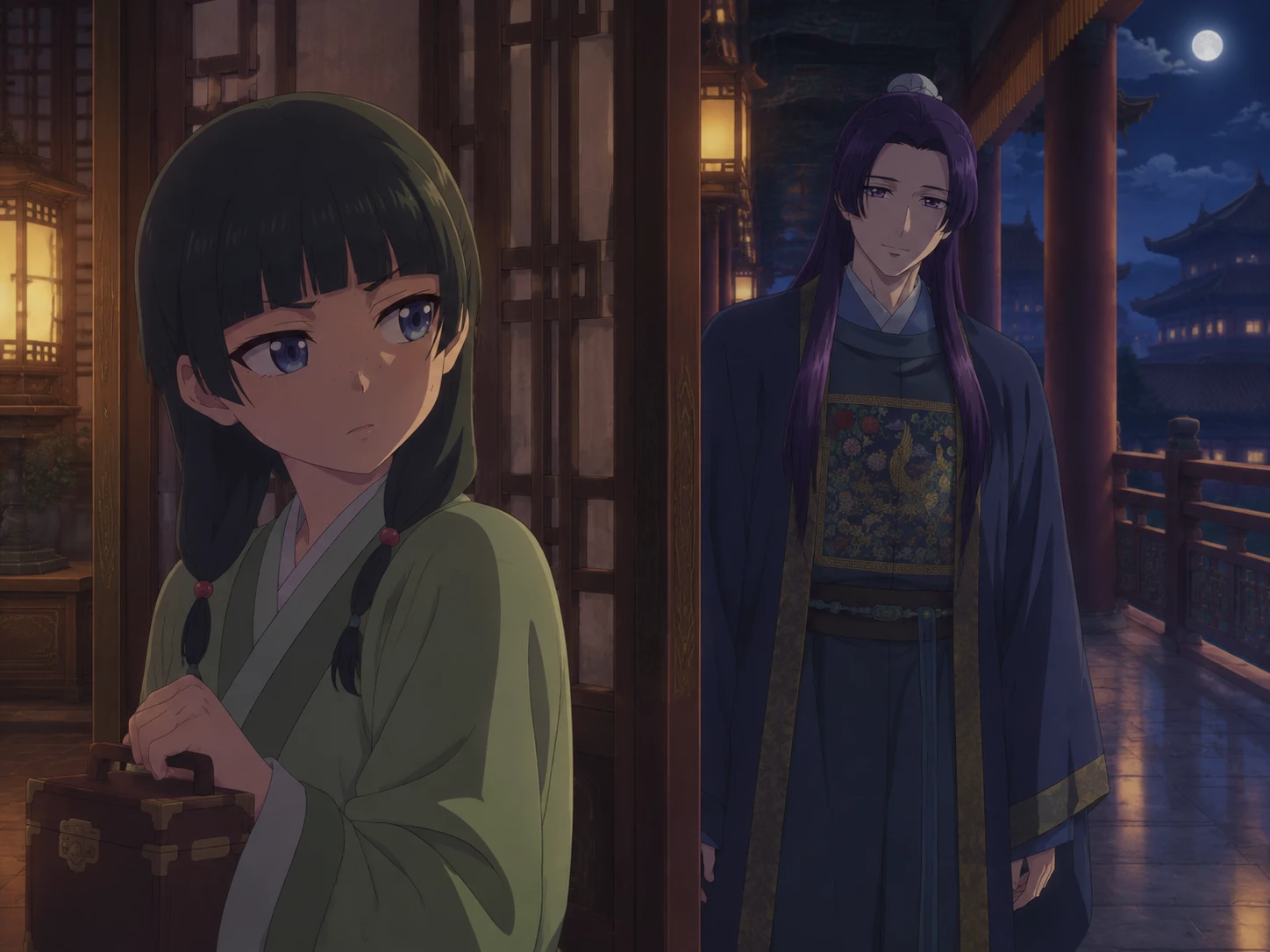
The Volume 5 epilogue makes this especially uncomfortable. Maomao discusses Lishu as a politically suitable match for Jinshi, and his reaction becomes physically coercive. The confrontation should not be reduced to a harmless romantic milestone or treated as proof that they are now an agreed couple.
The important conflict is that Maomao speaks in terms of a suitable arrangement while Jinshi wants his personal feelings to be recognized. His frustration helps explain the confrontation; it does not excuse the force he uses. Both the desire for closeness and the danger of unequal power are present in the passage.
If this material appears in the anime, framing, pacing, and access to Maomao's thoughts will affect how it is read. Compare what she actually says or does with what another character wants her response to mean. An adaptation's romantic atmosphere alone cannot settle the question of consent.
The broader Maomao and Jinshi relationship guide is a useful companion, but it ranges beyond these immediate scenes and contains additional relationship spoilers.
A Short Checklist for Watching the Next Chapter
Before an episode ends, these questions can help you catch the connections without turning viewing into homework:
- Who knows this? Separate information shown to the audience from what Maomao or another character has actually learned.
- What is observed, and what is inferred? An unusual insect is evidence; an explanation of someone's intention may still be a guess.
- Whose title is doing the work? Notice when access, hospitality, or obedience comes from rank rather than personal trust.
- Who has a choice? A proposed match can appear convenient to the court while leaving the people involved little freedom.
- Which earlier detail has returned? Books, food, letters, and casual conversations can become important well after their introduction.
These habits follow the way Maomao investigates: retain the detail, test the explanation, and resist making a larger claim than the evidence permits. They also leave room to enjoy the humor and character reactions that make the deductions memorable.
For a closer comparison of the opening episode with its source, read S3EP1 vs light novel Volume 5. It separates the preserved investigation from the medicine opening, palace expansions, and later material moved forward. Light novel spoilers through Volume 5.
For the next part of Maomao’s life in the pleasure district, read S3EP2 vs light novel Volume 5. The comparison follows the fire-rat robe, Jinshi’s rest, and the episode’s rearranged chapter order. Volume 5 spoilers.
Frequently Asked Questions
Which light novel should I read after the Shi clan story?
Start with Volume 5. Volume 4's epilogue is also worth revisiting for the changes to Gyokuyou's household and Maomao's everyday life. Reading from the beginning remains the fuller option if you want the internal narration and details an adaptation may compress.
Will Season 3 adapt all of Volumes 5 and 6?
These books are the continuation examined here, but that does not establish the anime's exact coverage. This guide does not claim a confirmed volume endpoint, episode count, or scene order. An official adaptation announcement is the appropriate source for those details.
Do I need to read the novels before watching Season 3?
No. This guide offers extra context for viewers who enjoy comparing the source with the adaptation. If you prefer surprises, catch up with the preceding anime story and leave the novel analysis until afterward.
Does an insect-book reference mean Shisui has returned?
No. The Volume 5 clue works through Maomao's memory and a recovered book. It shows that Shisui's influence continues; it is not evidence of a present-day reunion.
Why does the western journey involve so much politics?
Jinshi travels with royal status, Gyokuyou's family is connected to the region, and the party's social encounters involve marriage and influence. Maomao's small-scale observations therefore take place inside decisions that affect more than one household.
Are the manga and light novel volume numbers interchangeable?
No. This article's chapter references are for the light novels. The manga adaptations divide the material differently. See the light novel and manga comparison before using a book number as a reading checkpoint.