Spoiler Warning
Light novel spoilers through the end of Volume 5. This comparison discusses the medicine offered in the opening, Gyokuyou's elevation to empress, the locust investigation, and the Emperor and Ah-Duo's plans for Jinshi. It also refers to Volume 4's epilogue and briefly uses Volume 10, Chapter 2 to identify a relationship among Lakan's aides. The later plot of Volume 10 is not discussed.
Scene Locator: S3EP1 and Light Novel Volume 5
The episode compared here is labeled S3EP1. Its main story follows Volume 5, Chapters 1–2: the disappointing insect breakfast, Chou-u's drawings, a stolen encyclopedia, and the questioning of a former fortress guard. The opening and palace scenes also draw on material outside those two chapters.
- Volume 4, epilogue: Gyokuyou becomes empress, and her son is presented as Crown Prince.
- Volume 5, prologue and Chapters 1–2: the novel's original opening, followed by Maomao's life in the pleasure district and the insect investigation.
- Volume 5, Chapters 10 and 12: the western political situation, bestowed clan names, and the account of a merchant giving away medicine.
- Volume 5, epilogue: Ah-Duo's recollections of old promises and her thoughts about the “flower” Jinshi may choose.
Chapter numbers refer to the light novel, not either manga adaptation. For a broader introduction to this part of the story, start with our novel-based Season 3 viewing guide.
Volume-level entry only. The source is community-hosted; availability and rights status may vary.
The Main Difference: A New Frame Around a Familiar Story
S3EP1 preserves the central investigation while changing what the audience knows before Maomao catches up. In the novel, an unpleasant breakfast becomes a question about insects, then books, then a possible disaster. The episode places disturbing rural images and court politics around that chain of discovery.
This changes the weight of small details. A plate of insects is still funny, and Chou-u is still troublesome. Yet the opening has already made suffering visible, while the palace scenes have shown how much depends on the Emperor's authority. The everyday puzzle now sits inside a larger danger from the beginning.
The most useful distinction is between a new scene and new story information. The anime can invent a conversation or expand a ceremony while using facts that the novel establishes elsewhere. Much of this episode's creativity lies in that arrangement.
S3EP1 vs Light Novel: The Major Changes
Scroll the table sideways to compare all three columns.
| Episode sequence | Novel source | Adaptation change |
|---|---|---|
| The merchant offers medicine | Volume 5, Chapter 12 | A later account becomes an ominous opening scene. |
| The palace explains clans and the west | Volume 5, Chapters 10 and 12 | Political background moves earlier and gains visual diagrams. |
| Gyokuyou's public celebration | Volume 4 epilogue; Volume 5, Chapter 10 | A brief event and its political tensions become a larger gathering. |
| Lakan's Go game and the aides' reactions | No matching full scene in the opening chapters checked; aide relationship attested in Volume 10, Chapter 2 | Added performance develops the court's supporting cast. |
| The warning to Chou-u leads into his drawings | Volume 5, Chapter 1 | The novel's explicit overnight transition is compressed. |
| The former guard is questioned outside | Volume 5, Chapter 2 | The room changes; the chain of evidence remains. |
| The Emperor discusses choosing a flower | Volume 5, epilogue | Ah-Duo's private reflections become an earlier conversation and closing hook. |
The Medicine Opening Brings a Later Threat Forward
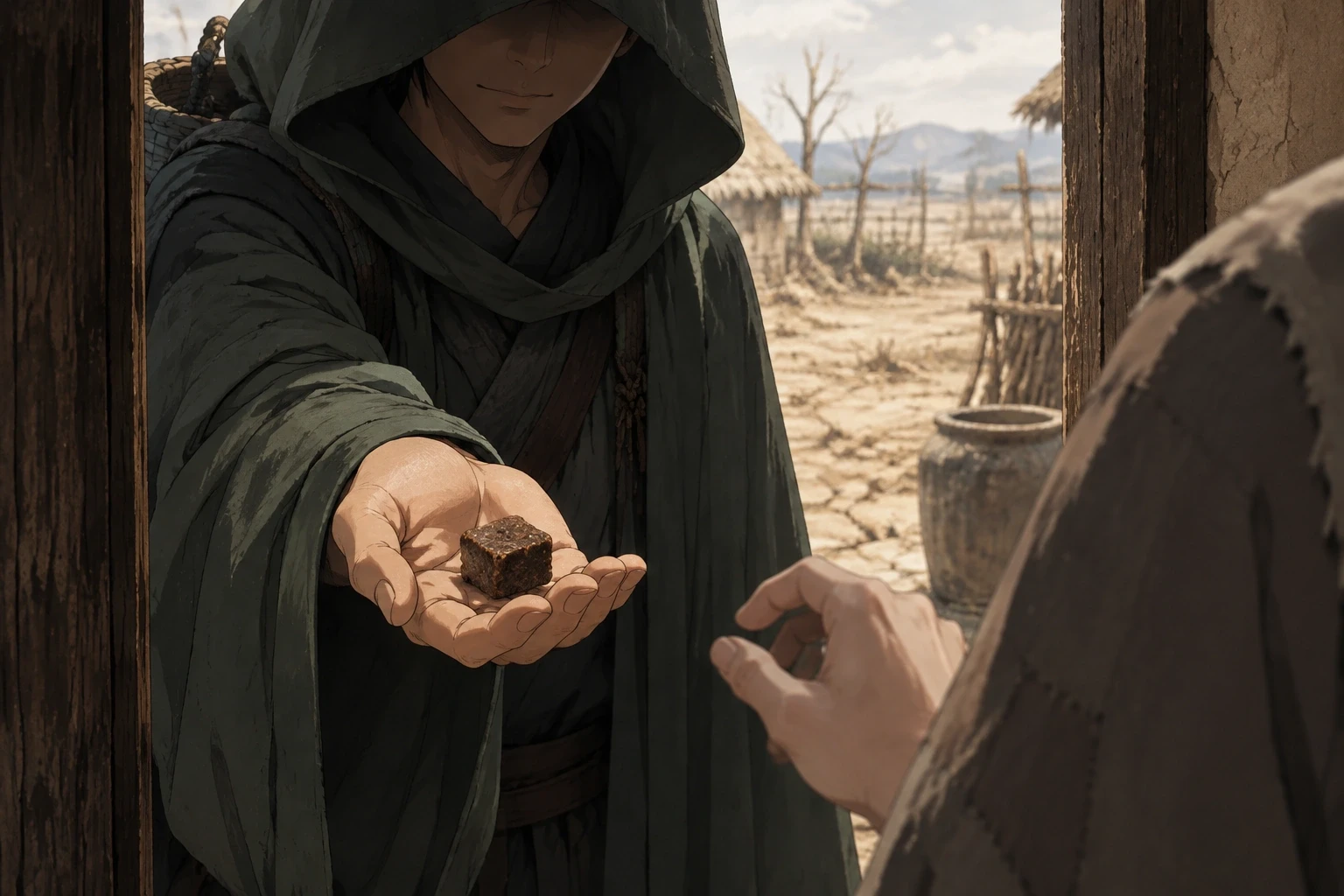
The novel's prologue begins with the young Emperor and Ah-Duo: an apple, an uncomfortable imperial duty, and a suddenly personal choice. The episode opens elsewhere, with damaged land, struggling people, and a cloaked merchant holding out a dark piece of medicine.
That offer has a clear counterpart in Volume 5, Chapter 12. A bodyguard produces a pain remedy previously given to him by a merchant traveling with entertainers. It resembles dark sugar. Maomao and Suirei recognize it as opium, while the man's account reveals that the gift came with promises of comfort and relief from worldly pain.
The episode turns the danger into an encounter before the investigation explains it. The merchant's reassuring manner can now be watched against the recipient's hardship. This makes the promise of relief unsettling: the very need that makes the offer attractive also creates an opportunity for exploitation.
The connection to the novel is stronger than a claim that the entire opening is anime-original. Its specific staging and rural imagery expand the material, while the offered drug and persuasive language have a source. The recipient's identity is not established clearly enough to equate that person with the novel's bodyguard.
The changed opening also shifts emphasis. The book first introduces an intimate history within the imperial family; the episode first introduces vulnerability beyond the palace. That does not tell us whether the prologue will be adapted later. It tells us what this episode wants the viewer to worry about first.
Palace Politics Arrive Before the Locust Investigation
The early discussion around Jinshi and Gaoshun gives the audience a map of power: families with bestowed names, the standing of older clans, the western region, and Gyokuyou's elevation. Diagrams make a system that can be dense on the page easier to follow on screen.
In Volume 5, Chapter 10, the Emperor and Gaoshun's conversation supplies much of the underlying logic. Crop failure can lead to hunger, hunger to raiding, and wider instability to war. The west therefore matters strategically. Gyokuyou's father, Gyokuen, governs a region whose importance exceeds his family's position inside the rear palace.
The same chapter explains why some observers consider Gyokuyou's promotion too rapid, and why Lihua had appeared closer to the position. Chapter 12 adds another piece: older bestowed-name families have lost some of their authority under the merit-based changes associated with the former Empress Regnant.
The anime gathers this background into an earlier scene and changes the way it is delivered. The effect is to make the audience understand the stakes before Maomao has finished assembling the evidence. Our analysis of why Jinshi has to go west follows the larger political consequences.
There is a tradeoff. Earlier explanation makes the danger legible, but it reduces the novel's gradual movement from a local curiosity to a national problem. Readers who enjoy discovering the scale of the case alongside Maomao may notice that difference most.
The Celebration Gives Court Politics Faces and Voices
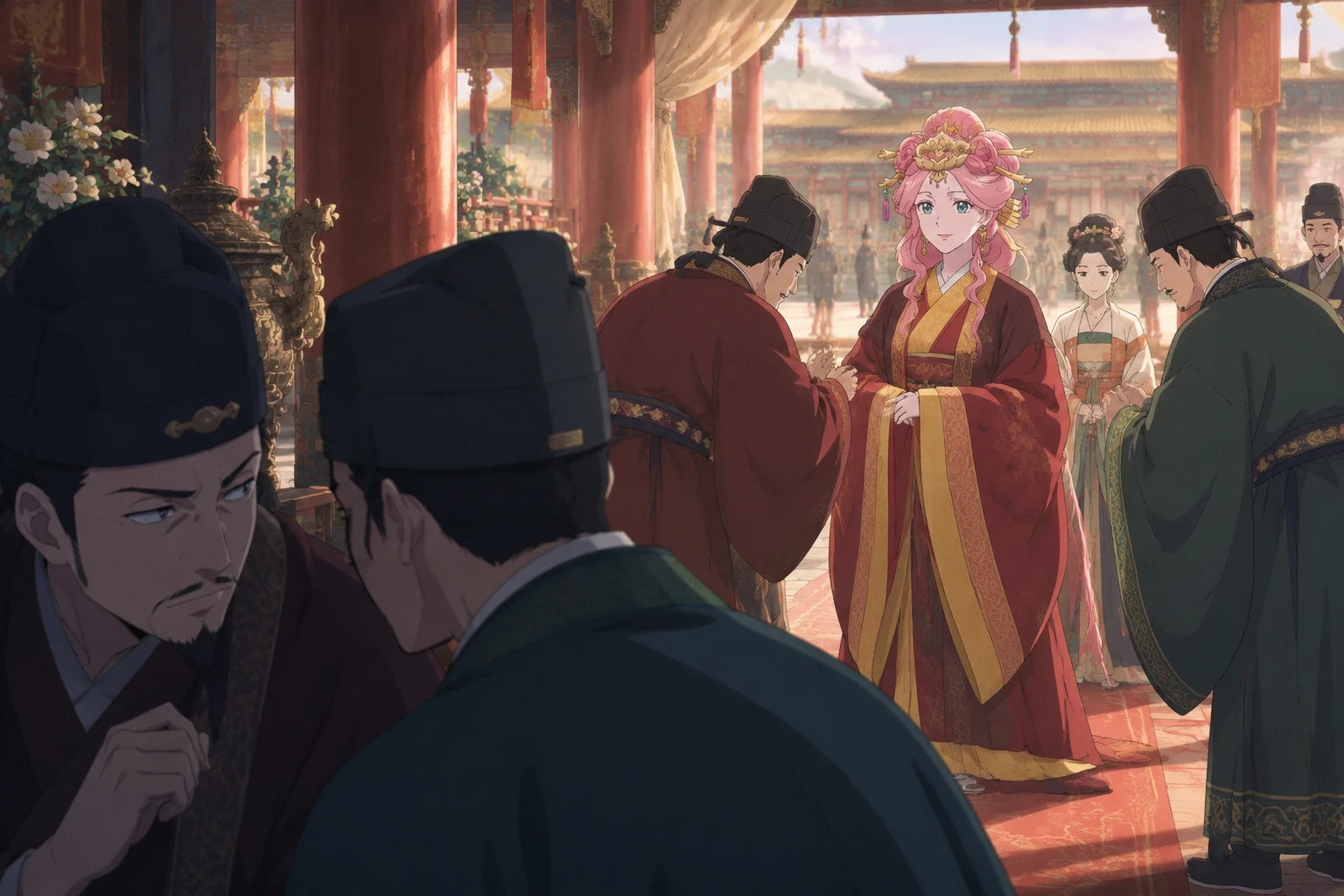
Gyokuyou becoming empress is already established in Volume 4's epilogue. The Crown Prince introduced there is her son; that title should not be confused with Jinshi's position. The episode expands the occasion into greetings, appearances, and the reactions of people whose futures are affected by the change.
Congratulating Gyokuen publicly and resenting his success privately can happen at the same gathering. The contrast gives visible form to the political resistance described later in the novel. Instead of only learning that the promotion provoked objections, the viewer sees how those objections coexist with formal courtesy.
That makes the celebration useful beyond spectacle. Gyokuyou's new status is a change in the balance of power, not simply a reward at the end of a palace story. For the source background, see Gyokuyou's road to becoming empress.
Lakan's Go Game Adds a Different Kind of Court Life
Lakan, Rikuson, and the other aide give the sequence a comic rhythm. Rikuson passes the problem along, Lakan concentrates on his game, and the people around him worry about managing the consequences. These reactions turn supporting officials into people with work, loyalties, and frustrations.
The complete performance has no matching scene in the novel's opening chapters used for this comparison. However, the relationship among the aides has a novel basis: Volume 10, Chapter 2 identifies Lakan's other deputy as a longer-serving colleague who had welcomed Rikuson's help in sharing the burden. That reference supports the relationship; it does not establish the character's earliest appearance.
The innovation is the use of that relationship here, inside this gathering. There is no need to invent the Go opponent's identity or treat every supporting figure as an anime-original character to explain why the sequence works.
Maomao's Story Keeps Its Chain of Evidence
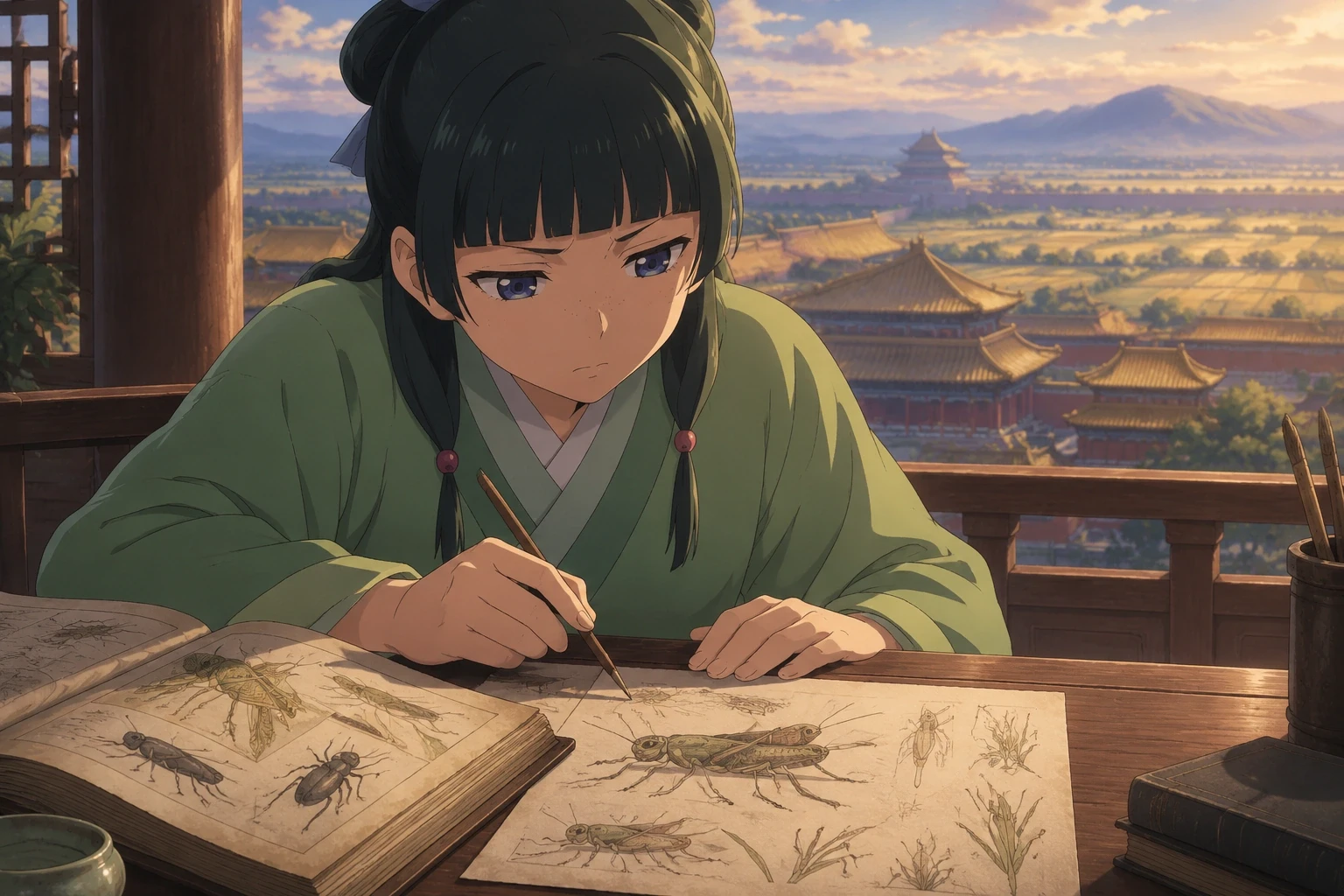
The pleasure-district material is much closer to Volume 5, Chapters 1–2. The insects bought for a meal, Chou-u's complaint about them, his drawing ability, the money earned from portraits, and the old madam's demands all belong to the novel's story.
So do Maomao's warning about the district's dangers and the unsettling sight of a street prostitute whose nose has been destroyed by illness. This is an important change in tone within the original material itself. The district can feel familiar and affectionate to Maomao while remaining dangerous to a child carrying money.
The insect drawings then connect Chou-u's talent to a wider problem. They also recall Shisui, whose interest in insects continues to matter through the knowledge she left behind. The difference between locusts and flying locusts is a clue with consequences far beyond an unpleasant meal.
The stolen books preserve that connection between personal memory and practical evidence. Lihaku helps find the seller, Maomao recognizes the former guard, Ukyou provides food when questioning becomes too harsh, and the man's experience supplies information Maomao does not have. The scene also preserves her need to stop him from exposing Chou-u's identity.
This matters to the adaptation's balance. The added palace material broadens the story, but the investigation still depends on observation, incomplete memories, ordinary experience, and cooperation. Maomao cannot solve the problem simply by knowing more than everyone else.
Smaller Changes Tighten the Time and Open Up the Space
The Drawings Follow the Nighttime Warning
In Chapter 1, Maomao tells Chou-u to eat and sleep. The narration then explicitly moves to the following morning, when she discovers his insect drawings. The episode connects the warning and the drawings within the nighttime setting, before moving into imagery explaining the insect problem.
Removing that clear sleep-and-wake transition makes the discovery feel like an immediate continuation of the conversation. It is a small change, but it turns two scenes into a more continuous movement from protecting the child to recognizing the value of what he remembers.
The Interrogation Moves Out of the Cramped Shop
Chapter 2 repeatedly emphasizes Maomao's small apothecary shop. Lihaku has to fit his large body inside, the books lie on the wooden floor, and Ukyou's presence makes an already narrow space more crowded. The episode stages the questioning largely in an open courtyard with seating.
The information remains the same, but the space changes how it can be performed. More people can stay visible, reactions can be exchanged across the scene, and the guard's questioning remains connected to the life of the establishment around him. These are changes to presentation, not a replacement for the book's mystery.
The Emperor's “Flower” Line Turns the Epilogue into a Hook
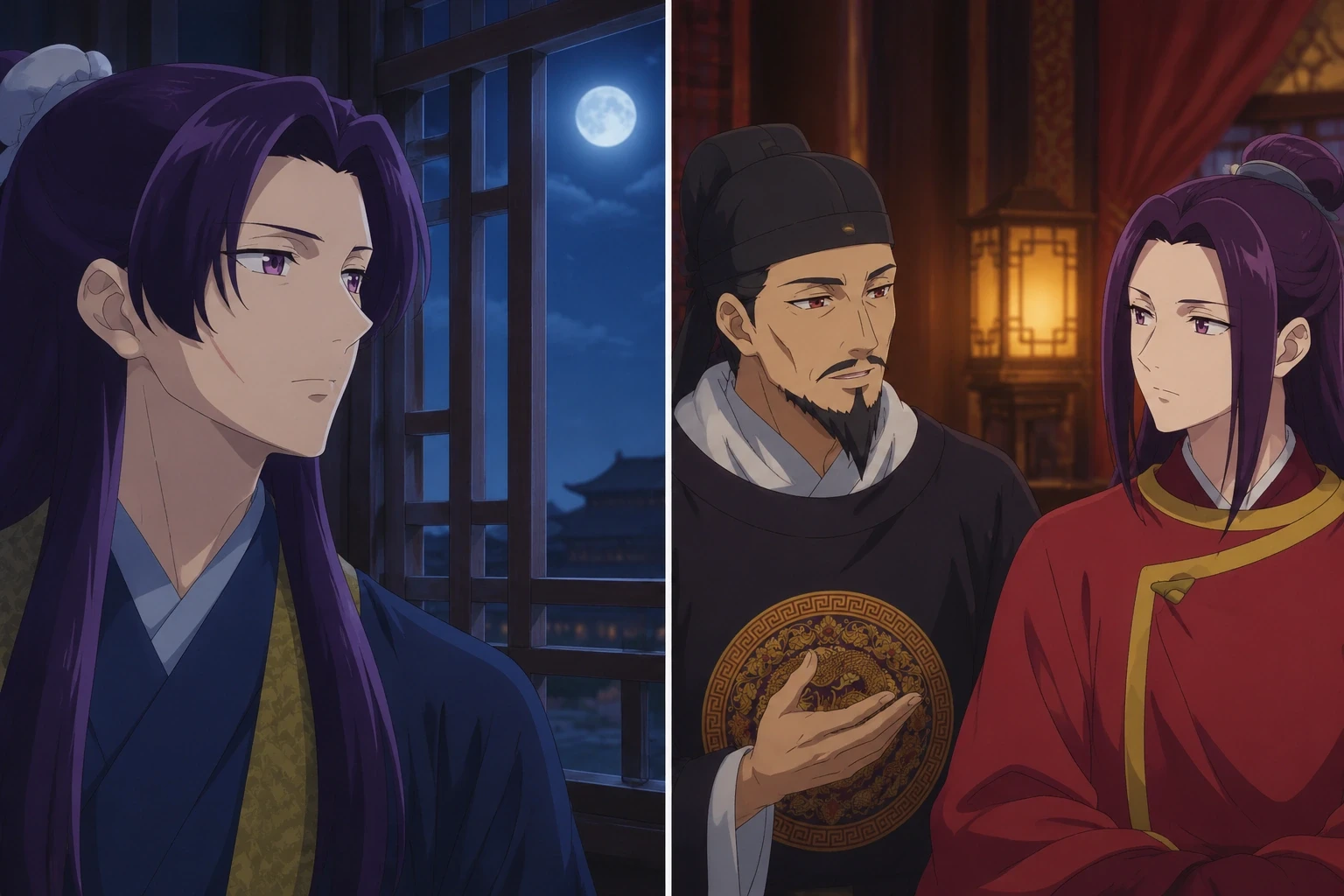
The novel's second chapter ends with Maomao considering a warning to Jinshi and counting the days until he next visits. The episode reaches that point, then adds a nighttime sequence: medicine preparation, the Emperor speaking with Ah-Duo, and Jinshi at a window beneath the moon.
The Emperor is the person who says it is time for “Moon” to choose a flower. He says it to Ah-Duo. The line should not be attributed to Jinshi or to Ah-Duo herself.
The source connection lies in Volume 5's epilogue, but the form is different. In the novel, Ah-Duo drinks alone and reflects on promises made long ago. Her thoughts connect the Emperor's choices, her own past, and the woman Jinshi might choose. The flower image belongs to that private reflection.
By turning it into an earlier conversation, the episode gives the Emperor an active role in the closing movement. A possibility that the novel leaves with Ah-Duo's thoughts becomes something being discussed while Jinshi is elsewhere. Cutting to him makes the audience feel the proximity of those expectations even though he is not participating in the conversation.
The result is a strong episode ending: the insect case remains open, and Jinshi's personal future has also become a question. Our article on Ah-Duo's wish for Jinshi's happiness explores that second concern further, with spoilers beyond Volume 5.
The medicine-making images should be kept distinct from Jinshi's window scene. Their placement does not establish that he is preparing the medicine, and a visible ingredient alone does not identify the prescription or its intended recipient.
For the novel's explanation of the marriage request, read why Jinshi's father wants him to choose a flower. It connects the western banquet with Ah-Duo's two promises and the later succession dispute. Additional novel spoilers through Volume 8.
What This Adaptation Gains—and What It Changes
S3EP1 makes Volume 5's connections visible earlier. Medicine offered to vulnerable people, insects that threaten crops, a politically significant imperial celebration, and a prince's possible marriage all enter the same episode. The larger story is already pressing on Maomao's ordinary day.
Its strongest additions are therefore structural. Later testimony becomes an opening encounter. Political narration becomes conversation and social behavior. Private recollection becomes a closing exchange. Meanwhile, the first two chapters continue to supply the investigation's essential steps.
The cost is a different rhythm of discovery. The novel lets the scale of the problem emerge more gradually around Maomao. The episode gives the viewer a wider perspective sooner. Whether that feels more compelling or less mysterious depends on which experience the viewer values, but it is a meaningful adaptation choice rather than a collection of unrelated extra scenes.
Comparison scope: This analysis follows the reviewed episode version and the light novel's chapter structure. It focuses on substantial narrative changes, not every line or gesture. It does not identify unclear background characters or infer future adaptation decisions from a scene's absence here.
Continue with our S3EP2 and light novel Volume 5 comparison to see how the fire-rat robe moves ahead of Jinshi’s visit, why the lullaby remains rooted in the book, and how the pastry mystery enters the ending. Volume 5 spoilers.
Follow the investigation into S3EP3 vs light novel Volume 5, covering Maomao’s medical reasoning, Basen’s book delivery, and the shift from narration to dialogue. Volume 5 spoilers.
FAQ: Apothecary Diaries S3EP1 vs the Light Novel
Which light novel chapters does S3EP1 adapt?
The central pleasure-district and insect-investigation story follows Volume 5, Chapters 1–2. The episode also uses material associated with Volume 4's epilogue and later parts of Volume 5, especially Chapters 10 and 12 and the epilogue. It does not adapt all of Volume 5 in one episode.
Is the opening medicine scene completely anime-original?
No. Volume 5, Chapter 12 includes an account of a merchant giving away a dark pain remedy, later identified as opium. The episode's opening expands and moves forward that kind of encounter. Its specific recipient cannot be confidently identified with the bodyguard who tells the story in the novel.
Who says that Moon should choose a flower?
The Emperor says it to Ah-Duo. The related flower image appears in Ah-Duo's private reflections in Volume 5's epilogue; the episode reshapes it into a conversation.
Does the anime invent Gyokuyou becoming empress?
No. Volume 4's epilogue already establishes her elevation. The episode expands the public occasion and gives reactions to the political tensions explained in Volume 5.
Where should I start reading to compare the episode properly?
Read Volume 5 from its prologue, with Volume 4's epilogue as background. Chapters 1–2 explain the main investigation, while the later chapter references above help distinguish additions from material moved forward. The light novel and manga comparison explains why manga volume numbers are not interchangeable with these references.