Spoiler Warning
Major light novel spoilers through Volume 15. This article discusses Jinshi's biological parents, the Emperor's illness and succession plans, new consort appointments, and the private conversation involving Jinshi, Maomao, and Ah-Duo. It does not predict the series' ending.
How Does Jinshi Come to Understand His Father's Burden?
Jinshi's understanding develops through choices that are never simply private. In Volume 5's epilogue, choosing a consort already means choosing between diplomatic and domestic alliances. In Volume 15, Chapter 13, the Emperor's illness makes succession urgent, and Jinshi helps arrange other women's consort appointments to balance court factions. He knows their wishes are being ignored and recognizes the cruelty of his own work.
That is the uncomfortable center of this father-and-son parallel: governing does not let Jinshi keep his hands clean. He can see why the Emperor makes calculated choices without concluding that every choice is justified. Two chapters later, he still rejects the idea that royal protection can make confinement harmless to the woman he loves.
Here, “his father” describes the biological relationship known to the reader. It does not mean Jinshi suddenly receives a clear explanation of his parentage. The distinction matters: he is learning the weight of the Emperor's position through work and conflict, while his own knowledge of the family secret remains uncertain. For the identity background, see why the Emperor publicly treats Jinshi as his younger brother.
Scene Locator: From Volume 5 to Volume 15
Read these scenes as stages of the same conflict: Jinshi first faces the political cost of his own marriage choice, then helps make choices for others before confronting the Emperor about Maomao.
- Volume 5, Epilogue: After the western-capital banquet, Jinshi explains the Emperor's instruction to choose a consort. The narration connects each choice to foreign relations and domestic alliances; Ah-Duo closes with the flower metaphor. Open Volume 5.
- Volume 15, Chapter 13: Jinshi discusses new consort appointments with the Ma siblings while officials press him about the Emperor's possible death. He recognizes the women's lack of choice and helps manage the rival factions.
- Volume 15, Chapter 15: Before surgery, the Emperor asks Jinshi to succeed him. Their argument moves from the young crown prince to the consequences of loving one woman inside the rear palace.
- Volume 15, Chapter 16: Ah-Duo's perspective, followed by her private conversation with the Emperor, reveals the personal cost of his wish to keep her close.
The epilogue and chapter labels identify the scenes; the descriptions above are paraphrases, not quotations from an English edition.
Volume-level entry only. The source is community-hosted; availability and rights status may vary.
Volume 5 Already Makes Choosing a Flower a Political Problem
The earlier difficulty is explicit in Volume 5's epilogue. After the western-capital banquet, Jinshi tells Maomao that the Emperor allowed him some enjoyment on the journey but also instructed him to choose carefully. The narration identifies the choice as a consort selection: the women have been gathered for that purpose, and choosing any of them will affect politics and the country's future.
The alternatives carry different obligations. A marriage could strengthen relations with a neighboring country or connect Jinshi to a domestic power. Holding the banquet in the west already suggests a preferred direction: closer western ties. Even Maomao's suggestion that Lishu is a suitable candidate weighs dynastic suitability against personal feelings; she has just noticed Lishu and Basen looking at one another. Jinshi is being offered a choice whose consequences extend far beyond the couple.
Ah-Duo's closing viewpoint makes the range of candidates concrete: a foreign princess, women related to Empress Gyokuyou, Lishu, Maomao, and even Suirei. She then wonders which flower Jinshi will choose. The flower metaphor therefore sits beside actual diplomatic and family interests. As with her later viewpoint, the reader should not assume that Jinshi hears or knows every part of her private assessment.
This is the necessary starting point for the later comparison with his father. Volume 5 puts Jinshi's own relationship inside a political calculation. Volume 15 takes him further: he participates in arranging other women's lives while still wanting Maomao to retain her freedom. The later chapters deepen an existing conflict; they do not introduce the problem of royal choice for the first time.
The Emperor's Illness Makes Every Choice Political
At the beginning of Volume 15, Chapter 13, officials repeatedly ask Jinshi what will happen if the Emperor dies. They are not simply concerned visitors. Some want Jinshi installed as heir, some oppose it, and others are waiting to see which side will benefit them.
Jinshi therefore cannot answer as a worried family member alone. His presence is already part of the succession calculation. Even refusing the throne affects people who have invested in the existing crown prince, an alternative candidate, or a particular branch of the imperial family.
This changes how the Emperor's conduct looks. A decision about whom to visit, promote, or favor can move power across the court. In Chapter 15, the Emperor points to the crown prince's youth and the danger of dependence on maternal relatives; Jinshi replies that replacing the established heir could itself create disorder. Both arguments have political substance. Neither man can make the problem disappear by insisting that his preferred outcome is reasonable.
For Jinshi, the burden is becoming concrete. He must deal with the people, documents, and competing expectations left outside his door. The pressure he resents in his own life is also part of the office his father has occupied for years.
Jinshi's Hardest Lesson: He Is Helping Choose Other Women's Lives
The sharpest evidence is the discussion of vacant upper-consort positions. Basen's elder sister brings information about candidates connected to the Empress Dowager's and the Empress's factions. Jinshi is familiar with the arrangements and has already considered a suitable candidate from the Empress's family network.
The narration does not present him as an innocent observer. It explicitly confronts the absence of the young woman's own wishes. Jinshi understands that considering every personal feeling would obstruct the political work, and he knows that what he is doing is cruel. His discomfort is not a vague dislike of palace customs; it is recognition of his own participation.
This is where the article's title earns its meaning. Jinshi wants the freedom to choose his own relationship, yet he is helping a system assign other people to relationships for political purposes. His objection to being used has become harder to keep separate from his willingness to use others.
The Emperor has also acted in advance. Visits to the prospective consorts can encourage their families to anticipate pregnancies and new influence. The text carefully distinguishes that expectation from an actual pregnancy: Jinshi does not know whether either woman is pregnant, much less whether a future child would be male.
He recognizes the Emperor's foresight, then works with his attendants to influence the factions. His immediate aim is practical: he cannot cure the illness, but he can help keep the court stable while treatment proceeds. Understanding his father here means seeing why political calculation continues even at the edge of surgery—and discovering how readily he can contribute to it.
His Father Has Enormous Power, but Very Little Ordinary Freedom
Chapter 15 adds the Emperor's own account. When Jinshi questions the attraction of ruling, the Emperor explains that it is the only life he has known. His upbringing left no ordinary alternative to becoming emperor. He also contrasts that confinement with the freedom Jinshi has already enjoyed through travel.
That does not make the Emperor powerless. In Chapter 16, Ah-Duo sees how much he could impose if he chose: he could publicly reveal Jinshi's birth and attempt to bind him to succession. His authority is precisely what makes his personal wishes so consequential.
The contradiction is the point. He can command a person to remain near him, yet cannot simply leave court and share that person's chosen life. Ah-Duo once wanted to become a merchant. The Emperor feared that if she left, she would not return. Keeping her available to him cost her possibilities he could not restore with comfort or status.
Jinshi's growing understanding should therefore not become a blanket defense of his father. The Emperor's restricted life helps explain his fear of losing people. It does not give him ownership of their futures. Ah-Duo's account keeps that distinction visible.
Why Jinshi Still Rejects His Father's Answer About Maomao
Their disagreement becomes most revealing when the Emperor suggests that Jinshi could rule while loving only one woman. He even offers a way around the immediate need for Jinshi to produce an heir: the existing crown prince could retain that position.
That detail matters. This scene does not establish an unavoidable rule that Jinshi must personally sleep with multiple consorts if he becomes emperor. His father is offering an exception. Jinshi's objection reaches beyond sexual exclusivity.
He argues that favoring one woman would make her the target of the others' resentment. The Emperor assumes that protection should answer that danger. Jinshi does not. He has seen enough of the rear palace to understand that hostility can damage someone without a visible attack, and that the woman confined there might change under the pressure.
When he looks toward Maomao, his concern is for the person she actually is. Keeping her beside him at the cost of that self would defeat the love he is trying to preserve. He says he would rather let her remain free than hold her close under those conditions.
Understanding the Emperor's predicament has not made Jinshi accept the Emperor's solution. It has made the stakes more specific: he cannot promise Maomao safety merely by promising to love her. For a closer reading of that exchange, continue with why Jinshi's father asks him to choose a flower.
Ah-Duo Shows What the Emperor's Protection Failed to Protect
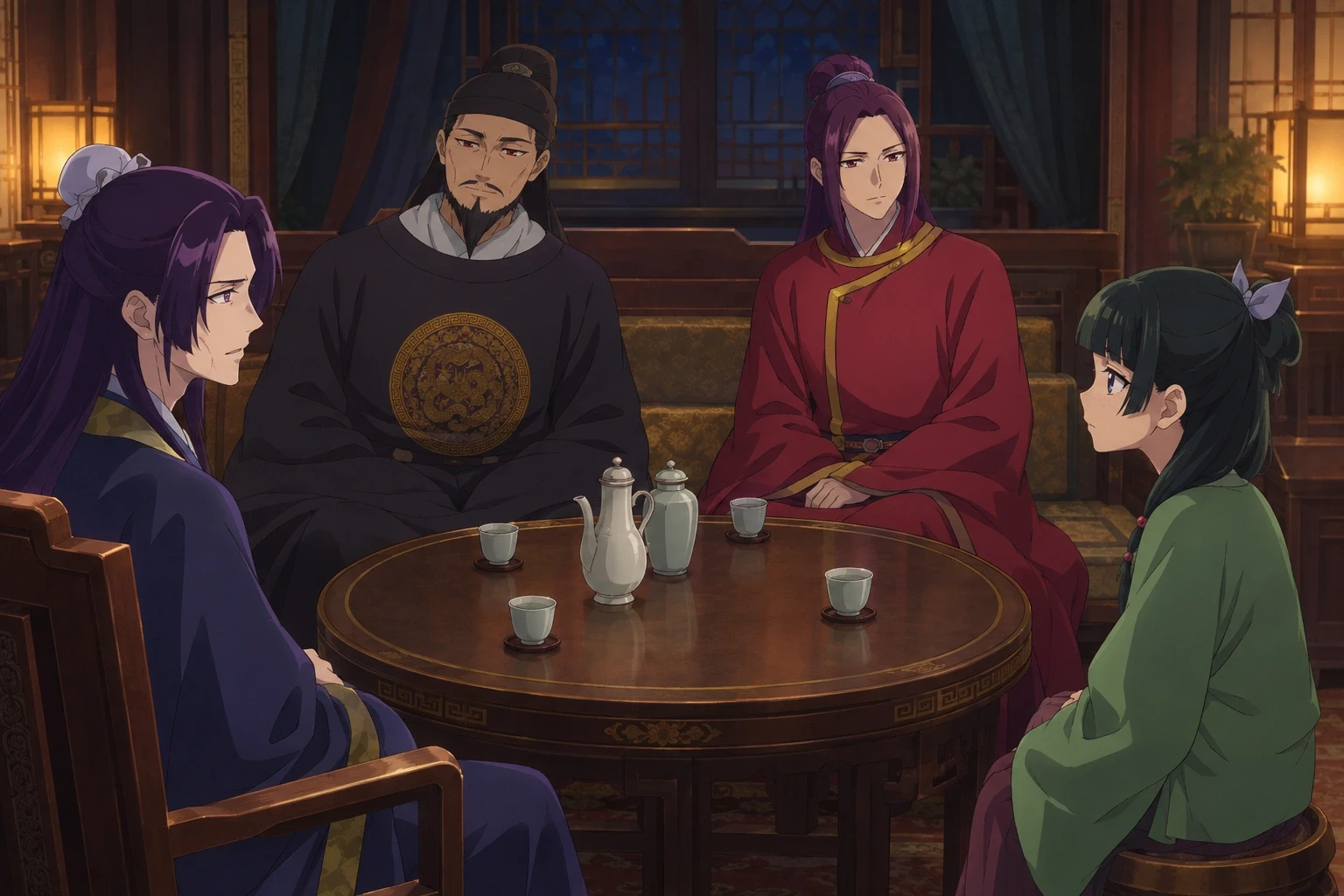
Ah-Duo's response gives the argument a history. In Chapter 16, she explains that the Emperor provided for her and continued to treat her as special, even after she left the rear palace. Those material facts did not erase the insults, threats, and lost freedom that came with her position.
His question about how he has wronged her exposes the gap between them. From his perspective, he has taken care of her. From hers, his wish to keep her close helped determine the shape of her entire life. A decision that he could make from above was one she had to live inside.
This is why the parallel with Jinshi and Maomao is more useful than a simple claim that the two couples are identical. Ah-Duo wants to know whether Jinshi will use his inherited power in the same way. His stated willingness to let Maomao go answers that question differently, and it moves her to tears.
Readers also debate whether Ah-Duo is the Emperor's only true love. That question is not necessary to explain these chapters. Ah-Duo herself acknowledges his affection for Gyokuyou. Reducing the other women to meaningless political appointments would flatten a text that gives affection, status, resentment, and obligation room to coexist.
There is also a limit to Jinshi's understanding: he and Maomao leave before the parents' private reckoning. The reader receives Ah-Duo's account; Jinshi does not hear that whole conversation. We should not give him knowledge that belongs only to the later viewpoint.
Jinshi's Answer Is to Share the Work Without Taking the Throne
Jinshi does not finish the argument by offering an easy escape for everyone. He says he wants to remain the Emperor's subject and later serve the crown prince. Ah-Duo immediately exposes the uncomfortable implication: someone else would then inherit the throne's burden and the difficult rear palace.
His answer is that a subject's work is to reduce the ruler's burden. This gives his refusal more substance than simply wanting a private romance. He is willing to perform political labor without making kingship his own destination.
Volume 5 establishes the political limits on Jinshi's own choice; Volume 15, Chapter 13 shows both the value and the cost of working within those limits. He can help stabilize the court. He can also participate in choices that deny women the agency he wants Maomao to retain. His insight is real, but it has not resolved that contradiction.
That is what makes this stage of Jinshi's development compelling. He understands more of what his father carries, recognizes a boundary he does not want to cross with Maomao, and still has to live with the compromises of serving the institution. The novel gives him a difficult position to work from, not a finished moral victory or a guaranteed ending.
Related context: the political meaning of Jinshi's left-abdomen brand and the hypothetical consequences of Jinshi inheriting the throne.
FAQ
Is the Emperor Jinshi's real father?
Yes. The Emperor and Ah-Duo are his biological parents, while his public identity is the Emperor's younger brother. For the earlier revelation and its audience, read Ah-Duo's confession to Maomao.
Does Jinshi know the Emperor is his father in Volume 15?
These scenes do not give him an explicit on-page disclosure. Maomao regards him as uninformed, while Ah-Duo briefly considers whether he might suspect and conceal it. That uncertainty should not be rewritten as confirmed knowledge.
Does understanding his father mean Jinshi wants to become emperor?
No. In Chapter 15 he refuses, explains the danger to Maomao, and offers to serve the current Emperor and the crown prince instead.
Does Volume 15 prove Jinshi and Maomao will never marry?
No. Jinshi rejects making her a consort under the conditions they are discussing. This is not a confirmed account of their eventual ending. See what the novels establish about their relationship for the broader question.
Related reader discussions include whether the Emperor approves of Maomao and how to interpret his love for Ah-Duo. They supply questions and competing fan readings; the scene analysis above rests on Volume 5's epilogue and Volume 15, Chapters 13, 15, and 16.