Spoiler Warning
This article discusses light novel spoilers for The Apothecary Diaries, including the Shrine of Choosing, the Emperor's succession pressure around Jinshi, Gyokuyou's son, Jinshi's refusal of the throne, the left-abdomen brand, and the political risk Maomao faces through her connection to Jinshi. The central question is hypothetical. It does not reveal a canon coronation because the novel has not established one. Anime-only readers should stop here.
Scene Locator
This hypothetical begins with two canon checkpoints rather than one future event. The first is Volume 3, Chapter 12: the Shrine of Choosing gives the Emperor an old ritual language for testing whether Jinshi could be connected to succession. Jinshi leads the successful route with Maomao's reasoning, but the shrine does not crown him. It creates political meaning, not an automatic result.
The second is the later imperial crisis around Jinshi's refusal. In the private four-person meeting and the left-abdomen brand scene, Jinshi's actions make his position clear: he does not want to take the throne at Gyokuyou's son's expense. The counterfactual asks what happens if that refusal is overcome by circumstances, not what the text says he chooses.
That distinction matters. The article draws consequences from established relationships between Jinshi, the Emperor, Gyokuyou, and Maomao. It does not invent a future reign, a canon marriage, or specific reforms that the novel has not shown.
Volume-level entry only. The source is community-hosted; availability and rights status may vary.
The Short Answer
If Jinshi inherited the throne, the court would gain an adult ruler with unusually strong knowledge of palace danger, but it would lose the simple public succession story built around Gyokuyou's son. Jinshi's accession would turn a potential alternative line into the ruling line. That shift would force everyone around him to be read differently: Gyokuyou as the mother of a displaced or delayed heir, Maomao as the woman closest to the new ruler, and the Emperor as the man who changed the future he had publicly organized.
It would also defeat the purpose of Jinshi's own restraint. The key canon fact is not merely that he could be useful as an emperor. It is that he keeps trying not to become one. A throne placed on him by crisis or political necessity would therefore be tragic in a very specific way: it would turn his attempt to protect other people from succession conflict into the conflict's new center.
That is why the most likely change is not a triumphant new regime. It is a rearrangement of risk. The court might become more stable in one immediate sense, yet far more cautious about bloodline, heirs, households, marriage, and who is allowed near Jinshi.
The Hypothetical Boundary: What Canon Supports and What It Does Not
Canon Supports Succession Pressure, Not a Finished Accession
The novel gives readers solid reasons to treat Jinshi as politically significant. The Emperor brings him to a ruler-selection shrine. His public and private positions make him useful to other people's succession calculations. Gyokuyou's son is still young when the court is measuring adult alternatives. These are facts that make the hypothetical worth asking.
But none of them turn into a completed coronation. Passing the Shrine of Choosing is not a legal shortcut around ministers, households, heirs, and faction power. It is a tool of legitimacy that can be invoked, interpreted, or resisted. The Emperor himself does not clear the shrine, which shows how uncomfortable the old ritual can be even for the man already on the throne.
Do Not Invent a Reign the Novel Has Not Written
It is reasonable to infer that Jinshi would take court duty seriously, because he already carries responsibility under pressure. It is not reasonable to declare which laws he would pass, whom he would marry, or how every faction would behave. The novel has not given readers a canon Jinshi reign to summarize.
The useful question is narrower: what existing relationships would immediately become harder to manage if the court made Jinshi ruler? The answer begins with succession security, not with fantasy policies.
The Succession Map Would Change Before Jinshi Could Change Anything
Jinshi's accession would transform the meaning of his existence. Before accession, he is dangerous partly because he can be used as an alternative to Gyokuyou's son. After accession, he would no longer be the alternative. He would be the ruling line, and every earlier act of restraint would be re-read as preparation, hesitation, or concealed ambition by people who never believed his refusal in the first place.
That re-reading is important because it makes the court less interested in what Jinshi wanted. Factions would ask whether Gyokuyou's son remains heir apparent, whether he becomes a secondary branch, and how far the Emperor's former public plan still matters. The answers might be negotiated peacefully, but they could not remain private.
This is the pressure behind Jinshi's refusal to become Gyokuyou's enemy. He does not need personal hostility with Gyokuyou for a succession conflict to exist. Once the crown moves toward him, the structure itself makes their households comparable.
The Shrine Would Become an Argument, Not Final Proof
Supporters could point to the Shrine of Choosing as an ancient sign that Jinshi belongs inside the succession story. Opponents could answer that Maomao's reasoning made the successful route possible, that the test measures a hereditary trait rather than governing fitness, or that an old ritual cannot settle a modern court dispute.
Both readings are grounded in the shrine scene. That is why it matters. The shrine would give Jinshi's accession a powerful symbol, but it would not silence politics. Maomao's explanation actually makes the symbol more debatable because it reveals a practical mechanism behind the myth.
What It Would Mean for the Emperor
For the Emperor, Jinshi inheriting would offer an adult successor he already knows can survive palace pressure. That is the tempting part. Jinshi understands ritual, secrecy, official duty, and the danger of people treating bodies or family history as political tools. He is not a stranger who must be taught how cruel the court can be.
But the Emperor would also be admitting that the public future around Gyokuyou's son was no longer enough on its own. Even if the change came from emergency rather than preference, the decision would reshape how every earlier succession move was understood. A choice meant to create stability could look like a reversal of the Emperor's own household order.
That is one reason the father-or-brother tension around Jinshi matters. In the Emperor and Jinshi relationship analysis, the Emperor's private treatment of Jinshi already carries the pressure of a man evaluating an heir. If Jinshi became ruler, that private pressure would become public history.
What It Would Mean for Gyokuyou's Son
Gyokuyou's son would not automatically become Jinshi's enemy, lose all protection, or vanish from the succession story. Those are melodramatic shortcuts. But his security would change immediately because he would no longer stand in the same uncomplicated position as the reigning Emperor's young public future.
Under a Jinshi reign, the court would have to define the boy's place again. Is he named heir? Is he protected as a future branch? Is he held at a careful political distance? The answer would matter because he is not merely a child in a family. He is Gyokuyou's son, attached to the Emperor's existing household legitimacy and to the future Jinshi was trying not to displace.
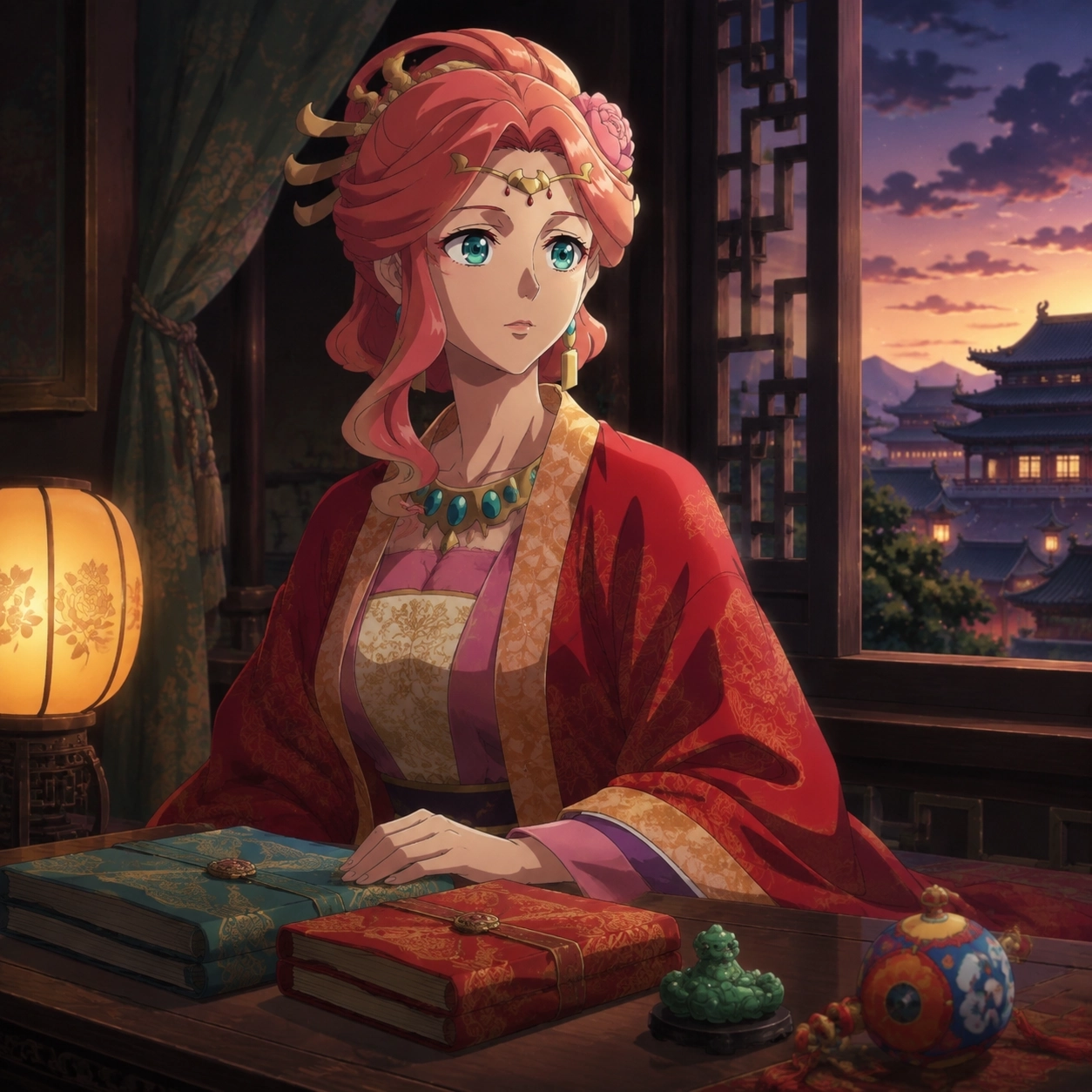
Gyokuyou's likely importance would therefore increase, not decrease. She would be the mother whose household must be reassured without being treated as a threat, and whose own political intelligence would matter in preventing a new court divide. The canon does not require her to become a villain. It shows why a sensible ruler would need her household protected from being turned into one by other people.
Jinshi's Brand Would Become a Publicly Painful Contradiction
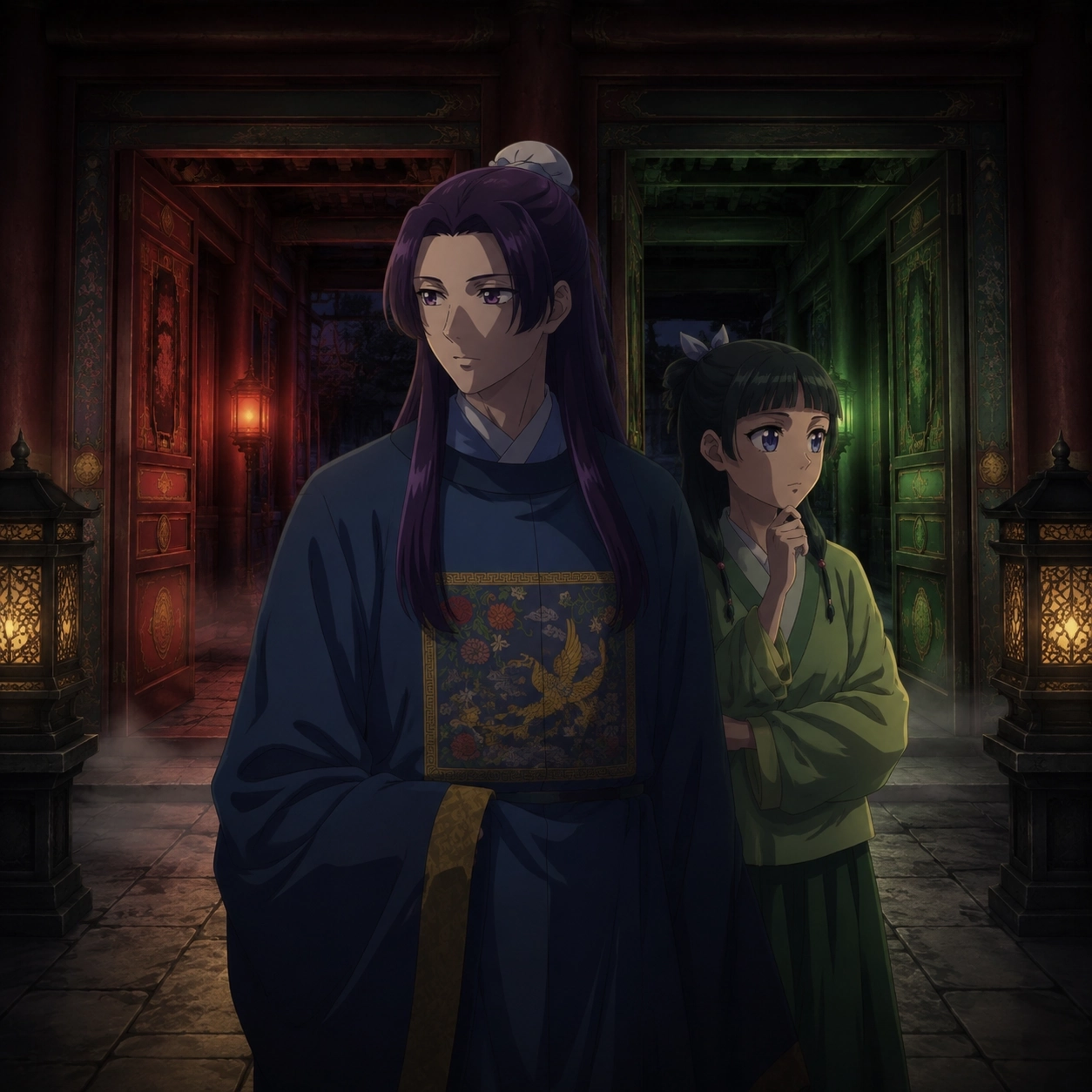
Jinshi's left-abdomen brand is his personal refusal to take the place that could endanger Gyokuyou's son's future. If he later inherited anyway, that wound would become impossible to read as only private self-denial. It would be evidence of how long he knew the cost of the crown and how little he wanted to pay it.
The brand would not prove that Jinshi had a secret plan to rule. It would prove the opposite: that the throne came with a political debt he had already tried to mark onto himself. An accession would not erase that meaning. It would make the sacrifice harsher.
What It Would Mean for Maomao
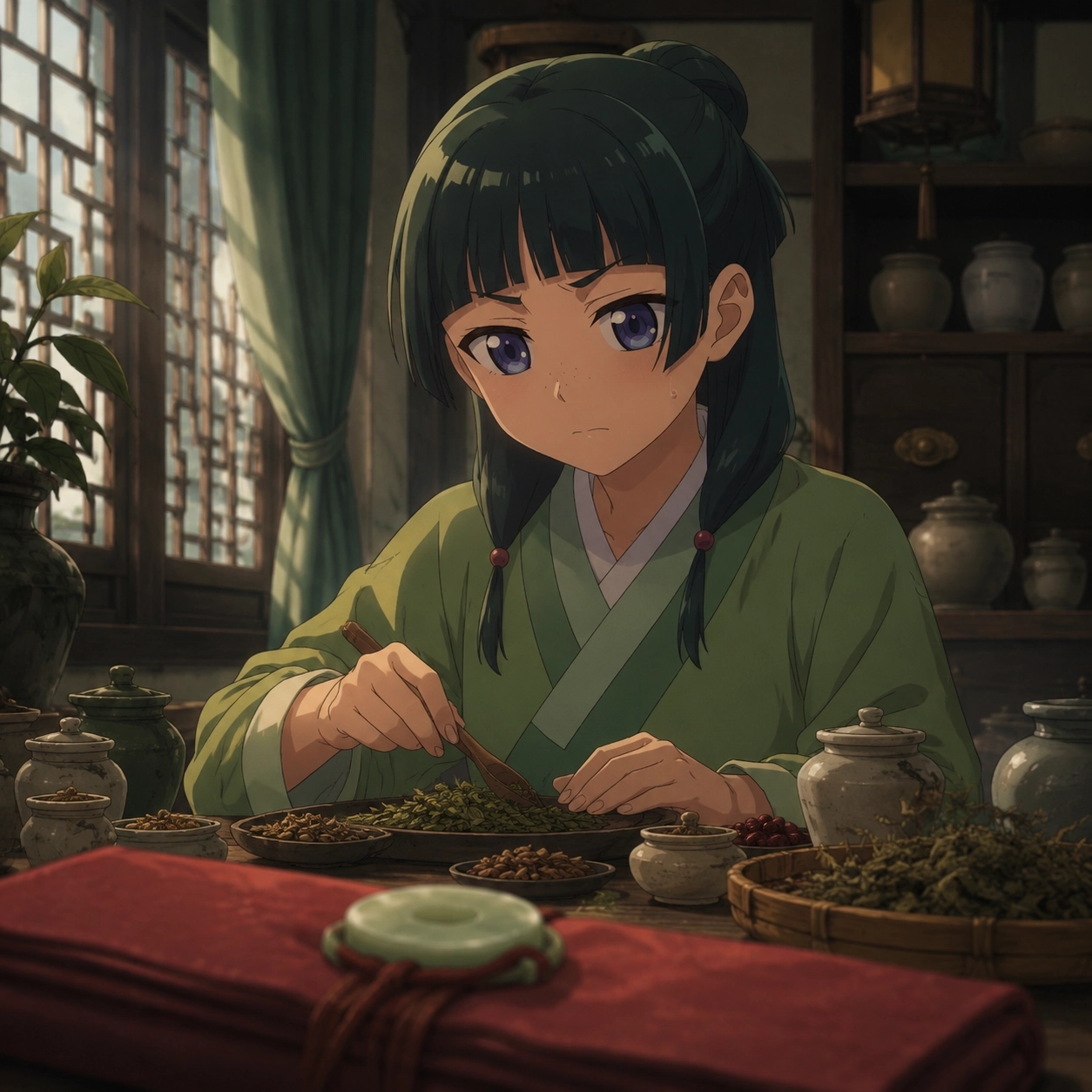
Maomao would not receive a simple romantic reward if Jinshi inherited. She would become more visible precisely because she is one of the people who can see past Jinshi's public mask. That visibility is dangerous in a court where intimate knowledge can be misread as factional influence, ambition, or access to the ruler.
The night-visit material already shows Maomao understanding that a private relationship with Jinshi cannot be separated from succession. Her practical preparation and concern for Gyokuyou's child are not evidence that she wants palace status. They show that she knows how quickly a private body can become a public political problem.
If Jinshi sat on the throne, that problem would intensify. Maomao could still be herself, still resist flattery, still care more about medicine than ceremony, but other people would no longer let her move through the palace as if her proximity to Jinshi were politically neutral. The risk is not that she would suddenly become a conventional consort. The risk is that the court would try to force that category onto her.
Maomao Would Remain a Check on Myth
At the Shrine of Choosing, Maomao turns an ancestral legend into a question about evidence, inheritance, and color vision. That habit would matter even more around a Jinshi reign. She is one of the few people able to resist the comforting story that a ruler is simply "chosen" and therefore beyond scrutiny.
That does not make her a secret ruler behind Jinshi. It makes her a person whose evidence-first mind could become politically valuable and therefore politically vulnerable. The difference matters.
What It Would Change in Jinshi
The deepest change would be that Jinshi could no longer use distance from the throne as his main form of protection. His existing pattern is to reduce the danger he poses to other people: refuse the crown, avoid becoming Gyokuyou's enemy, hide the wound rather than turn it into a public claim, and keep Maomao from being absorbed by his rank.
Accession would make that strategy impossible. He could still be restrained, but he could no longer be politically absent. Every decision about Gyokuyou's son, Maomao, his household, and the Emperor's former allies would be interpreted as the action of a ruler rather than the caution of a man trying to escape the role.
It is fair to expect a more careful ruler than a reckless one, because Jinshi has learned the cost of pressure. It is not fair to promise a perfect reign. The canon strength of this hypothetical is emotional and structural: Jinshi becoming emperor would force the person most determined not to endanger others to manage danger from the center of the empire.
What Would Not Magically Change
Passing a Test Does Not End Faction Politics
The Shrine of Choosing can strengthen a claim, but it cannot make every minister agree, protect every child, or erase the Emperor's existing arrangements. The test would be one argument inside a larger struggle over legitimacy.
Jinshi's Feelings Would Not Remove Maomao's Risk
Jinshi cares about Maomao. That is exactly why accession would be painful for both of them. Affection would not make the court ignore her. It would make the court look harder at her.
Gyokuyou Would Not Have to Become Jinshi's Personal Enemy
The canon shows political pressure more clearly than personal hatred. The conflict would be about protecting a child, defining a future line, and preventing factions from weaponizing two legitimate households against each other.
Jinshi Would Not Become a Different Person Overnight
A crown could change what Jinshi is allowed to do, but it would not erase the history that made him resist the crown. His caution, shame, loyalty, and need to protect people from his position would all remain part of the problem.
FAQ
Does Jinshi become emperor in canon?
This article does not claim that he does. It is a canon-grounded hypothetical built from the succession pressure already present in the novel.
Would the Shrine of Choosing make Jinshi emperor automatically?
No. The shrine provides old symbolic legitimacy, but it is not an automatic coronation mechanism. Jinshi's successful route also depends on Maomao's reasoning, which makes the result politically meaningful and politically debatable.
Would Gyokuyou's son lose his place entirely?
Not necessarily. The central change is that his status would need to be defined again under a Jinshi reign. That process would be politically sensitive because he represents the Emperor and Gyokuyou's public household future.
Would Maomao become empress?
The novel has not established that future, so this analysis does not invent it. The canon-grounded point is that Maomao would face greater political scrutiny because of her closeness to Jinshi.
Would Jinshi be a good emperor?
The text supports the idea that Jinshi understands responsibility and palace danger. It does not provide a canon reign from which to judge specific policies. His strongest likely quality would be restraint, but restraint alone cannot remove the succession problems his accession would create.
What should I read next?
Read the Shrine of Choosing analysis, whether the Emperor treats Jinshi as brother or son, why Jinshi marks his left abdomen, and why Jinshi avoids becoming Gyokuyou's enemy.
Continue the character discussion