Spoiler Warning
This article discusses major light novel spoilers for The Apothecary Diaries, including Jinshi's hidden identity pressure, the private imperial meeting with the Emperor, Gyokuyou, and Maomao, Jinshi's branding wound, the later western-capital follow-up, the Emperor's succession anxiety, and the Ah-Duo/Jinshi family secret. Anime-only readers should stop here.
Scene Locator
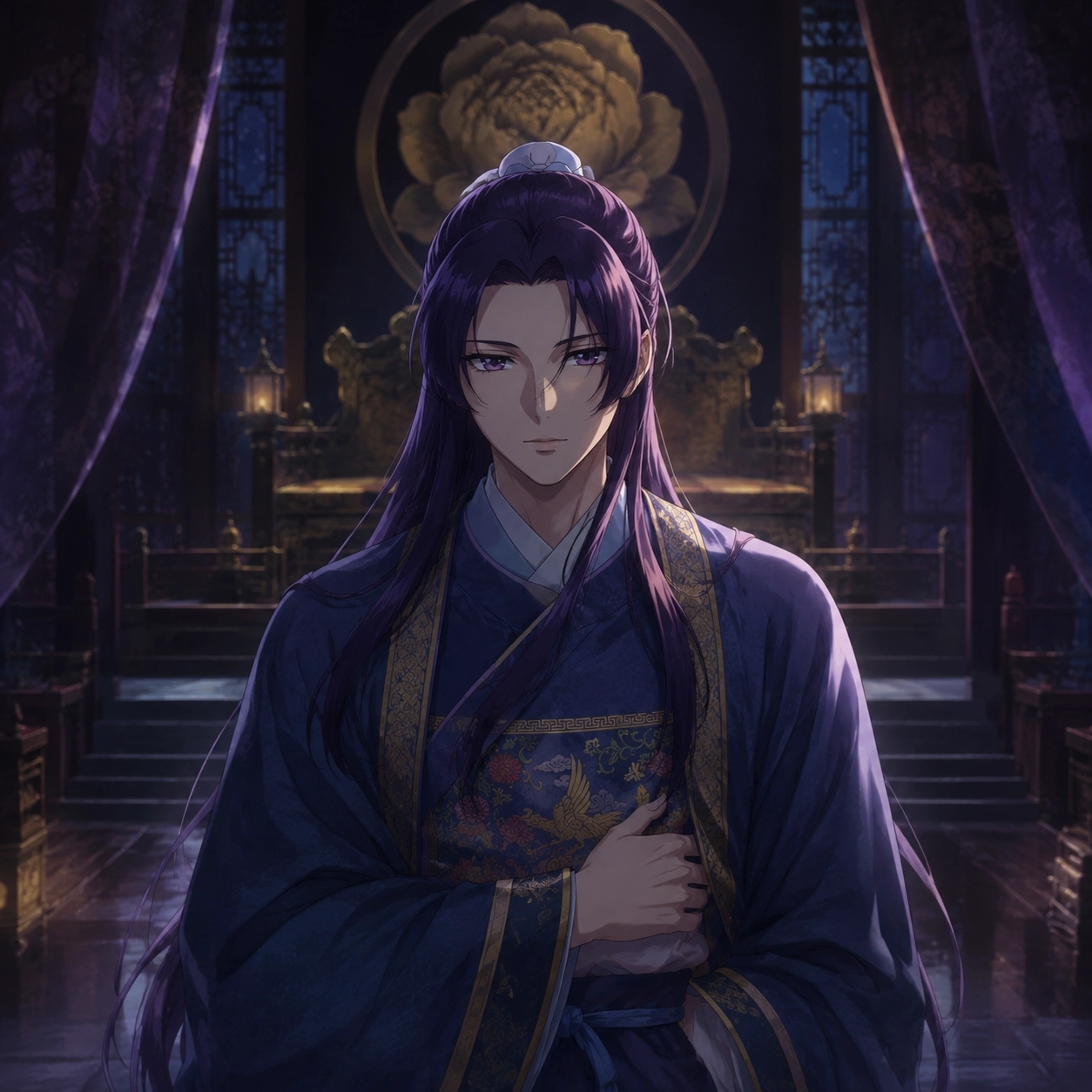
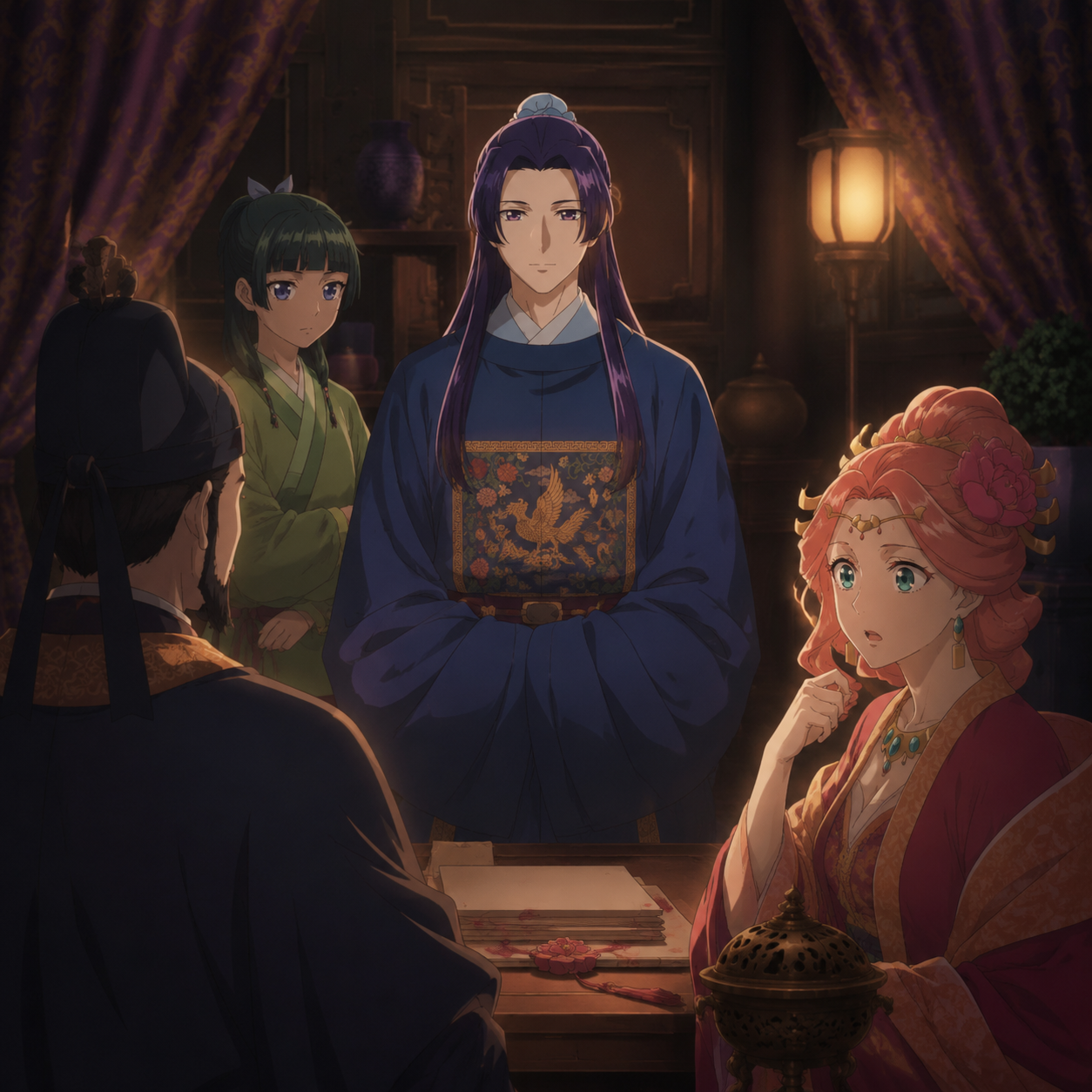
The brand belongs to the same late-light-novel chain as the secret four-person meeting between the Emperor, Jinshi, Gyokuyou, and Maomao. In that private royal space, Jinshi pushes the succession problem into the open and makes a physical declaration when words are not enough.
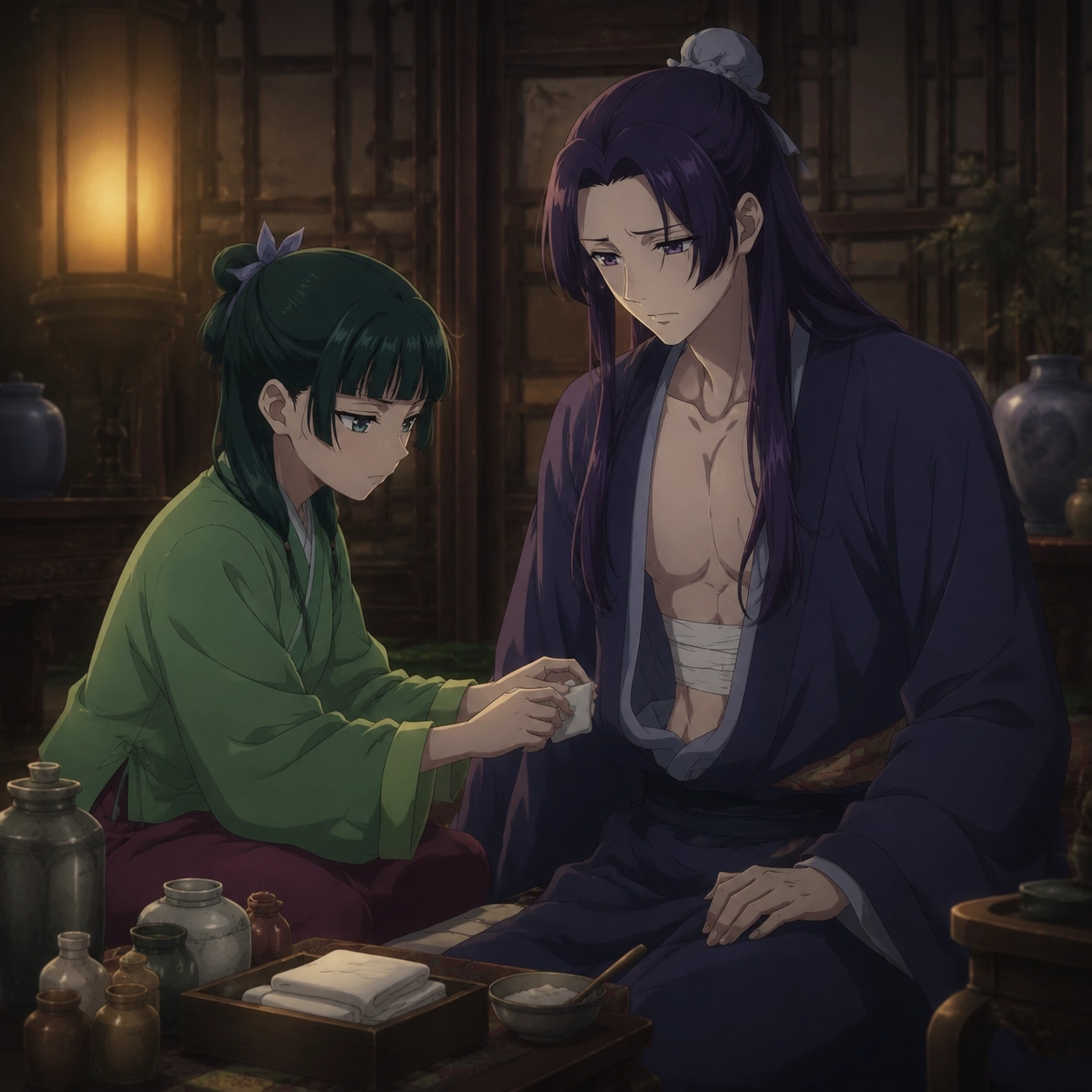
Later passages keep returning to the wound. Maomao treats the burn while Jinshi is in the west. She notices the mark on his left side, thinks of the huge taboo he has already broken, and reads his choice as painfully typical of him: a prince who could take the shortcut for himself, but keeps trying to choose the broad road for someone else.
Volume 13 and Volume 15 callbacks make the political meaning even clearer. Gyokuyou is one of the few people who knows the full peony-shaped mark on Jinshi's body. The Emperor's illness also revives the succession crisis, because if he dies while the crown prince is still young, many courtiers would look again to Jinshi, even if Jinshi himself hates the idea.
So this article should be read alongside why Jinshi does not want Gyokuyou as an enemy, whether the Emperor treats Jinshi as brother or son, and the Shrine of Choosing analysis.
Volume-level entry only. The source is community-hosted; availability and rights status may vary.
The Short Answer
Jinshi leaves the brand on his left abdomen because he is trying to make his refusal of the throne permanent. He has royal blood, public beauty, administrative ability, years of hidden palace service, and enough political usefulness that powerful families can keep turning him into a candidate. Saying "I do not want to be emperor" is not enough when other people can still use his name.
The mark is a violent anti-coronation. By burning a peony-like crest associated with Gyokuyou onto a hidden part of his body, Jinshi tries to show that he will not stand above Gyokuyou's son. He is not declaring himself a slave in the legal sense. He is using the imagery of ownership, submission, and bodily stigma to say that he belongs below the future line he could otherwise threaten.
The left abdomen matters because it is private but durable. It can be hidden under court clothing, so it does not create an immediate public scandal. Yet it is painful, intimate, and hard to erase. The novel does not give a ceremonial explanation for the left side, so the safest reading is practical and symbolic: it is a place where the mark can remain secret, become medical evidence for Maomao, and still act as a permanent oath among the few people who know.
What the "Slave Brand" Means
"Slave brand" is useful as a reader shorthand, but it needs care. The story does not turn Jinshi into a legal slave. The mark works because Li's world remembers body marking as a sign of ownership, humiliation, and political control. The court can abolish systems on paper, but the symbolism remains horrifyingly legible.
That is why the wound feels different from an ordinary scar. Jinshi is not injured by an enemy in battle. He is not hiding a wound he received while protecting someone. He chooses a brand, and that choice makes the wound into a document. It says something about rank, succession, and who he refuses to become.
The mark also inverts Jinshi's usual problem. People look at Jinshi and see beauty, status, and royal value. Those qualities make him politically desirable. The brand creates a second body underneath the visible one: not the flawless prince courtiers want to display, but a damaged person who has written refusal into his own skin.
That is why Maomao's medical gaze is so important. She does not romanticize the mark. She sees the burn, the treatment problem, the risk of infection, the permanent pattern, and the foolishness of doing this to a body. Her anger keeps the scene from becoming beautiful martyrdom. The article on Maomao and Jinshi's dynamic matters here because Maomao is one of the few people who can see both Jinshi's rank and his body without being dazzled by either.
Why the Left Abdomen Matters
The novel points readers to Jinshi's left side in a follow-up scene, when Maomao glances at his left abdomen after he mentions the punishment attached to his forbidden act. That small glance is doing a lot of work. It reminds us that the brand is not a metaphor floating above the story. It is still there, under the cloth, changing how Maomao reads him.
Because the text does not spell out a ritual reason for "left," we should not overstate it. The clearest reason is narrative and practical. The left abdomen is hidden enough for secrecy, vulnerable enough to hurt, and close enough to the center of the body to feel like a direct assault on the royal self Jinshi is expected to preserve.
If the mark were on his face or hand, the court would immediately know. If it were somewhere too trivial, it would not carry the same bodily cost. The side abdomen lets the wound become a secret oath: visible to Maomao when she treats him, meaningful to Gyokuyou and the Emperor, but not available for every faction to twist in public.
This private placement also keeps the contradiction alive. Jinshi wants the mark to matter politically, but he cannot let it become public politics. That is the tragedy of the scene. He makes a permanent sign, then depends on silence for the sign to work.
The Succession Reason: Jinshi Is Trying to Become Unusable
The simplest wrong answer is that Jinshi brands himself only because he loves Maomao. Maomao matters deeply, but the brand is bigger than romance. It happens inside a succession crisis.
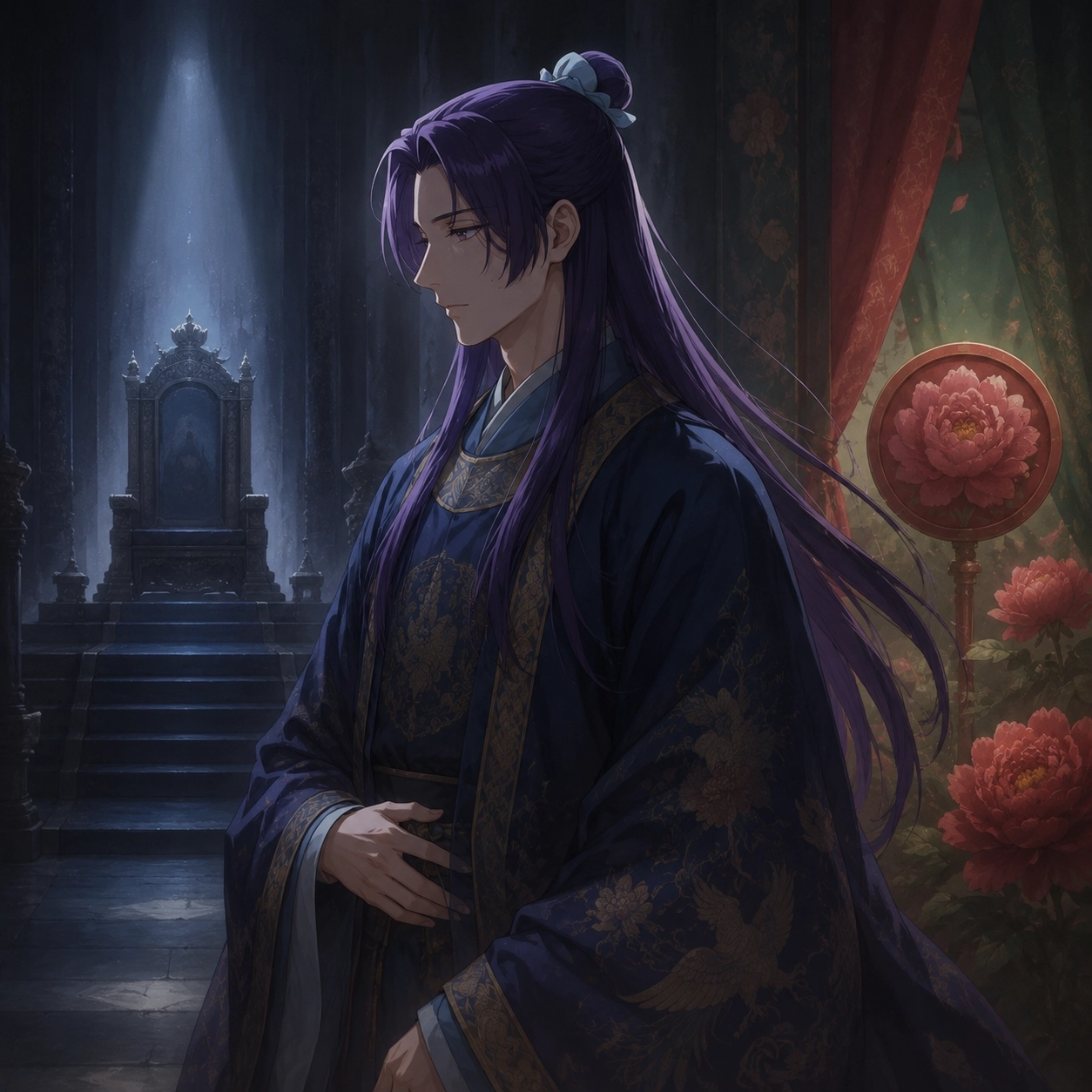
Before Gyokuyou's son is old enough to rule safely, Jinshi remains a dangerous alternative. He is young, adult, royal, capable, and familiar to the court. Even his reluctance does not protect him, because succession politics are not driven only by personal desire. If the Emperor weakens or dies, factions can still say that Jinshi is the more stable choice.
That is why the later Emperor illness chapters are so chilling. Characters understand that the young crown prince would need a regent, that Gyokuyou's western blood gives hostile courtiers an opening, and that Jinshi could be pushed forward despite his lack of ambition. The brand cannot fully stop that. The novel even notes that people will not simply accept a belly brand as an excuse. But the mark still reveals what Jinshi is fighting against.
In other words, the brand is not a perfect political solution. It is a desperate proof of intention. Jinshi cannot remove every faction's ability to use him, so he removes the last ambiguity in himself. He will not compete. He will not sit above Gyokuyou. He will not become the adult imperial male whose existence makes her son's future unsafe.
This is why the brand connects so directly to the Shrine of Choosing. The shrine tests whether Jinshi can stand inside a ruler-selection tradition. The brand answers from Jinshi's side: he wants no part of the seat.
Why Gyokuyou's Crest Matters
The peony-like mark matters because it ties Jinshi's refusal to Gyokuyou, not just to the Emperor. If his only audience were the Emperor, Jinshi could frame the issue as a request between brothers or between hidden father and son. But Gyokuyou's presence changes the meaning. She is the mother of the child whose claim Jinshi could destabilize.
When Jinshi later tells Gyokuyou that he will never be her enemy, the brand becomes the silent proof behind the sentence. He is not asking her to trust a court smile. He has already paid for that oath with his own body. That is why the Jinshi and Gyokuyou enemy question is really a succession question.
Gyokuyou's reaction also matters because she is not written as someone who demanded the wound. The horror belongs partly to her too. The mark protects her line in theory, but it also hands her a secret that cannot be openly explained. Her later road to empress is not just a rise in rank. It is a road through secrets like this one, where every promise creates another pressure point.
For readers following Gyokuyou's side, see Gyokuyou's road to empress and whether Empress Gyokuyou could become Jinshi's enemy. The brand is one of the private reasons that relationship is so charged.
Why Maomao Reads It More Clearly Than Anyone
Maomao is not moved by court theater in the way Jinshi might hope. She knows pain, bodies, scarring, and the stupidity of damaging usable flesh. So when she treats the brand, she reads it as both political symbol and medical problem.
Her later thoughts are especially revealing. She knows Jinshi is the kind of person who tries to choose the easier road for someone else while making the harder road for himself. That is the emotional center of the brand. He does not use his royal privilege to seize what he wants. He uses his body to block the path that would make others suffer because of him.
This is also why the brand complicates his relationship with Maomao. Jinshi can say he wants only one person, but becoming emperor would turn that person into a target. Later, when the Emperor presses him about ruling and taking only one beloved woman, Jinshi understands that even one favorite can be destroyed by the pressure of the rear palace. The brand is tied to the same fear: Jinshi knows rank does not merely protect people. It traps them.
Maomao's anger is therefore not coldness. It is one of the few sane responses in the room. She understands what the mark is trying to say, but she refuses to treat self-destruction as wisdom. That tension is why the scene hurts.
Later Payoff: The Brand Does Not Solve the Problem
The most important later payoff is that the brand does not magically free Jinshi. It records his will, but it does not control the court. When the Emperor's health becomes uncertain, the same succession pressures return. A young crown prince, faction resistance to Gyokuyou's bloodline, Lihua's son, regency fears, and Jinshi's adult royal status all remain live problems.
That is what makes the wound tragic rather than triumphant. Jinshi has done something irreversible, but politics can still ignore his intention. The court is very good at using bodies while pretending to respect persons. A brand can become evidence of loyalty to the few who understand it, but to ambitious factions it can be dismissed, hidden, or reframed.
Still, the brand matters because it tells readers who Jinshi is when no public script can save him. He is not a man secretly hungry for the throne. He is someone so desperate not to endanger Gyokuyou's line, the Emperor's order, and Maomao's freedom that he turns refusal into a wound.
That is why the left-abdomen brand remains one of the sharpest symbols in the light novel: private enough to be secret, permanent enough to be remembered, and politically loaded enough that every later succession scene presses on it.
FAQ
Did Jinshi literally become a slave?
No. The "slave brand" wording describes the symbolism of bodily marking, ownership, and submission. Legally, Jinshi remains royal. Symbolically, he is marking himself as someone who will not stand above Gyokuyou's heir.
Why is the brand on Jinshi's left abdomen?
The novel explicitly points to his left side in a later treatment scene, but it does not give a formal ritual reason for the side. The best reading is that the location is hidden, painful, durable, and private enough to function as a secret oath rather than a public scandal.
Is the brand mainly about Maomao?
Maomao is central as the witness and physician, and Jinshi's fear of trapping her matters later. But the brand itself is mainly a succession act. It is aimed at the Emperor, Gyokuyou, and the court factions that could use Jinshi as a rival heir.
Why does Gyokuyou need to know about it?
Because Gyokuyou's son is the future line Jinshi could threaten. The mark only works as an oath if the person most endangered by Jinshi's political value can understand what he is promising.
Does the brand successfully remove Jinshi from succession?
Not completely. It proves Jinshi's intention, but it cannot force ambitious courtiers to stop seeing him as useful. Later Emperor illness chapters show that the succession danger still remains.
What should I read next?
Read the secret four-person meeting analysis, the Emperor and Jinshi brother-or-son article, Jinshi and Ah-Duo's secret thread, and Jinshi's real name and identity.