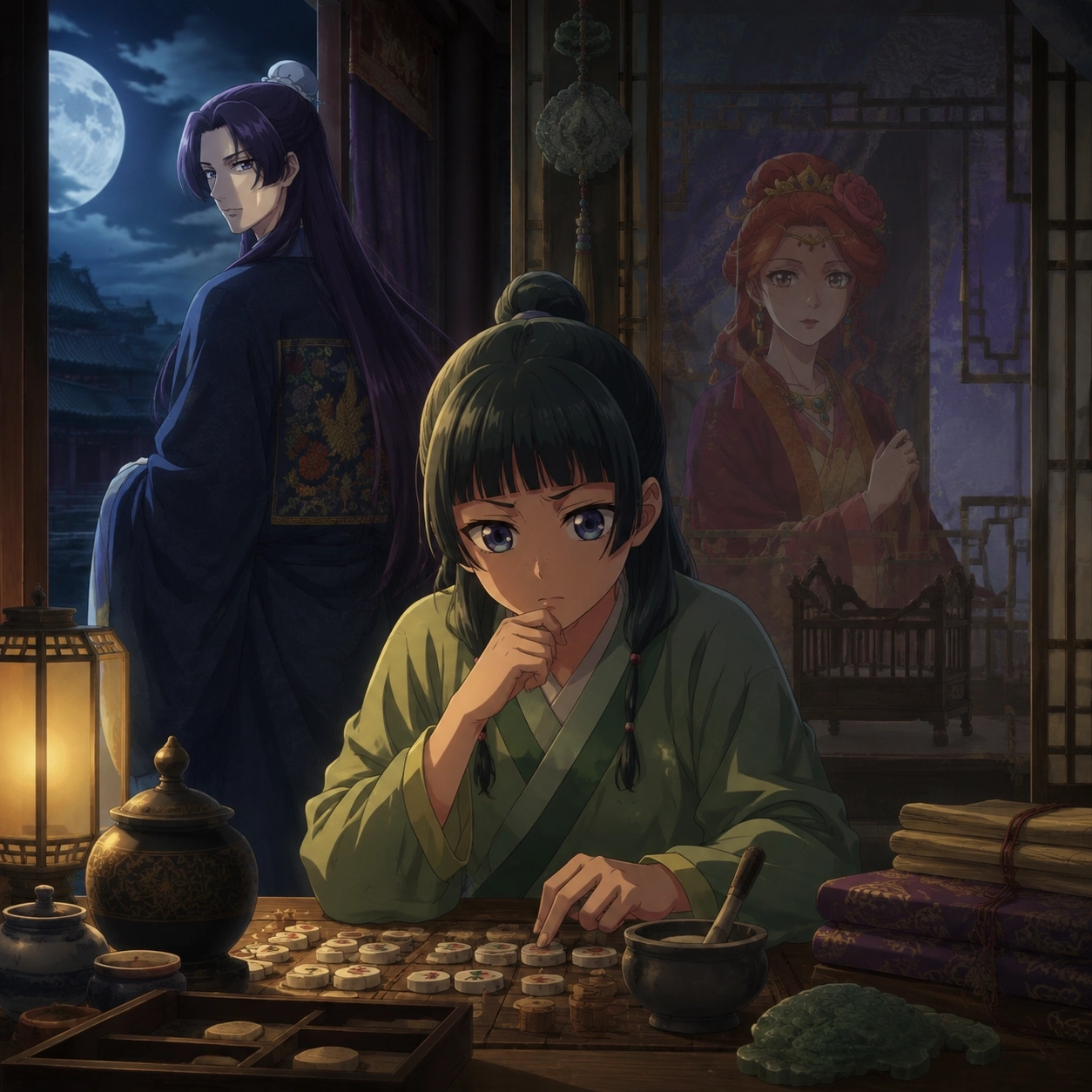
Spoiler Warning
This article discusses Volume 13, Chapters 14 and 15 of The Apothecary Diaries, including Ah-Duo's explanation of Jinshi's position, Maomao's pregnancy-risk planning, and the night visit that ends with Jinshi stopping. Anime-only readers should stop here.
Scene Locator
The setup appears in Volume 13, Chapter 14, “Ah-Duo's Truth.” The night visit, Maomao's cycle calculation, and Jinshi's emotional reversal continue in Volume 13, Chapter 15, “Jinshi's Hesitation, Maomao's Resolve.”
Volume 8, Chapter 20 concerns Jinshi's separate self-inflicted brand and succession decision. It is not the source chapter for Maomao's pregnancy-risk conversation.
Volume-level entry only. The source is community-hosted; availability and rights status may vary.
The Short Answer
Maomao is willing to treat pregnancy as a danger that must be contained, even if containment would damage her own body. Her reasoning is not that Jinshi is unimportant. It is the opposite: Jinshi's bloodline and public position make an unplanned child politically explosive, while Gyokuyou's son is already the expected future line.
That is why the scene sounds so severe. Maomao is not saying that she has already taken an abortifacient. She says she has counted her cycle and knows how she would handle a failure. The novel presents knowledge and willingness to bear the cost, not a confirmed act of taking medicine.
Her choice is therefore a grim form of protection. She would rather make herself the single casualty of a private consequence than allow a pregnancy to become a spark for a succession struggle that could consume Jinshi, Gyokuyou's household, and many others.
What the Novel Actually Says
Preparation is not proof of ingestion
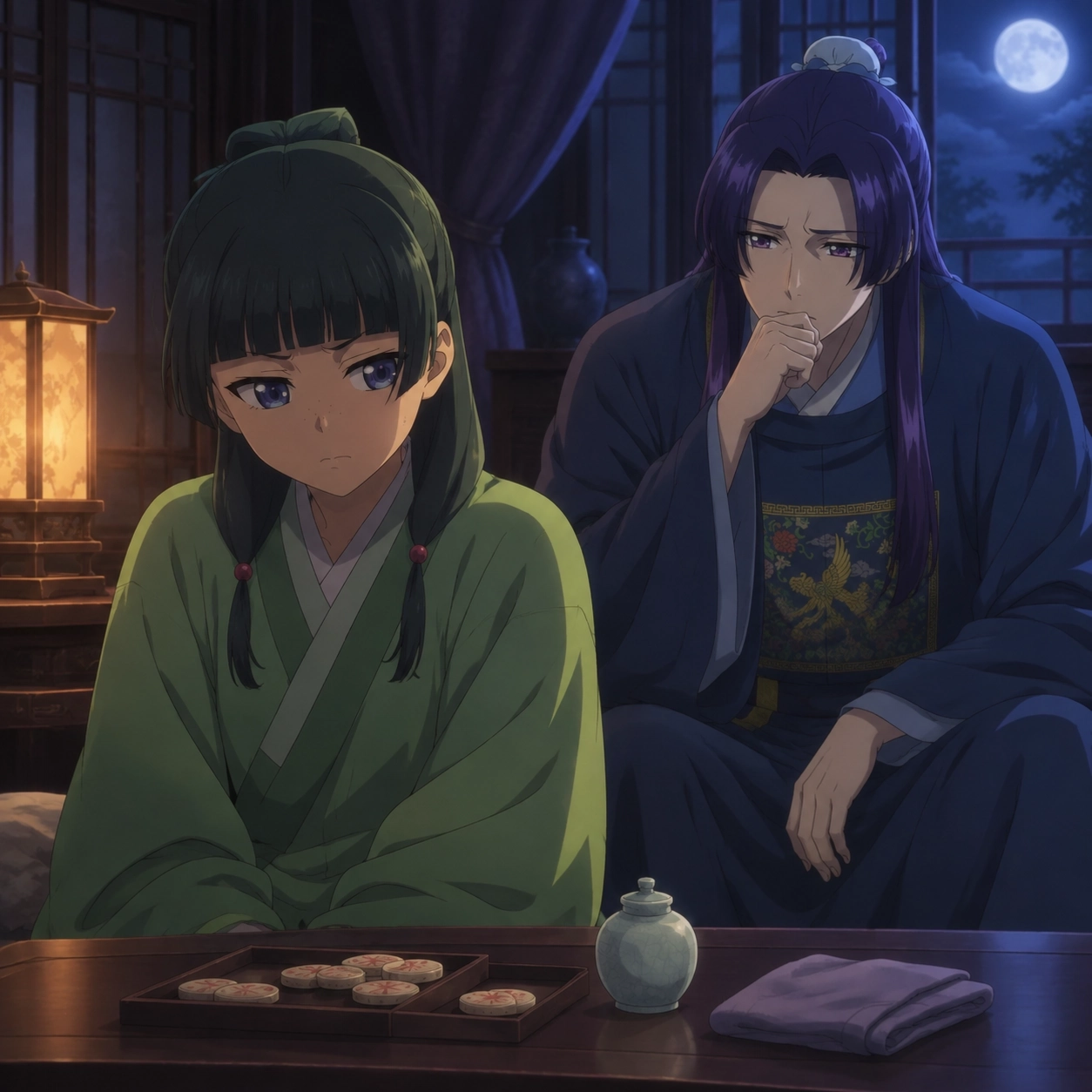
The distinction matters because the word “abortion” can make the scene sound more definite than it is. Maomao has practical knowledge from the pleasure district and knows that pregnancy can be ended by dangerous methods. She also knows that preventive methods can fail. The text never gives a scene in which she actually takes an abortifacient after the night visit.
When Maomao says she knows how to deal with failure, the important fact is her readiness to assume responsibility for the result. She is not making a medical recommendation for readers, and the story does not treat the methods she names as safe. They are desperate, harmful practices that reveal the world she has survived.
The real subject is political consequence
Maomao's body is the immediate site of risk, but succession is the subject underneath it. If she and Jinshi had a child before his position was settled, court factions could read that child as a rival claim, a hostage, or evidence that Jinshi should be pushed toward the throne. The private act would become public arithmetic.
This is also why the scene belongs beside the analysis of Jinshi's refusal. The two perspectives describe the same night from opposite sides: Maomao prepares to absorb the damage, while Jinshi stops because he cannot accept that preparation as the price of loving him.
Why Jinshi Changes the Calculation
Maomao would not make this calculation for an ordinary man whose private life could remain private. Jinshi is publicly the Emperor's younger brother, privately entangled with the truth about his birth, and constantly treated by the court as a possible adult answer to a succession problem he does not want.
His desire is real, but it does not exist outside that position. A child connected to Jinshi would invite questions about legitimacy, inheritance, and whether Gyokuyou's young son could safely remain the center of the imperial line. Even people who knew Jinshi did not want the throne could use the existence of a child to build a faction around him.
Maomao understands this with unusual clarity. Her response is not to ask Jinshi to become less royal overnight. Instead, she tries to reduce the chance that her own body will become the battlefield. That is why her answer feels both practical and heartbreaking.
For the larger identity question, see Jinshi's real name and hidden identity and the Emperor's brother-or-son relationship with Jinshi.
Why Gyokuyou Matters
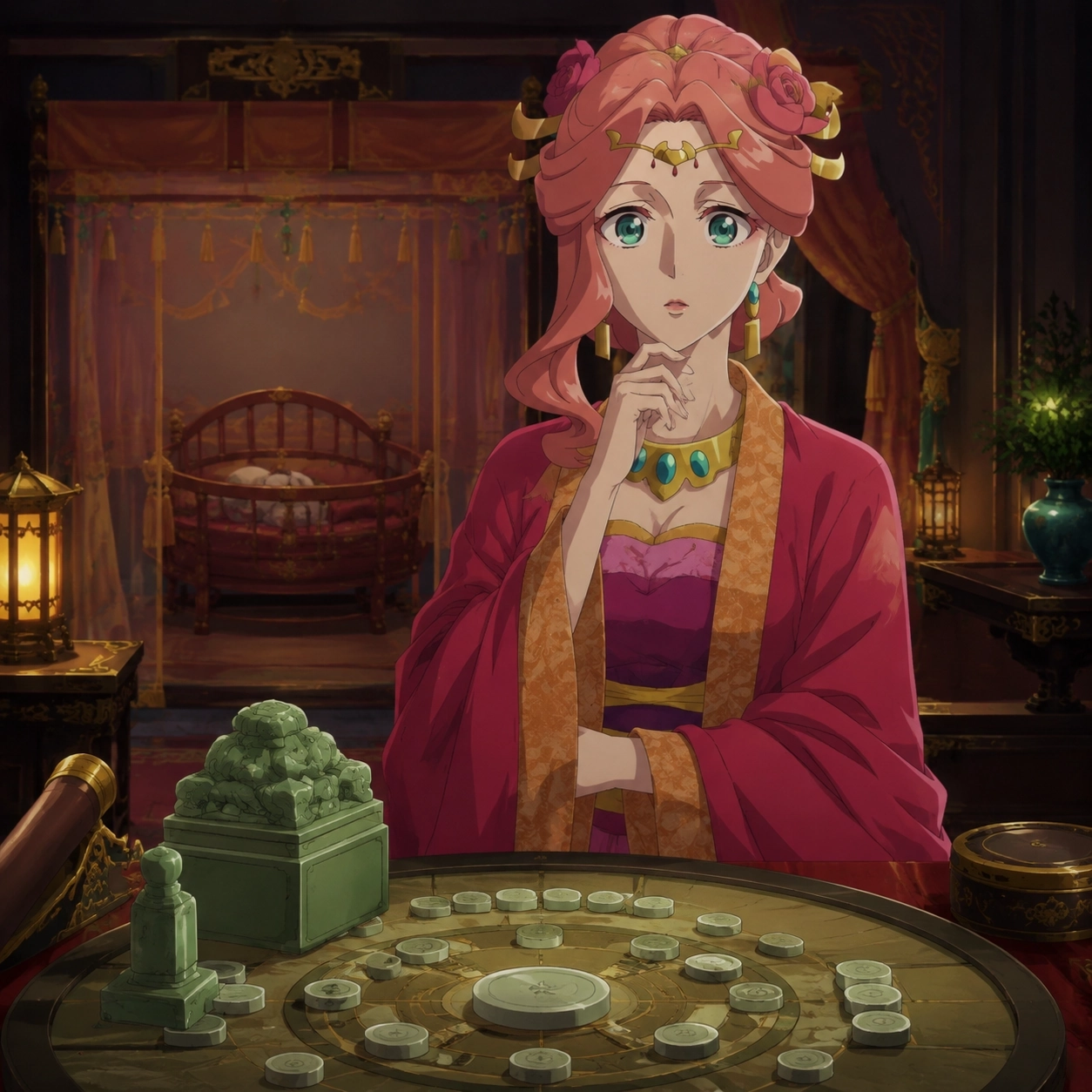
Gyokuyou is not a jealous rival standing between Maomao and Jinshi. She is the mother of the young heir whose future already gives the court a direction. Maomao's fear is that an unexpected pregnancy connected to Jinshi could make Gyokuyou's household look threatened, even if none of the three people wanted a confrontation.
This is the meaning of Maomao's concern about becoming Gyokuyou's enemy. She knows that Gyokuyou could be forced to treat a potential child as a political danger rather than a private family matter. She also knows that a rumor can create enemies before anyone has consciously chosen to become one.
Gyokuyou's own rise makes the danger sharper. Her road to empress is built on surviving threats to her children, maintaining a western-backed household, and turning personal trust into durable political legitimacy. A pregnancy tied to Jinshi could disturb that balance without Maomao ever intending to challenge her.
That is why this article should be read with Gyokuyou's road to empress and why Jinshi does not want to become Gyokuyou's enemy. Both explain why the danger is structural rather than romantic.
Maomao's Harsh Form of Protection
She counts lives before she counts feelings
Maomao's first instinct is not to ask who deserves happiness. She asks what chain reaction will follow. If one child could become the excuse for rival factions to move, then preventing that chain reaction can look more urgent to her than preserving her own comfort.
Her statement about using a needle, mercury, blows, or cold water is deliberately shocking. These are not presented as clever solutions. They show how far Maomao is willing to place herself between the court and a larger disaster. She would rather make the danger legible as one injured body than allow it to spread through hundreds of lives.
Her practicality is not emotional emptiness
Maomao's willingness to bear the cost can be misread as proof that she does not love Jinshi. The scene suggests the reverse. She has accepted his feelings and prepared herself for the consequences of entering his room. Her coldness is a survival method: she turns fear into a procedure because procedures are easier to control than court rumors.
That does not make her decision healthy or harmless. It shows the damage caused by a world in which a young woman must calculate pregnancy, rank, factional violence, and the safety of another woman's child before she can accept intimacy.
Ah-Duo's Warning Gives the Choice Its Scale
Ah-Duo's conversation in Chapter 14 prevents the night visit from being read as a simple bedroom misunderstanding. She explains the danger around Jinshi's bloodline and asks Maomao to imagine what would happen if a child appeared before the political situation was settled.
Maomao's answer is frightening precisely because she understands Ah-Duo. She is not promising to hide a baby and hope the court remains calm. She sees the possibility of a power struggle and decides that her own body would be easier to sacrifice than the lives that could be pulled into the struggle.
At the same time, Ah-Duo recognizes that Maomao is not merely being reckless. Maomao has accepted Jinshi's feelings, and that acceptance means accepting a country, a border, and a royal identity along with him. The warning deepens Maomao's resolve instead of erasing it.
For the separate emotional history behind that conversation, read the analysis of Ah-Duo's dream ending at fourteen.
Jinshi's Response Is the Other Half of the Scene
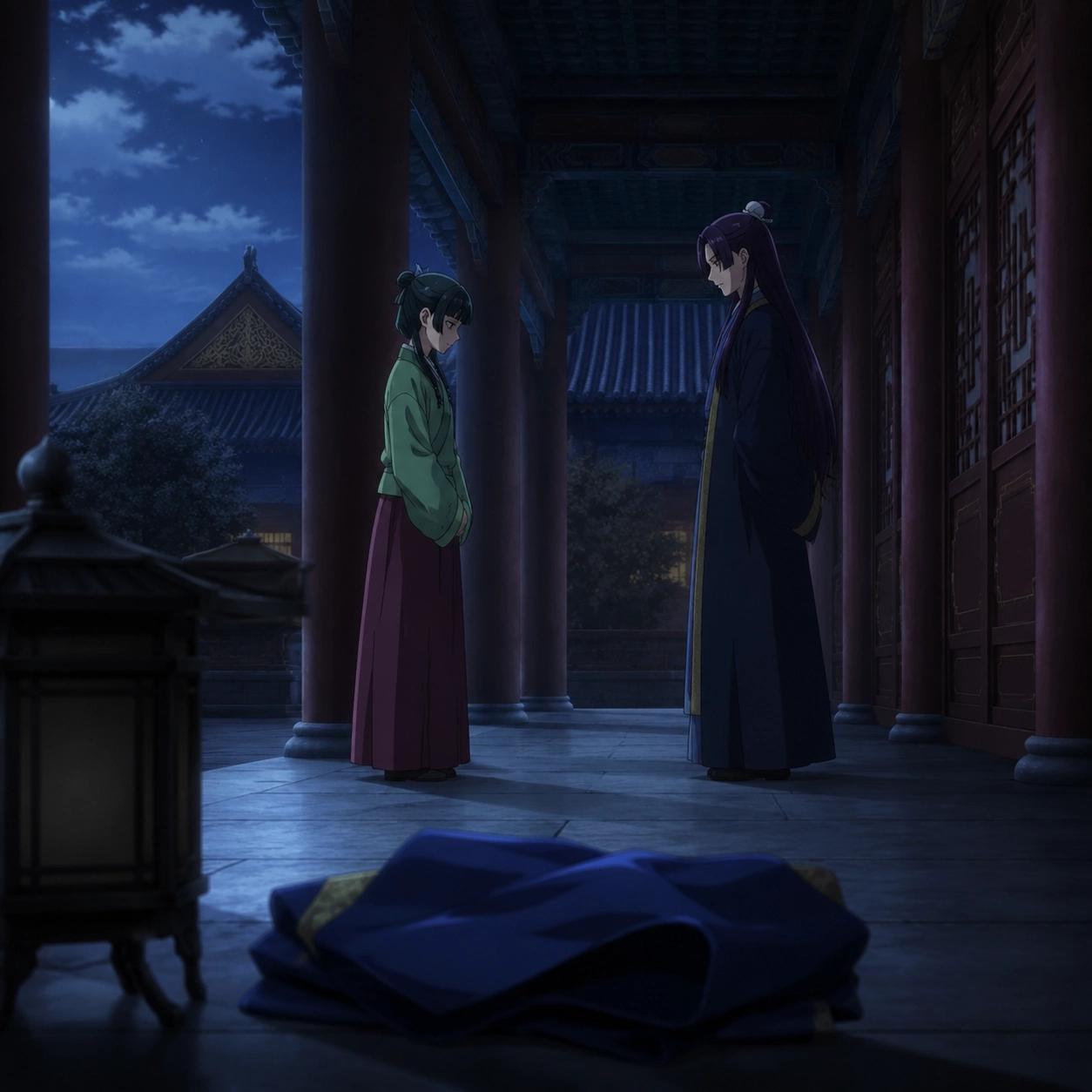
Jinshi does not hear Maomao's plan as proof that she has solved the problem. He hears that she is willing to harm herself because his status makes ordinary intimacy dangerous. His desire collapses into guilt, and he embraces her without continuing the act.
This is why his refusal is not a rejection of Maomao. It is a rejection of the bargain she has prepared to make. He can accept her consent, but he cannot accept a future in which her body is treated as the expendable part of his succession problem.
The scene also reveals a painful difference between them. Maomao thinks in terms of minimizing casualties. Jinshi thinks in terms of whether he has become the source of Maomao's injury. Neither is simply wrong, but their priorities collide at the exact moment they become honest with each other.
In that sense, Maomao's pregnancy-risk choice changes Jinshi more than a successful romantic night could have. It makes him confront the cost of postponing his imperial problem. He cannot keep asking Maomao to live inside uncertainty while pretending that desire alone is enough.
FAQ
Did Maomao actually take an abortion medicine?
No confirmed scene shows Maomao taking an abortifacient after the night visit. The novel says she knows how she would handle a failed pregnancy-prevention plan and names dangerous historical methods. This article should not turn that preparation into a confirmed act.
Why would Maomao consider such a dangerous option?
She believes an unplanned pregnancy with Jinshi could trigger a succession conflict around Gyokuyou's young heir. Her harsh calculation is that one injured body might prevent a wider political struggle and many deaths.
Is Maomao trying to become Gyokuyou's enemy?
No. Her concern about Gyokuyou shows that she is trying to avoid becoming a rival to Gyokuyou's household. She understands that court factions could create hostility even when Maomao herself has no desire to challenge Gyokuyou.
Does Maomao's plan mean she does not love Jinshi?
No. Her preparation shows that she takes Jinshi's feelings seriously. Her problem is that affection cannot erase biology, royal blood, or the political consequences of a child connected to Jinshi.
Why does Jinshi stop after hearing her answer?
He realizes that Maomao is prepared to bear bodily harm and political blame so that he can avoid a larger crisis. He stops because he cannot treat that self-sacrifice as the price of intimacy.
Which volume contains the scene?
The setup is in Volume 13, Chapter 14, and the night visit is in Volume 13, Chapter 15. Volume 8, Chapter 20 is a separate Jinshi succession and self-inflicted-brand event.
Continue the character discussion