Spoiler Warning
This article discusses light novel spoilers for Volume 15, including the Emperor's illness, the planned operation, Jinshi's refusal to inherit the throne, Ah-Duo's history with the Emperor, and the secret behind the baby exchange. Anime-only readers should stop here.
Scene Locator
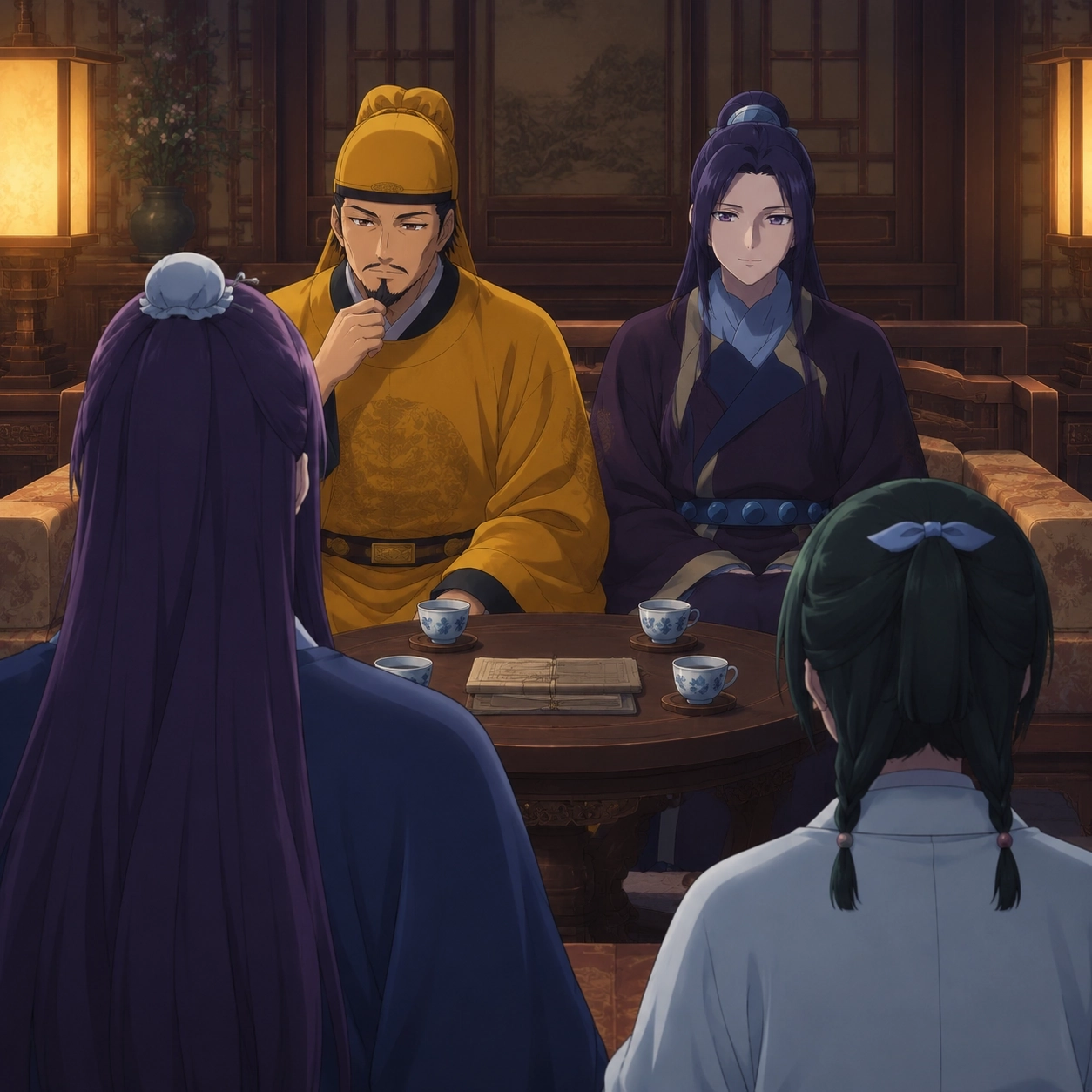
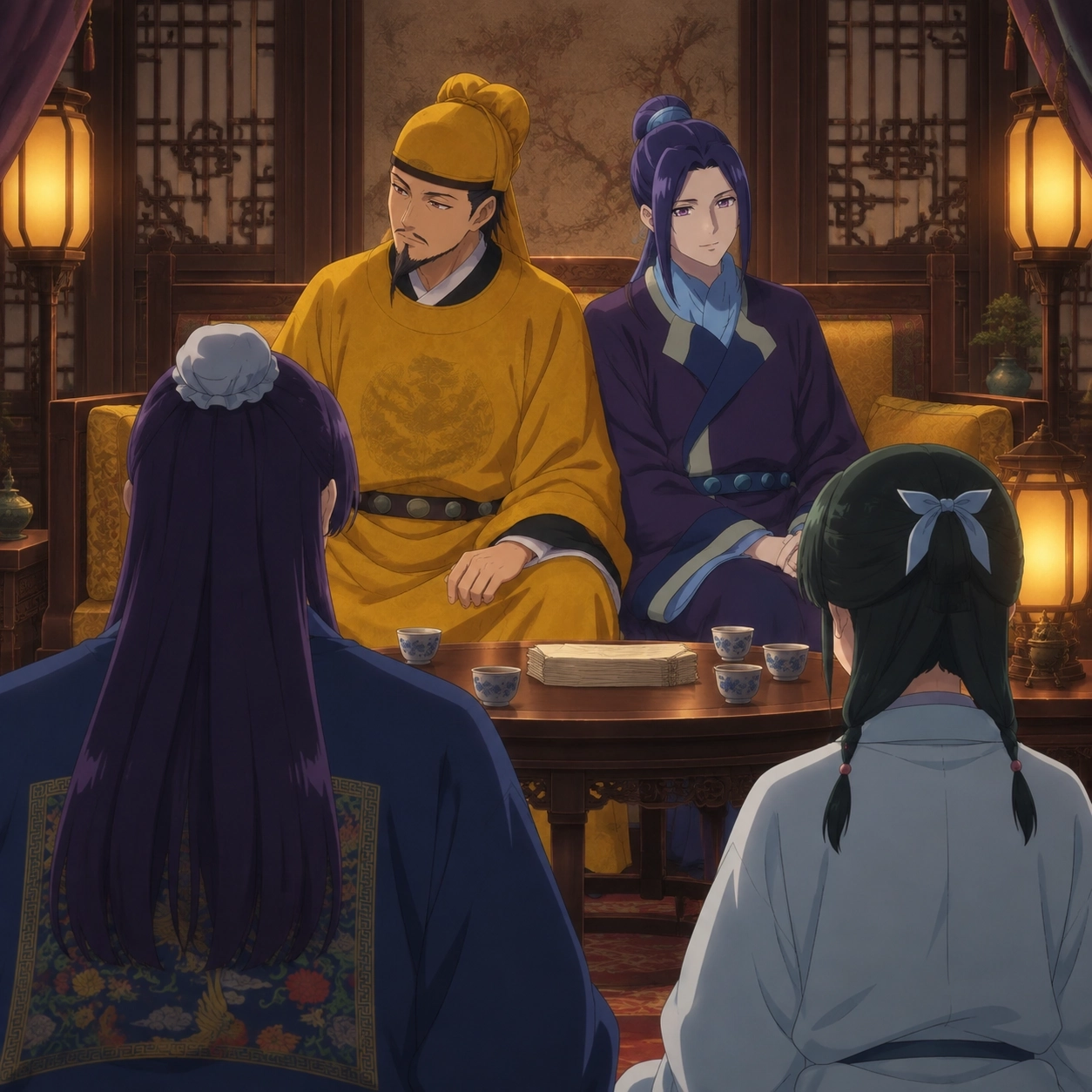
The meeting appears in Volume 15's chapters titled Confession: Omote and Confession: Ura. Maomao is escorted to a royal-only room she remembers from an earlier secret gathering. The narration explicitly says that Gyokuyou has been replaced by Ah-Duo this time. Inside, the Emperor and Ah-Duo are already seated, Maomao takes the smallest stool, Jinshi arrives afterward, and four cups confirm the four-person arrangement.
This is not a public council or a normal family dinner. The room is guarded, Maomao is searched before entering, and the Emperor is hiding how sick he is. The immediate reason for the gathering is the operation scheduled for the next day, but the conversation quickly becomes a question about what happens to the state and to Jinshi if the Emperor dies.
Volume-level entry only. This source is community-hosted; availability and rights status may vary.
For comparison, the site also has a separate analysis of the earlier Emperor, Jinshi, Gyokuyou, and Maomao meeting. That article should not be used as the locator for this Volume 15 conversation.
The Short Answer
The Emperor summons these four people because the operation is medically urgent and politically dangerous. He wants Maomao to explain the risk, Jinshi to confront the possibility of succession, and Ah-Duo to hear the decision in a room where their old promise and the hidden family history cannot be separated from the future of the court.
Maomao is the medical witness. Jinshi is the possible successor who refuses to treat the throne as a prize. Ah-Duo is the person who carries the emotional and historical burden of the exchanged babies. The Emperor is trying to secure both his medical future and the political future that would continue after him.
What Each Person Is Doing There
The four participants do not have equal authority or equal knowledge. The Emperor controls the room and asks the questions. Ah-Duo understands more of the old history than she says aloud. Jinshi is being forced to answer a succession question he has tried to avoid. Maomao watches, diagnoses, and explains, while carefully speaking only when the conversation permits it.
That imbalance is what makes the scene feel secret. The meeting is not designed to reveal every fact to everyone. It is designed to let the people most affected by the operation and the succession crisis hear enough to make the next decision.
Why This Is Not the Gyokuyou Meeting
The shared room creates the confusion. Maomao remembers it as the place where the Emperor, Jinshi, Gyokuyou, and Maomao once met, and where Jinshi's branding incident occurred. The Volume 15 narration then makes the change explicit: Ah-Duo replaces Gyokuyou.
So the two articles describe different meetings. The old article is about the Gyokuyou version and its own Volume 8 locator. This article is about the Volume 15 meeting with Ah-Duo, the Emperor's illness, and the succession discussion. Treating the participant swap as a simple name correction would erase the reason the new conversation matters.
The Surgery and the Succession Question
The Emperor says that he is not refusing the operation. He only wants to settle important business first. Maomao explains that the illness is consistent with appendicitis: if the inflamed appendix worsens, becomes infected, and ruptures, contamination in the abdominal cavity can lead to further illness and death. She estimates the operation's chance of success at more than ninety percent, but she cannot promise that the Emperor will survive.
This medical uncertainty gives the political conversation its pressure. The Emperor wants a written plan in case he has an accident during surgery. That is why he asks Jinshi whether he would inherit the throne, even though a young Crown Prince already exists.
Maomao's Medical Role
Maomao is not invited to decorate the meeting with a clever observation. She is there because the others need a clear explanation of the physical danger. The Emperor asks what happens if the condition is left untreated, and Maomao answers carefully instead of giving him the comforting answer he might prefer.
Her role also prevents the political argument from floating free of the body. The throne, the hidden identity, and the old promises all matter, but the Emperor is still a sick man holding his abdomen and trying to conceal pain under makeup. That is why this scene connects directly to the site's analysis of why the Emperor's surgery had to succeed.
Why Jinshi Refuses the Throne
Jinshi does not simply say that he dislikes power. He points to the existing Crown Prince, the older imperial relative Yuyuan, and the son of Lihua Consort as alternatives. He also argues that becoming Emperor would turn one beloved woman into a target for every other consort's resentment. In his view, even strong protection cannot block every grudge in a crowded rear palace.
Jinshi therefore chooses to remain the Emperor's subject and to serve the future ruler, even if that ruler is the young Crown Prince. He also says that he would rather let the woman he loves remain free than keep her beside him as a consort who would be trapped by his position. His words echo the pressure examined in the earlier analysis of why Jinshi stops before sleeping with Maomao, but this meeting makes the political cost of possession explicit.
Ah-Duo's Guilt and the Emperor's Anger
Ah-Duo's presence changes the meeting from a succession interview into a confrontation with the past. She calls the Emperor Yang and Jinshi Yue'er, names the dead infant and the baby exchange, and speaks as if every later tragedy proves that she failed in her duty. Maomao understands that Ah-Duo is blaming herself for decisions that also protected the child now standing in the room.
The Emperor cannot accept that self-accusation. When Ah-Duo says that everything is her fault, he loses his temper and orders her to stop. His anger is not proof that the past is simple or forgiven. It shows that he refuses to let Ah-Duo reduce a complicated history to a sentence in which she alone is guilty.
A Friendship, Not a Romance Claim
The scene shows unusual intimacy, but it does not require a reading that Ah-Duo is romantically in love with the Emperor. Their bond is an old friendship shaped by unequal status, a broken promise, shared history, and years of dependence. Ah-Duo can challenge him because she knew him before the full weight of the throne, not because the novel turns their relationship into a conventional romance.
This distinction matters when reading the later beard-tugging scene. The physical familiarity and teasing belong to the language of two old friends who can briefly speak without court ceremony. The site's Ah-Duo and the Emperor friendship analysis explores that privilege without changing what the novel says about their relationship.
The Private Continuation
After the Emperor agrees to undergo surgery, Jinshi and Maomao leave. Ah-Duo remains because the most personal part of the conversation has not yet happened. She asks whether the Emperor intends to write an edict that would give the throne to Jinshi, and she challenges the old promise that kept her tied to palace life.
Ah-Duo recalls that she once wanted to become a merchant. Becoming a palace woman turned a childhood promise into a lifelong restriction: the Emperor could give her comfort and protection, but she could not freely come to see him or leave whenever she wished. She eventually says that she will withdraw the old promise herself, while still choosing to stay because the people and responsibilities around her cannot simply be abandoned.
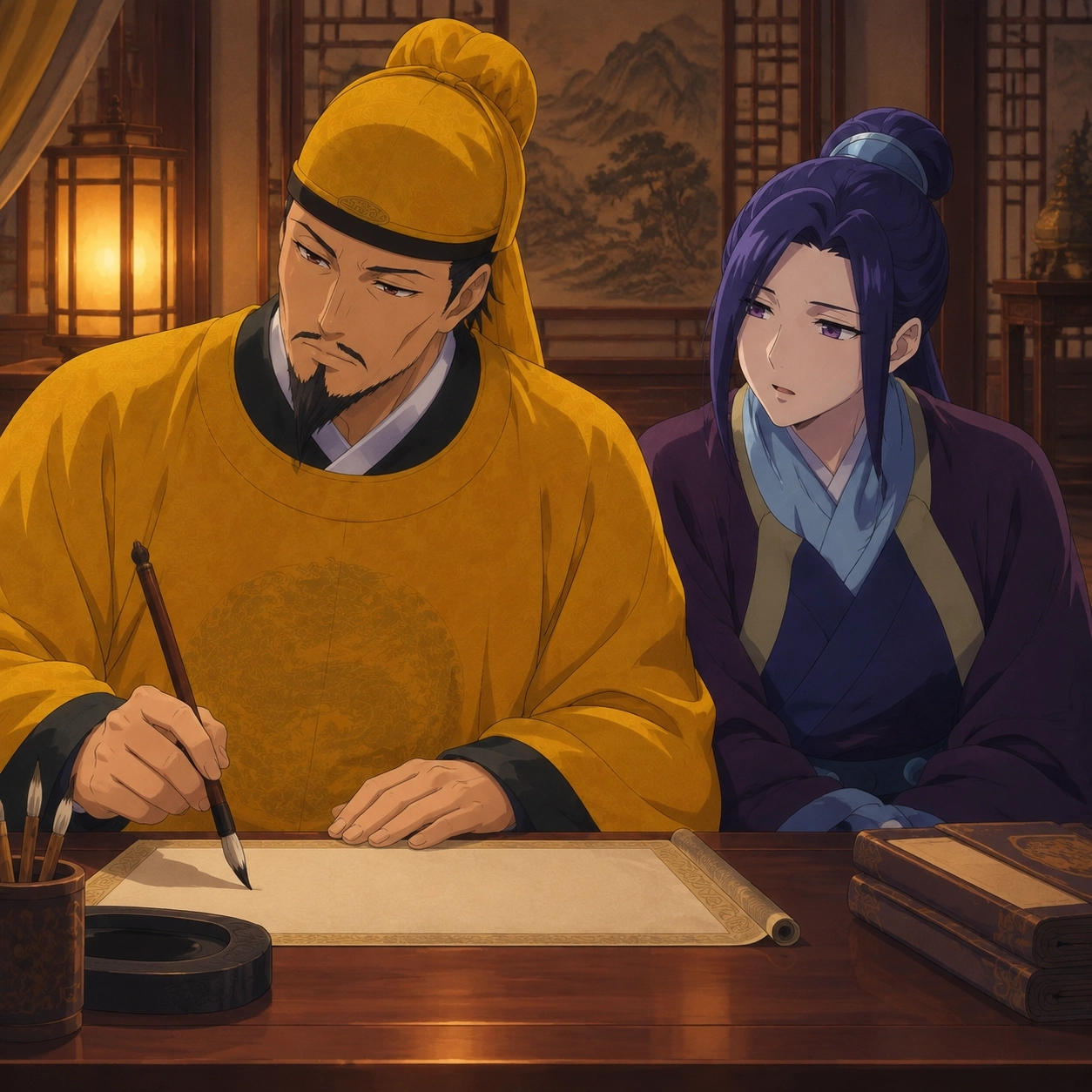
Her final request is not that Jinshi be crowned. It is that the Emperor let Jinshi do what he wants. The two old friends then begin drafting an edict while arguing like children. That ending keeps the meeting grounded in the novel's central contradiction: the Emperor is treated as Heaven, yet the people closest to him still see the frightened, stubborn person underneath.
What Maomao Can and Cannot Know
Maomao sees enough to understand that the meeting is about far more than an operation. She notices the Emperor's concealed pain, hears the succession debate, and witnesses Ah-Duo's self-blame. But the private conversation that follows takes place after she leaves. The article therefore separates what Maomao directly witnesses from what the reader learns in the continuation.
That boundary is important. The scene does not turn Maomao into an all-knowing narrator who receives every family confession. She is the medical and observational anchor of the first half; the second half gives Ah-Duo and the Emperor a private space to negotiate their old promise.
FAQ
Who are the four people in the Volume 15 meeting?
The Emperor, Jinshi, Ah-Duo, and Maomao. Ah-Duo takes Gyokuyou's place in this particular gathering.
Which volume contains this secret meeting?
It appears in Volume 15, across the chapters titled Confession: Omote and Confession: Ura.
Why does the Emperor call them together?
He wants to explain the situation before his operation, hear Jinshi's position on succession, and prepare for the possibility that he may not survive.
Does Jinshi agree to inherit the throne?
No. He argues that the existing Crown Prince and other imperial heirs should be considered, and says that he wants to remain a subject rather than become Emperor.
Does Ah-Duo love the Emperor romantically?
The scene supports a reading of them as exceptionally close old friends with a painful shared history. It does not require the claim that Ah-Duo is romantically in love with him.
Is this the same meeting as the Gyokuyou version?
No. The familiar room creates a deliberate parallel, but the participants and the central subject are different. The Gyokuyou meeting belongs to the site's separate Volume 8 article.
What should I read next?
Read Ah-Duo's direct confession about Jinshi, then compare it with the succession analysis and Ah-Duo's complaint about Yang and freedom.