Spoiler Warning
This article discusses major light novel spoilers for The Apothecary Diaries, including Jinshi's refusal to become emperor, the private imperial meeting with the Emperor and Gyokuyou, the branding wound, Maomao's deductions about Jinshi's parentage, Gyokuyou's crown-prince problem, and later references to the same royal-only room. Anime-only readers should stop here.
Scene Locator
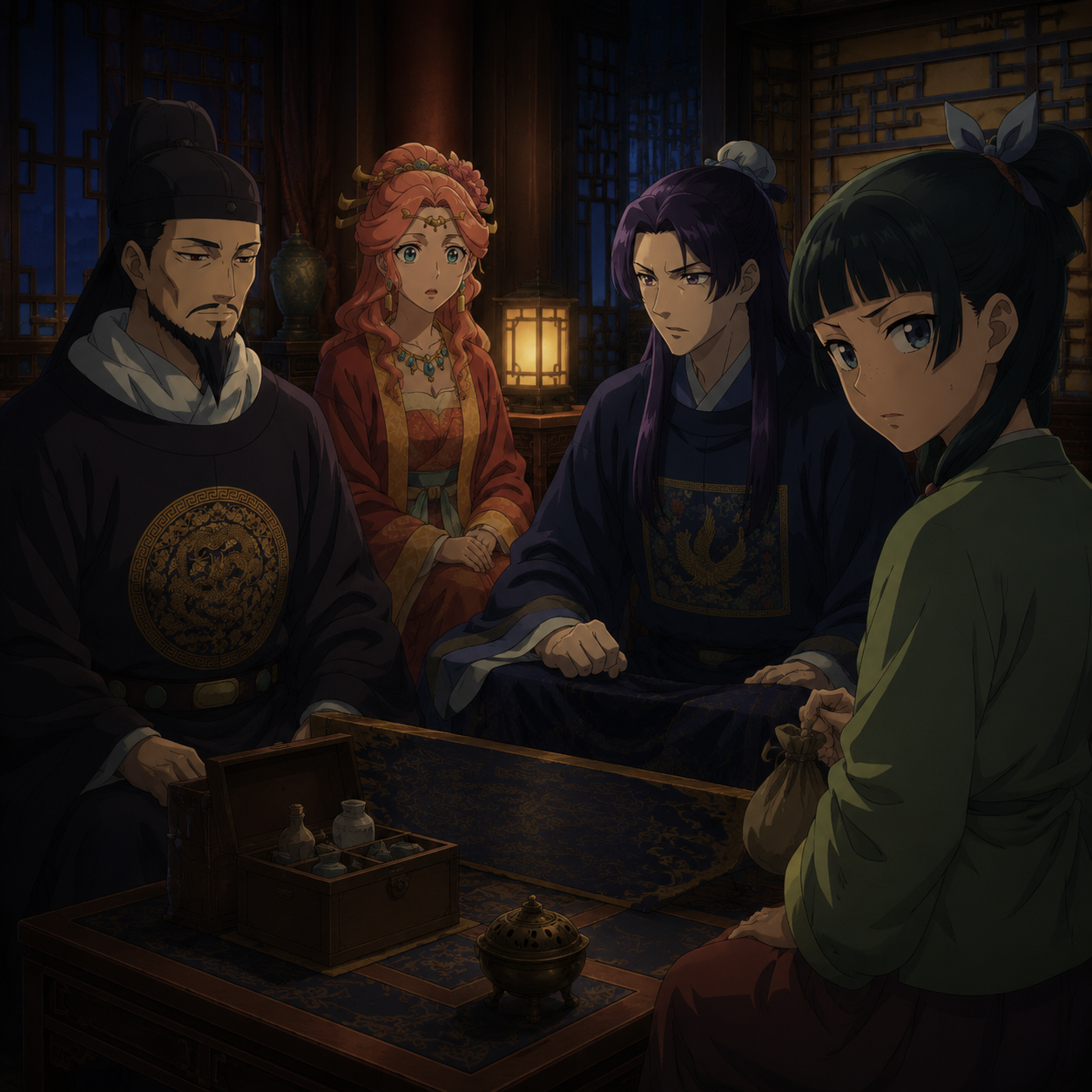
The four-person meeting occurs in Volume 8, chapter 20, after Jinshi has already been surrounded by marriage offers, faction pressure, an attempted poisoning, and an attack during ritual duty. Maomao is summoned late at night, searched thoroughly, and led into a royal-only room where she finds three people already waiting: the Emperor, Jinshi, and Gyokuyou.
The setting is important. The room is warm, sealed, guarded from outside, and arranged for privacy. There are no ordinary attendants inside. Even Gaoshun and Hongniang are absent. That absence tells readers the meeting is not palace entertainment. It is a controlled space where the court can discuss what cannot be said in normal court language.
Later, Volume 15 refers back to this same room as the royal space where the Emperor, Jinshi, and Gyokuyou once met with Maomao, and as the scene of Jinshi's branding incident. That later callback confirms how traumatic and politically important the room has become.
This scene should be read after the Emperor and Jinshi brother-or-son analysis, the Shrine of Choosing article, and why Jinshi does not want Gyokuyou as an enemy. The four-person meeting is where those threads stop being theory and become flesh, blood, rank, and panic.
Volume-level entry only. The source is community-hosted; availability and rights status may vary.
The Short Answer
The secret four-person meeting matters because Jinshi is trying to force a political answer before the succession problem traps him. He knows that if the Emperor dies too soon, many people may push him toward the throne. He also knows that Gyokuyou's son is still young, and that a young crown prince can be weakened by any adult imperial male who looks like a safer option.
So Jinshi brings the people whose positions define the problem. The Emperor is the only person who can grant or deny his request. Gyokuyou is the mother of the heir whose future Jinshi could threaten. Maomao is the practical witness who can understand the medical reality of what Jinshi does and keep the wound from becoming public knowledge.
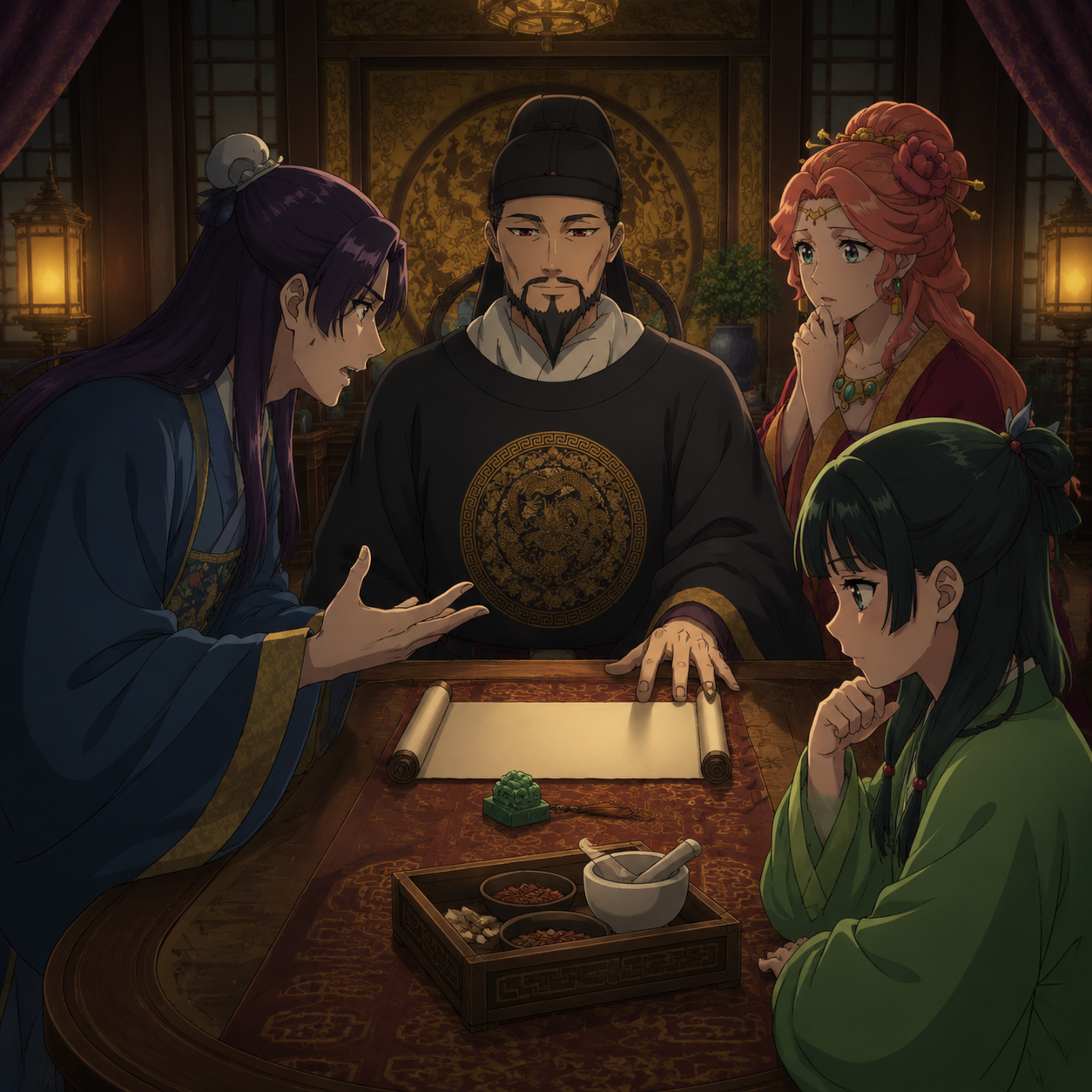
The meeting begins almost like a strange private banquet, but it turns into a succession negotiation. Jinshi argues that the Emperor must live long enough for Gyokuyou's son to mature. Then he asks to be granted a separate name, which would effectively remove him from the imperial family. When the Emperor refuses because the timing is too dangerous, Jinshi brands himself with a mark tied to Gyokuyou, turning his own body into proof that he will not become her enemy.
That is the core: Jinshi is not only saying "I do not want the throne." He is trying to make himself politically unusable as a rival heir.
Why the Meeting Must Be Secret
The meeting cannot happen in public because every topic inside it is explosive. Jinshi's possible succession value, Gyokuyou's son, the Emperor's health, factional marriage offers, attempted attacks, and the meaning of Jinshi's body all sit too close together. A normal court audience would turn the conversation into rumor before anyone could control it.
This is why Maomao's search matters. She is not simply being inconvenienced for comedy. The body search marks the room as a protected imperial zone. A person who enters it can carry no blade, no uncontrolled tool, and ideally no information back out. The irony is that Maomao, of all people, still enters with the one thing the meeting will need most: medical judgment.
The absence of attendants matters too. Gyokuyou does not have her usual household buffer. The Emperor is not surrounded by the normal performance of rulership. Jinshi is not hiding behind the beautiful administrator mask. Maomao has no friendly senior servant to dilute the air. The scene removes normal palace layers until only the essential players remain.
That is why this is not just a secret meeting. It is a political pressure chamber. The room exists so that official relationships can be suspended for a moment: brother, emperor, empress, apothecary, hidden son, rival candidate, future mother of the next line. The danger is that once those roles are named, they cannot be neatly unnamed.
Jinshi's Move: Refusing the Throne Before It Can Claim Him
Jinshi's first argument is coldly practical. The Emperor should live long enough for Gyokuyou's son to reach a safer age. This is not flattery. It is succession math. A child heir is fragile, and a court full of families will not politely wait for him to grow if a more convenient adult male remains nearby.
Jinshi then reveals why he has forced this private conversation. He has received expensive marriage pressure from powerful houses. He has faced poison and an attack. Both sides of court politics are already treating him as useful or dangerous. Some people want him tied to their family. Others want him removed. That means his public identity has become a battlefield.
His request for a bestowed name is therefore not a casual complaint about royal life. It is a legal and symbolic escape attempt. If he can become the Emperor's subject rather than remain royal, he can no longer serve as the cleanest adult male alternative to Gyokuyou's child.
The problem is that Jinshi's logic is too early and too late at the same time. Too early, because the crown prince and the other imperial children are still dangerously young. Too late, because factions are already moving around him. That tension explains why the Emperor refuses to grant the request immediately.
When words fail, Jinshi chooses the body. By branding himself with a mark associated with Gyokuyou's side, he creates a permanent argument: even if people try to use him, his own body now says he has placed himself beneath the future line he might otherwise threaten. It is horrifying, theatrical, sincere, and manipulative all at once.
The Emperor's Reaction: Anger, Grief, and a Hidden Family Shape
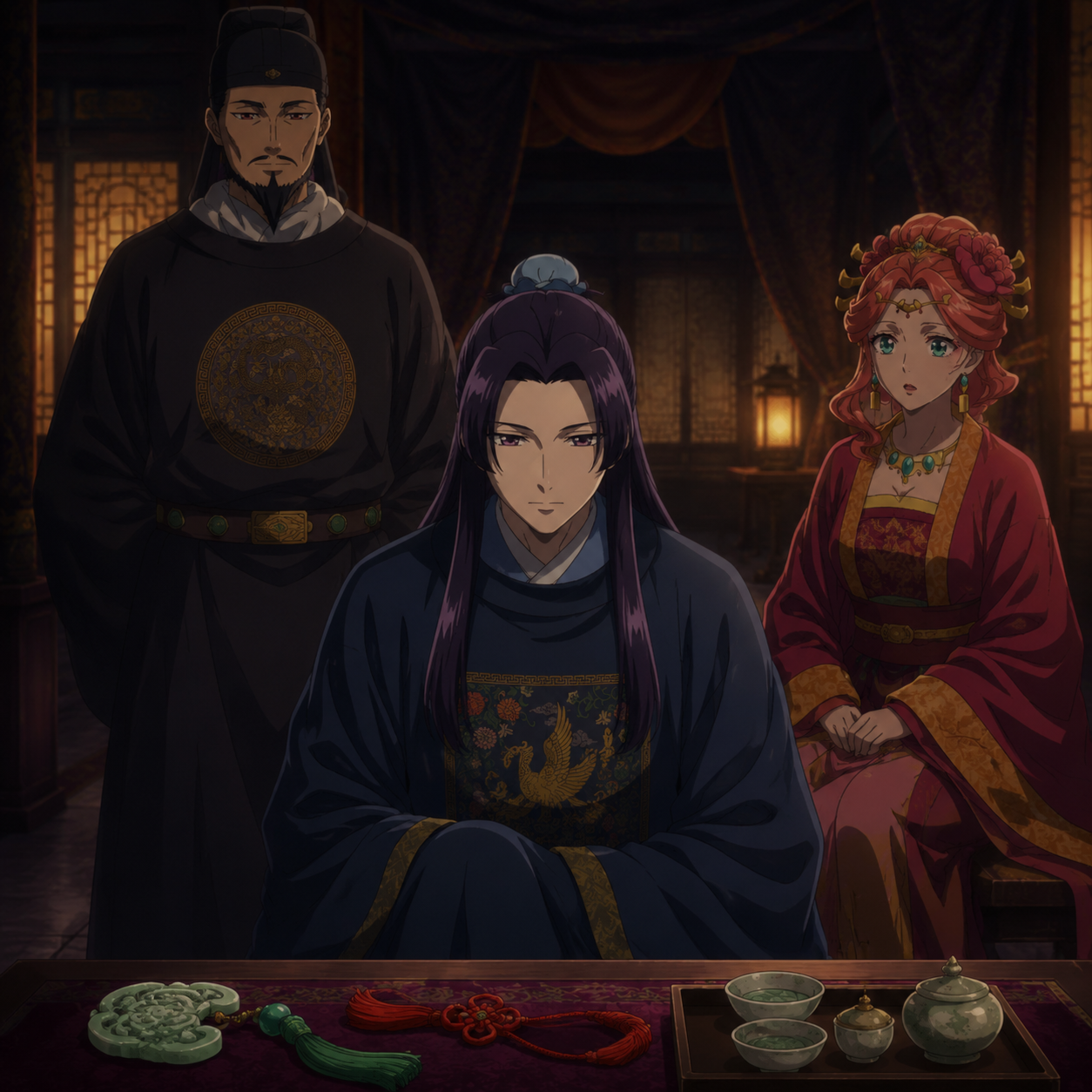
The Emperor's anger is not simply the anger of a ruler being challenged. It is also the anger of someone watching Jinshi harm himself in order to escape a role the Emperor still cannot easily release. That makes the scene more painful than a standard political quarrel.
Officially, Jinshi is the Emperor's younger brother. Yet the emotional texture of the scene points toward something more complicated. Maomao notices the Emperor's grief, his hesitation, and the way certain words remain unsaid in front of Gyokuyou. The meeting strengthens Maomao's private conclusion that Jinshi is best understood as the Emperor's hidden son, even though this cannot be spoken publicly.
This is why the scene pairs naturally with Ah-Duo's secret around Jinshi. The Emperor cannot simply act like a father, because the official record makes that impossible. But he also cannot react like a detached brother, because Jinshi's self-destruction cuts too deep.
The Emperor's silence after the branding is one of the most important parts of the scene. If he shouts as ruler, the meeting remains political. If he speaks too personally, he risks exposing what must remain hidden. So he leaves with the sadness of someone who understands both the state problem and the family wound.
Why Gyokuyou Must Witness It
Gyokuyou is not present as decoration. She is present because the meeting is about the future attached to her child. If Jinshi becomes a rival candidate, Gyokuyou's household, her son's position, and her later path as empress all become vulnerable. Jinshi cannot prove he is no threat to that future unless Gyokuyou herself sees the proof.
Her reaction matters because she is not written as a villain scheming against Jinshi. She is shocked because she understands enough to see the danger but not enough to control the scene. She did not summon Jinshi into this self-harm. She did not ask him to make a mark of submission. But once he does it, the political meaning lands in her lap.
The branding is tied to Gyokuyou's authority because Jinshi wants to show that he cannot stand above her line. He tells her, in effect, that he will not become her enemy. That line is the private root of later questions about whether Gyokuyou and Jinshi could become political enemies.
For Gyokuyou, the scene is both relief and horror. Relief, because Jinshi is trying to remove himself as a succession threat. Horror, because the cost is a permanent wound and a new secret that must not leak. This is exactly the kind of palace power she has to survive on her road from favored consort to empress. For that broader path, see Gyokuyou's road to empress.
Why Maomao Is There
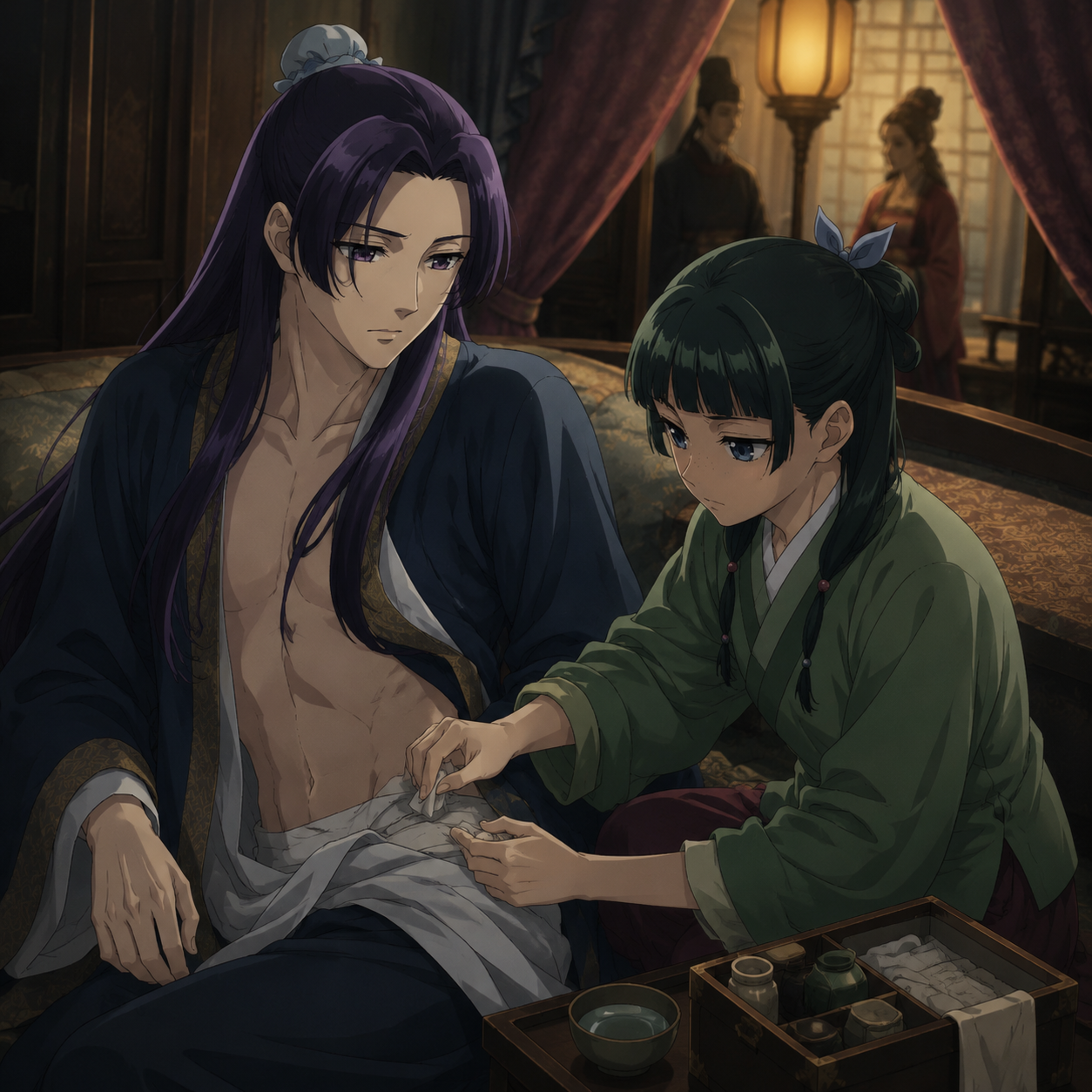
Maomao's presence looks absurd until the wound happens. She is not royal. She is not a minister. She is not Gyokuyou's official household strategist. Yet she is the one person in the room who can treat Jinshi without turning the injury into a public medical record.
That is why the scene keeps baiting her with expensive medicines. Jinshi knows her well enough to make the room itself a lure. It is funny on the surface, but it is also a way of ensuring that when the crisis happens, Maomao will stay where she is needed. The medicine is not only a joke. It is part of the trap.
Once Jinshi brands himself, Maomao becomes the only practical authority in the room. Rank falls away. The Emperor is stunned. Gyokuyou is shaken. Jinshi is injured. Maomao curses him, checks the wound, prepares treatment, and thinks through the danger of calling outside help. If another physician sees the brand, the secret spreads. If no one treats it, Jinshi suffers lasting medical damage. Maomao is forced to choose the narrow middle path.
This is why Maomao's role in the four-person meeting is more than "witness." She is the scene's truth-reader. She reads the wound, the Emperor's expression, Gyokuyou's fear, and Jinshi's self-destructive determination. Her usual talent for diagnosing bodies expands into diagnosing a royal household.
The scene also deepens Jinshi and Maomao's dynamic. Jinshi has made a violent political choice, but Maomao refuses to let him control what happens next. Her answer is not courtly obedience. It is medical anger. She treats him because she must, but she does not validate the method.
Connection to the Shrine of Choosing
The Shrine of Choosing asks whether Jinshi can be placed inside an older ruler-selection ritual. The secret four-person meeting answers what Jinshi thinks of that possibility: he wants out. Those two scenes mirror each other.
At the shrine, the Emperor explores whether Jinshi can stand as a possible successor under ancient legitimacy. Maomao's reasoning helps reveal how the ritual works. In the meeting room, Jinshi tries to destroy the political usefulness that the shrine and his bloodline create. Again, Maomao is present because her practical mind can handle what the court would rather hide.
That parallel is why the four-person meeting is so important for readers who focus on Jinshi's refusal to become emperor. Jinshi is not rejecting a vague future. He is rejecting a future the Emperor has already tested, factions have already noticed, and Gyokuyou's household would have to survive.
The meeting also changes how we read Gyokuyou. She is not simply an empress candidate standing somewhere else on the board. She is inside the room when Jinshi makes himself physically subordinate to her line. That does not remove all future tension, but it proves Jinshi understands the threat he represents to her children.
FAQ
What is the secret four-person meeting in The Apothecary Diaries?
It is the private Volume 8 meeting between the Emperor, Jinshi, Gyokuyou, and Maomao in a royal-only room. Jinshi uses the meeting to argue that he must be removed from the succession threat around Gyokuyou's young heir.
Why does Jinshi brand himself?
Jinshi brands himself to make his refusal of the throne permanent and visible to the people who matter. By marking himself with a symbol tied to Gyokuyou's authority, he tries to prove that he will not become a rival to her son's future.
Why is Gyokuyou present?
Gyokuyou is present because the succession risk directly affects her child. Jinshi cannot prove he is not her enemy unless she witnesses his decision and understands the cost.
Why is Maomao present if she is not royal?
Maomao is present because Jinshi needs someone who can understand medical danger, keep a secret, and treat the wound without creating a public record. She also becomes the reader's most reliable witness to the emotional truth in the room.
Does this meeting prove the Emperor sees Jinshi as a son?
It does not allow the truth to be spoken publicly, but it strongly reinforces the hidden-son reading. The Emperor's grief and restraint make more sense if Jinshi is not merely an official younger brother, which connects to the wider Ah-Duo identity secret.
What should I read next?
Read the Emperor and Jinshi brother-or-son analysis, the Shrine of Choosing article, why Jinshi does not want Gyokuyou as an enemy, and why Gyokuyou wants Maomao close.