Spoiler Warning
This article discusses light novel Volume 3 spoilers for The Apothecary Diaries, including the Shrine of Choosing, Wangmu bloodline lore, Maomao's explanation of the door mechanism, the Emperor's rejection by the shrine, Jinshi's possible succession role, and the wider pressure around Jinshi's hidden identity. Anime-only readers should stop here.
Scene Locator
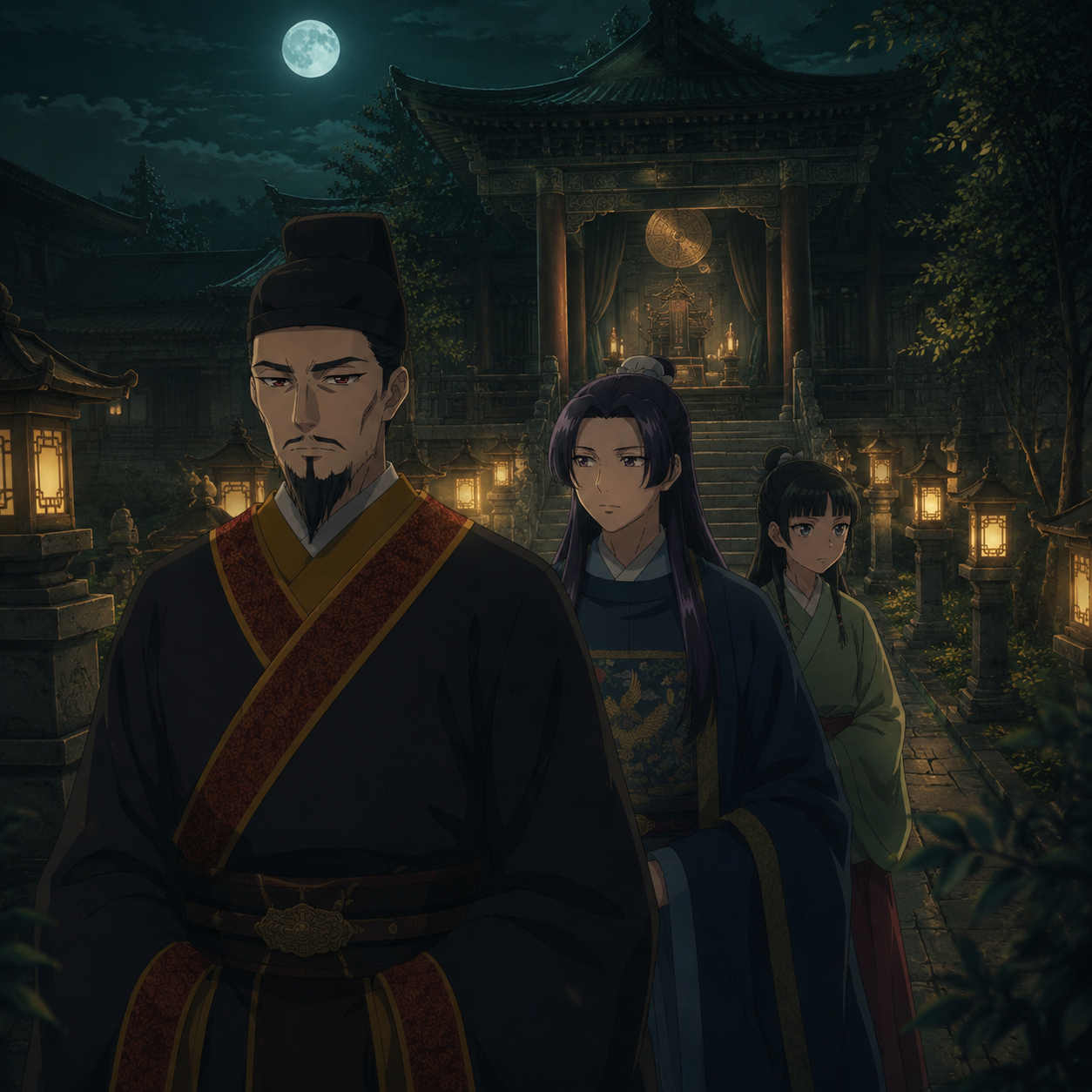
The Shrine of Choosing appears in Volume 3, chapter 12, after Maomao hears the old eunuch's lesson about Wangmu and the founding myth. The shrine is older than the rear palace, and its old rule is dangerous: the person who chooses the correct path can be recognized as the one fit to rule.
That is why the Emperor's night visit is not a small palace curiosity. After visiting Gyokuyou's Jade Pavilion, he stops Maomao after her poison-tasting duty and orders her to come with him. Jinshi is also called at the last moment, and he looks as if he does not fully know why he has been summoned.
At the shrine, the old eunuch says the result will probably be the same if the Emperor tries again. The Emperor then chooses two companions: Jinshi and Maomao. That pairing is the whole point of the scene. Jinshi is the person whose succession possibility matters, and Maomao is the person whose medical mind can reveal whether the shrine is divine judgment, bloodline screening, or something more practical.
This scene belongs beside Jinshi's hidden identity, Ah-Duo's secret around Jinshi, and the Emperor's trusted household network through Gaoshun. The shrine is a puzzle, yes, but it is also a quiet succession experiment.
Volume-level entry only. The source is community-hosted; availability and rights status may vary.
The Short Answer
The Emperor Is Testing Jinshi as a Possible Successor
The strongest reason the Emperor brings Jinshi is that the Shrine of Choosing is tied to the old idea that whoever clears it can become ruler. If Jinshi can pass through the correct path, then the Emperor has a powerful old-language answer to a modern succession question: Jinshi can be presented as someone chosen by the founding system, not merely as a politically convenient imperial relative.
This does not mean the Emperor can simply drag Jinshi to the roof and crown him on the spot. The current court has ministers, consorts, children, factions, and official succession pressure. But symbolically, the shrine matters because it predates that modern arrangement. It offers a more ancient kind of legitimacy, and that is exactly why bringing Jinshi is so loaded.
The Emperor has already been rejected by the shrine's logic. Bringing Jinshi gives him a way to ask a second question: if I am not the one this old mechanism recognizes, can Jinshi be made into that answer?
Maomao Is Brought Because She Can Unlock the Mechanism
Maomao is not brought because she has court rank. She is brought because the answer is hidden in medicine, inheritance, and color perception. The old eunuch hints that Luomen would understand the puzzle, and Maomao takes that as a challenge. Once she starts thinking through eye conditions, bloodline traits, and the door colors, the shrine stops looking like magic and starts looking like a designed screening device.
That makes her essential to the Emperor's succession test. Jinshi can walk the path, but Maomao can explain which path matters and why. Without Maomao, the Emperor only has rejection and rumor. With Maomao, he gets a theory: the shrine selects for a hereditary color-vision trait associated with Wangmu's line.
The Emperor Is Also Solving His Own Rejection
The Emperor is not only thinking about Jinshi. He also wants to know what it means that the shrine rejects him. The final message he receives is a rejection of the wrong kind of bloodline, not a simple statement that he is not royal. That kind of answer would bother any ruler who understands how legitimacy works.
Maomao's explanation gives him relief and danger at the same time. It suggests the shrine does not prove he is illegitimate; it only measures a trait that is not inherited by every descendant. But it also proves that the old succession device can still expose uncomfortable truths about the imperial family's origin story.
The Old Rule: Whoever Clears the Shrine Can Become Emperor
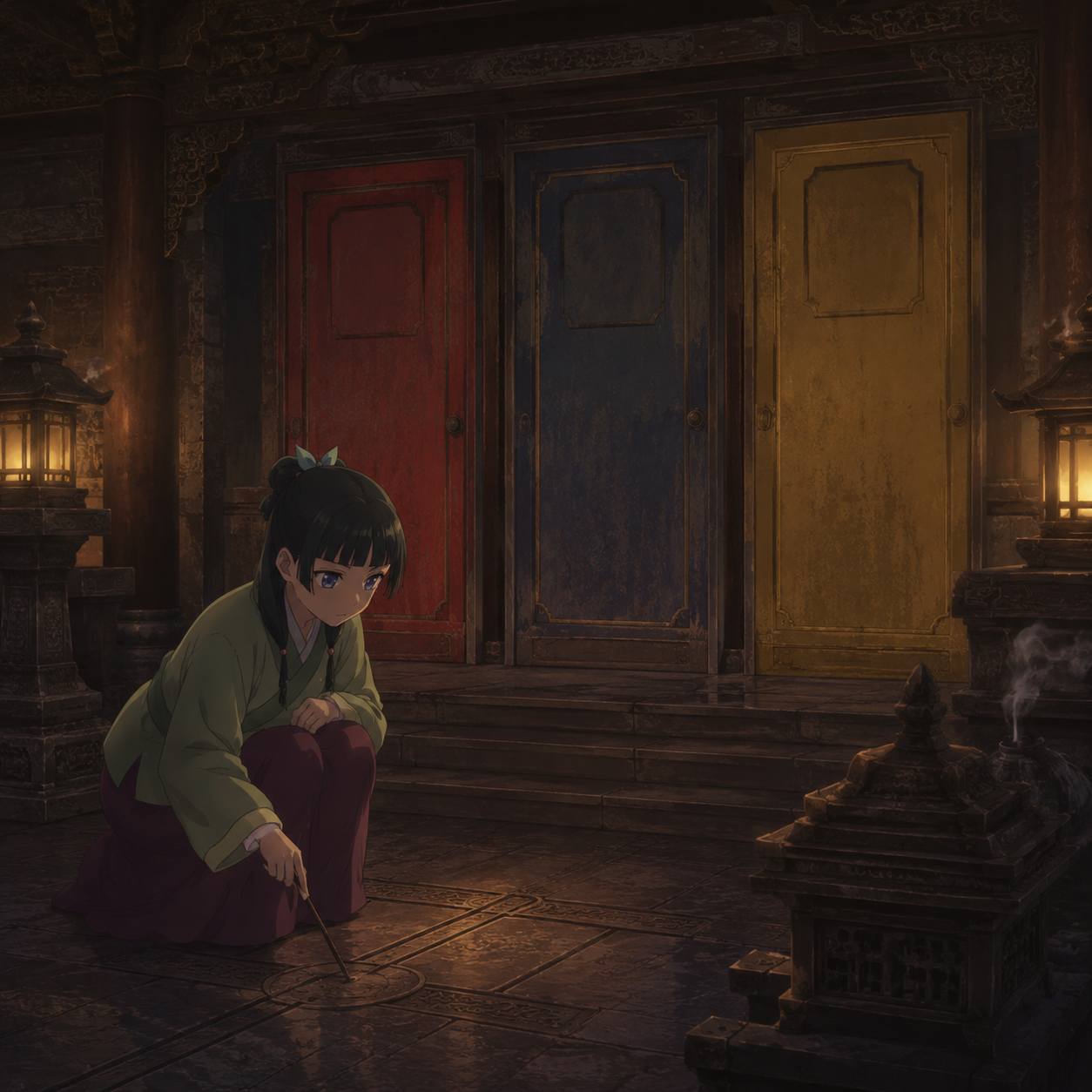
The shrine's oldest logic is blunt: the ruler is the person who chooses the correct path. In the founding myth, Wangmu's son passes the test and becomes the ruler. Later, that chosen-ruler idea hardens into imperial history, ritual, and inheritance.
That is why the door test cannot be dismissed as a children's riddle. The doors decide who is recognized as "Wangmu's son" in the shrine's symbolic language. The person who reaches the end is not just clever. They have passed a legitimacy test built into the country's origin story.
The current Emperor's problem is that he follows the instructions and still receives a rejection. The shrine treats him as royal but not as the correct Wangmu-descended candidate. For a ruler, that is politically poisonous information. It does not automatically remove him from the throne, but it creates an old ritual problem that later people could use.
The Shrine Is Older Than the Current Court
The shrine matters because it comes from before the rear palace and before the imperial order looks the way readers know it. Its authority is mythic, ancestral, and inconvenient. Modern officials might treat the Emperor as legitimate because the throne already exists, but the shrine asks an older question: does this person match Wangmu's line closely enough to be selected?
That older question gives the Emperor a reason to test Jinshi under controlled conditions. If Jinshi can be associated with the correct path, then the Emperor gains a possible ancient justification for Jinshi's future. If Jinshi cannot, the Emperor learns that the old shrine cannot support him either.
Passing Is Political, Even If Maomao Explains It Scientifically
Maomao's solution does not make the shrine politically harmless. In fact, it makes it more interesting. Once she explains that the test is based on inherited color perception, the shrine becomes less supernatural but more useful. It is not random. It has a biological logic that the old court could turn into a bloodline ritual.
That is why "who cleared it" still matters. A purely mystical test is hard to control. A hereditary screening test can be investigated, staged, repeated, and argued over. The Emperor brings Maomao because he needs the mechanism understood before he can know what Jinshi's passage would mean.
Why Jinshi Must Be There
Jinshi is brought first because he is close to imperial ritual. Maomao initially understands that much: Jinshi has duties connected to rites and ancestors, so a strange old shrine does not seem completely unrelated to him. But that surface reason is not enough. The deeper reason is succession.
The Emperor's choice of Jinshi is a controlled provocation. If the shrine says the one who reaches the correct endpoint can be ruler, then asking Jinshi to enter is asking whether Jinshi can be made to stand in that ancient role. The fact that Jinshi is confused makes the moment sharper. He is not presented as someone demanding the throne. He is placed into a possible heir test by the Emperor.
That fits the wider Jinshi problem. Publicly, Jinshi is the Emperor's younger brother. Privately, his identity is much more dangerous. The more readers know about Jinshi's real name and hidden rank, the easier it becomes to see why an old ruler-selection shrine would matter around him.
The Emperor May Want a Successor He Can Justify
The Emperor's interest in Jinshi is not just emotional. A ruler who knows his own legitimacy has ritual cracks may want a successor whose legitimacy can be explained through older symbols. The shrine offers exactly that possibility. If Jinshi passes, the Emperor can imagine Jinshi not merely as a relative, but as someone who can be tied to Wangmu's selection.
This matters even more because Jinshi himself does not want to be emperor. A reluctant successor is still a successor if the court can use him. The later political pressure explored in why Jinshi does not want to become Gyokuyou's enemy begins from the same problem: personal refusal does not erase symbolic usefulness.
Jinshi Walking the Path Is Not Neutral
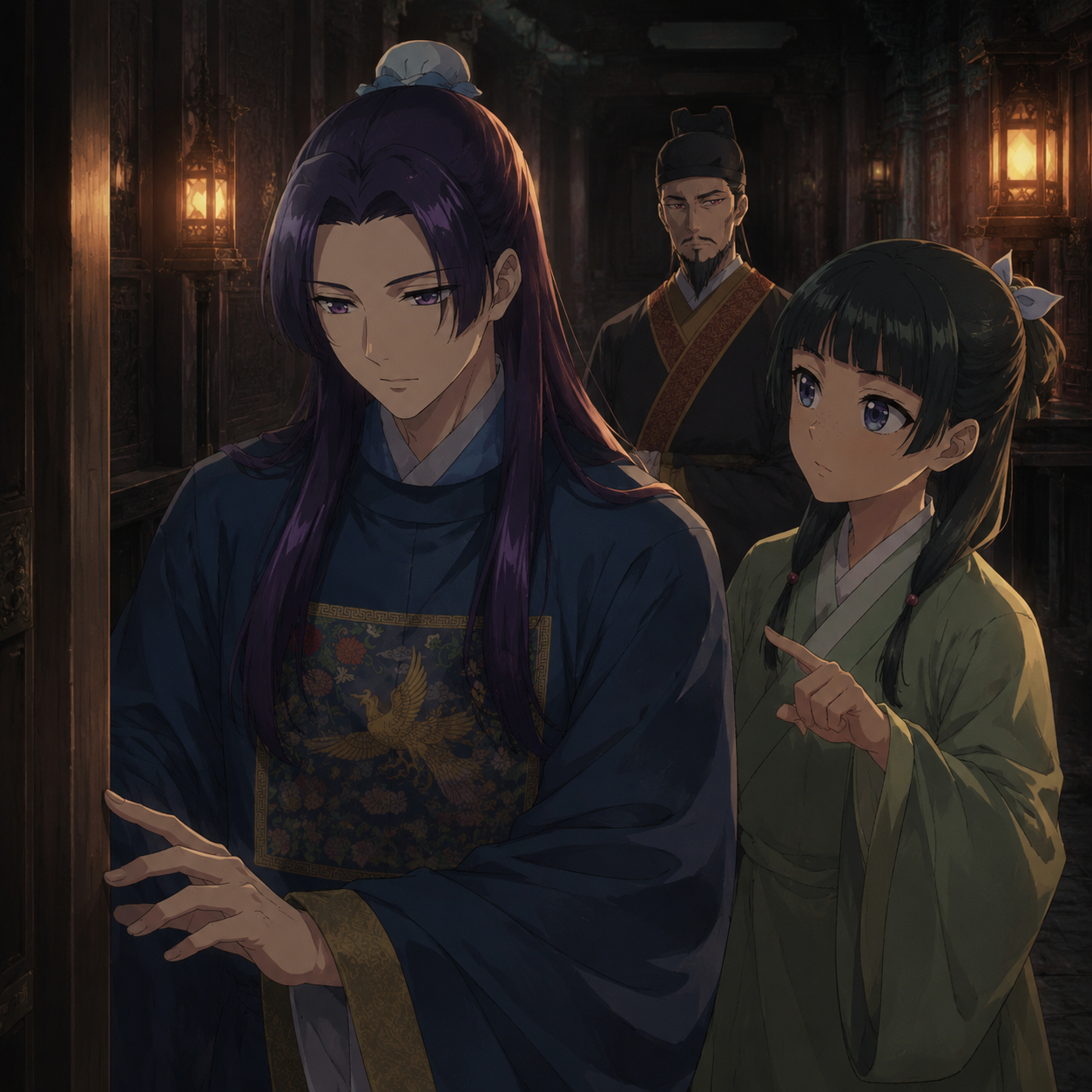
When Jinshi leads Maomao back through the shrine, he is physically the one opening doors and moving forward, even though Maomao tells him which choices to make. That detail creates an ambiguity the Emperor can study. Did Jinshi pass? Did Maomao pass? Did the pair pass because Maomao's knowledge made Jinshi's path possible?
The story does not need to answer that ambiguity in a simple way. The ambiguity is the point. Jinshi's body, Maomao's mind, and the Emperor's authority come together in one ritual space. That is a very Apothecary Diaries way of turning a puzzle into politics.
Why Maomao Must Be There
Maomao is the only person in the group who can make the shrine legible. The old eunuch's hint points toward Luomen's medical knowledge, and Maomao has enough of that training to follow the clue. She starts from the doors, the colors, the repeated choices, and the family-history questions, then moves toward inherited color-vision differences.
Her role is not decorative and not accidental. The Emperor already knows Maomao is useful in situations where bodies, poisons, and court politics overlap. The shrine is another version of that pattern. It looks like a legend, but the answer is hidden in physical traits and inheritance.
This is why the scene works so well as a Maomao scene. She does not solve power by flattering it. She diagnoses it. The same evidence-first habit that makes her valuable in Jinshi and Maomao's dynamic also lets her turn a founding myth into a testable mechanism.
Maomao Explains Why the Emperor Fails
The Emperor's first route ends in rejection because he reads the colors like an ordinary person. The correct route is designed for someone who cannot distinguish certain colors in the same way. Maomao realizes that the shrine is filtering for a hereditary trait, especially around red and green perception.
That explanation changes the meaning of the Emperor's failure. It does not have to mean he is fake, cursed, or unroyal. It means he did not inherit the specific trait the shrine was built to detect. That is a subtler answer, and a safer one, but it is still politically explosive.
Maomao Also Explains Why Consorts Were Brought
One of Maomao's strongest deductions is that the shrine's old practice of bringing women, including princesses or consorts, probably had bloodline meaning. If a ruling line wanted to preserve or restore Wangmu's trait, marriage choices mattered. The shrine could identify not only a ruler, but also the bloodline path that would keep future rulers connected to Wangmu.
That makes the Emperor's joke about making Maomao a consort darker than it first sounds. It is funny on the surface because Jinshi reacts quickly and because the Emperor is teasing. But the setting is a shrine where consorts historically mattered to succession. The joke lands inside a very real political structure.
What the Emperor Learns from Bringing Both of Them
The Emperor learns three things at once. First, he learns that the shrine's rejection of him has a practical explanation. Second, he learns that Jinshi can be placed inside the old ruler-selection ritual and guided to the correct endpoint. Third, he learns that Maomao's knowledge can expose, weaken, or redirect the power of the founding myth.
That combination is why he needed both Jinshi and Maomao. Jinshi alone would make the scene a succession test without an answer. Maomao alone would make it an intellectual solution without a candidate. Together, they let the Emperor see how an old legitimacy mechanism might operate around Jinshi.
The Emperor Gets a Possible Path for Jinshi
If the Emperor wants Jinshi to inherit, the shrine gives him a dangerous but tempting narrative. Jinshi can be associated with the correct path, the old eunuch can witness the result, and Maomao can explain why the path means something. That does not solve the modern politics of succession, but it gives the Emperor a tool.
The tool is risky because Maomao's explanation also proves the shrine can be understood and perhaps manipulated. A court that believes in divine selection might accept the result. A court that hears Maomao's full explanation might argue about whether Jinshi was chosen, coached, or used as a vessel for someone else's knowledge.
The Emperor Sees Jinshi and Maomao's Trust
The second passage also shows Jinshi trusting Maomao. He asks which door to choose, follows her instructions, and keeps moving even when the puzzle seems impossible. That trust matters because Maomao is not an official ritual expert. She is a sharp apothecary whose authority comes from evidence.
For the Emperor, that trust is useful information. If Jinshi is ever pulled toward succession, the people he listens to will matter. Maomao's influence is not courtly in the usual sense, but it changes what Jinshi can perceive and survive. That thread connects directly to why Jinshi later takes Maomao west.
The Emperor Also Learns the Limit of the Shrine
Maomao's final explanation prevents the shrine from becoming absolute. She makes clear that inheritance is not guaranteed. A descendant can fail to inherit the trait, and too much bloodline concentration can create other harms. In other words, the shrine is evidence, not destiny.
That is a very important limit. The Emperor may want Jinshi as a possible heir, and the shrine may provide an old sign of legitimacy, but Maomao's answer keeps the story from treating bloodline as clean divine truth. The shrine can support a claim, but it cannot make politics simple.
Common Misreadings
Misreading 1: The Emperor only wanted Maomao to solve a puzzle
No. Maomao's solution is essential, but the shrine is a succession test. The Emperor brings Jinshi because clearing the shrine carries ruler-selection meaning. Treating it as only a puzzle makes the scene too small.
Misreading 2: Jinshi passes completely on his own
Jinshi physically leads the second passage, but Maomao gives the door choices. That ambiguity matters. The Emperor can observe Jinshi in the ritual role, but the scene also proves that Maomao's reasoning is what makes the path possible.
Misreading 3: The Emperor's rejection means he is simply illegitimate
Maomao's explanation is more nuanced. The shrine appears to screen for a hereditary color-vision trait linked to Wangmu's line. A person can descend from the line without inheriting the trait the shrine tests for.
Misreading 4: The shrine proves destiny is real
The novel is more interested in how myth, biology, and power become tangled. The shrine feels like destiny to the court, but Maomao shows that its power comes from a physical mechanism and from people deciding what that mechanism means.
FAQ
Why does the Emperor take Jinshi and Maomao to the Shrine of Choosing?
Because the shrine is an old ruler-selection test. The Emperor wants to understand his own rejection, test whether Jinshi can stand as a possible successor under the shrine's old legitimacy, and use Maomao's medical reasoning to explain the mechanism.
Does the Emperor want Jinshi to inherit the throne?
The scene strongly supports that possibility. By bringing Jinshi to a shrine where the one who clears the correct path can be treated as chosen to rule, the Emperor is at least testing a path by which Jinshi could be justified as successor.
Does Jinshi pass the Shrine of Choosing?
Jinshi leads the successful second passage, but Maomao tells him which doors to choose. That creates the scene's key ambiguity: Jinshi occupies the ritual role, while Maomao provides the knowledge that makes success possible.
Why does Maomao solve the shrine?
Maomao realizes the door test is based on inherited color-vision differences, especially red-green perception. Her medical training from Luomen helps her understand why the shrine selects certain people and why the Emperor's failure does not automatically erase his bloodline.
What does Wangmu have to do with the shrine?
Wangmu is the founding mother figure tied to the country's origin myth. The shrine appears designed to identify people who share a trait associated with Wangmu's line, turning a physical inheritance pattern into a political and ritual claim.
What should I read next?
Read Jinshi's real name and hidden identity, Jinshi and Ah-Duo's secret, why Jinshi does not want to become Gyokuyou's enemy, and the setting guide for the palace context around this scene.